Synopsis: By 1971, the “Catholic Left” movement had conducted over 30 draft board raids, destroying close to a million Selective Service documents. But they were hardly a centralized or structured movement. Actions were carried out by independent groups of activists, angered by the war’s mounting toll and its collateral effects on impoverished cities like Camden. On the evening of August 21, 1971, Father Michael Doyle and a group of twenty Catholic antiwar activists were arrested attempting to break into a Camden, New Jersey draft board office to destroy records after the group was betrayed by a member of their own group acting as an agent provocateur for the F.B.I. This PBS documentary recounts their act of civil disobedience and the ensuing legal battle, which Supreme Court Justice William Brennan labeled “one of the great trials of the 20th century.” Political scientists like Howard Zinn provided expert testimony on the time honored American tradition of civil disobedience, resulting in the eventual acquittal of the activists on the grounds of jury nullification.
Synopsis: Angela Davis is a seasoned political activist who has dedicated her life to social reformation. She emerged as a prominent counterculture activist during the Civil Rights Movement and was once on the F.B.I.’s Ten Most Wanted list for her associations with the Communist Party USA and the Black Panther Party. Davis founded, Critical Resistance, an organization working to abolish the prison-industrial complex. She is a retired professor with the History of Consciousness Department at the University of California, Santa Cruz, and a former director of the university’s Feminist Studies department. In this talk, Angela Davis reflects on her successes and shares her insights on the strategies for change that have made — and will make — history.
Synopsis: Martin Luther King, Jr. speaks on Meet The Press one week after leading his historic five-day march from Selma to Montgomery, Alabama, to draw attention to the humiliating conditions in Alabama which included state enforced segregation, police brutality and racially-motivated murder. Dr. King asserts, “An individual who breaks a law that conscience tells him is unjust, and who willingly accepts the penalty of imprisonment in order to arouse the conscience of the community over its injustice, is in reality expressing the highest respect for the law.”
Here’s to the crazy ones. The misfits. The rebels. The troublemakers. The round pegs in the square holes. The ones who see things differently. They’re not fond of rules. And they have no respect for the status quo. You can quote them, disagree with them, glorify or vilify them. About the only thing you can’t do is ignore them. Because they change things. They push the human race forward. And while some may see them as the crazy ones, we see genius. Because the people who are crazy enough to think they can change the world, are the ones who do.
Modern Psychology has a word that is probably used more than any other word in Psychology. It is the word maladjusted. It is the ringing cry of modern child psychology — maladjusted. Now of course we all want to live the well adjusted life in order to avoid neurotic and schizophrenic personalities. But as I move toward my conclusion, I would like to say to you today, in a very honest manner, there’s some things in our society, and some things in our world, for which I am proud to be maladjusted. And I call upon all men of good will to be maladjusted to these things until the Good Society is realized.
I must honestly say to you that I never intend to adjust myself to racial segregation and discrimination. I never intend to adjust myself to religious bigotry. I never intend to adjust myself to economic conditions that will take necessities from the many to give luxuries to the few and leave millions of God’s children smothering in an airtight cage of poverty in the midst of an affluent society.
The Brookings Institute hypothesizes that a heightened police presence reduces violent crime. Yet as Malcolm X points out, Black neighborhoods have some of the highest violent crime rates even though they are some of the most heavily policed areas in the country. Malcolm X’s question is still relevant fifty years later. Does an increased police presence have the adverse effect of agitating community violence?
Racism – A History was first broadcast on BBC Four in March 2007 to mark the bicentenary of the Slave Trade Act 1807 which abolished the slave trade in the British Empire. The three-part documentary series closely examines the development of Racism over the last 500 years, revealing some uncomfortable truths about how racist attitudes came into being and were spread into popular culture.
Though the institution of slavery dates back to ancient civilizations, the modern concept of racism began with the African Slave Trade in the sixteenth century. The self interested desire to economically exploit Africans gave birth to the European concept that different races of human beings existed, distinguished by the colour of their skin.
Episode 1: The Colour of Money
The series begins by examining how the development of modern racist attitudes can be attributed to the colonial powers’ desire to justify the African slave trade. Professor James Walvin, Professor of History Emeritus at the University of York explains,
“the British don’t become slave traders and slavers because they are racist; they became racist because they use slaves for great profit in the Americas and devise a set of attitudes towards black people that justifies what they’ve done. The real engine behind the slave system is economics.”
It was this desire to legitimize the exploitation of Africans for cheap labor that ultimately fueled the creation of the idea that an hierarchy of the races existed. This notion was subsequently supported by religious and philosophic apologists which shifted public perception into believing the subjugation and dehumanization of Blacks was an acceptable social practice.
Episode 2: Fatal Impacts
Part Two examines how the practice of racial classification and scientific racism developed in European societies during the Nineteenth Century. Religious dogmas and discredited sciences such as Phrenology created the myth that Negroes were a sub-species giving European colonists the moral justification they needed to justify the mistreatment and exploitation of indigenous populations. These theories would eventually evolve into the discipline of Eugenics and the Nazi vision of the “Master Race,” which would lead to the forced labor and mass genocide of over eight million European Jews, Slavics and Romanians.
Episode 3: A Savage Legacy
Part three of the series examines the impact of racism in the 20th Century. By 1900, European colonial expansion had reached deep into the heart of Africa. Under the rule of King Leopold II, The Belgian Congo was turned into a vast rubber plantation. Men, women and children who failed to gather their latex quotas would have their limbs dismembered. The country became the scene of one of the century’s greatest racial genocides, as an estimated 10 million Africans perished under colonial rule. The final episode also explores the Jim Crow Era in America, the Apartheid regime which developed in South Africa and the institutional racism which still affects the United Kingdom.
Fair Use Notice
This video may contain copyrighted material. Such material is made available for educational purposes only in an effort to advance the understanding of human rights and social justice issues and is distributed without profit to those who have expressed a prior interest in receiving the included information for research and educational purposes. This constitutes a ‘fair use’ of any such copyrighted material in accordance with Title 17 U.S.C. Section 107 of the U.S. Copyright Law.
Following the protests in Birmingham, President Kennedy addressed the “moral crisis” of racial segregation and called for national participation in ensuring that America becomes the “land of the free” for all of its citizens.
President John F. Kennedy’s Civil Rights Address
June 11, 1963
This afternoon, following a series of threats and defiant statements, the presence of Alabama National Guardsmen was required on the University of Alabama to carry out the final and unequivocal order of the United States District Court of the Northern District of Alabama. This order called for the admission of two clearly qualified young Alabama residents who happen to have been born Negro.
That they were admitted peacefully on the campus is due in good measure to the conduct of the students of the University of Alabama, who met their responsibilities in a constructive way.
I hope that every American, regardless of where he lives, will stop and examine his conscience about this and other related incidents. This nation was founded by men of many nations and backgrounds. It was founded on the principle that all men are created equal, and that the rights of every man are diminished when the rights of one man are threatened.
Today we are committed to a worldwide struggle to promote and protect the rights of all who wish to be free. When Americans are sent to Vietnam or West Berlin, we do not ask for whites only. It ought to be possible, therefore, for American students of any color to attend any public institution they select without having to be backed up by troops.
It ought to be possible for American consumers of any color to receive equal service in places of public accommodation, such as hotels and restaurants and theaters and retail stores, without being forced to resort to demonstration in the street. It ought to be possible for American citizens of any color to register and to vote in a free election without interference or fear of reprisal.
It ought to be possible, in short, for every American to enjoy the privileges of being American without regard to his race or his color. In short, every American ought to have the right to be treated as he would wish to be treated, as one would wish his children to be treated. But this is not the case today.
The Negro baby born in America today, regardless of the section of the nation in which he is born, has about one half as much chance of completing high school as a white baby born in the same place on the same day, one third as much chance of completing college, one third as much chance of becoming a professional man, twice as much chance of becoming unemployed, about one seventh as much chance of earning $10,000 a year or more, a life expectancy which is seven years shorter, and the prospects of earning only half as much.
This is not a sectional issue. Difficulties over segregation and discrimination exist in every city, in every state of the Union, producing in many cities a rising tide of discontent that threatens the public safety. Nor is this a partisan issue. In a time of domestic crisis men of goodwill and generosity should be able to unite regardless of party or politics. This is not even a legal or legislative issue alone. It is better to settle these methods in the courts than on the streets, and new laws are needed at every level, but law alone cannot make men see right.
We are confronted primarily with a moral issue. It is as old as the Scriptures and is as clear as the American Constitution.
The heart of the question is whether all Americans are to be afforded equal rights and equal opportunities, whether we are going to treat our fellow Americans as we want to be treated. If an American, because his skin is dark, cannot eat lunch in a restaurant open to the public, if he can not send his children to the best public school available, if he cannot vote for the public officials who represent him, if, in short, he cannot enjoy the full and free life which all of us want, then who among us would be content to have the color of his skin changed and stand in his place? Who among us would be content with the counsels of patience and delay?
One hundred years have passed since President Lincoln freed the slaves, yet their heirs, their grandsons, are not fully free. They are not yet freed from the bonds of injustice. They are not yet freed from social and economic oppression. And this nation, for all its hopes and all its boasts, will not be fully free until all its citizens are free.
We preach freedom around the world, and we mean it, and we cherish our freedom here at home; but are we to say to the world, and, much more importantly, for each other, that this is a land of the free except for the Negroes; that we have no second-class citizens except Negroes; that we have no class or caste system, no ghettos, no master race, except with respect to Negroes?
Now the time has come for this nation to fulfill its promise. The events in Birmingham and elsewhere have so increased the cries for equality that no city or state or legislative body can prudently choose to ignore them.
The fires of frustration and discord are burning in every city, North and South, where legal remedies are not at hand. Redress is sought in the streets, in demonstrations, parades, and protests which create tensions and threaten violence and threaten lives.
We face, therefore, a moral crisis as a country and as a people. It cannot be met by repressive police action. It cannot be left to increased demonstrations in the streets. It cannot be quieted by token moves or talk. It is a time to act in the Congress, in your state and local legislative bodies and, above all, in all of our daily lives.
It is not enough to pin the blame on others, to say this is a problem of one section of the country or another, or deplore the facts that we face. A great change is at hand, and our task, our obligation, is to make that revolution, that change, peaceful and constructive for all.
Those who do nothing are inviting shame as well as violence. Those who act boldly are recognizing right as well as reality.
Next week I shall ask the Congress of the United States to act, to make a commitment it has not fully made in this century to the proposition that race has no place in American life or law. The federal judiciary has upheld that proposition in the conduct of its affairs, including the employment of federal personnel, the use of federal facilities, and the sale of federally financed housing.
But there are other necessary measures which only the Congress can provide, and they must be provided at this session. The old code of equity law under which we live commands for every wrong a remedy, but in too many communities, in too many parts of the country, wrongs are inflicted on Negro citizens and there are no remedies at law. Unless the Congress acts, their only remedy is in the streets.
I am, therefore, asking the Congress to enact legislation giving all Americans the right to be served in facilities which are open to the public — hotels, restaurants, theaters, retail stores, and similar establishments.
This seems to me to be an elementary right. Its denial is an arbitrary indignity that no American in 1963 should have to endure. But many do.
I have recently met with scores of business leaders urging them to take voluntary action to end this discrimination, and I have been encouraged by their response. In the last two weeks over seventy-five cities have seen progress made in desegregating these kinds of facilities. But many are unwilling to act alone, and for this reason, nationwide legislation is needed if we are to move this problem from the streets to the courts.
I am also asking Congress to authorize the federal government to participate more fully in lawsuits designed to end segregation in public education. We have succeeded in persuading many districts to desegregate voluntarily. Dozens have admitted Negroes without violence. Today, a negro is attending a state-supported institution in every one of our fifty states. But the pace is very slow.
Too many Negro children entering segregated grade schools at the time of the Supreme Court’s decision nine years ago will enter segregated high schools this fall, having suffered a loss which can never be restored. The lack of an adequate education denied the Negro a chance to get a decent job.
The orderly implementation of the Supreme Court decision, therefore, cannot be left solely to those who may not have the economic resources to carry the legal action or who may be subject to harassment.
Other features will also be requested, including greater protection for the right to vote. But legislation, I repeat, cannot solve this problem alone. It must be solved in the homes of every American in every community across our country.
In this respect, I want to pay tribute to those citizens, North and South, who have been working in their communities to make life better for all. They are acting not out of a sense of legal duty but out of a sense of human decency. Like our soldiers and sailors in all parts of the world, they are meeting freedom’s challenge on the firing line, and I salute them for their honor and courage.
My fellow Americans, this is a problem which faces us all — in every city of the North as well as the South. Today there are Negroes, unemployed — two or three times as many compared to whites — with inadequate education, moving into the large cities, unable to find work, young people particularly out of work and without hope, denied equal rights, denied the opportunity to eat at a restaurant or lunch counter or go to a movie theater, denied the right to a decent education… It seems to me that these are matters which concern us all, not merely Presidents or congressmen or governors, but every citizen of the United States.
This is one country. It has become one country because all the people who came here had an equal chance to develop their talents…
We have a right to expect that the Negro community will be responsible and will uphold the law; but they have a right to expect that the law will be fair, that the constitution will be color blind, as Justice Harlan said at the turn of the century.
This is what we are talking about. This is a matter which concerns this country and what it stands for, and in meeting it I ask the support of all our citizens.
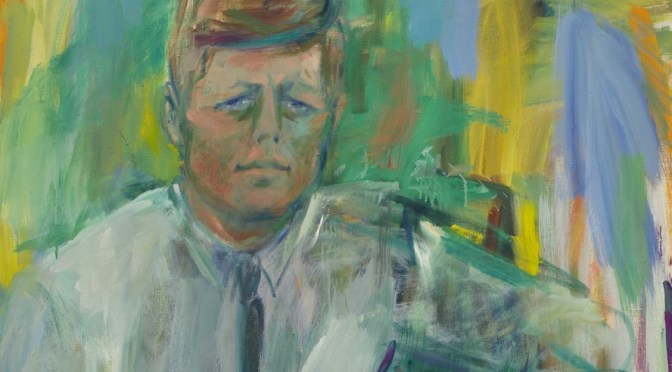
(Cover art: Portrait of President John F. Kennedy, by Elaine de Kooning)
There are paradigm shifting moments in human history when our perception of the world is changed forever. When these events occur, humanity’s collective consciousness irreversibly matures.
On Wednesday, August 28, 1963, at the Lincoln Memorial in Washington D.C., Dr. Martin Luther King, Jr. made an impassioned emotional appeal for racial equality which helped change the course of American history. King’s “I Have a Dream” speech has motivated generations of Americans to continue the struggle for a better society……
Dr. Martin Luther King Jr.’s “I Have A Dream” Speech, Washington, D.C., August 28, 1963
Cover Art: Tribute to Martin Luther King Jr. by Delawer-Omar



 Camden Civil Rights Project