With the famous phrase, “man is born free, but he is everywhere in chains,” Rousseau asserts that modern states repress the physical freedom that is our birthright, and do nothing to secure the civil freedom for the sake of which we enter into civil society. Legitimate political authority, he suggests, comes only from a social contract agreed upon by all citizens for their mutual preservation.
Rousseau’s central premise in The Social Contract is “how people might construct a genuinely free political society.” Rousseau concerns himself with the conditions under which rational individuals would form a civil society to preserve the peace and secure their own liberty and property interests. He concludes that the political arrangement which results in the greatest mutual benefit for all the parties is a common pact by which they agree “to subordinate themselves to the good of the community.” Rousseau contends that this social arrangement would require “total alienation of each associate with all of his rights to the whole community”, noting that if the forfeiture (alienation) were only partial then there would be no way of resolving disputes over “which powers and possessions the public good requires them to forfeit.” Rousseau asserts the subordination involved in this alienation is to the community as a whole, not to any individual or faction, and that this common forfeiture results in the greatest net gain of personal freedom for each member of society. The common good is determined by the sovereign, which is comprised of all parties to the social pact, declaring its general will. The general will represents the negotiated compromises voted upon by the entire community. The closer the vote comes to being unanimous, the healthier the society.
Rousseau distinguishes between “natural freedom” and “civil freedom” to illustrate how submission to the general will should result in no net loss of freedom. Rousseau asserts that prior to the formation of the social contract, individuals enjoy a type of “natural freedom” to act in their own best interest. Since all human beings enjoy this liberty, in a world occupied by many competitive claims, the practical value of this type of freedom may be almost nonexistent because the individual’s capacity to procure their wants will always be limited by his or her physical power in relation to others. Furthermore, the unhindered exercise of natural freedom pits individuals against one other over scarce resources, inevitably resulting in violence and uncertainty. Conversely, creation of the sovereign guarantees individuals a sphere of equality under the law which provides greater security in their persons and property. The loss of natural freedom to the general will is accompanied by a grant of civil freedom, defined as “the absence of impediments to pursuing one’s ends in cases where the law is silent.” Provided that the law is not meddlesome or intrusive (and Rousseau believes it will not be, since no individual has a motive to legislate burdensome laws) there will be a net benefit compared to the pre-political state.
Rousseau’s social contract has been maligned by a host of twentieth century philosophers as supporting either Communism or a tyranny by the majority. Rosseau promotes neither. The genius of Rousseau’s premise is not it’s claim that democracies should be guided by altruism or majoritarian rule, but rather that the legitimacy of a sovereign formed by consensus resides in its ability to serve the interests of those it governs. Rousseau observes that democracies which refuse to foster general consensus will eventually deteriorate into tyrannies which must be dissolved.
A downloadable PDF version of the book may be found HERE
Suggested Viewing:
Harvard Professor Lawrence Lessig makes the case that our democracy has become corrupt with money, leading to an inequality. Leesig argues that only 0.02% of the United States population actually determines who’s in power and that public policy reflects the desires of this segment of society. He introduces research conducted by Princeton which suggests that public opinion no longer affects change. The study reflects that in the aggregate, public opinion has a zero percent impact on policy decisions. Lessig says that this fundamental breakdown of the democratic system must be fixed before we will ever be able to address major challenges like climate change, social security, and student debt. He contends this may not the most important problem we face, but it’s the first problem we must address if we seek to resolve the major social problems facing our society.
Lawrence Lessig is the Roy L. Furman Professor of Law and Leadership at Harvard Law School, former director of the Edmond J. Safra Center for Ethics at Harvard University, and founder of Rootstrikers, a network of activists leading the fight against government corruption. He has authored numerous books, including Republic, Lost: How Money Corrupts Our Congress—and a Plan to Stop It, Code and Other Laws of Cyberspace, Free Culture, and Remix.
In his Discourse on the Origin of Inequality Among Mankind, Jean-Jacques Rousseau explores the origins of social inequality. Rousseau argues moral inequality is established by convention. In the modern world, human beings come to derive their very sense of self from the opinion of others, a fact which Rousseau sees as corrosive of freedom and destructive of individual authenticity.
Rousseau begins with humanity’s historical transition from its original state of isolated independence to the development of organized communities. According to Rousseau, man’s state of nature was a peaceful and quixotic time. People lived solitary, uncomplicated lives and their needs were easily satisfied by nature. Because of the natural abundance which existed, there was little need for competition. As a result, humans were naturally endowed with the capacity for compassion and were not inclined to harm one another for material gain.
This dynamic gradually changes as man begins to organize into communities. For Rousseau, civil society began as an irrational deception perpetrated upon humanity by individuals seeking to place their own interests above those of the community. Rousseau argues:
“The first man who, having fenced in a piece of land, said “This is mine,” and found people naive enough to believe him, that man was the true founder of civil society. From how many crimes, wars, and murders, from how many horrors and misfortunes might not any one have saved mankind, by pulling up the stakes, or filling up the ditch, and crying to his fellows: Beware of listening to this impostor; you are undone if you once forget that the fruits of the earth belong to us all, and the earth itself to nobody.”
Rousseau asserts, the weaker members of society are persuaded that the establishment of laws will provide them greater security by preserving their rights. Meanwhile, laws are created to entrench an artificial social hierarchy which seeks to preserve power and legitimize its exploitation of the more vulnerable members of society. The ensuing competition over property and social status corrupts human nature by extinguishing the compassion towards one another which existed in man’s original state of nature. This creates dangerous and unstable relationships, leading to the constant threat of violence.
Rousseau concludes that social inequality is only acceptable where it relates to differences in individual ability and talent. The moral deficiency of modern civilization, however, is that man’s liberty is undermined through an unnatural social construct which equates material gain with virtue. This creates a perverse incentive for individuals to increase their own privilege and status through the exploitation of their fellow citizens.
Rousseau envisions society as becoming increasingly hostile, eventually requiring despotic rule to maintain the inequality. As wealth becomes more concentrated, the potential for violent conflict increases. Rousseau argues this outcome may be avoided through a more equitable economic arrangement, but is pessimistic that this arrangement can be achieved through voluntary concessions by those in power.
A downloadable PDF version of the book may be found HERE
A version of the Book in digital format may be found HERE
Why Nations Fail, by Daron Acemoglu and James A. Robinson, is a grand exploration into the history of European colonialism and the economic success and/or failure of the social institutions it has established. Based on numerous historical case studies, the authors theorize that the sustained economic success of a country depends less on its policies, geography, culture, or value systems than on the political institutions it establishes to determine its economic outcomes.
Acemoglu and Robinson identify two different economic structures which they term “extractive” and “inclusive.” They argue that the common feature in all “extractive” systems is a small, dominant class of individuals who seek to concentrate power and exploit labor, resources and capital. According to the authors. “Wherever those with political power felt threatened by technology and innovation, they prevented it, and by doing so they effectively prevented wealth creation and prosperity.” In contrast, “inclusive” systems seek to distribute power among a larger segment of society in an effort to promote competition and innovation. They create positive feedback loops which keep the elites in check, ensuring their own expansion and persistence.
Acemoglu and Robinson, conclude that, historically, the countries which have experienced sustainable economic growth are those which have sufficiently decentralized power to protect the integrity of essential public functions, such as the enforcement of contracts and the administration of justice.
“In order for the virtuous cycle to work the first precondition is to have pluralism, which will constitute the rule of law and lead to more inclusive economic institutions. Inclusive economic institutions will remove the need for extraction since those in power will gain little but lose a lot if engaged in a repression and constraining democracy. Finally, they also recognize the importance of free media to provide information on threats against inclusive institutions.”
The authors assert that extractive institutions may deliver growth for a limited period, but ultimately fail because their interest in maintaining the existing power structure stifles innovation and competition. Conversely, inclusive institutions allow for the creative destruction of inefficient models, encouraging the development of new practices and technologies which spur economic growth.
“The virtuous cycle explains how the reforms of the political system in England or the US became irreversible, since those in power understood that any possible deviation would endanger their own position. The examples of British consolidation and its slow, contingent path to democracy in which the people gradually demanded and gradually received more rights; or the trust-busting in the US in the beginning of the 20th century; or the failed attempts of President Roosevelt to limit the power of the US Supreme Court illustrate this point.”
Acemoglu and Robinson find that historically, the artificial growth within extractive systems eventually comes to a crashing halt, most often resulting in political instability and regime change. Therefore, we should opt to avoid harsh economic consequences and political turmoil by establishing inclusive institutions.
A scanned version of the Book in digital format may be found HERE
Library Journal calls A People’s History of the United States, “a brilliant and moving history of the American people from the point of view of those…whose plight has been largely omitted from most histories.” In this groundbreaking work, the author explains how America’s past, from the Revolutionary War to the present day, has typically been characterized by the exploitation of large segments of American society.
Howard Zinn presents a realistic view of the American past which focuses on the human cost which often accompanied the capitalist expansion of the United states. The book is an important supplement to the view of American exceptionalism found in many textbooks, revealing uncomfortable events we have swept beneath the rug of American progress. According to Zinn:
My history… describes the inspiring struggle of those who have fought slavery and racism, of the labor organizers who have led strikes for the rights of working people, of the socialists and others who have protested war and militarism. My hero is not Theodore Roosevelt, who loved war and congratulated a general after a massacre of Filipino villagers at the turn of the century, but Mark Twain, who denounced the massacre and satirized imperialism.
I want young people to understand that ours is a beautiful country, but it has been taken over by men who have no respect for human rights or constitutional liberties. Our people are basically decent and caring, and our highest ideals are expressed in the Declaration of Independence, which says that all of us have an equal right to “life, liberty, and the pursuit of happiness.” The history of our country, I point out in my book, is a striving, against corporate robber barons and war makers, to make those ideals a reality — and all of us, of whatever age, can find immense satisfaction in becoming part of that.
Packed with vivid details and memorable quotations, Zinn’s award-winning classic continues to have a profound impact upon educators, scholars, and students of American History.
“It’s a wonderful, splendid book—a book that should be read by every American, student or otherwise, who wants to understand his country, its true history, and its hope for the future.” — Howard Fast, author of Spartacus and The Immigrants
“[It] should be required reading.” — Columbia University Historian Eric Foner, New York Times Book Review
A downloadable PDF version of the book may be found HERE
A version of the Book in digital format may be found HERE
A printer friendly version of the Book May be found HERE
“Theology is an understanding which both grows and, in a certain sense, changes. If the commitment of the Christian community in fact takes different forms throughout history, the understanding which accompanies the vicissitudes of this commitment will be constantly renewed and will take untrodden paths.”
“Much contemporary theology seems to start from the challenge of the nonbeliever. He questions our religious world and faces it with a demand for profound purification and renewal.
…But the challenge in a continent like Latin America does not come primarily from the man who does not believe, but from the man who is not a man, who is not recognized as such by the existing social order: he is in the ranks of the poor, the exploited; he is the man who scarcely knows that he is a man. His challenge is not aimed first at our religious world, but at our economic, social, political, and cultural world; therefore, it is an appeal for a revolutionary transformation of the very basis of a dehumanizing society.
The question is not therefore how to speak of God in an adult world, but how to proclaim Him as a Father in a world that is not human.”
– Gustavo Gutierrez, “Liberation, Theology, and Proclamation” (1974)
“In our theological efforts we have called this ‘Theology of Liberation’ because ‘liberation’ is very often translated to ‘salvation.’ How do we say to the poor, ‘God loves you’? This question is larger than our answers. It means it is an open question, and we try in this liberation theology, and I can say in the different liberation theologies, to try to answer this point.”
– Gustavo Gutierrez, remarks at Elmhurst College (2009)
Love of Neighbor
“One of the teachers of the law came and heard them debating. Noticing that Jesus had given them a good answer, he asked him, “Of all the commandments, which is the most important?
“The most important one,” answered Jesus, “is this: ‘Hear, O Israel: The Lord our God, the Lord is one. Love the Lord your God with all your heart and with all your soul and with all your mind and with all your strength.’ The second is this: ‘Love your neighbor as yourself.’ There is no commandment greater than these.”
– Mark 12:28-31, New International Version
“Love of neighbor is an essential component of Christian life. But as long as I apply that term only to the people who cross my path and come asking me for help, my world will remain pretty much the same. Individual almsgiving and social reformism is a type of love that never leaves its own front porch.
… On the other hand my world will change greatly if I go out to meet other people on their path and consider them as my neighbor, as the good Samaritan did… The Gospel tells us that the poor are the supreme embodiment of our neighbor. It is this option that serves as the focus for a new way of being human and Christian in today’s Latin America.”
– Gustavo Gutierrez, “Liberation Praxis and Christian Faith” (1979)
Christian Duty to Address Social Injustice
“Defend the cause of the weak and fatherless; maintain the rights of the poor and oppressed. Rescue the weak and needy; deliver them from the hand of the wicked.”
– Psalm 82:3-4, New International Version
“The Christian faithful are also obliged to promote social justice and, mindful of the precept of the Lord, to assist the poor.”
– 1983 CIC, canon 222.2
“According to Catholic teaching, through one’s words, prayers and deeds one must show solidarity with, and compassion for, the poor. Therefore, when instituting public policy one must always keep the ‘preferential option for the poor’ at the forefront of one’s mind. Accordingly, this doctrine implies that the moral test of any society is; ‘how it treats its most vulnerable members.’ The poor have the most urgent moral claim on the conscience of the nation. We are called to look at public policy decisions in terms of how they affect the poor.”
– Option for the Poor, Major themes from Catholic Social Teaching, Archdiocese of St. Paul & Minneapolis.
“I am not refusing the necessity, even today, of immediate help to the poor, but I say it is not enough. Today the call is to try to change the social structure and to change some mental categories—to be clearer about mental categories, the feeling of superiority, for example, to some cultures. This is a mental category and we need to change this.
In the ultimate analysis, poverty means death; unjust and early death. Missionaries of the 16th century, some years after their arrival on this continent, said, ‘The Indians are dying before their time.’ Well, it was true certainly, but it’s true today also. The poor are dying before their time because poverty means death—unjust and early death.”
– Gustavo Gutierrez, remarks at Elmhurst College (2009)
“It is not a question of idealizing poverty, but rather of taking it on as it is—an evil—to protest against it and to struggle to abolish it. As Paul Ricoeur says, you cannot really be with the poor unless you are struggling against poverty. Because of this solidarity—which manifests itself in specific action, a style of life, a break with one’s social class—one can also help the poor and exploited to become aware of their exploitation and seek liberation from it.
Christian poverty, and expression of love, is solidarity with the poor and is a protest against poverty. This is the concrete, contemporary meaning of the witness of poverty. It is a poverty lived not for its own sake, but rather as an authentic imitation of Christ; it is a poverty which means taking on the sinful human condition to liberate humankind from sin and all its consequences.”
“But God will never forget the needy; the hope of the afflicted will never perish.”
– Psalm 9:18, New International Version
“We must also engage in our work hopefully. Hope is not the same thing as optimism. Optimism merely reflects the desire that external circumstances may one day improve. There is nothing wrong with optimism, but we may not always have reasons for it.
The theological virtue of hope is much more than optimism. Hope is based on the conviction that God is at work in our lives and in the world. Hope is ultimately a gift from God given to sustain us during difficult times. Charles Péguy described hope as the ‘little sister’ that walks between the ‘taller sisters’ of faith and charity; when the taller sisters grow tired, the little one instills new life and energy into the other two. Hope never allows our faith to grow weak or our love to falter.”
The several social theories that emphasize social conflict have roots in the ideas of Karl Marx (1818-1883), the great German theorist and political activist. The Marxist, conflict approach emphasizes a materialist interpretation of history, a dialectical method of analysis, a critical stance toward existing social arrangements, and a political program of revolution or, at least, reform.
The materialistview of history starts from the premise that the most important determinant of social life is the work people are doing, especially work that results in provision of the basic necessities of life, food, clothing and shelter.Marx thought that the way the work is socially organized and the technology used in production will have a strong impact on every other aspect of society. He maintained that everything of value in society results from human labor. Thus,Marx saw working men and women as engaged in making society, in creating the conditions for their own existence.
Marx summarized the key elements of this materialist view of history as follows:
In the social production of their existence, men inevitably enter into definite relations, which are independent of their will, namely relations of production appropriate to a given stage in the development of their material forces of production. The totality of these relations of production constitutes the economic structure of society, the real foundation, on which arises a legal and political superstructure and to which correspond definite forms of social consciousness. The mode of production of material life conditions the general process of social, political and intellectual life. It is not the consciousness of men that determines their existence, but their social existence that determines their consciousness (Marx 1971:20).
Marx divided history into several stages, conforming to broad patterns in the economic structure of society. The most important stages for Marx’s argument were feudalism, capitalism, and socialism. The bulk of Marx’s writing is concerned with applying the materialist model of society to capitalism, the stage of economic and social development that Marx saw as dominant in 19th century Europe. For Marx, the central institution of capitalist society is private property, the system by which capital (that is, money, machines, tools, factories, and other material objects used in production) is controlled by a small minority of the population. This arrangement leads to two opposed classes, the owners of capital (called the bourgeoisie) and the workers (called the proletariat), whose only property is their own labor time, which they have to sell to the capitalists.
Owners are seen as making profits by paying workers less than their work is worth and, thus, exploiting them. (In Marxist terminology, material forces of production ormeans of production include capital, land, and labor, whereas social relations of production refers to the division of labor and implied class relationships.)
Economic exploitation leads directly to political oppression, as owners make use of their economic power to gain control of the state and turn it into a servant of bourgeois economic interests. Police power, for instance, is used to enforce property rights and guarantee unfair contracts between capitalist and worker. Oppression also takes more subtle forms: religion serves capitalist interests by pacifying the population; intellectuals, paid directly or indirectly by capitalists, spend their careers justifying and rationalizing the existing social and economic arrangements. In sum, the economic structure of society molds the superstructure, including ideas (e.g., morality, ideologies, art, and literature) and the social institutions that support the class structure of society (e.g., the state, the educational system, the family, and religious institutions). Because the dominant or ruling class (the bourgeoisie) controls the social relations of production, the dominant ideology in capitalist society is that of the ruling class. Ideology and social institutions, in turn, serve to reproduce and perpetuate the economic class structure. Thus, Marx viewed the exploitative economic arrangements of capitalism as the real foundation upon which the superstructure of social, political, and intellectual consciousness is built.
Marx’s view of history might seem completely cynical or pessimistic, were it not for the possibilities of change revealed by his method of dialectical analysis. (The Marxist dialectical method, based on Hegel’s earlier idealistic dialectic, focuses attention on how an existing social arrangement, or thesis, generates its social opposite, or antithesis, and on how a qualitatively different social form, orsynthesis, emerges from the resulting struggle.) Marx was an optimist. He believed that any stage of history based on exploitative economic arrangements generated within itself the seeds of its own destruction. For instance, feudalism, in which land owners exploited the peasantry, gave rise to a class of town-dwelling merchants, whose dedication to making profits eventually led to thebourgeois revolution and the modern capitalist era. Similarly, the class relations of capitalism will lead inevitably to the next stage, socialism. The class relations of capitalism embody a contradiction: capitalists need workers, and vice versa, but the economic interests of the two groups are fundamentally at odds. Such contradictions mean inherent conflict and instability, the class struggle. Adding to the instability of the capitalist system are the inescapable needs for ever-wider markets and ever-greater investments in capital to maintain the profits of capitalists. Marx expected that the resulting economic cycles of expansion and contraction, together with tensions that will build as the working class gains greater understanding of its exploited position (and thus attains class consciousness), will eventually culminate in a socialist revolution.
Despite this sense of the unalterable logic of history, Marxists see the need for social criticism and for political activity to speed the arrival of socialism, which, not being based on private property, is not expected to involve as many contradictions and conflicts as capitalism. Marxists believe that social theory and political practice are dialectically intertwined, with theory enhanced by political involvement and with political practice necessarily guided by theory. Intellectuals ought, therefore, to engage in praxis, to combine political criticism and political activity. Theory itself is seen as necessarily critical and value-laden, since the prevailing social relations are based upon alienating and dehumanizing exploitation of the labor of the working classes.
Marx’s ideas have been applied and reinterpreted by scholars for over a hundred years, starting with Marx’s close friend and collaborator, Friedrich Engels (1825-95), who supported Marx and his family for many years from the profits of the textile factories founded by Engels’ father, while Marx shut himself away in the library of the British Museum. Later, Vladimir I. Lenin (1870-1924), leader of the Russian revolution, made several influential contributions to Marxist theory. In recent years Marxist theory has taken a great variety of forms, notably the world-systems theory proposed by Immanuel Wallerstein (1974, 1980) and the comparative theory of revolutions put forward by Theda Skocpol (1980). Marxist ideas have also served as a starting point for many of the modern feminist theorists. Despite these applications, Marxism of any variety is still a minority position among American sociologists.
References
Marx, Karl. 1971. Preface to A Contribution to the Critique of Political Economy, Tr. S. W. Ryanzanskaya, edited by M. Dobb. London: Lawrence & Whishart.
Skocpol, Theda. 1980. States and Social Revolutions: A Comparative Analysis of France, Russia, and China. New York: Cambridge University Press.
Wallerstein, Immanuel M. 1974. The Modern World-System: Capitalist Agriculture and the Origins of the European World-Economy in the Sixteenth Century. New York: Academic Press.
. 1980. The Modern World-System II: Mercantilism and the Consolidation of the European World-Economy, 1600-1750. New York: Academic Press.
Racism – A History was first broadcast on BBC Four in March 2007 to mark the bicentenary of the Slave Trade Act 1807 which abolished the slave trade in the British Empire. The three-part documentary series closely examines the development of Racism over the last 500 years, revealing some uncomfortable truths about how racist attitudes came into being and were spread into popular culture.
Though the institution of slavery dates back to ancient civilizations, the modern concept of racism began with the African Slave Trade in the sixteenth century. The self interested desire to economically exploit Africans gave birth to the European concept that different races of human beings existed, distinguished by the colour of their skin.
Episode 1: The Colour of Money
The series begins by examining how the development of modern racist attitudes can be attributed to the colonial powers’ desire to justify the African slave trade. Professor James Walvin, Professor of History Emeritus at the University of York explains,
“the British don’t become slave traders and slavers because they are racist; they became racist because they use slaves for great profit in the Americas and devise a set of attitudes towards black people that justifies what they’ve done. The real engine behind the slave system is economics.”
It was this desire to legitimize the exploitation of Africans for cheap labor that ultimately fueled the creation of the idea that an hierarchy of the races existed. This notion was subsequently supported by religious and philosophic apologists which shifted public perception into believing the subjugation and dehumanization of Blacks was an acceptable social practice.
Episode 2: Fatal Impacts
Part Two examines how the practice of racial classification and scientific racism developed in European societies during the Nineteenth Century. Religious dogmas and discredited sciences such as Phrenology created the myth that Negroes were a sub-species giving European colonists the moral justification they needed to justify the mistreatment and exploitation of indigenous populations. These theories would eventually evolve into the discipline of Eugenics and the Nazi vision of the “Master Race,” which would lead to the forced labor and mass genocide of over eight million European Jews, Slavics and Romanians.
Episode 3: A Savage Legacy
Part three of the series examines the impact of racism in the 20th Century. By 1900, European colonial expansion had reached deep into the heart of Africa. Under the rule of King Leopold II, The Belgian Congo was turned into a vast rubber plantation. Men, women and children who failed to gather their latex quotas would have their limbs dismembered. The country became the scene of one of the century’s greatest racial genocides, as an estimated 10 million Africans perished under colonial rule. The final episode also explores the Jim Crow Era in America, the Apartheid regime which developed in South Africa and the institutional racism which still affects the United Kingdom.
Fair Use Notice
This video may contain copyrighted material. Such material is made available for educational purposes only in an effort to advance the understanding of human rights and social justice issues and is distributed without profit to those who have expressed a prior interest in receiving the included information for research and educational purposes. This constitutes a ‘fair use’ of any such copyrighted material in accordance with Title 17 U.S.C. Section 107 of the U.S. Copyright Law.
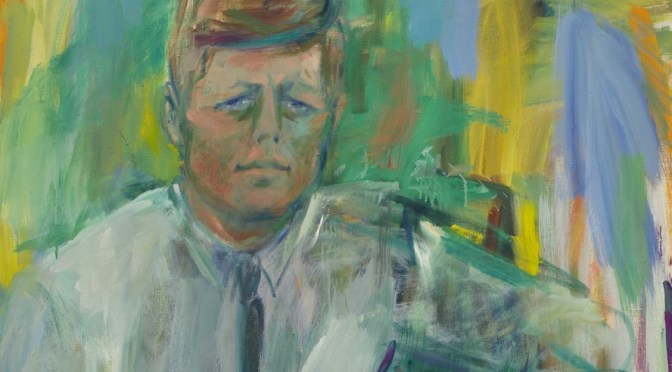
Following the protests in Birmingham, President Kennedy addressed the “moral crisis” of racial segregation and called for national participation in ensuring that America becomes the “land of the free” for all of its citizens.
President John F. Kennedy’s Civil Rights Address
June 11, 1963
This afternoon, following a series of threats and defiant statements, the presence of Alabama National Guardsmen was required on the University of Alabama to carry out the final and unequivocal order of the United States District Court of the Northern District of Alabama. This order called for the admission of two clearly qualified young Alabama residents who happen to have been born Negro.
That they were admitted peacefully on the campus is due in good measure to the conduct of the students of the University of Alabama, who met their responsibilities in a constructive way.
I hope that every American, regardless of where he lives, will stop and examine his conscience about this and other related incidents. This nation was founded by men of many nations and backgrounds. It was founded on the principle that all men are created equal, and that the rights of every man are diminished when the rights of one man are threatened.
Today we are committed to a worldwide struggle to promote and protect the rights of all who wish to be free. When Americans are sent to Vietnam or West Berlin, we do not ask for whites only. It ought to be possible, therefore, for American students of any color to attend any public institution they select without having to be backed up by troops.
It ought to be possible for American consumers of any color to receive equal service in places of public accommodation, such as hotels and restaurants and theaters and retail stores, without being forced to resort to demonstration in the street. It ought to be possible for American citizens of any color to register and to vote in a free election without interference or fear of reprisal.
It ought to be possible, in short, for every American to enjoy the privileges of being American without regard to his race or his color. In short, every American ought to have the right to be treated as he would wish to be treated, as one would wish his children to be treated. But this is not the case today.
The Negro baby born in America today, regardless of the section of the nation in which he is born, has about one half as much chance of completing high school as a white baby born in the same place on the same day, one third as much chance of completing college, one third as much chance of becoming a professional man, twice as much chance of becoming unemployed, about one seventh as much chance of earning $10,000 a year or more, a life expectancy which is seven years shorter, and the prospects of earning only half as much.
This is not a sectional issue. Difficulties over segregation and discrimination exist in every city, in every state of the Union, producing in many cities a rising tide of discontent that threatens the public safety. Nor is this a partisan issue. In a time of domestic crisis men of goodwill and generosity should be able to unite regardless of party or politics. This is not even a legal or legislative issue alone. It is better to settle these methods in the courts than on the streets, and new laws are needed at every level, but law alone cannot make men see right.
We are confronted primarily with a moral issue. It is as old as the Scriptures and is as clear as the American Constitution.
The heart of the question is whether all Americans are to be afforded equal rights and equal opportunities, whether we are going to treat our fellow Americans as we want to be treated. If an American, because his skin is dark, cannot eat lunch in a restaurant open to the public, if he can not send his children to the best public school available, if he cannot vote for the public officials who represent him, if, in short, he cannot enjoy the full and free life which all of us want, then who among us would be content to have the color of his skin changed and stand in his place? Who among us would be content with the counsels of patience and delay?
One hundred years have passed since President Lincoln freed the slaves, yet their heirs, their grandsons, are not fully free. They are not yet freed from the bonds of injustice. They are not yet freed from social and economic oppression. And this nation, for all its hopes and all its boasts, will not be fully free until all its citizens are free.
We preach freedom around the world, and we mean it, and we cherish our freedom here at home; but are we to say to the world, and, much more importantly, for each other, that this is a land of the free except for the Negroes; that we have no second-class citizens except Negroes; that we have no class or caste system, no ghettos, no master race, except with respect to Negroes?
Now the time has come for this nation to fulfill its promise. The events in Birmingham and elsewhere have so increased the cries for equality that no city or state or legislative body can prudently choose to ignore them.
The fires of frustration and discord are burning in every city, North and South, where legal remedies are not at hand. Redress is sought in the streets, in demonstrations, parades, and protests which create tensions and threaten violence and threaten lives.
We face, therefore, a moral crisis as a country and as a people. It cannot be met by repressive police action. It cannot be left to increased demonstrations in the streets. It cannot be quieted by token moves or talk. It is a time to act in the Congress, in your state and local legislative bodies and, above all, in all of our daily lives.
It is not enough to pin the blame on others, to say this is a problem of one section of the country or another, or deplore the facts that we face. A great change is at hand, and our task, our obligation, is to make that revolution, that change, peaceful and constructive for all.
Those who do nothing are inviting shame as well as violence. Those who act boldly are recognizing right as well as reality.
Next week I shall ask the Congress of the United States to act, to make a commitment it has not fully made in this century to the proposition that race has no place in American life or law. The federal judiciary has upheld that proposition in the conduct of its affairs, including the employment of federal personnel, the use of federal facilities, and the sale of federally financed housing.
But there are other necessary measures which only the Congress can provide, and they must be provided at this session. The old code of equity law under which we live commands for every wrong a remedy, but in too many communities, in too many parts of the country, wrongs are inflicted on Negro citizens and there are no remedies at law. Unless the Congress acts, their only remedy is in the streets.
I am, therefore, asking the Congress to enact legislation giving all Americans the right to be served in facilities which are open to the public — hotels, restaurants, theaters, retail stores, and similar establishments.
This seems to me to be an elementary right. Its denial is an arbitrary indignity that no American in 1963 should have to endure. But many do.
I have recently met with scores of business leaders urging them to take voluntary action to end this discrimination, and I have been encouraged by their response. In the last two weeks over seventy-five cities have seen progress made in desegregating these kinds of facilities. But many are unwilling to act alone, and for this reason, nationwide legislation is needed if we are to move this problem from the streets to the courts.
I am also asking Congress to authorize the federal government to participate more fully in lawsuits designed to end segregation in public education. We have succeeded in persuading many districts to desegregate voluntarily. Dozens have admitted Negroes without violence. Today, a negro is attending a state-supported institution in every one of our fifty states. But the pace is very slow.
Too many Negro children entering segregated grade schools at the time of the Supreme Court’s decision nine years ago will enter segregated high schools this fall, having suffered a loss which can never be restored. The lack of an adequate education denied the Negro a chance to get a decent job.
The orderly implementation of the Supreme Court decision, therefore, cannot be left solely to those who may not have the economic resources to carry the legal action or who may be subject to harassment.
Other features will also be requested, including greater protection for the right to vote. But legislation, I repeat, cannot solve this problem alone. It must be solved in the homes of every American in every community across our country.
In this respect, I want to pay tribute to those citizens, North and South, who have been working in their communities to make life better for all. They are acting not out of a sense of legal duty but out of a sense of human decency. Like our soldiers and sailors in all parts of the world, they are meeting freedom’s challenge on the firing line, and I salute them for their honor and courage.
My fellow Americans, this is a problem which faces us all — in every city of the North as well as the South. Today there are Negroes, unemployed — two or three times as many compared to whites — with inadequate education, moving into the large cities, unable to find work, young people particularly out of work and without hope, denied equal rights, denied the opportunity to eat at a restaurant or lunch counter or go to a movie theater, denied the right to a decent education… It seems to me that these are matters which concern us all, not merely Presidents or congressmen or governors, but every citizen of the United States.
This is one country. It has become one country because all the people who came here had an equal chance to develop their talents…
We have a right to expect that the Negro community will be responsible and will uphold the law; but they have a right to expect that the law will be fair, that the constitution will be color blind, as Justice Harlan said at the turn of the century.
This is what we are talking about. This is a matter which concerns this country and what it stands for, and in meeting it I ask the support of all our citizens.
(Cover art: Portrait of President John F. Kennedy, by Elaine de Kooning)
There are paradigm shifting moments in human history when our perception of the world is changed forever. When these events occur, humanity’s collective consciousness irreversibly matures.
On Wednesday, August 28, 1963, at the Lincoln Memorial in Washington D.C., Dr. Martin Luther King, Jr. made an impassioned emotional appeal for racial equality which helped change the course of American history. King’s “I Have a Dream” speech has motivated generations of Americans to continue the struggle for a better society……
Dr. Martin Luther King Jr.’s “I Have A Dream” Speech, Washington, D.C., August 28, 1963
Cover Art: Tribute to Martin Luther King Jr. by Delawer-Omar
Adam Curtis’ acclaimed series Century of the Self examines how the introduction of Sigmund Freud’s theory of Psychoanalysis has come to shape American culture. The seriesadvances the thesis that Freud’s views of the unconscious set the stage for corporations, and later politicians, to manipulate public behavior through appeals to our unconscious fears and desires. Curtis’ detailed examination of how Psychoanalytic theories have been used to create a desire based consumer economy, manufacture public consent for unpopular military intervention and to emotionally manipulate the public in political campaigns raises important ethical questions about whether the utilization of psychological conditioning techniques to direct group behaviors is consistent with Democratic ideals.
Episode 1: Happiness Machines
Episode one explores the evolution of the American public relations industry and the use of Freud’s theories of Psychoanalysis to appeal to the subconscious desires of consumers. Freud’s cousin, Edward Bernays, first introduced the these principles in the United States by convincing American corporations that they could increase their sales by appealing to individual’s unconscious emotions.
Bernays created marketing innovations such as celebrity endorsements and the sexualization of consumer products. One of Bernays more controversial campaigns succeeded in breaking the taboo on female smoking by linking cigarettes with the Suffragette movement. Bernays successfully persuaded woman to adopt the harmful habit by referring to cigarettes as “liberty sticks” and symbolizing the act of smoking as an expression of liberation and independence. By satisfying the inner irrational desires that his uncle had identified, people could be persuaded to act in ways they would not normally behave.
It was the beginning of organizational psychology and the social engineering practices which the soon come to dominate American society.
Episode 2: The Engineering of Consent
Part two explores how policymakers in post World War II America came to embrace Freud’s underlying premise that human behavior was influenced by irrational subconscious desires and used Bernay’s propaganda techniques to engineer public consent. Public officials became mistrustful of the general public, concerned that if individuals were left alone to act on their irrational desires, the atrocities committed by Germany in World War II could repeat themselves in America. As a result, policy planners became preoccupied with installing social controls to identify and suppress the public’s potentially dangerous desires through social indoctrination.
Psychoanalysis gained increasing influence throughout American society as it proposed that dangerous behaviors could be controlled by conditioning individuals to obey social norms. Psychoanalysists were employed to create organizational models as this ideology rapidly spread through the corporate and public sectors. However, this rigid system of social conformity created problems of it’s own as rates of depression, anxiety and disillusionment began to rise within the general public. As the failures mounted, the tenets of psychoanalysis would be placed into question.
Episode 3: There is a Policeman Inside All of Our Heads, He Must Be Destroyed
The third segment explores how the perceived failures of psychoanalysis led to the public rejection of social conformity in favor of individual expression. Beginning in the 1960s, a group of psychotherapists influenced by the theories of Wilhelm Reich began to challenge the validity of the psychoanalytic model in explaining human behavior. They asserted that unleashing an individual’s subconscious desires led to empowerment and creativity. As the individual empowerment movement spread, the idea that individuals could transform society through political activism was soon replaced with the notion that a better society could only be achieved through individual transformation. Corporate marketers learned to capitalize on the ideological shift by persuading consumers to express their individuality through the products they purchased.
Episode 4: Eight People Sipping Wine In Kettering
This final installment of the series examines how politicians in the U.S. and Britain discovered the advantages of incorporating psychoanalytic principles into their political campaigns. Curtis explores the introduction of political focus groups to gather information about the subconscious motivations of voters and the ideological shift away from the public good towards fulfillment of individual desires. The segment focuses on the how politicians began pandering to individual self interest in an effort to maintain public office. Curtis raises the ethical question of whether the political shift towards egocentrism is actually capable of producing a more democratic society or if it simply exploits the public desires for self-liberation to maintain the existing power structure.


 In his Discourse on the Origin of Inequality Among Mankind, Jean-Jacques Rousseau explores the origins of social inequality. Rousseau argues moral inequality is established by convention. In the modern world, human beings come to derive their very sense of self from the opinion of others, a fact which Rousseau sees as corrosive of freedom and destructive of individual authenticity.
 Why Nations Fail, by Daron Acemoglu and James A. Robinson, is a grand exploration into the history of European colonialism and the economic success and/or failure of the social institutions it has established. Based on numerous historical case studies, the authors theorize that the sustained economic success of a country depends less on its policies, geography, culture, or value systems than on the political institutions it establishes to determine its economic outcomes.
 Library Journal calls A People’s History of the United States, “a brilliant and moving history of the American people from the point of view of those…whose plight has been largely omitted from most histories.” In this groundbreaking work, the author explains how America’s past, from the Revolutionary War to the present day, has typically been characterized by the exploitation of large segments of American society.



 Camden Civil Rights Project