Category Archives: Articles

Private Education Grant Tied to Gov. Christie Staying in Office

By Bob Braun/Star-Ledger Columnist

December 13, 2012 at 6:30 AM, updated December 13, 2012 at 6:32 AM

What passes for educational reform in New Jersey has relied heavily on private foundation money — millions from the likes of Mark Zuckerberg and Bill Gates, among others — and a common complaint of critics is that the public is rarely made aware of the conditions of those grants. One recent grant from a California-based foundation includes this unusual stipulation: Gov. Chris Christie must stay in office in New Jersey.

“That’s astonishing,” says David Sciarra, executive director of the Education Law Center in Newark and a frequent critic of the Christie administration’s policies. “It is highly unusual, maybe precedent-setting — to require that an elected official remain in office as a condition for a grant.”

Sciarra, whose organization forced the disclosure of the terms of the grant from the Eli and Edythe Broad Foundation, has called for an independent review of the $430,000 award. It was Sciarra who gave The Star-Ledger a copy of the grant papers.

“Some independent body, the Legislature or the state comptroller’s office, should look into the entire relationship between the Broad foundation and the state,” Sciarra says, adding that the requirement of Christie’s continued presence — negotiated while the governor was considered a presidential or vice presidential contender last spring — was not the only problem with the grant.

Christie’s office would not comment and referred all questions to the state education department, where spokeswoman Barbara Morgan dismissed the concern because, she said, all the funds from the grant would be paid out before next year’s election.

Morgan, who conceded governors leave office for reasons other than elections, also said the provision was appropriate because “It is his administration receiving the grant.”

A spokeswoman for the foundation had a different take. In an e-mail, Erica Lepping, its senior communications director, wrote:

“Research shows that American school systems making the greatest academic gains have certain ingredients in place, including strong leaders who champion strategies that are designed to create environments that support students and teachers, so we consider the presence of strong leaders to be important when we hand over our dollars.

“Of course the longevity of a governor is entirely up to a state.”

The Broad foundation has extensive links to New Jersey. It runs an academy that trains educators who have been hired in New Jersey — including Education Commissioner Christopher Cerf. It also provided $1.5 million in grants for education reform in a program channeled through the Council of Chief State School Officers, a national organization.

Other curious provisions include “benchmarks” that appear to commit the state to pursue certain policies, some of which are controversial. For example, at a time when the Legislature is reviewing the state’s approach to charter schools, one benchmark reads:

“The percent of high quality public charter schools in New Jersey, as measured by NJDOE’s” — New Jersey Department of Education’s — “definition of high quality, will increase by 50 (percent) by 2014-15.”

Sciarra says he takes this to mean the state agreed to increase the number of charter schools by 50 percent. Morgan and Lepping say it means only that the number of existing charter schools considered to be of “high quality” will increase by half.

“It says what it says,” says Sciarra. “It is a foundation driving public educational policy that should be set by the Legislature.”

Some provisions in the grant suggest the Broad foundation — referred to in the document as “TBF” — wants to stay out of the public eye as much as possible. In the document’s language, the state education department is referred to as the “Grantee.”

“TBF reserves the right not to be included in Grantee’s publicity,” reads one provision that also requires that “all public announcements of this grant by Grantee, including without limitation, oral, print, electronic or other announcements, must be coordinated with TBF. Grantee must contact the Senior Director of Communications on TBF’s staff to obtain and obtain approval of Grantee’s plans.”

It also contains a long provision related to “confidentiality” and contends that “all records, files, drawings, documents, equipment and other tangible items, wherever located, relating in any way to the Confidential Material or otherwise to TBF’s business that Grantee Parties prepare, use or encounter will be and remain TBF’s sole and exclusive property.”

If the state is legally required to make any of these materials public — either through subpoenas or other legal process — it must give the foundation advance notice of such disclosure “so that TBF may contest the disclosure and or/seek a protective order.”

Lepping says this is not aimed at keeping the foundation’s relationship with the state a secret. She says the confidentiality provision is limited to a “small subset” of files that may contain personal information. She says the foundation is committed to “transparency.”

Sciarra disagrees. “This grant was negotiated in private and approved by the state without the release of its terms and conditions. The state only made it public because it was forced to under the Open Public Records Act.”

Apocalypse, New Jersey: A Dispatch From America’s Most Desperate Town

No jobs, no hope – and surveillance cameras everywhere. The strange, sad story of Camden

 download (4)


BY December 11, 2013

The first thing you notice about Camden, New Jersey, is that pretty much everyone you talk to has just gotten his or her ass kicked.

Instead of shaking hands, people here are always lifting hats, sleeves, pant legs and shirttails to show you wounds or scars, then pointing in the direction of where the bad thing just happened.

“I been shot six times,” says Raymond, a self-described gangster I meet standing on a downtown corner. He pulls up his pant leg. “The last time I got shot was three years ago, twice in the femur.” He gives an intellectual nod. “The femur, you know, that’s the largest bone in the leg.”

“First they hit me in the head,” says Dwayne “The Wiz” Charbonneau, a junkie who had been robbed the night before. He lifts his wool cap to expose a still-oozing red strawberry and pulls his sweatpants down at the waist, drawing a few passing glances. “After that, they ripped my pockets out. You can see right here. . . .”

Even the cops have their stories: “You can see right here, that’s where he bit me,” says one police officer, lifting his pant leg. “And I’m thinking to myself, ‘I’m going to have to shoot this dog.'”

“I’ve seen people shot and gotten blood on me,” says Thomas Bayard Townsend III, a friendly convicted murderer with a tear tattoo under his eye. “If you turn around here, and your curiosity gets the best of you, it can cost you your life.”

Camden is just across the Delaware River from the brick and polished cobblestone streets of downtown Philadelphia, where oblivious tourists pour in every year, gobbling cheese steaks and gazing at the Liberty Bell, having no idea that they’re a short walk over the Ben Franklin Bridge from a full-blown sovereignty crisis – an un-Fantasy Island of extreme poverty and violence where the police just a few years ago essentially surrendered a city of 77,000.

All over America, communities are failing. Once-mighty Rust Belt capitals that made steel or cars are now wastelands. Elsewhere, struggling white rural America is stocking up on canned goods and embracing the politics of chaos, sending pols to Washington ready to hit the default button and start the whole national experiment all over again.

But in Camden, chaos is already here. In September, its last supermarket closed, and the city has been declared a “food desert” by the USDA. The place is literally dying, its population having plummeted from above 120,000 in the Fifties to less than 80,000 today. Thirty percent of the remaining population is under 18, an astonishing number that’s 10 to 15 percent higher than any other “very challenged” city, to use the police euphemism. Their home is a city with thousands of abandoned houses but no money to demolish them, leaving whole blocks full of Ninth Ward-style wreckage to gather waste and rats.

It’s a major metropolitan area run by armed teenagers with no access to jobs or healthy food, and not long ago, while the rest of America was ranting about debt ceilings and Obamacares, Camden quietly got pushed off the map. That was three years ago, when new governor and presumptive future presidential candidate Chris Christie abruptly cut back on the state subsidies that kept Camden on life support. The move left the city almost completely ungoverned – a graphic preview of what might lie ahead for communities that don’t generate enough of their own tax revenue to keep their lights on. Over three years, fires raged, violent crime spiked and the murder rate soared so high that on a per-capita basis, it “put us somewhere between Honduras and Somalia,” says Police Chief J. Scott Thomson.

“They let us run amok,” says a tat-covered ex-con and addict named Gigi. “It was like fires, and rain, and babies crying, and dogs barking. It was like Armageddon.”

Not long ago, Camden was everything about America that worked. In 1917, a report counted 365 industries in Camden that employed 51,000 people. Famous warships like the Indianapolis were built in Camden’s sprawling shipyards. Campbell’s soup was made here. Victor Talking Machine Company, which later became RCA Victor, made its home in Camden, and the city once produced a good portion of the world’s phonographs; those cool eight-hole pencil sharpeners you might remember from grade school – they were made in Camden too. The first drive-in movie was shown here, in 1933, and one of the country’s first planned communities was built here by the federal government for shipyard workers nearly a century ago.

But then, in a familiar narrative, it all went to hell. RCA, looking, among other things, for an escape from unionized labor, moved many of its Camden jobs to Bloomington, Indiana. New York Shipbuilding closed in the Sixties, taking 7,000 jobs with it. Campbell’s stuck it out until the Nineties, when it closed up its last factory, leaving only its corporate headquarters that today is surrounded by gates high and thick enough to keep out a herd of attacking rhinoceroses.

Once the jobs started to disappear, racial tensions rose. Disturbances broke out in 1969 and 1971, the first in response to a rumor about the beating of a young black girl by police, the second after a Hispanic man named Rafael Gonzales really was beaten by two officers. Authorities filed charges against the two cops in that case, but they initially kept their jobs. The city exploded, with countless fires, three people shot, 87 injured. “Order” was eventually restored, but with the help of an alarmist press, the incidents solidified in the public’s mind the idea that Camden was a seething, busted city, out of control with black anger.

With legal business mostly gone, illegal business took hold. Those hundreds of industries have been replaced by about 175 open-air drug markets, through which some quarter of a billion dollars in dope moves every year. But the total municipal tax revenue for this city was about $24 million a year back in 2011 – an insanely low number. The police force alone in Camden costs more than $65 million a year. If you’re keeping score at home, that’s a little more than $450 a year in local taxes paid per person, if you only count people old enough to file tax returns. That’s less than half of the $923 that the average New Jersey resident spends just in sales taxes every year.

The city for decades hadn’t been able to pay even for its own cops, so it funded most of its operating budget from state subsidies. But once Christie assumed office, he announced that “the taxpayers of New Jersey aren’t going to pay any more for Camden’s excesses.” In a sweeping, statewide budget massacre, he cut municipal state aid by $445 million. The new line was, people who paid the taxes were cutting off the people who didn’t. In other words: your crime, your problem.

The “excesses” Christie was referring to included employment contracts negotiated by the police union. A charitable explanation of the sweet deal Camden gave its cops over the years was that the police union had an unusually strong bargaining position. “Remember, this was the only police force in South Jersey whose members regularly had to risk their lives,” says retired Rutgers-Camden professor Howard Gillette. The less-charitable say these deals were the result of a hey-it-isn’t-our-money-anyway subsidy-mongering. Whatever the cause, until Christie came along, the Camden police had a relatively rich contract, with overtime up the wazoo and paid days off on birthdays. If a cop worked an overnight, he got a 12 percent “shift enhancement” bump, which made sense because of the extreme danger. But an officer who clocked in at noon under the same agreement still got an extra four percent. “Every shift was enhanced,” says a spokesman for the new department.

But a big reason that Christie hit Camden’s police unions so hard was simply that he could. He’d wanted to go after New Jersey urban schools, which he derided as “failure factories.” But a series of state Supreme Court rulings based on a lawsuit originally filed on behalf of students in Camden and three other poor communities in the Eighties – Abbott v. Burke, a landmark case that would mandate roughly equal per-pupil spending levels across New Jersey – made cuts effectively impossible. The courts didn’t offer similar protection to police budgets, though. By New Year’s 2011, the writing was on the wall. After Christie announced his budget plans, panicked city leaders got together, pored over their books and collective-bargaining agreements, and realized the unthinkable was about to happen. Camden, a city that even before any potential curtailing of state subsidies made Detroit or East St. Louis seem like Martha’s Vineyard, was about to see its police force, one of its biggest expenditures, chopped nearly in half.

On January 18th, 2011, the city laid off 168 of its 368 police officers, kicking off a dramatic, years-long, cops-versus-locals, house-to-house battle over a few square miles of North American territory that should have been national news, but has not been, likely because it took place in an isolated black and Hispanic ghost town.

After the 2011 layoffs, police went into almost total retreat. Drug dealers cheerfully gave interviews to local reporters while slinging in broad daylight. Some enterprising locals made up T-shirts celebrating the transfer of power from the cops back to the streets: JANUARY 18, 2011 – it’s our time. A later design aped the logo of rap pioneers Run-DMC, and “Run-CMD” – “CMD” stands both for “Camden” and “Cash, Money, Drugs” – became the unofficial symbol of the unoccupied city, seen in town on everything from T-shirts to a lovingly rendered piece of wall graffiti on crime-ridden Mount Ephraim Avenue.

Cops started calling in sick in record numbers, with absenteeism rates rising as high as 30 percent over the rest of 2011. Burglaries rose by a shocking 65 percent. The next year, 2012, little Camden set a record with 67 homicides, officially making it the most dangerous place in America, with 10 times the per-capita murder rate of cities like New York: Locals complained that policing was completely nonexistent and the cops were “just out here to pick up the bodies.” The carnage left Camden’s crime rate on par with places like Haiti after its 2010 earthquake, and with other infamous Third World hot spots, as police officials later noticed to their dismay when they studied U.N. statistics.

At times in 2011 and 2012, the entire city was patrolled by as few as 12 officers. Police triaged 911 calls like an overworked field hospital, sometimes giving up on property and drug crimes altogether, focusing their limited personnel mainly on gun crimes committed during daylight hours. Heading into 2013, Camden was sliding further and further out of police control. “If Camden was overseas, we’d have sent troops and foreign aid,” says Chuck Wexler of the Police Executive Research Forum, a guy Chief Thomson refers to as his “wartime consigliere.”

Then, this year, after two years of chaos, Christie and local leaders instituted a new reform, breaking the unions of the old municipal police force and reconstituting a new Metro police department under county control. The old city cops were all cut loose and had to reapply for work with the county, under new contracts that tightened up those collective-bargaining “excesses.” The new contracts chopped away at everything from overtime to uniform allowances to severance pay, cutting the average cost per officer from $182,168 under the city force to $99,605 in the county force. As “the transfer” from a municipal police force to a county model went into effect last May, state money began flowing again, albeit more modestly. Christie promised $10 million in funding for the city and the county to help the new cops. Police began building up their numbers to old levels.

Predictably, the new Camden County-run police began to turn crime stats in the right direction with a combination of beefed-up numbers, significant investments in technology, and a cheaper and at least temporarily de-unionized membership. Whether the entire thing was done out of economic necessity or careful political calculation, Christie got what he wanted – county-controlled police forces seemed to be his plan from the start for places like Camden.

In fact, just a few months ago, Christie publicly touted Camden’s new county force as the model he hopes to employ for Trenton, and perhaps some of Jersey’s other crime-sick cities. (For a state with one of the highest median household incomes in America, New Jersey also has four of the country’s biggest urban basket cases in Camden, Trenton, Paterson and Newark.) Local county officials, echoing Christie, called Camden the “police model of the future for New Jersey.”

In recent months, Christie has visited Camden several times, making it plain that he puts the daring 2011 gambit here in his political win column. And not everyone in Camden disagrees. One ex-con I talked to in the city surprised me by saying he liked what Christie had done, and compared Camden’s decades-long consumption of state subsidies to the backward incentive system he’d seen in prison. “In prison, you can lie in your bed all day long and get credit for good time toward release,” he said, shaking his head. “You should have to do something other than lie there.”

No matter what side of the argument you’re on, the upshot of the dramatic change was that Camden would essentially no longer be policing itself, but instead be policed by a force run by its wealthier and whiter neighbors, i.e., the more affluent towns like Cherry Hill and Haddonfield that surround Camden in the county. The reconstituted force included a lot of rehires from the old city force (many of whom had to accept cuts and/or demotions in order to stay employed), but it also attracted a wave of new young hires from across the state, many of them white and from smaller, less adrenaline-filled suburban jurisdictions to the north and east.

And whereas the old city police had a rep for not wanting to get out of the car in certain bad neighborhoods, the new force is beginning to acquire an opposite rep for overzealousness. “These new guys,” complains local junkie Mark Mercado, “not only will they get out of the car, they’ll haul you in just for practice.”

Energized county officials say they have a plan now for retaking Camden’s streets one impenetrable neighborhood at a time, using old-school techniques like foot patrols and simple get-to-know-you community interactions (new officers stop and talk to residents as a matter of strategy and policy). But the plan also involves the use of space-age cameras and military-style surveillance, which ironically will turn this crumbling dead-poor dopescape of barred row homes and deserted factories into a high-end proving ground for futuristic crowd-control technology.

Beginning in 2011, when the city first installed a new $4.5 million command center – it has since been taken over by the county – police here have gained a series of what they call “force multipliers.” One hundred and twenty-one cameras cover virtually every inch of sidewalk here, cameras that can spot a stash in a discarded pack of Newports from blocks away. Police have a giant 30-foot mobile crane called SkyPatrol they can park in a neighborhood and essentially throw a net over six square blocks; the ungainly Japanese-robot-style device can read the heat signature of a dealer with a gun sitting in total darkness. There are 35 microphones planted around the city that can instantly detect the exact location of a gunshot down to a few meters (and just as instantly train cameras on escape routes). Planted on the backs of a fleet of new cruisers are Minority Report-style scanners that read license plates and automatically generate warning letters to send to your mom in the suburbs if you’ve been spotted taking the Volvo registered in her name to score a bag of Black Magic on 7th and Vine.

The streets have noticed the new technology. Dealers and junkies alike have even begun to ascribe to the police powers they don’t actually have. “They have facial-recognition on cars, man,” says Townsend, the homeless ex-con with the murder sheet. “So that when you go by ’em, they see if you are wanted for anything.”

For sure, there’s bitterness on streets in Camden over the fact that the city was essentially abandoned three years ago. But misery loves company, and this is a place where even the police seem shellshocked. Some of them, you get the sense, feel abandoned too – cut off from the rest of America just like everyone else here. Very few of them have the pretend-macho air you get from hotshot cops in other tough cities. Camden police will come straight out and tell you stories about getting their faces kicked in and/or beaten half to death. And they all talk about this place with a kind of awe, often shaking their heads and whispering through the worst stories.

“The kid happened to be on a bike,” begins a 20-year police vet named John Martinez, closing his eyes as he remembers a story from July 2011. He was riding with a rookie partner that day. The city at the time was still in near-total chaos, with drug dealing mostly going unchallenged by the police. But on that hot July afternoon, Martinez spotted a teenager doing a hand-to-hand on Grant Street, shrugged, and decided to pursue anyway.

“[The dealer] saw me walking up to him. I told the rookie to stay in the car, because 90 percent of the time, they run.” The kid started pedaling away. The rookie gave chase in the car, then stopped, jumped out and went after him on foot. Martinez started to follow, but then looked back at the car and realized his newbie partner had left it running.

“I started to run with him,” he said, “but I thought, ‘Yeah, this’ll be gone.'”

By this, Martinez meant the car. Last summer, in fact, a male-female pair of suburban junkies stole a squad car parked right in front of police headquarters, ran over the cop it belonged to (he survived, but his leg was shattered, his career over), tore across the bridge into Philly pursued by a phalanx of Camden cops (“You can imagine the public’s bewilderment, seeing police cars chasing a police car,” recalls Thomson), and crashed in Philly after a long chase – only to flee on foot, double back, and steal another car, this time a Philadelphia police cruiser.

“Junkie Bonnie and Clyde” were eventually caught, but the point is, you can’t leave a car running in Camden, especially a police car. So on that July day, Martinez went back to his cruiser instead of helping out his partner. Eventually, another experienced officer showed up, also toting a rookie partner. The two rookies ended up catching the suspect on foot and were trying to get him cuffed when Martinez started to sense a problem. A crowd of about a hundred formed in the blink of an eye and started pelting the cops with bottles and rocks. Martinez ended up chasing onto a porch a teenager who’d thrown a bottle.

Next thing Martinez knew, he was jumped by “women, older women, men, kids. . . . As soon as I grabbed the kid, everybody started trying to forcibly take him from me. They’re punching me in the back, on the side of the head. . . . ”

In the struggle, Martinez and the kid ended up crashing backward through the porch railing and tumbling to the street, where Martinez suddenly found himself looking up at 100 furious people, with an angry teenager on top of him, reaching for the gun in Martinez’s thigh holster. The three other cops rushed to his aid – the two rookies making another mistake in the process. They’d cuffed the original suspect and put him in the back of the car, but in the rush to save Martinez, they again left the cruiser unlocked. Backup arrived a few moments later, but when Martinez got back to his feet, he realized the crowd had left them all a big surprise.

“We go back to the original police car where that drug-dealing suspect was, and the back door is open and he’s gone,” Martinez recounts. The neighborhood had taken the suspect back, cuffs and all. “But I’ll take that.”

The moral of the story: Arrests in North Camden, the most stricken part of town, sometimes just don’t take. Many cops here have stories about busts that either didn’t happen or almost didn’t happen when the streets made an opposite ruling. “Ninth and Cedar. I remember chasing a guy a block and a half – he had a Tec-9,” says Joe Wysocki, a quiet, soft-spoken 20-year Camden vet. “Handcuffing him, I remember looking up and there were, like, 60 people around me. I threw the guy into the car, jumped in the back seat with him, and [my partner] took off.”

“Telling the prisoner, ‘Move over,'” joked another cop in the room.

“Yeah,” says Wysocki. “Sometimes you just have to scoop and run.”

Nobody in North Camden calls the police. When the county installed the new “ShotSpotter” technology that pinpoints the locations of gunshots, they discovered that 30 percent of all shootings in the city go unreported, many of them from North Camden. “North Camden would generally like to police itself,” says Thomson. “Rather than getting a call of an adult who had assaulted a child, generally you’ll get a call to send an ambulance and a police officer to the corner of 7th and York because there’s a person laying there beaten nearly to death with chains.”

Late October 2013. It’s nearly three years after the layoffs. A trio of squad cars flies through North Camden. Over the police radio, a voice chimes in from the RTOIC, or Real-Time Tactical Operational Intelligence Center, a super-high-tech, Star Trek-ish bridge of giant screen displays back at the metaphorical Green Zone that is police headquarters. There, a team of police analysts monitors the city using six different advanced technologies, watching those 121 camera feeds via 10 42-inch monitors and six different listening stations tracking cruisers by GPS. Somebody back there apparently spotted a drug deal through a camera near where this police convoy is cruising.

“Black male, white shirt, bald head,” the radio crackles. “White shirt, bald head.”

The cars take off like rockets and screech to a halt at exactly that same spot where John Martinez once almost punched his ticket, the 400 block of Grant Street. We’re right in front of that same house. The wooden railing through which Martinez crashed backward two years ago has been replaced by an iron one, and leaning against it is a similar crowd of angry onlookers, glaring at the cops. Around the corner, near the house with the new porch railing, a young black dude in a white shirt stands surrounded by police, trying not to make sudden moves.

About 10 yards off from the “suspect,” barking loudly and standing next to his handler-partner, Sgt. Zack James, is Zero, a black Czech shepherd police dog. Everything connected with crime in Camden breaks some kind of record, and Zero is no exception – he’s dragged down 65 suspects in foot chases, something only one other canine in state-police history has done. Zero is friendly enough in nonworking situations (he even drops to his back and sticks his tongue out to the command “Cute and cuddly!”), but the department’s male cops still cover their balls reflexively, even from great distances, if they see him loose in the parking lot.

Sgt. James, a burly officer who lives and works with Zero full-time, seems like he’s ready to do a Lambeau leap in celebration, if only someone would try to run on his dog and become number 66. But in this case, they’ve got the wrong guy. There’s a brief interrogation, the guy walks away slowly, and dog and humans pile back into their respective cars and screech out at high speeds, disappearing as quickly as they came.

Any reporter who’s been embedded in Iraq or Afghanistan will find these scenes extremely familiar – high-speed engagements backed by top-end surveillance technology, watched by crowds whose reactions range from bemusement to rage to eye-rolling disappointment. In that latter category is Bryan Morton, a fortysomething community leader of sorts who still lives in the North Camden house where he was born. Morton went away in his youth for eight and a half years for armed robbery and drug dealing, got out, went straight, got his college degree, worked for years running local re-entry programs, founded a North Camden Little League, and had things looking up for himself, before he was laid off last May. Fortunately, he’d bought a food cart six years before that, which he left in his backyard as a backup plan; he now drives across town before dawn every day, setting up next to the McDonald’s in Camden’s pinhead-size “downtown.”

Handsome, articulate, charming, Morton had just been robbed the day I met him. The guy he hired to fix up his cart bolted after the last payment, taking big chunks of his cart’s sheet metal with him. There had also been another murder in North Camden the day before, a drug killing a few blocks up from Morton’s house. Asked how bad things have been in North Camden since the 2011 layoffs, he laughs faintly. “Hell, the police gave up on this neighborhood long before that,” he says, hoisting the cart onto his pickup truck’s trailer hitch in the predawn light in front of his house. For years, he says, cops would drive through his block once every half-hour or so, pretending to police the place, but they wouldn’t stop unless they had to.

“We know you’re afraid to get out of the car,” he says. “We know that.”

North Camden is one of a few neighborhoods in the city that still feels less policed than occupied. There’s even an infamous brick housing-project tower here called Northgate 1 where the middle floors carry the nickname “Little Iraq,” for the residents’ reputation for being not quite under government control. In fact, when the state raided the tower to serve warrants a few years back, they were so concerned with ground-level resistance that they invaded from the sky, like soldiers in Afghanistan, rappelling onto the roof by helicopter. The state police believed they’d sent a message, but there are locals who reacted to the Rambo-commando episode with the same you’ve-gotta-be-kidding-me incredulity you see on faces of kids surrounded by multiple squad cars and millions of dollars in technology, busted for loitering or a few lids of weed. “They pussies,” is how one Camdenite put it.

Thomson, the city’s energetic young police chief – he carries an uncanny resemblance to Homeland lead actor Damian Lewis – is trying to provide a counterargument to the alien-occupier vibe. His plan is to stabilize the city with foot patrols one neighborhood at a time. On an October afternoon he drives me through Fairview, that once-dazzling planned city full of brick homes built for New York Shipbuilding workers nearly a century ago.

A little overgrown still, the place now looks, well, nice, with few of the rat-infested vacant homes and factories that dominate much of the rest of the city. Conspicuously, there’s no obvious drug traffic here. “A year ago, this space was controlled by gangsters,” Thomson says proudly. “Now you have kids playing there.”

He nods in the direction of a street corner, where a policeman in a paramilitary-style uniform, all steel-blue with a baseball-style cap, stands on guard. There’s one of these sentries every few hundred feet, each seemingly within eyesight of the other, each standing bolt upright and saluting military-style when the chief drives by. We watch as a few elderly black pedestrians amble by, and if you listen carefully you can catch the street patrolmen diligently offering RoboCop-ian greetings to each one as they pass.

The plan is to deploy more and more of these getting-to-know-you details, moving neighborhood by neighborhood, working their way up to places like North Camden, where the police will eventually answer once and for all the question of whether they will lay it all on the line for America’s most unsafe neighborhood.

Thomson is engaging and smart, and has the infectious enthusiasm of a politician, except that he seems sincere. Driving through Camden, watching these grim scenes of pseudo-occupation that in this part of the world count as progress, my overwhelming feeling was a weird kind of sympathy: None of this shit is on him. In another life, actually, he and someone like Bryan Morton might have been co-workers, or political running mates, since both men – the chief with his foot patrols, Morton with his pan-Camden Little League – say they’re working toward the same thing: trying to create safe places for people to go in a city that historically isn’t terribly safe even across the street from police headquarters.

But Thomson’s optimism is based, again, upon the assumption that if you create enough safe streets and parks in a place like Camden, jobs will return, and things will somehow go back to normal. But what if the jobs stay in China, Mexico, Indonesia? Then the high-tech security efforts in cities like this start to feel like something other than securing a few streets for future employers. Then it’s the best security money can buy, but just for security’s sake, turning a scene like Camden into a very expensive, very dark nihilistic comedy: a perpetual self-occupation. Thomson clearly doesn’t believe this. He has hope – he’s as intensely focused on development gains like the opening of a new $62 million Rutgers-Camden nursing building as he is about locking people up – but even he at times can’t help but sound like a military commander charged with recapturing alien territory.

“What you lose in one month, it takes five or six months to get back,” he says, referring to the footing the police lost after the layoffs. “After what we went through, that’s five to seven years we don’t have.”

Early afternoon, I’m parked near a little stretch of grass and chain-link in the shadow of the “Little Iraq” Northgate 1 tower. I’m riding with Kevin Lutz, a one-time homicide detective from the old municipal police days who’s just become a sergeant in the new force. Lutz doesn’t have any issues with getting out of any cars. In fact, he seems to get along with most everyone, even the local crew chiefs. We passed one earlier, a ripped character with a shaved head and a bushy Sunni beard who, word is, someone from another block had incompetently tried to assassinate the day before.

“Hey, what’s up?” Lutz asks him. “How’s your health?”

“I’m all right, man, I’m all right,” the guy says, waving.

Lutz smiles and drives on. “He took one right in the chest yesterday, center mass,” he says. “It was just buckshot, though. But check him out, walking around the next day, like it’s nothing.”

Later, we’re near the towers. Lutz spots a white girl sitting on a brick wall ringing the Northgate 1 parking lot, wobbling, then suddenly falling backward over onto her head. He drives over and the girl, obviously a junkie, gets up and is walking around, disoriented. She starts spinning an impossible-to-follow tale about her friend being attacked in adjacent Northgate Park, a story that within minutes changes to a new story about that same friend just heading toward Northgate Park to get some chicken. The constant in the story is that she needs to get to Northgate Park. There’s nowhere to get chicken in Northgate Park, but you can get all the dope you want.

“Hey, go home,” says Lutz. “OK? There’s nothing good in that direction. We both know what’s going on.”

“But I’ve got to find my friend!” the girl screams.

“Go home,” Lutz repeats, driving off.

She starts in the right direction, back toward Philly, but in the rearview mirror Lutz sees her doing a 180 and heading back to Northgate. He casually turns around. About 85 percent of the heroin customers in this city are like this: young, white and from the suburbs. At all hours of the day, you can see junkies plodding across the Ben Franklin Bridge, usually carrying a knapsack that contains a set of works and, very often, a “Homeless and Hungry” sign they’ve just used to panhandle in Philly. The ones who don’t come on foot come by car, at all hours of the day, and they come in such huge numbers that police say they couldn’t deal with them all if they had a force of 5,000.

This is another potential hole in the policing plan: The fact that broken suburbs – full of increasingly un- or underemployed young people – send a seemingly limitless supply of customers for Camden’s drug trade. The typical profile is a suburban kid who tore an ACL or got in a car accident back in high school, got an Oxy prescription, and within a few years ended up here. This city, incidentally, has a reputation for having the best dope on the East Coast, which partly explains the daily influx of white junkies (“Dope,” jokes Morton, “is a Caucasian drug”). In fact, when Camden made the papers a few years back after a batch of Fentanyl-laced heroin caused a series of fatalities here, it attracted dope fiends from hundreds of miles away. “People were like, ‘Wow, I’ve gotta try that,'” says Adrian, a recovering addict from nearby Logan Township who used to come in from the suburbs to score every day and is now here to visit a nearby methadone clinic. “Yeah,” says her friend Adam, another suburban white methadone commuter. “If someone dies at a dope set, that’s where you want to get your dope.”

While I was talking to Adam and Adrian in the city’s lone McDonald’s, an ambulance showed up – somebody OD’d in the parking lot. Adrian craned her head and nodded, watching the paramedics. She says she and Adam often sit at the city transportation center in the mornings and watch the steady flow of fights and drug-induced seizures.

“The thing about Camden is, when you come back here, you can always say, ‘At least my life is better than what I thought,'” says Adrian. Two minutes later, she’s in full McNod, head all the way back, eyes completely closed, zoned out from a methadone dose she got at a nearby clinic.

A decade or so ago, you wouldn’t have seen white people just hanging out in downtown Camden. Now they’re here by the hundreds every day. “There wasn’t no white people up in this motherfucker,” says Raymond, the self-described gangster who was shot six times. Now, he says, the city is full of white kids on dope. “The last few years, it’s like an epidemic surge,” he says.

That’s the crazy thing about this city. The Camden story was originally a controversial political effort to isolate urban crime and slash municipal spending by moving political power out of dying nonwhite cities. And they do it, this radical restructuring backed by the best in Baghdad-style security technology, and for a second or two it looks like it’s working – only the whole thing might be rendered moot in the end by the collapse of the rest of America. All over the country, we’ve been so busy arguing over who’s productive and who isn’t that we might not be noticing that the whole ship is going down. There’s no lesson in any of it, just a giant mess that still isn’t cleaned up.

Back in Northgate with Sgt. Lutz, we’ve circled around now, and Lutz shouts at the girl, who’s made it all the way to the park.

“Hey, I told you to go home!” he shouts.

“But I need to get some fucking chicken!” she shouts back.

Lutz laughs, shakes his head, drives off, nodding toward Northgate Park.

“Best chicken in Camden,” he says.

This story is from the December 19th, 2013 – January 2nd, 2014 issue of Rolling Stone.

From The Archives Issue 1198: December 19, 2013

Read more: http://www.rollingstone.com/culture/news/apocalypse-new-jersey-a-dispatch-from-americas-most-desperate-town-20131211#ixzz3mgb9fNZz
Follow us: @rollingstone on Twitter | RollingStone on Facebook

Miguel Covarrubias

Miguel Covarrubias was a Mexican artist who is best known for his work as an illustrator, writer, and anthropologist. Covarrubias’ style was highly influential in America, especially in the 1920s and 1930s, and his artwork and caricatures of influential politicians and artists were featured on the covers of The New Yorker and Vanity Fair. Covarrubias’ artwork displayed his keen interest in anthropology and cultural studies.  Continue reading Miguel Covarrubias

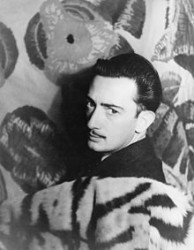
Salvador Dalí

Salvador Dalí (1904-1989) was a prominent Spanish Surrealist painter and is one of the most celebrated artists of the 20th Century. Dalí was a leading figure in the French Surrealist Art Movement and his fiercely technical, yet highly unconventional paintings, sculptures and public behavior ushered in a new generation of imaginative expression.  Continue reading Salvador Dalí

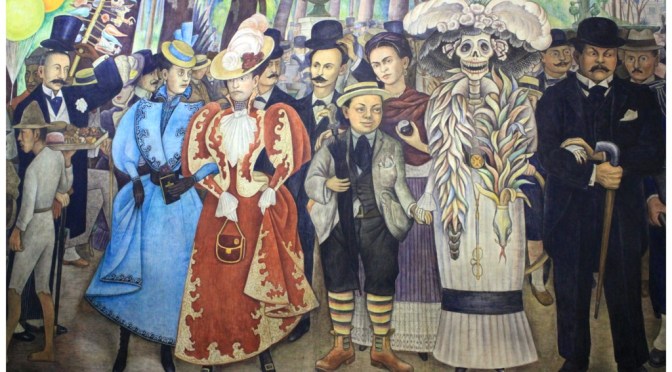
Dream of a Sunday Afternoon in Alameda Central Park

Artist: Diego Rivera

Medium: Fresco mural located in Mexico City

Date: c. 1947

In Dream of a Sunday Afternoon in Alameda Central Park, hundreds of characters from Mexico’s history gather for a stroll through Mexico City’s largest park. The mural is a surrealist scene, complete with historical personages, which portrays 400 years of Mexican history. Read from left to right, the mural chronologically progresses from the conquest and colonization of Mexico (left), to the Mexican Revolution (center) through to the modern era (right). Prominent figures represented in the mural include: Hernán Cortés, the Spanish conqueror who initiated the fall of the Aztec Empire; Sor Juana, a seventeenth-century nun and one of Mexico’s most notable writers; Porfirio Díaz, whose dictatorship at the turn of the twentieth century inspired the Mexican Revolution; and President Benito Juárez, who restored the republic after French occupation.

The center scene of the mural has been described as a snapshot of bourgeois life in 1895 Mexico — refined ladies and gentlemen promenade in their Sunday best, under the watchful eye of Porfirio Díaz in his plumed military garb. One gets a sense of the inequality which stirred Mexican commoners to overthrow the dictatator Porfirio Díaz and establish their independence.

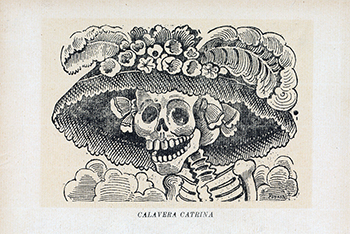
The centerpeice of the mural is a self portrait of Rivera, standing with his wife, artist Frida Kahlo, printmaker and draughtsman, José Guadalupe Posada, and Posada’s Catrina Skeleton character. Catrina was a slang term in early Twentieth Century Mexico, to describe an elegant, upper-class Mexican woman who dressed in European fashion.

Posada’s depiction of La Catrina as a skeleton was understood to be a critique of the Mexican elite. Rivera adorns La Calavera Catrina with an elaborate boa necklace, representative of the feathered Mesoamerican serpent god Quetzalcóatl.

José Guadalupe Posada, La Calavera Catrina, etching, 34.5 x 23 cm, c. 1913

More often than not history is written by the victor and thus reflects an incomplete story. Dream of a Sunday Afternoon in Alameda Central Park is the antithesis of this: Rivera gives voice to the the forgotten indigenous population normally edited from the historical record by telling their story through his grand narrative. The artist reminds the viewer that the struggles and glory of four centuries of Mexican history are due to the participation of Mexicans from all strata of society.

Essay by Doris Maria-Reina Bravo

(Edited by Lawrence Christopher Skufca)

Into Bondage

Aaron Douglas, oil on canvas, c. 1936

Into Bondage premiered as one element of a four-part mural series in the Hall of Negro Life at the 1936 Texas Centennial Exposition in Dallas. It was Douglas’ intention to create and present fresh, modern images depicting the contributions of African Americans to the state’s history and achievements. This painting portrays slavery, as Douglas believed that understanding the past was essential to moving forward in the future.

The bound captives descend toward two large ships that are set to transport the Africans across the Atlantic to their future of enslavement. While most of the men’s heads are bowed low in despair, the woman on the left looks up and raises her shackled hands above the horizon line.

The large central figure’s eye slit recalls the masks of the Dan people of Africa. His profiled head and chest and twist of the hips demonstrate Douglas’ predilection for ancient Egyptian art. Although the man stands on a pedestal referencing the auction block from which he will be sold, a ray of light from the North Star, which guided slaves on the Underground Railroad, illuminates his face and foreshadows his ultimate freedom.

Religion and Psychology: Complementary Disciplines or Competing Ideologies?

Religion and Science have shared a complex relationship which has historically fluctuated between cooperation and conflict. Both disciplines arise from an intellectual desire to explain the natural world, but their paths have diverged over the nature of knowledge. Holmes Rolston III, a Distinguished Professor of Philosophy at Colorado State University, sees their missions as complimentary, but different: “science operates with the presumption that there are causes to things, religion with the presumption that there are meanings to things.” [1]. Using the Aristotlean model, science generally deals the notion of efficient causation, the explanation of how phenomenon occurs, while religion deals with the notion of final causation, or why it occurs. [2].

Science claims objectivity by incorporating the scientific method. Its goal is to compile empirically observable facts in an effort to understand and predict phenomena in the Natural World. It then tries to establish cause and effect relationships and create explanatory theories of how the universe operates. Its reasoning is deductive; it observes the specific to make inferences about the general. Reality is only experienced through the senses and should remain value neutral. The purpose of Science is to explain what is, not what ought to be.

Religion agrees that the world is intelligible and is capable of being logically understood. However, natural law alone “provides only the beginning of illumination.” [3]. The understanding gained through our senses is useful, but incomplete. Its full value is realized by imparting significance, or “meaning” to the phenomenon. Reality is subject to our conscious awareness; shaped by interpretation, as well as, by experience. Religion’s purpose is to supply the meanings for why things happen; to explain what is in order to evaluate what ought to be. In this feature, Religion is more akin to Philosophy than Science.

According to Rolston, the problem occurs when the two disciplines transcend these boundaries by trying to explain the world in the other’s terms. Each discipline operates logically only within its own paradigm. Science is constrained to explaining causal events through quantitative proofs while Religion is restricted to applying qualitative proofs. This principle is exemplified by the social sciences attempts to measure abstract concepts such as Justice or Happiness. When Science enters into the realm of meanings, its method no longer retains its validity. Likewise, religious logic breaks down when it attempts to attribute causes.

Psychology can be fairly assessed as trying to accomplish both objectives. In its study of the organic biology of the brain, its course remains scientific. Psychology explores biological makeup, chemical reactions, and neural activity through synaptic nerves in an attempt to compile causal explanations for how the organic brain operates. It uses the same methodology as biologists, chemists, and physicists. Where it deviates from its sure scientific footing is through its attempt to assess how the conscious mind operates. Here it seems to enter the realm of the theosophical by trying to derive meaning for why the sentient mind interprets reality in the way that it does.

A valid critique of Psychology is justified when it turns its attention away from testable hypothesis’ to generate its theories. It often takes a philosophical approach in its inquiries and tries to legitimize subjective intellectual contemplation as objective scientific evaluation. The questions it attempts to answer, such as the origin of religious belief, however, are not always scientific in nature. It is at these times that a conflict between Psychology and Religion arises, and they become little more than competing ideologies.

For the purposes of this paper I will take a look at two competing psychological theories about the origin and nature of religious belief. The first contribution will be an analysis of Sigmund Freud’s Future of an Illusion, which offers a negative view of Religion. The second text will be William James’ lectures on The Varieties of Religious Experience which present a more optimistic view of Religion. Hopefully this will shed some light on the difficulties Psychology faces when attempting to inquire into the nature of religious belief.

Freud and Religion

Freud became aware of subconscious mental processes while treating mental patients suffering from neurosis and hysteria. Freud developed a method of analyzing human pathology termed Psychoanalysis which he viewed as an application of the scientific method to the study of human behavior. In an exercise called free association, Freud asked patients to randomly express their thoughts in therapy sessions. Freud believed this provided valuable insights into how the human mind draws conclusions about reality.

Freud theorized that the human psyche was controlled in a large part by the subconscious which sought to project primal instincts such as fear, sexuality and aggression outwardly. According to Freud, emotional symptoms and character traits were complex solutions to the unresolved conflicts of childhood. He believed that the subconscious was a composition of unrealized instincts and desires which manifested themselves in the personality of an individual. This was the basis for his analysis of religious beliefs.

Freud believed religious belief arises as a form of wish fulfillment in man’s psychological attempts to control the uncertainty of nature and fate, “life and the universe must be robbed of its terrors.” [4]. Freud saw the development of consciousness as part of the evolutionary process, with religious belief being an initial stage. In this developmental stage, which he termed “humanization of nature,” Freud suggests:

Impersonal forces and destinies cannot be approached; they remain eternally remote. But if the elements have passions that rage as they do in our own souls, if death itself is not something spontaneous but the violent act of an evil will, If everywhere in nature there are beings around us that we can know in our own society, then we can breathe freely, can feel at home in the uncanny and can deal by psychical means with our senseless psychology. [5].

Freud believed that the “humanization of nature” allowed individuals to project feelings of control over natural forces. The individual cannot comprehend the overwhelming forces of nature as his equal, therefore he makes them divine and gives them the attributes of a father. “It has an infantile prototype … For once before one has found oneself in a similar state of helplessness: as a small child, in relation to one’s parents.” [6]. Parents, like nature, cause fear in individuals by stripping them of their sense of control “thus it was natural to assimilate the two situations.” [7]. The father figure is adopted as the model for the divinity. He is to be feared for his powerful influence on the survival of the child, and yet trusted for his protection against external dangers.

At this point Freud turns toward the failing of the original model. There was a gradual shift in the understanding of the Gods’ role in controlling nature. As individuals realized that the Gods did not protect them from pain and suffering, they made the Gods subordinate to Fate. The Gods who created fate, along with nature, had arranged it so they could leave them to operate on their own. “The more autonomous nature became and the more the god’s withdrew from it … the more did morality become their domain.” [8]. The Gods attention turned towards remedying “the defects and evils of civilization.” [9]. This change in commission resulted in a handing down of divine precepts which “were elevated beyond human society and were extended to nature and the universe.” [10].

According to Freud, this led to the understanding of a higher moral order and purpose, imparting religious significance to individual lives. The divine attributes eventually evolved into a single divine entity projected as a benevolent caretaker whose rules protect us from the “merciless” forces of this world. “In the end all good is rewarded and all evil punished, if not actually in this form of life then in the later existences that begin after death.” [11]. This allows the individual to rationalize the existence of pain and suffering in the world and permits hope of a distant redress of grievances.

Freud’s conclusion is that religious teachings are not the product of experience or the end results of rational logic, but are simply illusions. Religious beliefs, in his assessment, are the product of our subconscious desires to fulfill “the oldest, strongest, and most urgent wishes of mankind.” [12]. Religious belief is wish fulfillment projected into the external world; God is simply a false archetype constructed as a form of psychological defense mechanism.

Freud’s belief is that the provability of Science is superior to that of Religion, and that the illusion will eventually pass into oblivion. On an individual level, Religion is simply cerebral self medication, whereas on a societal level, it is a means of coercing reluctant individuals into suppressing their primal instincts. According to Freud, this is the one saving grace of Religion.

A legitimate criticism of Freud is that he abandons the scientific method for the same type of philosophical inquiry into epistemology which he rejects. Freud collects no empirical data, forms no testable hypothesis, and presents no objective evidence to support his theory of Religion. His assumptions wind up being just as unproven as the dogma of religious belief. Freud acknowledges this lack of evidence, simply asking us to rely on the validity of the psychoanalytic approach.

Another critique of Freud’s “humanization of nature” model is that individuals are driven to pursue both, religious and scientific knowledge for the same reasons; the lack of control over one’s environment leads one to inquire into cause and effect relationships in an effort to control their environment. Scientific inquiry best serves these interests when attempting to control defined physical and chemical interaction, and is quite deficient in explaining social relationships. Conversely, religious practice is limited in scope to the examination of human behavior. With the exception of Occultism, Religion does not concern itself with controlling physical processes.  Therefore, both disciplines serve different, but necessary, psychological needs.

An atheistic reliance on Science in the social realm simply provides a rationalization for dismissing unwanted moral restraints.  “Why can’t the theist put down Freud’s rival belief? Antireligious “scientific” belief is really the same in kind, a governing Weltanschauung, and we can easily postulate it for some unconscious rebellion against one’s parents, some desire to be free from guilt or moral commandments…” [13].

Finally, Freud’s analysis fails to adequately account for the belief systems of Eastern religions. Freud’s explanation of unconscious archetypes does not account for the development of non-deistic belief systems such as Buddhism or Confucianism, which do not provide the psychological comfort of a  personal deity. Neither does it adequately address the belief shared by Hindus and Deists, of an impersonal, mechanistic God whose primary function is to administer the proper functioning of divinely ordained cycles and relationships within the natural world. Not all religious belief systems fit easily into the paradigm of Freud’s psychoanalytic hypothesis.

As a result, Freud’s analysis leaves the door open for the possibility that the concept of the Divine exists as a form of innate knowledge, rather than being the result of socialization.  Assuming, arguendo, the ontological arguments of Socrates and Rene Descartes, the concept of God may simply be the unconscious acknowledgement  that we understand such abstract concepts as infinity, perfection, omnipotence, omniscience, and omnipresence, despite the fact they form no part of the human experience. In this scenario, it would be natural for an individual to analogize the divine attributes with  comprehensible human archetypes, such as father, mother, king, teacher and healer. Perhaps, this is the most rational way to communicate abstract concepts which are not commonly experienced through sensory perception. Personalizing the divine attributes through human archetypes may simply be the best educational tool we have developed for conveying universally intuited moral understanding.

James and Religion

In 1902, distinguished psychologist and philosopher, William James, gave a series of lectures at the University of Edinburgh, entitled, The Varieties of Religious Experience. James studied the written testimony of numerous individuals attempting to describe their personal spiritual experiences, in an attempt to conduct an empirical study of religious beliefs. Like Freud, most of his observations came from individual case studies and his arguments have more of a philosophical ring to them.  However, in contrast to Freud,  James focuses on the personal nature of religious experience outside the context of socialized community belief structures.

James views Religion as an individual consciousness, rather than a group experience. His position is that the truly religious person is not shaped by society. James acknowledges there is a superficial mode of Religion in which the adherent follows “conventional observances” as proscribed by his culture. James agrees that in this type of simple religious observance, the adherent is not intellectually transformed, but simply conditioned to perform traditional practices and customs. James writes this off as “meaningless” religious observance. To James, the true believer is an eccentric personality and individualistic in his approach, pointing out that many religious believers are inspired to act in ways that are contrary to traditional norms. This is exhibited by the “exceptional and eccentric” demeanor of religious reformers such as George Foxx. [14].

James argues that an individual’s religious beliefs are grounded in the conscious: “All our attitudes moral, practical, or emotional, as well as religious are due to the ‘objects’ of our consciousness, the things which we believe to exist, whether real or ideally along with ourselves.” [15]. Concrete concepts such as God, as well as more abstract concepts such as mercy, justice, and holiness exist as “pure ideas” of which the individual has no prior experience. These ideals may be “present to our senses” or may merely exist as thought, but they bring forth sincere and genuine responses.

The paradox is that words like God, soul, and immortality have no sub-context in the natural world. They are theoretically devoid of any significance yet are understood in the context of religious practice much the same way as Science lends significance to words such as time and space in the material world. According to James, “This absolute determinability of our mind by abstractions is one of the cardinal facts in our human constitution.” [16].

James’ view is that attributing human characteristics  to God is a consequence of the inability to meaningfully express the concepts Religion deals with. These abstract religious concepts are internalized as intuitions that operate on a deeper level than rational thought. In James’ view rationality is preconditioned for by our intuitions and is an inferior method for founding belief: “The truth is that in metaphysical and religious sphere, articulate reasons are cogent for us only when our inarticulate feelings of reality have already been impressed in favor of the same conclusion.” [17]. Our instinct leads and our intelligence follows. As a result, no belief system, whether scientific or rational, can be changed by rational argument.

James did not see the natural world as perceived through the senses as a providing a full measure of reality. James speculated “…so long as we deal with the cosmic and the general we deal only with the symbols of reality, but as soon as we deal with private and personal phenomena as such, we deal with realities in the completest sense of the term” [18].

In James’ opinion, our inner experience may be subjective and unscientific, but it has the greatest effect on shaping our reality. Inner religious motivations lead to changes in character and manifest themselves in the deeds accomplished by the religious individual. The “stronghold of religion” lies in this individuality, or self-actualization of the believer, and through this “the theologian’s contention that the religious man is moved by an external power is vindicated.” [19].

James acknowledges that proof of whether God exists is not needed for Religion to serve its purpose. James determines the way to save the utility of religious belief is by supplying justification for the illusion. His defense of Religion consigns the Divinity to the role of little more than an inspirational device. For James, the actual power of God is manifested through the individual’s belief in God.

James’ view of Religion is very individualistic in this sense. There is no sense of community, morality, or an ordered universe such as prevails in many religious traditions. James disposes of any notion of a universal purpose by assigning personal beliefs about the divine dictate as overbeliefs. In James’ view, a person is only capable of ascertaining the divine will for their own behavior and interactions.

James dismisses the notion of a personal deity, defining God is a personal experience rather than a sovereign entity. This addresses the critique that Religion is oppressive in the application of its subjective moral standards onto unwilling members of society, but it takes much of the substance away from what a Divine Being is or represents in most cultures.

At a purely subjective level Religion is vindicated. Whether or not religious tenets are correct is of no consequence as long as they prove useful to the individual. The subconscious self creates a personal entity which guides us through our personal reality, making God a “causal agent as well as a medium of communion.” [20]. This subjective perception of reality serves a rational function of empowering the individual religious believer.

Conclusions

Freud and James’ individual case studies leave us with an unsatisfactory scientific resolution as to the original source of religious faith. Ironically, both theories fall victim to the same epistemological shortcomings they originally set out to confront by examining the source of the concept of God. What we are left with is the centuries old question DeCartes left us with — does the intrinsic belief in God originate from an idea implanted by an external force which acts upon us, or is it simply the by-product of an innate desire to assign meaning to an incomprehensible world.

Neither Freud nor James provides us with a scientific solution to the problem. They offer no insights on what empirical data we should collect, form no testable hypothesis to validate their conclusions, do not control for different religious ideologies, and base their findings on a miniscule sample of humanity. Instead, each man relies on the trustworthiness of the psychoanalytic approach to correctly diagnose the subjective, unconscious motivations of their subjects.  Freud and James both come to the determination that religious belief is an internalized rationalization of the outside world, but arrive at different conclusions for the utility this rationalization serves.

For Freud, religious belief is simply a psychological defense mechanism — a kind of personalized rationalization to provide us with a sense of self-control over an unpredictable and hostile environment. Its usefulness is in providing  a societal control mechanism which coerces reluctant individuals into suppressing their primal instincts.

James, on the other hand, views religious belief as an individualized experience. Our inner experience helps shape our reality. The utility of Religion is in the self-actualization of the believer which empowers us to achieve greater accomplishments. Personal faith motivates us to look beyond our individual deficiencies.

Neither intellectual attributes religious belief to a pathological condition or a deficiency in critical reasoning skills. Conversely, each psychologist views Religion as a natural cognitive outgrowth of the mind’s attempt to process imperfect information which cannot be experienced through our natural senses. What motivates us to attach personal significance to mundane human experiences? Why do individuals continue in their religious faith with little or no tangible proof of its utility? Is the belief in a Divine Being helpful or harmful to our daily existence? These are qualitative inquiries which fall outside the realm of testable scientific hypothesis. As such, they are subjective experiences which become matters of personal conscience.

Psychology’s conjecture into how the mind forms abstract religious concepts requires it to resort to the same speculative ontological arguments for which it criticizes  Theology.  Psychology retains its sure scientific footing when it limits its scope to the ream of quantifiable proofs; it overreaches when it attempts to magnify subjective  individual  experiences into broad, generalized assumptions. Likewise, Religion retains its integrity when it limits its examination to the realm of individual human potential; overreaching when it attempts to extrapolate broad, generalized principles and indiscriminately apply them at an organizational level. When reduced to over-simplified, dogmatic doctrine, both fields of study are susceptible to harmful misapplication. It is at these ideological impasses that Psychology and Religion stop functioning as  complimentary disciplines and become little more than competing belief systems.

By Lawrence Christopher Skufca (2007)

Some Rights Reserved

Bibliography

[1]. Holmes Rolston III, Science and Religion: A Critical Survey, pp. 22-23.

[2]. Owen Gingrich, “God’s Universe.” p. 12.

[3]. Holmes Rolston III, Science and Religion: A Critical Survey, p. 23

[4]. Sigmund Freud, The Future of an Illusion, p. 20.

[5]. Ibid., p. 20.

[6]. Ibid., p. 21.

[7]. Ibid., p. 21.

[8]. Ibid., p. 22.

[9]. Ibid., p. 22.

[10]. Ibid., p. 23.

[11]. Ibid., p. 23.

[12]. Ibid., p. 38.

[13]. Holmes Rolston III, Science and Religion: A Critical Survey, p. 163.

[14]. William James, The Varieties of Religious Experience, Lecture I. p. 4.

[15]. William James, The Varieties of Religious Experience, Lecture III. p. 1.

[16]. Ibid., p. 3.

[17]. Ibid., p. 13.

[18]. William James, The Varieties of Religious Experience, Lecture XX. p. 11.

[19]. Ibid., p. 20.

[20]. Ibid., p. 22.

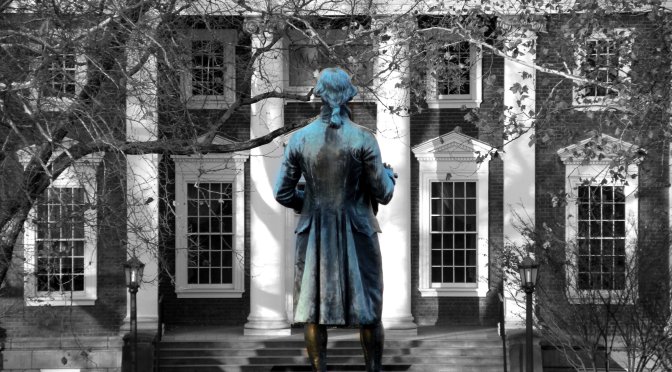
Thomas Jefferson: The Progressive Libertarian

Thomas Jefferson’s last testament to his political, religious, and educational ideology is encapsulated by his self-ascribed epitaph: “Here lies Thomas Jefferson, Author of the Declaration of American Independence, of the Statute of Virginia for Religious Freedom, and father of the University of Virginia.” [1]. Fittingly, these three accomplishments are the culmination of Thomas Jefferson’s lifework, and reflect the progress he made in affecting American attitudes in each of these areas. Continue reading Thomas Jefferson: The Progressive Libertarian

Terrorists Are the Threat, Not Muslims

Islam is the world’s second largest religion. A 2012 Pew Research Center study estimates Islam has 1.6 billion adherents, making up over 23% of the world population. Conversely, there are less than 2.4 million suspected Muslim terrorists in the World. Less than one third of these militants have declared Jihad on the West.

The Hezbollah Party in Lebanon is generally agreed by Western intelligence agencies to have the largest terrorist capabilities in the World. Surprisingly, there are no membership estimates. However, based on the common knowledge that Hezbollah is a Shi’ite organization, and the estimates that the Shi’ites represent approximately 27% of the Lebanese population, if every Shia in Lebanon was a member of Hezbollah, at most, the party would have an estimated 1,588,292 members. Nevertheless, Hezbollah activities are known to be limited to the Palestinian struggle with Israel and unlike the extremist groups seeking to impose Sharia Law, Hezbollah does not promote an Anti-Western, Anti-Christian Agenda.

The rest of the known Muslim terrorist organizations in the Middle East which advocate strict Sharia government, total less than 764,500 members. The Muslim Brotherhood (which surprisingly the U.S. does not designate as a terrorist organization) claims 500,000 adherents; Jaish al-Islam (Syria) ranges anywhere between 5,000-50,000 members; the Tehrik-i-Taliban (Pakistan) has less than 35,000 members; The Taliban (Afghanistan) has an estimated 25,000-36,000 fighters; ISIS (Syria) can ‘muster’ between 20,000 and 31,500 fighters; Ahrar al-Sham has an estimated 10,000-20,000 members; Boko Haram (Yobe State) has an estimated 10,000-15,000 members; The Haqquani Network (Afghanistan) has an estimated 10,000 members; Lashkar-e-Zill (Afghanistan) has an estimated 10,000 members; Liwa al-Tawhid (Syria) has an estimated 8,000-10,000 members; Suqour al-Sham (Syria) has an estimated 9,000-10,000 members; the military wing of Hamas (Palestine) has an estimated 10,000 operatives; Jabhat al-Nusra (Syria) has an estimated 5,000-7,000 operatives; Al Shabab (Somalia) has an estimated 3,000-5,000 members; Lashkar-e-Taiba is estimated to have “several thousand” members; Ansar al-Sham (Syria) has approximately 2,500 fighters; the Jamiat-ul-Mujahideen (Bangladesh), at it’s peak, had approximately 2,000 members; Hizbul-Mujahideen (Kashmir) has an estimated 1500 operatives; Lashkar-e-Jhangvi (Pakistan) has less than 1000 members; Jemaah Islamiyah (Indonesia) has less than 1000 members; Al-Qaeda has an estimated 500-1000 operatives; Ansar al-Islam (Iraq) has 500-1000 members; Harkat-ul-Jihadi al-Islami (Pakistan has 500-700 members; Abu Sayyaf (Philippines) has 200-500 members; Harakat-ul-Mujahedeen (Pakistan) has an estimated 300 members; Jaish-e-Muhammad (Pakistan) has “several hundred” armed volunteers; and Al-Badr (Kashmir) has an estimated 200 operatives.

These numbers reflect that less than .0015% of Muslims would qualify as members of suspected terrorist organizations. Less than .0005% would be of the Anti-Western Jihadist persuasion. Put another way, 99.9995% of Muslims are not Anti-Western militant extremists.

The United States has a population of approximately 320 million people. Approximately 6/10 of one percent of the population is Muslim, for a total of two million Muslims in the U.S. If the numbers above hold up, out of 2 million Muslims, there would potentially be as many as 1000 militant Muslims in the U.S., with as few as 40 of them being a member of ISIS. This means 1 out of every 1999 Muslims you meet in America might harbor anti-Western extremist views. More importantly, this means 1998 out of 1999 do not. If we limit the conversation to members of ISIS, these numbers would skyrocket. Statistically speaking, the odds of a U.S. Muslim being a member of ISIS would increase to 1 in 50,000.

To place these numbers in the proper perspective, if the average American met one new Muslim per day, on the average, you would only meet one militant Muslim every 5 1/2 years. You would average one member of ISIS every 138 years.

So as we are bombarded with all the rhetoric and sensationalist claims designed to persuade us that these 40 statistical anomalies are the biggest threat the U.S. has ever faced, let us please remember that it is the terrorists who are the threat and not the Muslims.

By Lawrence Christopher Skufca (2015)

The Gadfly Syndrome: The Tension Between the Good Individual and the Good Citizen

In the Apology, Socrates describes himself as a “gadfly” cast upon the city of Athens to awaken it from its slumber.[1] Herein lies the tension between the individual and the social aspect of the philosopher – the act of existing as both a good human being and a good citizen. For Socrates, the “unexamined life is not worth living,” [2] therefore it is the duty of every individual to engage in the search for the truths about society and one’s self. However, the individual’s duty to self-discovery is reliant upon his interaction with the city. Unfortunately, it is precisely this activity which makes the philosopher a nuisance to the public good. His inquiries subject the city to repeated offense, as the philosopher continuously questions the moral foundations upon which the city gains its legitimacy. The contradictions that are presented serve as a constant reminder of the city’s own self-deficiency. Thus, the gadfly eventually gets swatted.

This is the paradox presented by the lifestyle advocated by Socrates. The human being and the citizen have a mutual claim on the philosopher’s life. Like a bad marriage, they can’t seem to live with each other, nor can they seem to live without one other, but are simply forced to coexist in a conflicting state of mutual necessity. The two are perpetually at odds with one other due to their separate allegiances; the one to philosophy and the other to the city. This is the dilemma I hope to resolve. In doing so I will look to several texts to examine (1) the solitary life of the philosopher and its claim on the human being, (2) the social life of the citizen and his responsibility towards the city, and (3) the conflict between the philosopher’s two natures.

INDIVIDUAL SELF-AWARENESS

One aspect of the philosophical life is its radical call to forsake the material comforts of home, family, and wealth in pursuit of the truth. In the Symposium, Socrates describes the life of the philosopher through his portrayal of Eros: “First of all, he is always poor; and he is far from being tender and beautiful, as the many believe, but is tough, squalid, shoeless, and homeless … always dwelling with neediness … Eros is — necessarily — a philosopher.”[3] Much like Eros, Socrates has chosen to be “careless” for his own things by accepting a life of poverty.”[4] Although the Socratic depiction of Eros seems to contain an element of self-reflection, it also serves as a metaphor for the self-discipline required to live a truly philosophic existence.

Socrates’ Myth of the Soul in Phaedrus, gives us an ample word picture of the soul, and how the philosopher directs it. The soul is likened to a “natural union of a team of winged horses and their charioteer.”[7] The charioteer is in charge of two horses; a white one of good stock (the spirited part of the soul), and a black one of bad stock (the desirous part of the soul). The driver, or ruling part of the soul,[8] is responsible for steering the chariot (soul) clearly, although the two horses pull the chariot in different directions. On Socrates’ account, this makes “chariot driving … a painfully difficult business.”[9] The success of the chariot driver rests on his ability to guide the two horses to catch a glimpse of the transcendent forms of the truths, “visible only to intelligence.”[10]

The ruling part of the soul must gain control over the spirited and desirous part of the soul if it is to keep from being prejudiced by their competing passions. As Socrates notes, it is the desirous part of the soul which is the most difficult to conquer: “The heaviness of the bad horse drags its charioteer towards the earth [away from the truth] and weighs him down if he has failed to train it well, and this causes the most extreme toil and trouble the soul will face.”[11] Thus, the more control the philosopher has over his passions, the more truth he is permitted to see.

The philosopher must become a “skilled hunter” [5] in recognizing the truth for the correct governance of his soul.[6] The soul can never be led to true understanding if the ruling part lacks authority over the soul; the discovery of true knowledge is ultimately found by recollecting those eternal, permanent truths that are only perceivable through disciplined thought. Therefore, Socrates contends the individual who is unable to subdue his passions can never truly achieve the status of a good human being:

A soul that never saw the truth cannot take a human shape, since a human being must understand speech in terms of general forms, proceeding to bring many perceptions together into a reasoned unity. That process is a recollection of the things our soul saw … when it disregarded the things we now call real and lifted up its head to what is truly real instead.[12]


THE CIVIC LIFE OF THE INDIVIDUAL

The philosopher exists on the continuum between “being wise and being without understanding,” thus, he can never use himself as the sole standard for truth. No matter how skillful the chariot driver the soul needs dialogue with the city; for “all the great arts require endless talk and ethereal speculation about nature.” [13].

Dialogue is a way of conditioning the receptivity of the soul towards learning: “the rhetorical art, taken as a whole, [being] a way of directing the soul by means of speech.”[18] It is the virtue of speaking the truth,[19] for the person who speaks “well and nobly” must understand the reality of what he speaks of.[20] This form of artful speaking forces the orator to engage in the activity of philosophy by carefully examining the nature of the things he speaks about. It is a systematic art of “divisions and collections”[21] by which to differentiate and categorize things as to gain a fuller understanding into their nature.

After the Oracle at Delphi prophesies there is no one wiser than Socrates, the philosopher’s first impulse is to measure his knowledge by speaking to those in the city who are “reputed to be wise.”[14] Socrates discovers that “those with the best reputations” seem to be the “most deficient,” while those with lesser reputations seem “to be men more fit in being prudent.”[15] He accredits this to the fact that because each “performed his art nobly, each one deemed himself wisest also in the other things, the greatest things.”[16] Therefore Socrates recognizes his wisdom to be the realization of his own ignorance: “for probably neither of us knows anything noble and good, but he supposes he knows something when he does not know, while I … do not even suppose that I do.”[17]


Thus, Socratic dialogue becomes a method for transmitting knowledge,[22] enabling the philosopher to lead himself, and others to knowledge by directing souls[23] through the process of recollection. The Meno slave narrative provides a vivid example of how the process of recollection operates. The conversation with Meno’s slave takes on the form of a cross-examination by which he is skillfully led to distinguish a recognizable form of truth. Without any prior knowledge of geometry, Socrates directs the slave to acknowledge a simple geometrical reality through a series of leading questions. Socrates goes on to explain that “the truth about the beings is always present for us in the soul.”[24]

Simple truths, such as mathematical proofs, serve as a springboard in the dialectical education for grasping the recognizable form of the truth through the mind’s eye: “whoever has been educated up to this point in erotics, beholding successively and correctly the beautiful things, in now going to the perfect end of erotics shall suddenly glimpse something beautiful in its nature.”[25] The dialectician can only lead the student towards the answer to these truths; he can never directly provide the solution. This serves a twofold purpose, 1.) for the student to fully recognize the truth, he must take the final dialectical leap himself, and 2.) it provides confirmation to the philosopher of the existence of the truth.

THE CONFLICT BETWEEN THE INDIVIDUAL’S TWO NATURES

The citizen is dependent on the city for his physical and intellectual well-being. The city nurtures, educates and protects its citizens from birth through death via its laws and social institutions. [26] This is the duty of the city; its legitimacy depends on the good that it claims to provide its citizens, that of justice executed through the law. In exchange for the city’s protection, the citizen enters into a willing covenant to preserve the laws of the city through his obedience. This is the duty of the good citizen. In Crito, Athens makes a claim on Socrates’ life; his obedience to its laws in exchange for the good it provides. So long as Socrates chooses to remain in the city, he has willingly consented to this arrangement. [27]. Nevertheless, while the city may own the philosopher’s body, it cannot own his soul.

The allegiance of the good human being is to the protection of the soul through philosophic activity. A tension develops between the human being’s obligation to truth and the citizen’s duty to the law. Philosophical intercourse within the city will ultimately challenge the city’s integrity by inquiring into the basis of its laws. This eventually places both, the philosopher and the city in jeopardy: “For there is no human being who will preserve his life if he genuinely opposes … [the] multitude.” [28]. Anytus reminds Socrates of how “very easy” it is to be harmed for speaking against the city, when he objects to Socrates examination of the esteemed fathers of Athens. [29]. Therefore, the philosopher must protect himself and the city by engaging in private, rather than public dialogue.

The skilled lawgiver must recognize the correct application of the truth. The problem with Athens is that it has fallen asleep, thus lacks the necessary self-awareness to distinguish justice from immorality. Socrates contends that for the law to be viewed as legitimate, it must be universally accepted as noble:

“Noble things, it would seem, are everywhere considered noble, and base things base; not base things noble or noble things base … And thus, as a universal rule, realities, not unrealities are accepted as real, both among us and all other men.” [30].

This forms the basis of the Socratic notion of the law’s responsibility to truth. Only when the good is applied can the law and justice coexist.

CONCLUSION
What the city fails to realize is that it has a need for the philosopher. In order to maintain its legitimate claim to authority, the City’s laws must provide a benefit to the citizen. For the laws to provide a benefit they must be founded on truth. The ancient standards of law based on prophecy, tradition and the opinion of the many contain contradictions that incessantly leave them open to question, making them detrimental to the city’s continued existence. Once corrupted by bad governance, the City loses its legitimate claim of authority over the citizen.
The skill of lawmaking is to apply the good which benefits the citizen. Socrates duty as a citizen requires him to become the “gadfly” which alerts Athens of the deficiencies which would undermine respect for its laws. His duty as a philosopher requires him to prod lawmakers into gaining control over their passions and correctly assess the Good. By doing so, Socrates’ is able to find consistency between his obligations of being a good citizen and a good human being. He becomes a useful nuisance to the City through his constant diagnosis of the social ills which threaten its health.


By Lawrence Christopher Skufca (2008)

Some Rights Reserved

 (Cover Art: Ezra Pound‘s “Gadfly” Signature)

Bibliography

[1] Plato. Apology of Socrates. “4 Texts on Socrates.” Trans Thomas G. and Starry West (Ithaca, NY: Cornell Univ. Press, 1984); 31a.

[2] Ibid.; 38a.

[3] Plato. Symposium. Trans Seth Benardette. (Chicago, Il: Chicago Univ. Press); 203d-204b.

[4] Plato. Apology of Socrates. “4 Texts on Socrates.” Trans Thomas G. and Starry West (Ithaca, NY: Cornell Univ. Press, 1984); 31b,31c.

[5] Plato. Symposium. Trans Seth Benardette. (Chicago, Il: Chicago Univ. Press); 203e.

[6] Plato. The Republic. Trans Alan Bloom. (New York, NY: Basic Books, Inc., 1968); 591b.

[7] Plato. Phaedrus. Trans. Alexander Nehamas and Paul Woodruff. (Indianapolis, IN: Hackett Publishing, 1995); 246b.

[8] see footnote 69, p. 31, Phaedrus.

[9] Plato. Phaedrus. Trans. Alexander Nehamas and Paul Woodruff. (Indianapolis, IN: Hackett Publishing, 1995); 246b.

[10] Ibid.; 247c,d.

[11] Ibid.; 247b.

[12] Ibid.; 249c.

[13] Ibid.; 270a.

[14] Plato. Apology of Socrates. “4 Texts on Socrates.” Trans Thomas G. and Starry West (Ithaca, NY: Cornell Univ. Press, 1984); 20c.

[15] Ibid.; 22a.

[16] Ibid.; 22e.

[17] Ibid.; 21d.

[18] Plato. Phaedrus. Trans. Alexander Nehamas and Paul Woodruff. (Indianapolis, IN: Hackett Publishing, 1995); 261a.

[19] Plato. Apology of Socrates. “4 Texts on Socrates.” Trans Thomas G. and Starry West (Ithaca, NY: Cornell Univ. Press, 1984); 18a.

[20] Plato. Phaedrus. Trans. Alexander Nehamas and Paul Woodruff. (Indianapolis, IN: Hackett Publishing, 1995); 261a.

[21] Ibid.; 266b.

[22] Ibid.; 270d.

[23] Ibid.; 271d.

[24] Plato. Meno. “Protagoras and Meno.” Trans. Robert C. Bartlett. (Ithaca, NY: Cornell Univ. Press, 2004); 86b.

[25] Plato. Symposium. Trans Seth Benardette. (Chicago, Il: Chicago Univ. Press); 211a.

[26] Plato. Crito. “4 texts on Socrates.” Trans Thomas G. and Starry West (Ithaca, NY: Cornell Univ. Press, 1984); 51d.

[27] Ibid.; 51e.

[28] Plato. Apology of Socrates. “4 Texts on Socrates.” Trans Thomas G. and Starry West (Ithaca, NY: Cornell Univ. Press, 1984); 32a.

[29] Plato. Meno. “Protagoras and Meno.” Trans. Robert C. Bartlett. (Ithaca, NY: Cornell Univ. Press, 2004); 94e.

[30] Plato. Minos. The Annenberg/CPB Project. (Internet: www.perseus.tufts.edu, 2008); 316b.