

Artist: Lois Mailou Jones
Medium: oil on canvas
Date: c. 1935
Category Archives: Art Gallery

Free Clinic
Artist: Jacob Lawrence
Medium: gouache on tan wove paper, laid down on ivory cardboard
Date: c. 1937
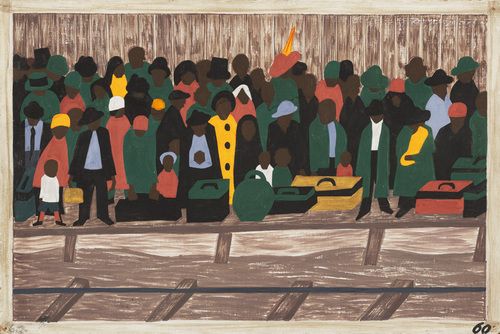
And the Migrants Kept Coming (Panel #60)
Artist: Jacob Lawrence
Medium: tempera on panel board
Date: c.1941
Jacob Lawrence’s The Migration Series, is a sequence of 60 paintings, depicting the mass migration of African Americans from the rural South to the urban North between World War I and World War II—a development which had previously received little public attention.
Lawrence, with the help of his wife, artist Gwendolyn Knight, spent months preparing the 60 boards and distilling the subject matter into captions. He created the paintings in tempera, a water-base paint that dries rapidly. To keep the colors consistent, Lawrence applied one hue at a time to every painting where it was to appear, requiring him to plan all 60 paintings in detail at once.
The series was the subject of a solo show at the Downtown Gallery in Manhattan in 1941, making Lawrence the first black artist represented by a prominent New York gallery.
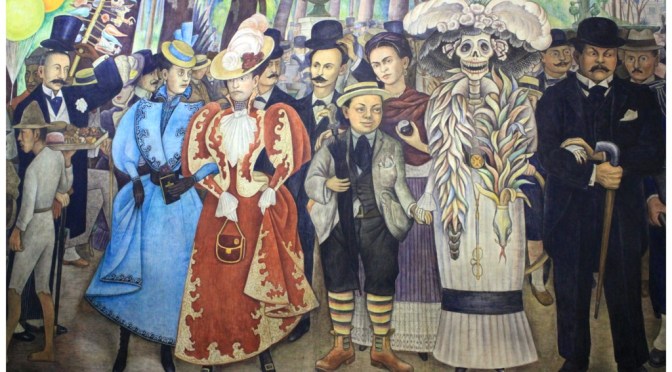
Dream of a Sunday Afternoon in Alameda Central Park
Artist: Diego Rivera
Medium: Fresco mural located in Mexico City
Date: c. 1947
In Dream of a Sunday Afternoon in Alameda Central Park, hundreds of characters from Mexico’s history gather for a stroll through Mexico City’s largest park. The mural is a surrealist scene, complete with historical personages, which portrays 400 years of Mexican history. Read from left to right, the mural chronologically progresses from the conquest and colonization of Mexico (left), to the Mexican Revolution (center) through to the modern era (right). Prominent figures represented in the mural include: Hernán Cortés, the Spanish conqueror who initiated the fall of the Aztec Empire; Sor Juana, a seventeenth-century nun and one of Mexico’s most notable writers; Porfirio Díaz, whose dictatorship at the turn of the twentieth century inspired the Mexican Revolution; and President Benito Juárez, who restored the republic after French occupation.
The center scene of the mural has been described as a snapshot of bourgeois life in 1895 Mexico — refined ladies and gentlemen promenade in their Sunday best, under the watchful eye of Porfirio Díaz in his plumed military garb. One gets a sense of the inequality which stirred Mexican commoners to overthrow the dictatator Porfirio Díaz and establish their independence.
The centerpeice of the mural is a self portrait of Rivera, standing with his wife, artist Frida Kahlo, printmaker and draughtsman, José Guadalupe Posada, and Posada’s Catrina Skeleton character. Catrina was a slang term in early Twentieth Century Mexico, to describe an elegant, upper-class Mexican woman who dressed in European fashion.
Posada’s depiction of La Catrina as a skeleton was understood to be a critique of the Mexican elite. Rivera adorns La Calavera Catrina with an elaborate boa necklace, representative of the feathered Mesoamerican serpent god Quetzalcóatl.
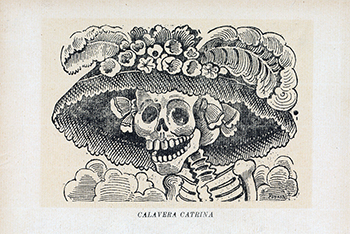
José Guadalupe Posada, La Calavera Catrina, etching, 34.5 x 23 cm, c. 1913
More often than not history is written by the victor and thus reflects an incomplete story. Dream of a Sunday Afternoon in Alameda Central Park is the antithesis of this: Rivera gives voice to the the forgotten indigenous population normally edited from the historical record by telling their story through his grand narrative. The artist reminds the viewer that the struggles and glory of four centuries of Mexican history are due to the participation of Mexicans from all strata of society.
Essay by Doris Maria-Reina Bravo
(Edited by Lawrence Christopher Skufca)

Flower Seller
Artist: Diego Rivera
Medium: oil on masonite
Date: c. 1941
The Flower Seller is one of Diego Rivera’s best known paintings. It depicts a young woman kneeling before a large bundle of Cala Lilies. The young woman’s clothes are typical of those worn by early 20th century Mexican women, simple, yet colorful. The double braids indicate that this is a young girl, not yet married. The Calla Lily is indigenous to Mexico and was represented by Rivera in many of his works. Rivera most likely incorporates the flora to signify that the girl remains pure and undefiled.

Detroit Industry
Artist: Diego Rivera
Medium: Fresco mural located at the Detroit Institute of Arts, Detroit, MI
Date: c. 1932
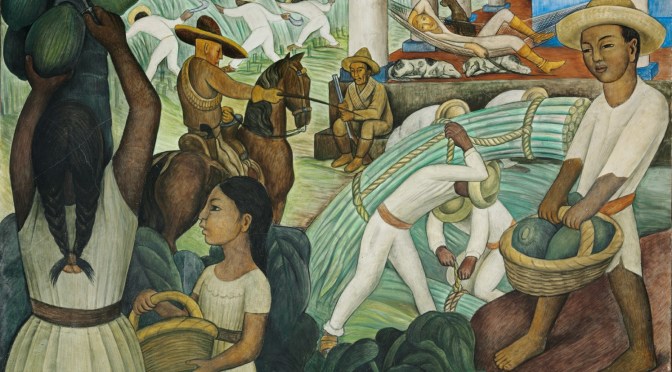
Sugar Cane
Artist: Diego Rivera
Medium: Fresco, mural located at Philadelphia Museum of Art
Date: c. 1931
Sugar Cane was specifically commissioned for the Museum of Modern Art’s Diego Rivera exhibition of 1931. This panel illustrates the operation of a sugar plantation in the southern state of Morelos, Mexico, during the Spanish colonial period. In creating the scene, Rivera adapted an image he had formerly made for a mural cycle at the Palace of Cortez in Cuernavaca, Mexico.
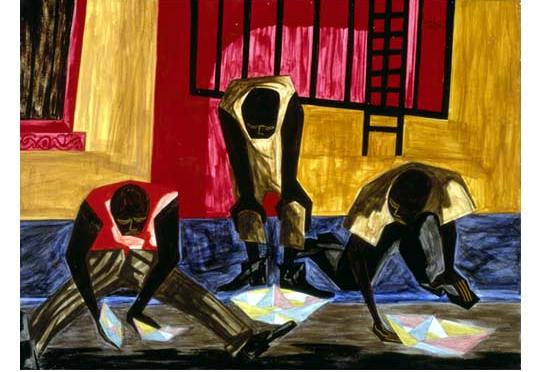
Paper Boats
Artist: Jacob Lawrence
Medium: tempera on gessoed panel
Date: c. 1949

Octaroon Girl
Artist: Archibald Motley, Jr.
Medium: oil on canvas
Date: c. 1925

Birds in Flight
Artist: Aaron Douglas
Medium: oil on canvas
Date: c. 1927
In 1927, Aaron Douglas and his wife, Alta, moved to France for a yearlong period of study. While working in Paris, Douglas met his idol Henry Ossawa Tanner and greatly expanded his knowledge of modern painting, especially Cubism. The angular Cubist rhythms that animate this dynamic canvas, which Douglas made during his stay in Paris, reflect his discovery of the work of Picasso. Like Picasso, Douglas embraced African sculpture and masks as a source of imagery for his modernist abstractions, which, after his return to the United States in 1928, would make him one of the foremost visual artists of the Harlem Renaissance.
 Camden Civil Rights Project