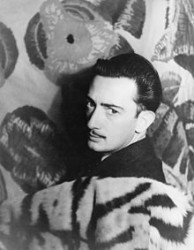
Salvador Dalí (1904-1989) was a prominent Spanish Surrealist painter and is one of the most celebrated artists of the 20th Century. Dalí was a leading figure in the French Surrealist Art Movement and his fiercely technical, yet highly unconventional paintings, sculptures and public behavior ushered in a new generation of imaginative expression. Continue reading Salvador Dalí
All posts by Lawrence Christopher Skufca, J.D.
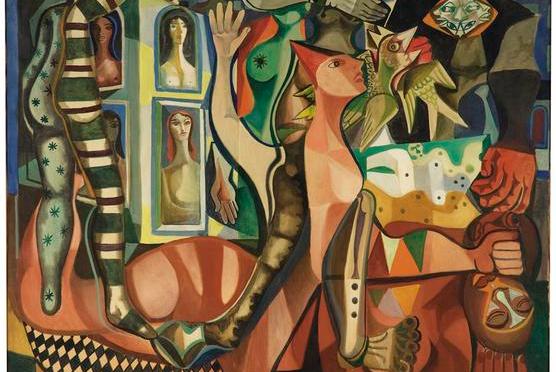
Sohos de Carnival
Artist: Emiliano Di Cavalcanti
Medium: oil on canvas
Date: c. 1955
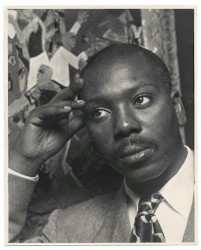
Jacob Lawrence
Jacob Lawrence (1917-2000) was an American painter, associated with the Harlem Renaissance and the Social Realist Movement. Lawrence forged a unique and original art form, combining the tempera technique (pigment mixed with a binder consisting of egg yolk thinned with water) with a cubist style. All of his work was unmistakably modern, but remained within the conceptual framework of realism and figurative painting. Lawrence referred to his style as “dynamic cubism,” though by his own account the primary influence was not so much the French tradition, so much as the shapes and colors of Harlem. Continue reading Jacob Lawrence
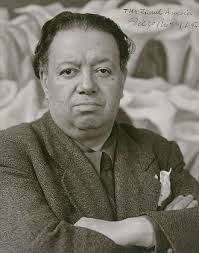
Diego Rivera
Diego Rivera (1186-1957) is considered one of the greatest Mexican painters of the twentieth century. Among his many artistic contributions, Rivera is credited with the reintroduction of fresco painting and his works helped establish the Mexican Mural Movement. Between 1922 and 1953, Rivera painted murals in Mexico City, Chapingo, Cuernavaca, San Francisco, Detroit, and New York City. Rivera’s political views and tempestuous romance with the painter Frieda Kahlo were a continuous source of public intrigue. Continue reading Diego Rivera

Guernica
Artist: Pablo Picasso
Medium: oil on canvas
Date: c. 1937
One of Picasso’s best known works, Guernica is Picasso’s critique of the German bombing raid of a little Basque village in northern Spain. As Germany gears up for war, Adolph Hitler, with the approval of Generalissimo Francisco Franco, chooses the village of Guernica as a site for bombing practice. On April 27th, 1937, the unsuspecting hamlet is pounded with high-explosive and incendiary bombs for over three hours. Townspeople are cut down as they run from the crumbling buildings. Guernica burns for three days. Sixteen hundred civilians are killed or wounded.
By May 1st, news of the massacre at Guernica reaches Paris, where more than a million protesters flood the streets to voice their outrage in the largest May Day demonstration the city has ever seen. Eyewitness reports fill the front pages of Paris papers. Picasso is stunned by the stark black and white photographs. Appalled and enraged, Picasso rushes through the crowded streets to his studio, where he quickly sketches the first images for the mural he will call Guernica.
Prior to the bombing, Picasso had been commissioned to create the centerpiece for the Spanish art exhibition at the 1937 World’s Fair in Paris. Three months later, Guernica is delivered to the Spanish Pavilion at the Paris Exposition. Almost prophetically, the Spanish Pavilion stands in the shadow of Albert Speer’s monolith to Nazi Germany. The Spanish Pavilion’s main attraction, Picasso’s Guernica, is a sober indictment of the tragic events in Spain.
After the Fair, Guernica tours Europe and Northern America to raise consciousness about the threat of fascism. From the beginning of World War II until 1981, Guernica is housed in its temporary home at the Museum of Modern Art in New York, though it makes frequent trips abroad to such places as Munich, Cologne, Stockholm, and even Sao Palo in Brazil. The one place it does not go is Spain. Although Picasso had always intended for the mural to be owned by the Spanish people, he refuses to allow it to travel to Spain until the country enjoys “public liberties and democratic institutions.”
Described as modern art’s most powerful anti-war statement, Guernica is seen as an amalgamation of pastoral and epic styles. Guernica is a mural-size canvas (3.5 m (11 ft) tall x 7.8 m (25.6 ft) wide) painted in oil. The somber palate of blue, black and white intensify the drama, producing a stark, almost photographic record of the tragedy. The meaning of key figures – a woman with outstretched arms, a bull, an agonized horse – are left open to one’s interpretation. When asked for their symbolic meaning , Picasso replied “A painting is not thought out and settled in advance. While it is being done, it changes as one’s thoughts change. And when it’s finished, it goes on changing, according to the state of mind of whoever is looking at it.”

Urban Folk Art
Corey Barksdale, untitled, oil on canvas, n.d.

Corey Barksdale
Atlanta artist Corey Barksdale was born in Nashville, Tennessee, into a family of Artists. A prolific Atlanta artist, his fine art subject matter ranges from human figures to non-objective abstracts. In recent years he has concentrated his talents on themes that portray the love and strength that exists within the African American community.
Barksdale earned his Bachelor of Fine Arts Degree at the prestigious Atlanta College of Art in 1994. During this period he was heavily influenced by the abstract expressionists and admired such mainstream artists as Jasper Johns, Clyfford Still, and William de Kooning. The African-American masters Aaron Douglas, John Biggers, Romere Bearden, and William Tolliver instilled in him a appreciation of African/American artistic heritage.

Abstract Collage
Corey Barksdale, untitled, oil on canvas, n.d.

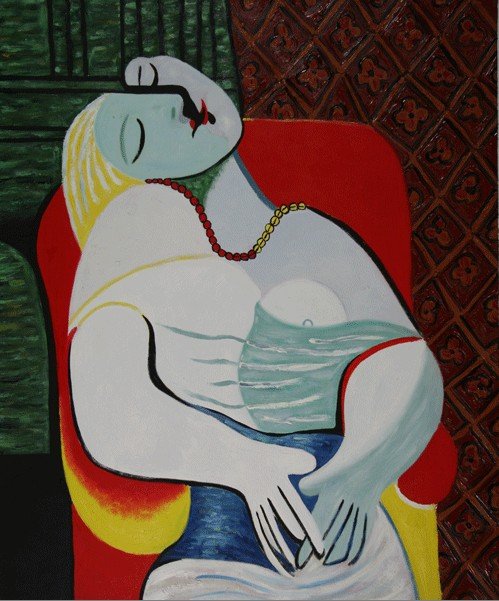
Le Repos
Artist: Pablo Picasso
Medium: oil on canvas
Date: c. 1932
Le Repos, or The Rest, painted by Pablo Picasso in 1932, depicts a woman sleeping peacefully on her arms. The painting contains zones of colors with deep curved outlines. Picasso painted several variations of the work, which he also entitled Le Repos. The model was Picasso’s mistress during this period, Marie-Thérèse Walter. She is portrayed in many of his paintings, the most infamous being Le Reve, or The Dream.
In 2006, Le Repos sold for $34.7 million (£25 million) at an auction held by Christie’s.

Girl
Artist: Miguel Covarrubias
Medium: watercolour, pastel and black crayon on paper
Date: c. 1930’s
 Camden Civil Rights Project