Synopsis: In this brief five minute video, Municipal consultant, Dr. Amara Enyia, shares some insights on effective community organizing. She educates young activists on the importance of gaining a better understanding of their own motivations, the key issues their community faces, the existing power dynamics within the community, and the people skills required to collaborate within existing community networks. Amara Enyia serves as the Chief Executive Officer of ACE Municipal Partners LLC, a full service municipal consulting firm that works with small and mid-sized cities in the Chicago/NW Indiana area, Central America, South America, and Africa. She’s also the founder and lead author of the blog “The Municipal Maven,” which features the intersection of politics, policy and the public through the lens of municipalities.
Synopsis: Political Scientist, Erica Chenowith, speaks about her research on the impressive historical record of civil resistance in the 20th century and discusses the promise of unarmed struggle in the 21st century. According to her research, from 1900-2006, campaigns of nonviolent civil resistance were twice as likely to succeed as violent campaigns. Chenowith asserts a “3.5% rule”—the notion that no government can withstand a challenge of 3.5% of its population without either accommodating the movement or (in extreme cases) disintegrating. Chenowith is a faculty member and Ph.D. program co-director at the University of Denver’s Josef Korbel School of International Studies.
Synopsis: Matt Damon, a lifelong friend of Howard Zinn, reads excerpts from Zinn’s 1970 speech on civil disobedience. Zinn delivered the speech at Johns Hopkins University in Baltimore as his opening statement in a debate on civil disobedience with the philosopher Charles Frankel. Zinn was a social activist and political science professor at Boston University during the civil rights era who has authored over twenty books, including his seminal work, A People’s History of the United States.
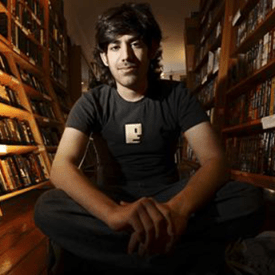
Synopsis: Filmmaker Brian Knappenberger explores the life and work of programming prodigy and internet activist Aaron Swartz. The documentary presents a dynamic and tragic portrait of the life of Reddit co-founder Aaron Swartz, a champion of open access who grew up to lead the internet community into a new age of data sharing and free speech. The film examines how the suppression of information and lack of government transparency has been used to avoid public scrutiny and prevent informed participation in the democratic process.
Synopsis: When Julian Assange first launched his whistle-blower website, Wikileaks, he was heralded as a public hero for exposing government and corporate corruption. Public opinion quickly shifted as Western governments who had been exposed launched a full scale campaign to marginalize Assange and paint him as a threat to national security. Swedish Television’s Jesper Huor and Bosse Lindquist investigate the history of WikiLeaks and its mission through the lens of Wikileaks founder Julian Assange, his partner Daniel Domscheit Berg, the editorial teams at the Guardian, Der Spiegel and New York Times newspapers, and the US State Department officials who were forced to address and contain the early leaks.
Synopsis: By 1971, the “Catholic Left” movement had conducted over 30 draft board raids, destroying close to a million Selective Service documents. But they were hardly a centralized or structured movement. Actions were carried out by independent groups of activists, angered by the war’s mounting toll and its collateral effects on impoverished cities like Camden. On the evening of August 21, 1971, Father Michael Doyle and a group of twenty Catholic antiwar activists were arrested attempting to break into a Camden, New Jersey draft board office to destroy records after the group was betrayed by a member of their own group acting as an agent provocateur for the F.B.I. This PBS documentary recounts their act of civil disobedience and the ensuing legal battle, which Supreme Court Justice William Brennan labeled “one of the great trials of the 20th century.” Political scientists like Howard Zinn provided expert testimony on the time honored American tradition of civil disobedience, resulting in the eventual acquittal of the activists on the grounds of jury nullification.
Synopsis: Angela Davis is a seasoned political activist who has dedicated her life to social reformation. She emerged as a prominent counterculture activist during the Civil Rights Movement and was once on the F.B.I.’s Ten Most Wanted list for her associations with the Communist Party USA and the Black Panther Party. Davis founded, Critical Resistance, an organization working to abolish the prison-industrial complex. She is a retired professor with the History of Consciousness Department at the University of California, Santa Cruz, and a former director of the university’s Feminist Studies department. In this talk, Angela Davis reflects on her successes and shares her insights on the strategies for change that have made — and will make — history.
Synopsis: Martin Luther King, Jr. speaks on Meet The Press one week after leading his historic five-day march from Selma to Montgomery, Alabama, to draw attention to the humiliating conditions in Alabama which included state enforced segregation, police brutality and racially-motivated murder. Dr. King asserts, “An individual who breaks a law that conscience tells him is unjust, and who willingly accepts the penalty of imprisonment in order to arouse the conscience of the community over its injustice, is in reality expressing the highest respect for the law.”
Here’s to the crazy ones. The misfits. The rebels. The troublemakers. The round pegs in the square holes. The ones who see things differently. They’re not fond of rules. And they have no respect for the status quo. You can quote them, disagree with them, glorify or vilify them. About the only thing you can’t do is ignore them. Because they change things. They push the human race forward. And while some may see them as the crazy ones, we see genius. Because the people who are crazy enough to think they can change the world, are the ones who do.
Modern Psychology has a word that is probably used more than any other word in Psychology. It is the word maladjusted. It is the ringing cry of modern child psychology — maladjusted. Now of course we all want to live the well adjusted life in order to avoid neurotic and schizophrenic personalities. But as I move toward my conclusion, I would like to say to you today, in a very honest manner, there’s some things in our society, and some things in our world, for which I am proud to be maladjusted. And I call upon all men of good will to be maladjusted to these things until the Good Society is realized.
I must honestly say to you that I never intend to adjust myself to racial segregation and discrimination. I never intend to adjust myself to religious bigotry. I never intend to adjust myself to economic conditions that will take necessities from the many to give luxuries to the few and leave millions of God’s children smothering in an airtight cage of poverty in the midst of an affluent society.

 Camden Civil Rights Project