Category Archives: Philosophy

The Subdivision of Property: Thomas Jefferson’s Letter to James Madison

Thomas Jefferson to James Madison

28 Oct. 1785 Papers 8:681–82

Seven o’clock, and retired to my fireside, I have determined to enter into conversation with you; this [Fontainebleau] is a village of about 5,000 inhabitants when the court is not here and 20,000 when they are, occupying a valley thro’ which runs a brook, and on each side of it a ridge of small mountains most of which are naked rock. The king comes here in the fall always, to hunt. His court attend him, as do also the foreign diplomatic corps. But as this is not indispensably required, and my finances do not admit the expence of a continued residence here, I propose to come occasionally to attend the king’s levees, returning again to Paris, distant 40 miles. This being the first trip, I set out yesterday morning to take a view of the place. For this purpose I shaped my course towards the highest of the mountains in sight, to the top of which was about a league. As soon as I had got clear of the town I fell in with a poor woman walking at the same rate with myself and going the same course. Wishing to know the condition of the labouring poor I entered into conversation with her, which I began by enquiries for the path which would lead me into the mountain: and thence proceeded to enquiries into her vocation, condition and circumstance. She told me she was a day labourer, at 8. sous or 4 d. sterling the day; that she had two children to maintain, and to pay a rent of 30 livres for her house (which would consume the hire of 75 days), that often she could get no emploiment, and of course was without bread. As we had walked together near a mile and she had so far served me as a guide, I gave her, on parting 24 sous. She burst into tears of a gratitude which I could perceive was unfeigned, because she was unable to utter a word. She had probably never before received so great an aid. This little attendrissement, with the solitude of my walk led me into a train of reflections on that unequal division of property which occasions the numberless instances of wretchedness which I had observed in this country and is to be observed all over Europe. The property of this country is absolutely concentered in a very few hands, having revenues of from half a million of guineas a year downwards. These employ the flower of the country as servants, some of them having as many as 200 domestics, not labouring. They employ also a great number of manufacturers, and tradesmen, and lastly the class of labouring husbandmen. But after all these comes the most numerous of all the classes, that is, the poor who cannot find work. I asked myself what could be the reason that so many should be permitted to beg who are willing to work, in a country where there is a very considerable proportion of uncultivated lands? These lands are kept idle mostly for the sake of game. It should seem then that it must be because of the enormous wealth of the proprietors which places them above attention to the increase of their revenues by permitting these lands to be laboured. I am conscious that an equal division of property is impracticable. But the consequences of this enormous inequality producing so much misery to the bulk of mankind, legislators cannot invent too many devices for subdividing property, only taking care to let their subdivisions go hand in hand with the natural affections of the human mind. The descent of property of every kind therefore to all the children, or to all the brothers and sisters, or other relations in equal degree is a politic measure, and a practicable one. Another means of silently lessening the inequality of property is to exempt all from taxation below a certain point, and to tax the higher portions of property in geometrical progression as they rise. Whenever there is in any country, uncultivated lands and unemployed poor, it is clear that the laws of property have been so far extended as to violate natural right. The earth is given as a common stock for man to labour and live on. If, for the encouragement of industry we allow it to be appropriated, we must take care that other employment be furnished to those excluded from the appropriation. If we do not the fundamental right to labour the earth returns to the unemployed. It is too soon yet in our country to say that every man who cannot find employment but who can find uncultivated land, shall be at liberty to cultivate it, paying a moderate rent. But it is not too soon to provide by every possible means that as few as possible shall be without a little portion of land. The small landholders are the most precious part of a state.


The Founders’ Constitution
Volume 1, Chapter 15, Document 32
http://press-pubs.uchicago.edu/founders/documents/v1ch15s32.html
The University of Chicago Press

The Papers of Thomas Jefferson. Edited by Julian P. Boyd et al. Princeton: Princeton University Press, 1950–.

The Social Contract (1762)

With the famous phrase, “man is born free, but he is everywhere in chains,” Rousseau asserts that modern states repress the physical freedom that is our birthright, and do nothing to secure the civil freedom for the sake of which we enter into civil society. Legitimate political authority, he suggests, comes only from a social contract agreed upon by all citizens for their mutual preservation.

Rousseau’s central premise in The Social Contract is “how people might construct a genuinely free political society.” Rousseau concerns himself with the conditions under which rational individuals would form a civil society to preserve the peace and secure their own liberty and property interests. He concludes that the political arrangement which results in the greatest mutual benefit for all the parties is a common pact by which they agree  “to subordinate themselves to the good of the community.” Rousseau contends that this social arrangement would require “total alienation of each associate with all of his rights to the whole community”, noting that if the forfeiture (alienation) were only partial then there would be no way of resolving disputes over “which powers and possessions the public good requires them to forfeit.” Rousseau asserts the subordination involved in this alienation is to the community as a whole, not to any individual or faction, and  that this common forfeiture results in the greatest net gain of personal freedom for each member of society. The common good is determined by the sovereign, which is comprised of all parties to the social pact, declaring its general will. The general will represents the negotiated compromises voted upon by the entire community. The closer the vote comes to being unanimous, the healthier the society.

Rousseau distinguishes between “natural freedom” and “civil freedom” to illustrate how submission to the general will should result in no net loss of freedom. Rousseau asserts that prior to the formation of the social contract, individuals enjoy a type of “natural freedom” to act in their own best interest. Since all human beings enjoy this liberty, in a world occupied by many competitive claims, the practical value of this type of freedom may be almost nonexistent because the individual’s capacity to procure their wants will always be limited by his or her physical power in relation to others. Furthermore, the unhindered exercise of natural freedom pits individuals against one other over scarce resources, inevitably resulting in violence and uncertainty. Conversely, creation of the sovereign guarantees individuals a sphere of equality under the law which provides greater security in their persons and property. The loss of natural freedom to the general will is accompanied by a grant of civil freedom, defined as “the absence of impediments to pursuing one’s ends in cases where the law is silent.”  Provided that the law is not meddlesome or intrusive (and Rousseau believes it will not be, since no individual has a motive to legislate burdensome laws) there will be a net benefit compared to the pre-political state.

Rousseau’s social contract has been maligned by a host of twentieth century philosophers as supporting either Communism or a tyranny by the majority. Rosseau promotes neither. The genius of Rousseau’s premise is not it’s claim that democracies should be guided by altruism or majoritarian rule, but rather that the legitimacy of a sovereign formed by consensus resides in its ability to serve the interests of those it governs. Rousseau observes that democracies which refuse to foster general consensus will eventually deteriorate into tyrannies which must be dissolved.

A downloadable PDF version of the book may be found HERE 

Suggested Viewing:

Harvard Professor Lawrence Lessig makes the case that our democracy has become corrupt with money, leading to an inequality. Leesig argues that only 0.02% of the United States population actually determines who’s in power and that public policy reflects the desires of this segment of society. He introduces research conducted by Princeton which suggests that public opinion no longer affects change. The study reflects that in the aggregate, public opinion has a zero percent impact on policy decisions. Lessig says that this fundamental breakdown of the democratic system must be fixed before we will ever be able to address major challenges like climate change, social security, and student debt. He contends this may not the most important problem we face, but it’s the first problem we must address if we seek to resolve the major social problems facing our society.

Lawrence Lessig is the Roy L. Furman Professor of Law and Leadership at Harvard Law School, former director of the Edmond J. Safra Center for Ethics at Harvard University, and founder of Rootstrikers, a network of activists leading the fight against government corruption. He has authored numerous books, including Republic, Lost: How Money Corrupts Our Congress—and a Plan to Stop It, Code and Other Laws of Cyberspace, Free Culture, and Remix.

Discourse On The Origin of Inequality Among Mankind (1751)

In his Discourse on the Origin of Inequality Among Mankind, Jean-Jacques Rousseau explores the origins of social inequality. Rousseau argues moral inequality is established by convention. In the modern world, human beings come to derive their very sense of self from the opinion of others, a fact which Rousseau sees as corrosive of freedom and destructive of individual authenticity.

Rousseau begins with humanity’s historical transition from its original state of isolated independence to the development of organized communities. According to Rousseau, man’s state of nature was a peaceful and quixotic time. People lived solitary, uncomplicated lives and their needs were easily satisfied by nature. Because of the natural abundance which existed, there was little need for competition. As a result, humans were naturally endowed with the capacity for compassion and were not inclined to harm one another for material gain.

This dynamic gradually changes as man begins to organize into communities. For Rousseau, civil society began as an irrational deception perpetrated upon humanity by individuals seeking to place their own interests above those of the community. Rousseau argues:

“The first man who, having fenced in a piece of land, said “This is mine,” and found people naive enough to believe him, that man was the true founder of civil society. From how many crimes, wars, and murders, from how many horrors and misfortunes might not any one have saved mankind, by pulling up the stakes, or filling up the ditch, and crying to his fellows: Beware of listening to this impostor; you are undone if you once forget that the fruits of the earth belong to us all, and the earth itself to nobody.”

Rousseau asserts, the weaker members of society are persuaded that the establishment of laws will provide them greater security by preserving their rights. Meanwhile, laws are created to entrench an artificial social hierarchy which seeks to preserve power and legitimize its exploitation of the more vulnerable members of society. The ensuing competition over property and social status corrupts human nature by extinguishing the compassion towards one another which existed in man’s original state of nature. This creates dangerous and unstable relationships, leading to the constant threat of violence.

Rousseau concludes that social inequality is only acceptable where it relates to differences in individual ability and talent. The moral deficiency of modern civilization, however, is that man’s liberty is undermined through an unnatural social construct which equates material gain with virtue. This creates a perverse incentive for individuals to increase their own privilege and status through the exploitation of their fellow citizens.

Rousseau envisions society as becoming increasingly hostile, eventually requiring despotic rule to maintain the inequality. As wealth becomes more concentrated, the potential for violent conflict increases. Rousseau argues this outcome may be avoided through a more equitable economic arrangement, but is pessimistic that this arrangement can be achieved through voluntary concessions by those in power.

A downloadable PDF version of the book may be found HERE 

A version of the Book in digital format may be found HERE  

The Major Tenets of Liberation Theology

The Aims of Theology

“Theology is an understanding which both grows and, in a certain sense, changes. If the commitment of the Christian community in fact takes different forms throughout history, the understanding which accompanies the vicissitudes of this commitment will be constantly renewed and will take untrodden paths.”

Gustavo Gutierrez, A Theology of Liberation (1973)

“Much contemporary theology seems to start from the challenge of the nonbeliever. He questions our religious world and faces it with a demand for profound purification and renewal.

…But the challenge in a continent like Latin America does not come primarily from the man who does not believe, but from the man who is not a man, who is not recognized as such by the existing social order: he is in the ranks of the poor, the exploited; he is the man who scarcely knows that he is a man. His challenge is not aimed first at our religious world, but at our economic, social, political, and cultural world; therefore, it is an appeal for a revolutionary transformation of the very basis of a dehumanizing society.

The question is not therefore how to speak of God in an adult world, but how to proclaim Him as a Father in a world that is not human.”

Gustavo Gutierrez, “Liberation, Theology, and Proclamation” (1974)

“In our theological efforts we have called this ‘Theology of Liberation’ because ‘liberation’ is very often translated to ‘salvation.’ How do we say to the poor, ‘God loves you’? This question is larger than our answers. It means it is an open question, and we try in this liberation theology, and I can say in the different liberation theologies, to try to answer this point.”

Gustavo Gutierrez, remarks at Elmhurst College (2009)

Love of Neighbor

“One of the teachers of the law came and heard them debating. Noticing that Jesus had given them a good answer, he asked him, “Of all the commandments, which is the most important?

“The most important one,” answered Jesus, “is this: ‘Hear, O Israel: The Lord our God, the Lord is one. Love the Lord your God with all your heart and with all your soul and with all your mind and with all your strength.’ The second is this: ‘Love your neighbor as yourself.’ There is no commandment greater than these.”

Mark 12:28-31, New International Version

“Love of neighbor is an essential component of Christian life. But as long as I apply that term only to the people who cross my path and come asking me for help, my world will remain pretty much the same. Individual almsgiving and social reformism is a type of love that never leaves its own front porch.

… On the other hand my world will change greatly if I go out to meet other people on their path and consider them as my neighbor, as the good Samaritan did… The Gospel tells us that the poor are the supreme embodiment of our neighbor. It is this option that serves as the focus for a new way of being human and Christian in today’s Latin America.”

Gustavo Gutierrez, “Liberation Praxis and Christian Faith” (1979)

Christian Duty to Address Social Injustice

“Defend the cause of the weak and fatherless; maintain the rights of the poor and oppressed. Rescue the weak and needy; deliver them from the hand of the wicked.”

Psalm 82:3-4, New International Version

“The Christian faithful are also obliged to promote social justice and, mindful of the precept of the Lord, to assist the poor.”

1983 CIC, canon 222.2

“According to Catholic teaching, through one’s words, prayers and deeds one must show solidarity with, and compassion for, the poor. Therefore, when instituting public policy one must always keep the ‘preferential option for the poor’ at the forefront of one’s mind. Accordingly, this doctrine implies that the moral test of any society is; ‘how it treats its most vulnerable members.’ The poor have the most urgent moral claim on the conscience of the nation. We are called to look at public policy decisions in terms of how they affect the poor.”

Option for the Poor, Major themes from Catholic Social Teaching, Archdiocese of St. Paul & Minneapolis.

“I am not refusing the necessity, even today, of immediate help to the poor, but I say it is not enough. Today the call is to try to change the social structure and to change some mental categories—to be clearer about mental categories, the feeling of superiority, for example, to some cultures. This is a mental category and we need to change this.

In the ultimate analysis, poverty means death; unjust and early death. Missionaries of the 16th century, some years after their arrival on this continent, said, ‘The Indians are dying before their time.’ Well, it was true certainly, but it’s true today also. The poor are dying before their time because poverty means death—unjust and early death.”

Gustavo Gutierrez, remarks at Elmhurst College (2009)

“It is not a question of idealizing poverty, but rather of taking it on as it is—an evil—to protest against it and to struggle to abolish it. As Paul Ricoeur says, you cannot really be with the poor unless you are struggling against poverty. Because of this solidarity—which manifests itself in specific action, a style of life, a break with one’s social class—one can also help the poor and exploited to become aware of their exploitation and seek liberation from it.

Christian poverty, and expression of love, is solidarity with the poor and is a protest against poverty. This is the concrete, contemporary meaning of the witness of poverty. It is a poverty lived not for its own sake, but rather as an authentic imitation of Christ; it is a poverty which means taking on the sinful human condition to liberate humankind from sin and all its consequences.”

Gustavo Gutierrez, A Theology of Liberation (1973)

Keep Hope Alive

“But God will never forget the needy; the hope of the afflicted will never perish.”

– Psalm 9:18, New International Version

“We must also engage in our work hopefully. Hope is not the same thing as optimism. Optimism merely reflects the desire that external circumstances may one day improve. There is nothing wrong with optimism, but we may not always have reasons for it.

The theological virtue of hope is much more than optimism. Hope is based on the conviction that God is at work in our lives and in the world. Hope is ultimately a gift from God given to sustain us during difficult times. Charles Péguy described hope as the ‘little sister’ that walks between the ‘taller sisters’ of faith and charity; when the taller sisters grow tired, the little one instills new life and energy into the other two. Hope never allows our faith to grow weak or our love to falter.”

Remembering the Poor: An Interview with Gustavo Gutierrez, America Magazine (Feb. 3, 2003)

Edited by L. Christopher Skufca (Camden Civil Rights Project)

Learn more about Father Gustavo Gutierrez on his Bio Page

Social Conflict Theory

by Kent McClelland

The several social theories that emphasize social conflict have roots in the ideas of Karl Marx (1818-1883), the great German theorist and political activist. The Marxist, conflict approach emphasizes a materialist interpretation of history, a dialectical method of analysis, a critical stance toward existing social arrangements, and a political program of revolution or, at least, reform.

The materialist view of history starts from the premise that the most important determinant of social life is the work people are doing, especially work that results in provision of the basic necessities of life, food, clothing and shelter.Marx thought that the way the work is socially organized and the technology used in production will have a strong impact on every other aspect of society. He maintained that everything of value in society results from human labor. Thus,Marx saw working men and women as engaged in making society, in creating the conditions for their own existence.

Marx summarized the key elements of this materialist view of history as follows:

In the social production of their existence, men inevitably enter into definite relations, which are independent of their will, namely relations of production appropriate to a given stage in the development of their material forces of production. The totality of these relations of production constitutes the economic structure of society, the real foundation, on which arises a legal and political superstructure and to which correspond definite forms of social consciousness. The mode of production of material life conditions the general process of social, political and intellectual life. It is not the consciousness of men that determines their existence, but their social existence that determines their consciousness (Marx 1971:20).

Marx divided history into several stages, conforming to broad patterns in the economic structure of society. The most important stages for Marx’s argument were feudalism, capitalism, and socialism. The bulk of Marx’s writing is concerned with applying the materialist model of society to capitalism, the stage of economic and social development that Marx saw as dominant in 19th century Europe. For Marx, the central institution of capitalist society is private property, the system by which capital (that is, money, machines, tools, factories, and other material objects used in production) is controlled by a small minority of the population. This arrangement leads to two opposed classes, the owners of capital (called the bourgeoisie) and the workers (called the proletariat), whose only property is their own labor time, which they have to sell to the capitalists.

Owners are seen as making profits by paying workers less than their work is worth and, thus, exploiting them. (In Marxist terminology, material forces of production or means of production include capital, land, and labor, whereas social relations of production refers to the division of labor and implied class relationships.)

Economic exploitation leads directly to political oppression, as owners make use of their economic power to gain control of the state and turn it into a servant of bourgeois economic interests. Police power, for instance, is used to enforce property rights and guarantee unfair contracts between capitalist and worker. Oppression also takes more subtle forms: religion serves capitalist interests by pacifying the population; intellectuals, paid directly or indirectly by capitalists, spend their careers justifying and rationalizing the existing social and economic arrangements. In sum, the economic structure of society molds the superstructure, including ideas (e.g., morality, ideologies, art, and literature) and the social institutions that support the class structure of society (e.g., the state, the educational system, the family, and religious institutions). Because the dominant or ruling class (the bourgeoisie) controls the social relations of production, the dominant ideology in capitalist society is that of the ruling class. Ideology and social institutions, in turn, serve to reproduce and perpetuate the economic class structure. Thus, Marx viewed the exploitative economic arrangements of capitalism as the real foundation upon which the superstructure of social, political, and intellectual consciousness is built.

Marx’s view of history might seem completely cynical or pessimistic, were it not for the possibilities of change revealed by his method of dialectical analysis. (The Marxist dialectical method, based on Hegel’s earlier idealistic dialectic, focuses attention on how an existing social arrangement, or thesis, generates its social opposite, or antithesis, and on how a qualitatively different social form, orsynthesis, emerges from the resulting struggle.) Marx was an optimist. He believed that any stage of history based on exploitative economic arrangements generated within itself the seeds of its own destruction. For instance, feudalism, in which land owners exploited the peasantry, gave rise to a class of town-dwelling merchants, whose dedication to making profits eventually led to thebourgeois revolution and the modern capitalist era. Similarly, the class relations of capitalism will lead inevitably to the next stage, socialism. The class relations of capitalism embody a contradiction: capitalists need workers, and vice versa, but the economic interests of the two groups are fundamentally at odds. Such contradictions mean inherent conflict and instability, the class struggle. Adding to the instability of the capitalist system are the inescapable needs for ever-wider markets and ever-greater investments in capital to maintain the profits of capitalists. Marx expected that the resulting economic cycles of expansion and contraction, together with tensions that will build as the working class gains greater understanding of its exploited position (and thus attains class consciousness), will eventually culminate in a socialist revolution.

Despite this sense of the unalterable logic of history, Marxists see the need for social criticism and for political activity to speed the arrival of socialism, which, not being based on private property, is not expected to involve as many contradictions and conflicts as capitalism. Marxists believe that social theory and political practice are dialectically intertwined, with theory enhanced by political involvement and with political practice necessarily guided by theory. Intellectuals ought, therefore, to engage in praxis, to combine political criticism and political activity. Theory itself is seen as necessarily critical and value-laden, since the prevailing social relations are based upon alienating and dehumanizing  exploitation of the labor of the working classes.

Marx’s ideas have been applied and reinterpreted by scholars for over a hundred years, starting with Marx’s close friend and collaborator, Friedrich Engels (1825-95), who supported Marx and his family for many years from the profits of the textile factories founded by Engels’ father, while Marx shut himself away in the library of the British Museum. Later, Vladimir I. Lenin (1870-1924), leader of the Russian revolution, made several influential contributions to Marxist theory. In recent years Marxist theory has taken a great variety of forms, notably the world-systems theory proposed by Immanuel Wallerstein (1974, 1980) and the comparative theory of revolutions put forward by Theda Skocpol (1980). Marxist ideas have also served as a starting point for many of the modern feminist theorists. Despite these applications, Marxism of any variety is still a minority position among American sociologists.

References

Marx, Karl. 1971. Preface to A Contribution to the Critique of Political Economy, Tr. S. W. Ryanzanskaya, edited by M. Dobb. London: Lawrence & Whishart.

Skocpol, Theda. 1980. States and Social Revolutions: A Comparative Analysis of France, Russia, and China. New York: Cambridge University Press.

Wallerstein, Immanuel M. 1974. The Modern World-System: Capitalist Agriculture and the Origins of the European World-Economy in the Sixteenth Century. New York: Academic Press.

         . 1980. The Modern World-System II: Mercantilism and the Consolidation of the European World-Economy, 1600-1750. New York: Academic Press.

Game Theory and Social Emotions

logo4replacecolors

by Richard Landes

Game theory examines the ways that various people “play” their interactions with others. All games take place on at least two levels. The first is material gain or loss (often quantifiable, and the focus of most formal game theory), and the second, psychological perception of having won or lost (rarely quantifiable until recently, ignored). In honor-shame cultures, the perception of others’ actions plays a much stronger role than “rational” concerns about material gain and loss regardless of relative advantage which, in principle, governs civil society behavior (rational choice theory). Rational choice theory, focused on quantifiable self-interest as a motivation, tends to downplay emotional components of game playing. It discusses fixed- and variable-sum games. The following discussion analyzes the cultural and emotional dimensions of a player’s preference for one strategy over another, and focuses on zero-, positive- and negative-sum games.

ZERO-SUM GAMES are games in which one side wins and the other loses. Hard zero-sum insists that only when the other loses can one win. Hard zero-sum reflects an emotional demand that a victory can only be savored when the defeated one knows himself to be defeated. All sports and gambling games are zero-sum. War, theft and raiding are hard zero-sum. The dominating imperative: “rule or be ruled” takes zero-sum relations at a political level as axiomatic. I must dominate lest you do the same. “Do onto others before they do onto you.” The joke about the peasant whom the genie offers one wish, but whatever he asks for his neighbor gets double illustrates the zero-sum mentality to perfection: “Poke out one of my eyes.”

POSITIVE-SUM GAMES are games in which both sides win. In closed positive-sum transactions, although both parties may “win”, one side is guaranteed a significantly greater victory (noblesse oblige, or British imperialism). Open-ended positive-sum is based on a voluntary agreement to interact (contract, joint venture, constitution) on rules that apply equally to both sides, and an agreement that whatever results from the interaction, both sides will accept no matter how diverse the end result (civil society, meritocracy). Rationality and “rational choice theory” assume that actors will work to maximize their own advantage, with minimal concern for how it might help someone else even more. As opposed to the mutilated kingship and dominion of zero-sum, democracy and civil society derive from the extremely rare accomplishment of a positive-sum mentality among a critical mass of citizens.

NEGATIVE-SUM GAMES are games in which both sides lose. This represents the height of irrationality to positive-sum players, but it proves a surprisingly durable choice of game-players. The self-destructive element in conjunction with aggression often derives from losing a hard zero-sum game and not accepting an offer to switch to positive-sum. In terms of the zero-sum genie joke above, negative-sum thinking — illustrated with deep poignancy by the Palestinian ruling elites — runs along the lines of “poke out both of my eyes if only I can get one of my enemy’s.”

THE EMOTIONS AND LOGIC OF ZERO-SUM: I win, you lose; or, you win, I lose. In modern society, these interactions get played out in sports. When played out in economic life, however, zero-sum assumes a fixed set of resources (no economic growth). Therefore, whatever has worked to the advantage of the other has diminished the self. In its harshest forms, zero-sum holds that not only does one person win and the other lose, but in order for one to win, the other must lose. Zero-sum emotions include:

  • total scarcity — if you gain (wealth, status), I lose
  • Schadenfreude — your misfortune brings me gladness;
  • envy — your success diminishes me;
  • triumphalism — I’m bigger because you are smaller; and
  • resentment — as long as you have more success than me, I despise you, if necessary in secret.

The appeal of these emotions — risking all to feel triumphalism and dominion — is well-nigh universal. Hence, in civil societies, zero-sum games are delegated to sports and gambling. In prime divider societies, they invade the realm of real life: “war is the sport of kings.”

In order to understand this mentality, we have to put aside cognitive egocentrism. We are raised in a culture that places heavy emphasis on positive-sum relations, or on the notion of mutually beneficial win-win. We consider positive-sum so obviously appropriate that it is virtually synonymous with rationality. When our economists assume rationality as their axiomatic understanding of individual decision-making, they reflect this widespread cultural assumption that, at least formally, dates back to Adam Smith. And not surprisingly, the mentality of zero-sum – one wins, one loses – strikes us, as self-destructive.

Let us consider the nature and logic of zero-sum interactions, especially in terms of the emotional pay-offs. The basic rule of human interaction in many honor-shame cultures holds that honor is a limited commodity, that one person’s honor means the loss of honor of another. Politically this leads to what Eli Sagan has termed the “paranoid imperative”: rule or be ruled. “If I don’t rule over you, you will rule over me. I must therefore try to dominate you lest you dominate me. If you win, I lose; in order for me to win, you must lose.”

(I prefer the designation “dominating imperative” for this set of beliefs. The paranoid imperative I prefer to reserve for: exterminate or be exterminated. Hence the distinction in matters of Judeophobia between, for example, zero-sum anti-Judaism and paranoid anti-Semitism.)

This attitude of rule-or-be-ruled justifies what Mao used to call “pre-emptive retaliation strikes.” They happen all the time, from international relations to familial ones. The classic expression of this attitude comes in two forms: 1) the more basic “honor-shame” culture of the tribal warrior, where honor comes from dominion (that is, the Germanic, Celtic, and Mediterranean subterranean levels of European culture), and 2) the “civilized empires” in which a certain degree of restraint in the exercise of immediate dominion opened up both a space for an expanding “middle class”, largely urban, and for a much wider range of conquest and dominion for a small elite.

As the Romans liked to tell themselves, the first Romans quickly understood that they could either be masters or slaves, so they chose to be masters, and did it so well that they conquered the world. Rome is the poster boy forlibido dominandi (the lust to dominate). Roman imperialism illustrates the accuracy of the Athenian remark to the Melians ca. 416 BCE that it had been a law long before their time and would be long after, “that those who can do what they will and those who can’t suffer what they must.”

This statement helps us understand the emotional and strategic logic of zero-sum in what seemed like a negative-sum choice in the genie-peasant joke cited above: “Poke out one of my eyes.” If this were a chess move (i.e. a zero-sum game) rather than a joke, you’d put two exclamation points after it. In one deft move, this man has turned around a painful dilemma into a spectacular “win” for himself. The peasant’s dilemma was that anything that benefited him, made his neighbor twice as well off: a thousand head of cattle for him meant two thousand for his neighbor. In the world of the dominating imperative, one assumes that if one’s neighbor is twice as wealthy as oneself, that neighbor will use his superiority to try to control you. Our peasant resolves the dilemma with a dramatic queen sacrifice: “in the kingdom of the blind, the one-eyed is king.” He has bought his dominion at the price of his self-mutilation. Envy unchecked is one of the key components of a culture of impoverishment.

THE LOGIC AND EMOTIONS OF POSITIVE-SUM: The logic of positive-sum seems clear to people brought up in civil society. Compromise is the essence of democracy; going for hard zero-sum blights growth and mutual prosperity. But the emotions of zero-sum can be quite demanding. In order to neutralize Schadenfreude, especially in a modern society where individuals’ conditions change rapidly, one has to learn to tolerate, even take pleasure in other people’s success, even success in direct comparison with one’s own choices. The “rational” response to the genie’s dilemma — one might call it the modern liberal’s response — is to say, “give me ten million bucks and good for my neighbor who gets twenty.” But being rational is not that easy.

To accept defeat without scape-goating, cheating, or using force to redress the imbalance, to accept the occasional public humiliation for the sake of integrity rather than saving face at the cost of honesty, requires a commitment to fair-play and self-criticism (e.g., to accepting the “bad” news that one has lost). This generous attitude towards others and modesty towards oneself are not easy and natural emotions. They must be fostered. Both civil society and demotic millennialism nurture these emotions, and great men like the Englishman William Blake can “root” for the Americans in their support of experiments in freedom even against their “own side.”

The emotional dimensions that determine these two worlds of social interaction also substantiate the emotional attachments some of us have either to the Politically-Correct Paradigm (PCP (we are all committed to positive-sum games) or the Honor-Shame Jihad Paradigm (JP) (they are, alas, committed to hard zero-sum desires). Our ironic dilemma is that the more those who favor the naturally generous view of positive-sum adhere to PCP, the more they contribute to the zero-sum behavior of demopaths and the hard-zero-sum players, whose intentions they systematically misinterpret. Without understanding the interplay between the logic and emotions of zero- and positive-sum strategies, we will have difficulty figuring a way out of the current dilemma of the thrash of cultures.

Further Reading

Alexander, J. McKenzie, “Evolutionary Game Theory“, The Stanford Encyclopedia of Philosophy (Fall 2009 Edition), Edward N. Zalta (ed.). Stable URL: http://plato.stanford.edu/entries/game-evolutionary/

Wormuth, Francis D, “The Politics of Bedlam“, Bulletin of the Atomic Scientists (December 1963).

Original Source: http://www.theaugeanstables.com/reflections-from-second-draft/game-theory-and-social-emotions/

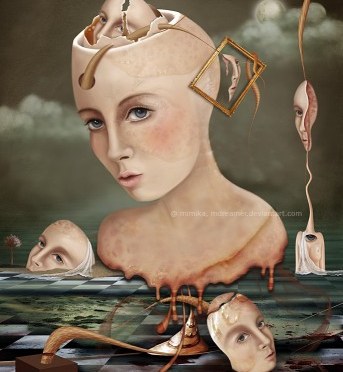
(Artwork: Schizophrenia by Mimika Papadimitriou)

Unmasking the Motives of the Good Samaritan

download (1)

By Claire Andre and Manuel Velasquez

“Even at our best, we are only out for ourselves” claim many people, including many eminent psychologists. Everything we do–from the considerate to the heroic, we do ultimately for our own benefit. In some instances, the personal gain is obvious, such as when we reap public admiration or praise. In other instances, it’s not so obvious. Consider this:

You’re walking down a quiet road one evening and suddenly come upon a horrible scene. Ahead of you is a truck turned on its side and lying on the pavement is the driver, a young man. His face is bloody and he is barely moving. What do you do? You help. But why do you help? What, exactly, is your motive?

You are likely to reply that you helped because you wanted to reduce the man’s distress. But many psychologists would offer a different explanation: When we see someone in distress, we ourselves experience feelings of distress, such as shock, alarm, worry, or fear. This unpleasant emotional arousal leads us to want to increase our own well being by reducing these feelings. One way to this goal is to reduce the other’s distress. Helping, then, is only a means to reducing our own distress. What appears to be altruistically motivated behavior is really only self interest in disguise.

The view that human beings act from self-interest and from self interest alone is not new. It has long been the dominant view in psychology and in much of Western thought. Thomas Hobbes, the seventeenth century philosopher, believed that human beings always acted from self-interest. On one occasion Hobbes was seen giving money to a beggar. When asked why, he explained that he was trying to relieve his own discomfort at seeing the beggar in need.

But if it is true that human beings always act from egoistic motives, then it’s difficult to talk about ethics. First, ethics as traditionally conceived is supposed to override self-interest: if we have a moral obligation to do something, we ought to do it even when it’s not in our own interests to do so. It makes no sense, however, to tell people that they ought to act contrary to self-interest if they can act only in terms of self-interest. Moreover, an important traditional element in ethical decision-making is an impartial consideration of the interests of others. The moral point of view goes beyond self-interest to a standpoint that takes everyone’s interests into account. Ethics, then, assumes that self interest is not the basis for all human behavior, although some philosophers, e.g., Hobbes, have tried to base ethics on self-interest. Their efforts, however, have not been widely accepted. While egoism may be a strong motivator of human behavior, ethics traditionally assumes that human beings are also capable of acting from a concern for others that is not derived from a concern for their own welfare.

One challenge to the Hobbesian view of human beings comes from recent studies in psychology by Dr. C. Daniel Bateson of the University of Kansas. Bateson and his colleagues have performed a number of experiments to examine how people respond to others in need. He hypothesized that if people were motivated to help others only out of self-interest, e.g., to relieve their own distress, they would help only when helping was the easiest way to accomplish this goal. If they could easily escape the situation and thereby escape whatever was causing them distress, they would do that instead. By contrast, if people were motivated to help out of a genuine concern for another in need, their ultimate goal would be to reduce the other’s distress, which could only be accomplished by helping the person, whether or not other ways of reducing their own discomfort were available.

Through a series of experiments, Bateson found that when subjects encountered someone in need, they typically reported experiencing two distinct kinds of emotions: personal distress (alarm, worry, or grief) or empathy (sympathy, compassion, or tenderness). While subjects experiencing either of the emotions helped the person in need, the underlying motivations differed according to which emotion was present. When escape was made easy, 67% of subjects reporting feelings of distress escaped rather than helped. However, only 17% of the subjects reporting feelings of empathy escaped; the overwhelming majority of them stayed to help the person in need, even though they could have easily escaped. Feelings of empathy, Bateson claims, appear to arouse a genuinely altruistic motivation to help that is not derived from self interest, a finding contrary to the Hobbesian point of view.

The motives which lie behind our behaviors are often mixed and complex. But studies such as these are among the challenges to the long held view that even at our best, we are only out for ourselves. Rather, at our best, we may only be out for others.

“. . . there is some benevolence, however small, . . . some particle of the dove kneaded into our frame, along with elements of the wolf and serpent.” –David Hume

Further reading:

C. D Bateson, B. D. Duncan, P. Ackerman, T. Buckley, and K. Birtch, “Is Empathetic Emotion A Source of Altruistic Motivation?Journal of Personality and Social Psychology, Vol. 40 (February 1981), pp. 290-302.

C Daniel Batson, L. Dyck, J. R. Brandt, J. G. Batson, A. L. Powell, M. R. McMaster, and C. Griffitt, “Five Studies Testing Two New Egoistic Alternatives to the Empathy-Altruism Hypothesis,” Journal of Personality and Social Psychology, Vol. 55 (July 1988), pp. 52-77.

AIfe Kohn, “Beyond Selfishness,” Psychology Today, Vol. 22 (October 1988) pp. 34-38.

Original Source: http://www.scu.edu/ethics/publications/iie/v2n1/samaritan.html

Aaron Swartz: Guerilla Open Access Manifesto

Information is power. But like all power, there are those who want to keep it for themselves. The world’s entire scientific and cultural heritage, published over centuries in books and journals, is increasingly being digitized and locked up by a handful of private corporations. Want to read the papers featuring the most famous results of the sciences? You’ll need to send enormous amounts to publishers like Reed Elsevier.

There are those struggling to change this. The Open Access Movement has fought valiantly to ensure that scientists do not sign their copyrights away but instead ensure their work is published on the Internet, under terms that allow anyone to access it. But even under the best scenarios, their work will only apply to things published in the future. Everything up until now will have been lost.

That is too high a price to pay. Forcing academics to pay money to read the work of their colleagues? Scanning entire libraries but only allowing the folks at Google to read them? Providing scientific articles to those at elite universities in the First World, but not to children in the Global South? It’s outrageous and unacceptable.

“I agree,” many say, “but what can we do? The companies hold the copyrights, they make enormous amounts of money by charging for access, and it’s perfectly legal — there’s nothing we can do to stop them.” But there is something we can, something that’s already being done: we can fight back.

Those with access to these resources — students, librarians, scientists — you have been given a privilege. You get to feed at this banquet of knowledge while the rest of the world is locked out. But you need not — indeed, morally, you cannot — keep this privilege for yourselves. You have a duty to share it with the world. And you have: trading passwords with colleagues, filling download requests for friends.

Meanwhile, those who have been locked out are not standing idly by. You have been sneaking through holes and climbing over fences, liberating the information locked up by the publishers and sharing them with your friends.

But all of this action goes on in the dark, hidden underground. It’s called stealing or piracy, as if sharing a wealth of knowledge were the moral equivalent of plundering a ship and murdering its crew. But sharing isn’t immoral — it’s a moral imperative. Only those blinded by greed would refuse to let a friend make a copy.

Large corporations, of course, are blinded by greed. The laws under which they operate require it — their shareholders would revolt at anything less. And the politicians they have bought off back them, passing laws giving them the exclusive power to decide who can make copies.

There is no justice in following unjust laws. It’s time to come into the light and, in the grand tradition of civil disobedience, declare our opposition to this private theft of public culture.

We need to take information, wherever it is stored, make our copies and share them with the world. We need to take stuff that’s out of copyright and add it to the archive. We need to buy secret databases and put them on the Web. We need to download scientific journals and upload them to file sharing networks. We need to fight for Guerilla Open Access.

With enough of us, around the world, we’ll not just send a strong message opposing the privatization of knowledge — we’ll make it a thing of the past. Will you join us?

Aaron Swartz

July 2008, Eremo, Italy

Religion and Psychology: Complementary Disciplines or Competing Ideologies?

Religion and Science have shared a complex relationship which has historically fluctuated between cooperation and conflict. Both disciplines arise from an intellectual desire to explain the natural world, but their paths have diverged over the nature of knowledge. Holmes Rolston III, a Distinguished Professor of Philosophy at Colorado State University, sees their missions as complimentary, but different: “science operates with the presumption that there are causes to things, religion with the presumption that there are meanings to things.” [1]. Using the Aristotlean model, science generally deals the notion of efficient causation, the explanation of how phenomenon occurs, while religion deals with the notion of final causation, or why it occurs. [2].

Science claims objectivity by incorporating the scientific method. Its goal is to compile empirically observable facts in an effort to understand and predict phenomena in the Natural World. It then tries to establish cause and effect relationships and create explanatory theories of how the universe operates. Its reasoning is deductive; it observes the specific to make inferences about the general. Reality is only experienced through the senses and should remain value neutral. The purpose of Science is to explain what is, not what ought to be.

Religion agrees that the world is intelligible and is capable of being logically understood. However, natural law alone “provides only the beginning of illumination.” [3]. The understanding gained through our senses is useful, but incomplete. Its full value is realized by imparting significance, or “meaning” to the phenomenon. Reality is subject to our conscious awareness; shaped by interpretation, as well as, by experience. Religion’s purpose is to supply the meanings for why things happen; to explain what is in order to evaluate what ought to be. In this feature, Religion is more akin to Philosophy than Science.

According to Rolston, the problem occurs when the two disciplines transcend these boundaries by trying to explain the world in the other’s terms. Each discipline operates logically only within its own paradigm. Science is constrained to explaining causal events through quantitative proofs while Religion is restricted to applying qualitative proofs. This principle is exemplified by the social sciences attempts to measure abstract concepts such as Justice or Happiness. When Science enters into the realm of meanings, its method no longer retains its validity. Likewise, religious logic breaks down when it attempts to attribute causes.

Psychology can be fairly assessed as trying to accomplish both objectives. In its study of the organic biology of the brain, its course remains scientific. Psychology explores biological makeup, chemical reactions, and neural activity through synaptic nerves in an attempt to compile causal explanations for how the organic brain operates. It uses the same methodology as biologists, chemists, and physicists. Where it deviates from its sure scientific footing is through its attempt to assess how the conscious mind operates. Here it seems to enter the realm of the theosophical by trying to derive meaning for why the sentient mind interprets reality in the way that it does.

A valid critique of Psychology is justified when it turns its attention away from testable hypothesis’ to generate its theories. It often takes a philosophical approach in its inquiries and tries to legitimize subjective intellectual contemplation as objective scientific evaluation. The questions it attempts to answer, such as the origin of religious belief, however, are not always scientific in nature. It is at these times that a conflict between Psychology and Religion arises, and they become little more than competing ideologies.

For the purposes of this paper I will take a look at two competing psychological theories about the origin and nature of religious belief. The first contribution will be an analysis of Sigmund Freud’s Future of an Illusion, which offers a negative view of Religion. The second text will be William James’ lectures on The Varieties of Religious Experience which present a more optimistic view of Religion. Hopefully this will shed some light on the difficulties Psychology faces when attempting to inquire into the nature of religious belief.

Freud and Religion

Freud became aware of subconscious mental processes while treating mental patients suffering from neurosis and hysteria. Freud developed a method of analyzing human pathology termed Psychoanalysis which he viewed as an application of the scientific method to the study of human behavior. In an exercise called free association, Freud asked patients to randomly express their thoughts in therapy sessions. Freud believed this provided valuable insights into how the human mind draws conclusions about reality.

Freud theorized that the human psyche was controlled in a large part by the subconscious which sought to project primal instincts such as fear, sexuality and aggression outwardly. According to Freud, emotional symptoms and character traits were complex solutions to the unresolved conflicts of childhood. He believed that the subconscious was a composition of unrealized instincts and desires which manifested themselves in the personality of an individual. This was the basis for his analysis of religious beliefs.

Freud believed religious belief arises as a form of wish fulfillment in man’s psychological attempts to control the uncertainty of nature and fate, “life and the universe must be robbed of its terrors.” [4]. Freud saw the development of consciousness as part of the evolutionary process, with religious belief being an initial stage. In this developmental stage, which he termed “humanization of nature,” Freud suggests:

Impersonal forces and destinies cannot be approached; they remain eternally remote. But if the elements have passions that rage as they do in our own souls, if death itself is not something spontaneous but the violent act of an evil will, If everywhere in nature there are beings around us that we can know in our own society, then we can breathe freely, can feel at home in the uncanny and can deal by psychical means with our senseless psychology. [5].

Freud believed that the “humanization of nature” allowed individuals to project feelings of control over natural forces. The individual cannot comprehend the overwhelming forces of nature as his equal, therefore he makes them divine and gives them the attributes of a father. “It has an infantile prototype … For once before one has found oneself in a similar state of helplessness: as a small child, in relation to one’s parents.” [6]. Parents, like nature, cause fear in individuals by stripping them of their sense of control “thus it was natural to assimilate the two situations.” [7]. The father figure is adopted as the model for the divinity. He is to be feared for his powerful influence on the survival of the child, and yet trusted for his protection against external dangers.

At this point Freud turns toward the failing of the original model. There was a gradual shift in the understanding of the Gods’ role in controlling nature. As individuals realized that the Gods did not protect them from pain and suffering, they made the Gods subordinate to Fate. The Gods who created fate, along with nature, had arranged it so they could leave them to operate on their own. “The more autonomous nature became and the more the god’s withdrew from it … the more did morality become their domain.” [8]. The Gods attention turned towards remedying “the defects and evils of civilization.” [9]. This change in commission resulted in a handing down of divine precepts which “were elevated beyond human society and were extended to nature and the universe.” [10].

According to Freud, this led to the understanding of a higher moral order and purpose, imparting religious significance to individual lives. The divine attributes eventually evolved into a single divine entity projected as a benevolent caretaker whose rules protect us from the “merciless” forces of this world. “In the end all good is rewarded and all evil punished, if not actually in this form of life then in the later existences that begin after death.” [11]. This allows the individual to rationalize the existence of pain and suffering in the world and permits hope of a distant redress of grievances.

Freud’s conclusion is that religious teachings are not the product of experience or the end results of rational logic, but are simply illusions. Religious beliefs, in his assessment, are the product of our subconscious desires to fulfill “the oldest, strongest, and most urgent wishes of mankind.” [12]. Religious belief is wish fulfillment projected into the external world; God is simply a false archetype constructed as a form of psychological defense mechanism.

Freud’s belief is that the provability of Science is superior to that of Religion, and that the illusion will eventually pass into oblivion. On an individual level, Religion is simply cerebral self medication, whereas on a societal level, it is a means of coercing reluctant individuals into suppressing their primal instincts. According to Freud, this is the one saving grace of Religion.

A legitimate criticism of Freud is that he abandons the scientific method for the same type of philosophical inquiry into epistemology which he rejects. Freud collects no empirical data, forms no testable hypothesis, and presents no objective evidence to support his theory of Religion. His assumptions wind up being just as unproven as the dogma of religious belief. Freud acknowledges this lack of evidence, simply asking us to rely on the validity of the psychoanalytic approach.

Another critique of Freud’s “humanization of nature” model is that individuals are driven to pursue both, religious and scientific knowledge for the same reasons; the lack of control over one’s environment leads one to inquire into cause and effect relationships in an effort to control their environment. Scientific inquiry best serves these interests when attempting to control defined physical and chemical interaction, and is quite deficient in explaining social relationships. Conversely, religious practice is limited in scope to the examination of human behavior. With the exception of Occultism, Religion does not concern itself with controlling physical processes.  Therefore, both disciplines serve different, but necessary, psychological needs.

An atheistic reliance on Science in the social realm simply provides a rationalization for dismissing unwanted moral restraints.  “Why can’t the theist put down Freud’s rival belief? Antireligious “scientific” belief is really the same in kind, a governing Weltanschauung, and we can easily postulate it for some unconscious rebellion against one’s parents, some desire to be free from guilt or moral commandments…” [13].

Finally, Freud’s analysis fails to adequately account for the belief systems of Eastern religions. Freud’s explanation of unconscious archetypes does not account for the development of non-deistic belief systems such as Buddhism or Confucianism, which do not provide the psychological comfort of a  personal deity. Neither does it adequately address the belief shared by Hindus and Deists, of an impersonal, mechanistic God whose primary function is to administer the proper functioning of divinely ordained cycles and relationships within the natural world. Not all religious belief systems fit easily into the paradigm of Freud’s psychoanalytic hypothesis.

As a result, Freud’s analysis leaves the door open for the possibility that the concept of the Divine exists as a form of innate knowledge, rather than being the result of socialization.  Assuming, arguendo, the ontological arguments of Socrates and Rene Descartes, the concept of God may simply be the unconscious acknowledgement  that we understand such abstract concepts as infinity, perfection, omnipotence, omniscience, and omnipresence, despite the fact they form no part of the human experience. In this scenario, it would be natural for an individual to analogize the divine attributes with  comprehensible human archetypes, such as father, mother, king, teacher and healer. Perhaps, this is the most rational way to communicate abstract concepts which are not commonly experienced through sensory perception. Personalizing the divine attributes through human archetypes may simply be the best educational tool we have developed for conveying universally intuited moral understanding.

James and Religion

In 1902, distinguished psychologist and philosopher, William James, gave a series of lectures at the University of Edinburgh, entitled, The Varieties of Religious Experience. James studied the written testimony of numerous individuals attempting to describe their personal spiritual experiences, in an attempt to conduct an empirical study of religious beliefs. Like Freud, most of his observations came from individual case studies and his arguments have more of a philosophical ring to them.  However, in contrast to Freud,  James focuses on the personal nature of religious experience outside the context of socialized community belief structures.

James views Religion as an individual consciousness, rather than a group experience. His position is that the truly religious person is not shaped by society. James acknowledges there is a superficial mode of Religion in which the adherent follows “conventional observances” as proscribed by his culture. James agrees that in this type of simple religious observance, the adherent is not intellectually transformed, but simply conditioned to perform traditional practices and customs. James writes this off as “meaningless” religious observance. To James, the true believer is an eccentric personality and individualistic in his approach, pointing out that many religious believers are inspired to act in ways that are contrary to traditional norms. This is exhibited by the “exceptional and eccentric” demeanor of religious reformers such as George Foxx. [14].

James argues that an individual’s religious beliefs are grounded in the conscious: “All our attitudes moral, practical, or emotional, as well as religious are due to the ‘objects’ of our consciousness, the things which we believe to exist, whether real or ideally along with ourselves.” [15]. Concrete concepts such as God, as well as more abstract concepts such as mercy, justice, and holiness exist as “pure ideas” of which the individual has no prior experience. These ideals may be “present to our senses” or may merely exist as thought, but they bring forth sincere and genuine responses.

The paradox is that words like God, soul, and immortality have no sub-context in the natural world. They are theoretically devoid of any significance yet are understood in the context of religious practice much the same way as Science lends significance to words such as time and space in the material world. According to James, “This absolute determinability of our mind by abstractions is one of the cardinal facts in our human constitution.” [16].

James’ view is that attributing human characteristics  to God is a consequence of the inability to meaningfully express the concepts Religion deals with. These abstract religious concepts are internalized as intuitions that operate on a deeper level than rational thought. In James’ view rationality is preconditioned for by our intuitions and is an inferior method for founding belief: “The truth is that in metaphysical and religious sphere, articulate reasons are cogent for us only when our inarticulate feelings of reality have already been impressed in favor of the same conclusion.” [17]. Our instinct leads and our intelligence follows. As a result, no belief system, whether scientific or rational, can be changed by rational argument.

James did not see the natural world as perceived through the senses as a providing a full measure of reality. James speculated “…so long as we deal with the cosmic and the general we deal only with the symbols of reality, but as soon as we deal with private and personal phenomena as such, we deal with realities in the completest sense of the term” [18].

In James’ opinion, our inner experience may be subjective and unscientific, but it has the greatest effect on shaping our reality. Inner religious motivations lead to changes in character and manifest themselves in the deeds accomplished by the religious individual. The “stronghold of religion” lies in this individuality, or self-actualization of the believer, and through this “the theologian’s contention that the religious man is moved by an external power is vindicated.” [19].

James acknowledges that proof of whether God exists is not needed for Religion to serve its purpose. James determines the way to save the utility of religious belief is by supplying justification for the illusion. His defense of Religion consigns the Divinity to the role of little more than an inspirational device. For James, the actual power of God is manifested through the individual’s belief in God.

James’ view of Religion is very individualistic in this sense. There is no sense of community, morality, or an ordered universe such as prevails in many religious traditions. James disposes of any notion of a universal purpose by assigning personal beliefs about the divine dictate as overbeliefs. In James’ view, a person is only capable of ascertaining the divine will for their own behavior and interactions.

James dismisses the notion of a personal deity, defining God is a personal experience rather than a sovereign entity. This addresses the critique that Religion is oppressive in the application of its subjective moral standards onto unwilling members of society, but it takes much of the substance away from what a Divine Being is or represents in most cultures.

At a purely subjective level Religion is vindicated. Whether or not religious tenets are correct is of no consequence as long as they prove useful to the individual. The subconscious self creates a personal entity which guides us through our personal reality, making God a “causal agent as well as a medium of communion.” [20]. This subjective perception of reality serves a rational function of empowering the individual religious believer.

Conclusions

Freud and James’ individual case studies leave us with an unsatisfactory scientific resolution as to the original source of religious faith. Ironically, both theories fall victim to the same epistemological shortcomings they originally set out to confront by examining the source of the concept of God. What we are left with is the centuries old question DeCartes left us with — does the intrinsic belief in God originate from an idea implanted by an external force which acts upon us, or is it simply the by-product of an innate desire to assign meaning to an incomprehensible world.

Neither Freud nor James provides us with a scientific solution to the problem. They offer no insights on what empirical data we should collect, form no testable hypothesis to validate their conclusions, do not control for different religious ideologies, and base their findings on a miniscule sample of humanity. Instead, each man relies on the trustworthiness of the psychoanalytic approach to correctly diagnose the subjective, unconscious motivations of their subjects.  Freud and James both come to the determination that religious belief is an internalized rationalization of the outside world, but arrive at different conclusions for the utility this rationalization serves.

For Freud, religious belief is simply a psychological defense mechanism — a kind of personalized rationalization to provide us with a sense of self-control over an unpredictable and hostile environment. Its usefulness is in providing  a societal control mechanism which coerces reluctant individuals into suppressing their primal instincts.

James, on the other hand, views religious belief as an individualized experience. Our inner experience helps shape our reality. The utility of Religion is in the self-actualization of the believer which empowers us to achieve greater accomplishments. Personal faith motivates us to look beyond our individual deficiencies.

Neither intellectual attributes religious belief to a pathological condition or a deficiency in critical reasoning skills. Conversely, each psychologist views Religion as a natural cognitive outgrowth of the mind’s attempt to process imperfect information which cannot be experienced through our natural senses. What motivates us to attach personal significance to mundane human experiences? Why do individuals continue in their religious faith with little or no tangible proof of its utility? Is the belief in a Divine Being helpful or harmful to our daily existence? These are qualitative inquiries which fall outside the realm of testable scientific hypothesis. As such, they are subjective experiences which become matters of personal conscience.

Psychology’s conjecture into how the mind forms abstract religious concepts requires it to resort to the same speculative ontological arguments for which it criticizes  Theology.  Psychology retains its sure scientific footing when it limits its scope to the ream of quantifiable proofs; it overreaches when it attempts to magnify subjective  individual  experiences into broad, generalized assumptions. Likewise, Religion retains its integrity when it limits its examination to the realm of individual human potential; overreaching when it attempts to extrapolate broad, generalized principles and indiscriminately apply them at an organizational level. When reduced to over-simplified, dogmatic doctrine, both fields of study are susceptible to harmful misapplication. It is at these ideological impasses that Psychology and Religion stop functioning as  complimentary disciplines and become little more than competing belief systems.

By Lawrence Christopher Skufca (2007)

Some Rights Reserved

Bibliography

[1]. Holmes Rolston III, Science and Religion: A Critical Survey, pp. 22-23.

[2]. Owen Gingrich, “God’s Universe.” p. 12.

[3]. Holmes Rolston III, Science and Religion: A Critical Survey, p. 23

[4]. Sigmund Freud, The Future of an Illusion, p. 20.

[5]. Ibid., p. 20.

[6]. Ibid., p. 21.

[7]. Ibid., p. 21.

[8]. Ibid., p. 22.

[9]. Ibid., p. 22.

[10]. Ibid., p. 23.

[11]. Ibid., p. 23.

[12]. Ibid., p. 38.

[13]. Holmes Rolston III, Science and Religion: A Critical Survey, p. 163.

[14]. William James, The Varieties of Religious Experience, Lecture I. p. 4.

[15]. William James, The Varieties of Religious Experience, Lecture III. p. 1.

[16]. Ibid., p. 3.

[17]. Ibid., p. 13.

[18]. William James, The Varieties of Religious Experience, Lecture XX. p. 11.

[19]. Ibid., p. 20.

[20]. Ibid., p. 22.