Category Archives: First Amendment

The Major Tenets of Liberation Theology

The Aims of Theology

“Theology is an understanding which both grows and, in a certain sense, changes. If the commitment of the Christian community in fact takes different forms throughout history, the understanding which accompanies the vicissitudes of this commitment will be constantly renewed and will take untrodden paths.”

Gustavo Gutierrez, A Theology of Liberation (1973)

“Much contemporary theology seems to start from the challenge of the nonbeliever. He questions our religious world and faces it with a demand for profound purification and renewal.

…But the challenge in a continent like Latin America does not come primarily from the man who does not believe, but from the man who is not a man, who is not recognized as such by the existing social order: he is in the ranks of the poor, the exploited; he is the man who scarcely knows that he is a man. His challenge is not aimed first at our religious world, but at our economic, social, political, and cultural world; therefore, it is an appeal for a revolutionary transformation of the very basis of a dehumanizing society.

The question is not therefore how to speak of God in an adult world, but how to proclaim Him as a Father in a world that is not human.”

Gustavo Gutierrez, “Liberation, Theology, and Proclamation” (1974)

“In our theological efforts we have called this ‘Theology of Liberation’ because ‘liberation’ is very often translated to ‘salvation.’ How do we say to the poor, ‘God loves you’? This question is larger than our answers. It means it is an open question, and we try in this liberation theology, and I can say in the different liberation theologies, to try to answer this point.”

Gustavo Gutierrez, remarks at Elmhurst College (2009)

Love of Neighbor

“One of the teachers of the law came and heard them debating. Noticing that Jesus had given them a good answer, he asked him, “Of all the commandments, which is the most important?

“The most important one,” answered Jesus, “is this: ‘Hear, O Israel: The Lord our God, the Lord is one. Love the Lord your God with all your heart and with all your soul and with all your mind and with all your strength.’ The second is this: ‘Love your neighbor as yourself.’ There is no commandment greater than these.”

Mark 12:28-31, New International Version

“Love of neighbor is an essential component of Christian life. But as long as I apply that term only to the people who cross my path and come asking me for help, my world will remain pretty much the same. Individual almsgiving and social reformism is a type of love that never leaves its own front porch.

… On the other hand my world will change greatly if I go out to meet other people on their path and consider them as my neighbor, as the good Samaritan did… The Gospel tells us that the poor are the supreme embodiment of our neighbor. It is this option that serves as the focus for a new way of being human and Christian in today’s Latin America.”

Gustavo Gutierrez, “Liberation Praxis and Christian Faith” (1979)

Christian Duty to Address Social Injustice

“Defend the cause of the weak and fatherless; maintain the rights of the poor and oppressed. Rescue the weak and needy; deliver them from the hand of the wicked.”

Psalm 82:3-4, New International Version

“The Christian faithful are also obliged to promote social justice and, mindful of the precept of the Lord, to assist the poor.”

1983 CIC, canon 222.2

“According to Catholic teaching, through one’s words, prayers and deeds one must show solidarity with, and compassion for, the poor. Therefore, when instituting public policy one must always keep the ‘preferential option for the poor’ at the forefront of one’s mind. Accordingly, this doctrine implies that the moral test of any society is; ‘how it treats its most vulnerable members.’ The poor have the most urgent moral claim on the conscience of the nation. We are called to look at public policy decisions in terms of how they affect the poor.”

Option for the Poor, Major themes from Catholic Social Teaching, Archdiocese of St. Paul & Minneapolis.

“I am not refusing the necessity, even today, of immediate help to the poor, but I say it is not enough. Today the call is to try to change the social structure and to change some mental categories—to be clearer about mental categories, the feeling of superiority, for example, to some cultures. This is a mental category and we need to change this.

In the ultimate analysis, poverty means death; unjust and early death. Missionaries of the 16th century, some years after their arrival on this continent, said, ‘The Indians are dying before their time.’ Well, it was true certainly, but it’s true today also. The poor are dying before their time because poverty means death—unjust and early death.”

Gustavo Gutierrez, remarks at Elmhurst College (2009)

“It is not a question of idealizing poverty, but rather of taking it on as it is—an evil—to protest against it and to struggle to abolish it. As Paul Ricoeur says, you cannot really be with the poor unless you are struggling against poverty. Because of this solidarity—which manifests itself in specific action, a style of life, a break with one’s social class—one can also help the poor and exploited to become aware of their exploitation and seek liberation from it.

Christian poverty, and expression of love, is solidarity with the poor and is a protest against poverty. This is the concrete, contemporary meaning of the witness of poverty. It is a poverty lived not for its own sake, but rather as an authentic imitation of Christ; it is a poverty which means taking on the sinful human condition to liberate humankind from sin and all its consequences.”

Gustavo Gutierrez, A Theology of Liberation (1973)

Keep Hope Alive

“But God will never forget the needy; the hope of the afflicted will never perish.”

– Psalm 9:18, New International Version

“We must also engage in our work hopefully. Hope is not the same thing as optimism. Optimism merely reflects the desire that external circumstances may one day improve. There is nothing wrong with optimism, but we may not always have reasons for it.

The theological virtue of hope is much more than optimism. Hope is based on the conviction that God is at work in our lives and in the world. Hope is ultimately a gift from God given to sustain us during difficult times. Charles Péguy described hope as the ‘little sister’ that walks between the ‘taller sisters’ of faith and charity; when the taller sisters grow tired, the little one instills new life and energy into the other two. Hope never allows our faith to grow weak or our love to falter.”

Remembering the Poor: An Interview with Gustavo Gutierrez, America Magazine (Feb. 3, 2003)

Edited by L. Christopher Skufca (Camden Civil Rights Project)

Learn more about Father Gustavo Gutierrez on his Bio Page

Hashtag Activism Isn’t a Cop-Out

An organizer of Ferguson protests argues that social-media tools encourage demonstrations, rather than deflating them.

download

Mainstream-media figures often portray social media as a buzzing hive of useless outrage. Thinkpieces present hashtag activism as vanity activism, in which narcissistic pronouncements substitute for actual engagement, and anger is leveraged at best for petty entertainment and at worst for coordinated harassment.

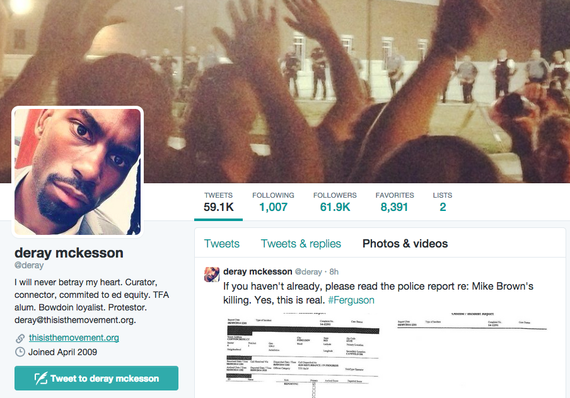
Yet activists themselves often argue that social media is important to their work. DeRay Mckesson, who has emerged as one of a number of leading organizers and activists against police brutality, has spoken on his feed about how vital Twitter is for boosting a movement. When he first drove from his home in Minneapolis—where he works as a school administrator, traveling for protests mainly on weekends—to Ferguson to participate in the protests, Mckesson knew no one; he didn’t even know where he would sleep. Facebook networks found him a couch, and social media was vital in connecting him with the community of protestors. Mckesson reports live from protests through Twitter, where his following has ballooned from 800 followers to more than 61,000 since he began his activism. He’s also used social networks to raise awareness and to organize, by for example creating a text-message alert that informed thousands the instant the grand jury in Ferguson returned a no-indictment verdict in the Michael Brown case.

I talked to Mckesson about social media, protest, and the connections between the two. This interview has been edited for length and clarity.

Noah Berlatsky: What role has social-media activism played in the movement against police brutality that started in Ferguson?

DeRay Mckesson: Missouri would have convinced you that we did not exist if it were not for social media. The intensity with which they responded to protestors very early—we were able to document that and share it quickly with people in a way that we never could have without social media. We were able to tell our own stories.

The history of blackness is also a history of erasure. Everybody has told the story of black people in struggle except black people. The black people in the struggle haven’t had the means to tell the story historically. There were a million slaves but you see very few slave narratives. And that is intentional. So what was powerful in the context of Ferguson is that there were many people able to tell their story as the story unfolded.

The other thing I will add is that Twitter specifically has been interesting because we’re able to get feedback and responses in real time. If we think about this as community building, and we think of community building as a manifestation of love, and we think about love being about accountability, and accountability about justice, what’s interesting is that Twitter has kept us honest. There’s a democracy of feedback. I’ve had really robust conversations with people who aren’t physically in the space, but who have such great ideas. And that’s proven to be invaluable.
Berlatsky: The civil-rights movement of the ’60s obviously didn’t have Twitter or social media or the Internet, but it was able to get its message out to the media in other ways. Why wouldn’t traditional media be adequate now?

Mckesson: Ferguson exists in a tradition of protest. But what is different about Ferguson, or what is important about Ferguson, is that the movement began with regular people. There was no Martin, there was no Malcolm, there was no NAACP, it wasn’t the Urban League. People came together who didn’t necessarily know each other, but knew what they were experiencing was wrong. And that is what started this. What makes that really important, unlike previous struggle, is that—who is the spokesperson? The people. The people, in a very democratic way, became the voice of the struggle.

Our access to information is also so much greater than in the past. For instance, there’s an officer in Ferguson who is really aggressive with protestors for no reason. And I was able to take a picture of him—he would cover his badge with his hand, he would not show his name. So I took a picture of him, put it online, and within 30 minutes they knew everything about him. And that’s a different way of empowering people.

Berlatsky: It sounds like you’re saying that Twitter allowed the movement to be a lot more decentralized. Is that an advantage or a disadvantage? It seems like it might be a disadvantage in terms of settling on specific goals, for example.
Mckesson: It is not that we’re anti-organization. There are structures that have formed as a result of protest, that are really powerful. It is just that you did not need those structures to begin protest. You are enough to start a movement. Individual people can come together around things that they know are unjust. And they can spark change. Your body can be part of the protest; you don’t need a VIP pass to protest. And Twitter allowed that to happen.

I think that what we are doing is building a radical new community in struggle that did not exist before. Twitter has enabled us to create community. I think the phase we’re in is a community-building phase. Yes, we need to address policy, yes, we need to address elections; we need to do all those things. But on the heels of building a strong community.

A screenshot of Mckesson's Twitter profile (Twitter)
A screenshot of Mckesson’s Twitter profile (Twitter)

Berlatsky: You also publish—along with Johnetta (Netta) Elzie—an online newsletter about the protest movement called Words to Action. Do you see yourself as a journalist? Or as an activist? Or both? How important is social media to those roles, or to combining them?

Mckesson: I see myself as a protestor who is also telling the story as it happens. The newsletter started—I remember when Trayvon died, I wanted to follow the case, but I didn’t know what was fact or fiction. I didn’t want that to be the story of Mike Brown. There was so much news; there was so much stuff that was unclear. There were so many questions. The goal was to create a space where people could go to get true news.
Now the movement has spread beyond St. Louis, we cover stories from around the country. So the goal was to be a hub of information. I think the first newsletter that went out had 400 subscribers, and we’re at a little bit less than 14,000 now. And we did a text-message alert for the no-indictment—you could sign up to get a text when the decision came out. And 21,000 people signed up in 10 days, which was wild. So the work is focused on, how can we use the tools we have access to in order to create infrastructure for the movement.

And that’s what Netta and I have been focused on. None of this takes away from our protesting. We don’t put the newsletter out when we’re out until 4 in the morning protesting. The trade-off always veers in the favor of protest. It’s rooted in the confrontation and disruption that is protest. We want to make structures to empower people. The newsletter is a way to empower people. Because we believe that the truth is actually so damning that we can just tell you all the news that’s happening and you should be radicalized. We believe that.

Berlatsky: I saw you talking about Iggy Azalea and issues of appropriation on Twitter a little bit back. That’s the sort of cultural issue that I think many people would say is just a distraction, or is just a way for people to express outrage without working for social change. Do you see cultural conversations around Iggy, or similar issues, as a distraction from your work as an organizer? Or are they complementary?
Mckesson: Good lord. Iggy. (laughs) You’re really trying to get me in trouble.

When people think about protest, they think that protest is always confrontation, protest is always disruption. But protest is also intellectual confrontation and disruption. So part of what we do when the police speak is that we question. The thing about people like Iggy is that we also question. We question what it means to have your success be on a medium and a platform that was born of black struggle, like hip-hop or rap, and what does it mean that you identify with everything but the struggle part? Which is the Iggy issue.

We question these issues of race and struggle and white privilege, because we know that those issues are real, and because those issues have real implications in black communities. And white supremacy is not only dangerous but it is deadly. We know this to be true.

Berlatsky: Do you get a lot of harassment on social media?

Mckesson: Yeah, the death threats aren’t fun. They put my address out there, that’s not fun. I get called a nigger more than I’ve ever been called that in my entire life. I’ve blocked over 9,000 people, so I don’t personally see it as much anymore, but my friends do. So that sort of stuff I don’t love.

But what social media has done is that it has exposed the intensity of hatred in America. People who you wouldn’t expect to be racist … some of the tweets are from people who are well-intentioned but racist. And I appreciate that that’s exposed. People now understand where you’re coming from. And it’s deeply problematic. But we don’t have to guess anymore; we get it.

The harassment is never a good thing. But there’s something valuable in making sure you’re not surrounded by people who think like you. It helps you understand what you think better. And I appreciate that about Twitter. It’s a cacophony of voices. Even when you don’t agree, you at least understand different perspectives. The medium itself sets that up.

Social Media and the Internet: A Story of Privatization

Victoria D. Baranetsky

Abstract

This article will question what role private and public actors assume in the current structure of data collection and what potential rights are violated. To tease out the relationship between the private and government sectors, this article, for sake of argument, accepts as fact that surveillance is a core government function and that data is a public resource collected by private organizations. While those assumptions may be challenged by different definitions of what constitutes a public function, public resource, or mode of collection, this article does not take on those challenges. It also does not ask the normative question of whether data collection should cease or the descriptive inquiry of whether data collection could even be halted if the public wanted it to be.

Rather, this article simply examines the structure surrounding data collection in terms of privatization, and asks whether certain legal doctrines may be triggered, including the Fourth Amendment. To do so, this article will first set out a definition of a privatization and use the military as an example. In Section II, the article will then engage in a short history of the Internet to show how electronic data collection was a core government function later “privatized” by Silicon Valley corporations. Section III will then explain how this dynamic between private and public oversight raises Fourth Amendment concerns. Finally, the Conclusion will then set out suggestions for the future, including a potential justification for new privacy rights.

.pdf available at: http://digitalcommons.pace.edu/cgi/viewcontent.cgi?article=1884&context=plr

The End of America

In The End of America (2008), best-selling author Naomi Wolf lays out her case for saving American democracy. In authoritative research and documentation Wolf explains how events of the last six years parallel steps taken in the early years of the 20th century’s worst dictatorships such as Germany, Russia, China, and Chile.

The book cuts across political parties and ideologies and speaks directly to those among us who are concerned about the ever-tightening noose being placed around our liberties.

In this timely call to arms, Naomi Wolf compels us to face the way our free America is under assault. She warns us–with the straight-to-fellow-citizens urgency of one of Thomas Paine’s revolutionary pamphlets–that we have little time to lose if our children are to live in real freedom.

According to Wolf:

Recent history has profound lessons for us in the U.S. today about how fascist, totalitarian, and other repressive leaders seize and maintain power, especially in what were once democracies. The secret is that these leaders all tend to take very similar, parallel steps. The Founders of this nation were so deeply familiar with tyranny and the habits and practices of tyrants that they set up our checks and balances precisely out of fear of what is unfolding today. We are seeing these same kinds of tactics now closing down freedoms in America, turning our nation into something that in the near future could be quite other than the open society in which we grew up and learned to love liberty.

Wolf is taking her message directly to the American people in the most accessible form and as part of a large national campaign to reach out to ordinary Americans about the dangers we face today. This includes a lecture and speaking tour, and being part of the nascent American Freedom Campaign, a grassroots effort to ensure that presidential candidates pledge to uphold the constitution and protect our liberties from further erosion.

Corporations Spy on Nonprofits With Impunity

download (3)

Ralph Nader Headshot

By Consumer advocate, lawyer and author
Posted: 08/22/2014 8:16 pm EDT Updated: 10/22/2014 5:59 am EDT
Here’s a dirty little secret you won’t see in the daily papers: Corporations conduct espionage against U.S. nonprofit organizations without fear of being brought to justice.

Yes, that means using a great array of spycraft and snoopery, including planned electronic surveillance, wiretapping, information warfare, infiltration, dumpster diving and so much more.

The evidence abounds.

For example, six years ago, based on extensive documentary evidence, James Ridgeway reported in Mother Jones on a major corporate espionage scheme by Dow Chemical focused on Greenpeace and other environmental and food activists.

Greenpeace was running a potent campaign against Dow’s use of chlorine to manufacture paper and plastics. Dow grew worried and eventually desperate.

Ridgeway’s article and subsequent revelations produced jaw-dropping information about how Dow’s private investigators, from the firm Beckett Brown International (BBI), hired:

• An off-duty DC police officer who gained access to Greenpeace trash dumpsters at least 55 times;

• a company called NetSafe Inc., staffed by former National Security Agency (NSA) employees expert in computer intrusion and electronic surveillance; and,

• a company called TriWest Investigations, which obtained phone records of Greenpeace employees or contractors. BBI’s notes to its clients contain verbatim quotes that they attribute to specific Greenpeace employees.

Using this information, Greenpeace filed a lawsuit against Dow Chemical, Dow’s PR firms Ketchum and Dezenhall Resources, and others, alleging trespass on Greenpeace’s property, invasion of privacy by intrusion, and theft of confidential documents.

Yesterday, the D.C. Court of Appeals dismissed Greenpeace’s lawsuit. In her decision, Judge Anna Blackburne-Rigsby notes that “However Greenpeace’s factual allegations may be regarded,” its “legal arguments cannot prevail as a matter of law” because “the common law torts alleged by Greenpeace are simply ill-suited as potential remedies.” At this time Greenpeace has not decided whether to appeal.

The Court’s opinion focused on technicalities, like who owned the trash containers in the office building where Greenpeace has its headquarters and whether the claim of intrusion triggers a one year or three year statute of limitations. But, whether or not the Court’s legal analyses hold water, the outcome — no legal remedies for grave abuses — is lamentable.

Greenpeace’s lawsuit “will endure in the historical record to educate the public about the extent to which big business will go to stifle First Amendment protected activities,” wrote lawyer Heidi Boghosian, author of Spying on Democracy. “It is crucially important that organizations and individuals continue to challenge such practices in court while also bringing notice of them to the media and to the public at large.”

This is hardly the only case of corporate espionage against nonprofits. Last year, my colleagues produced a report titled Spooky Business, which documented 27 sets of stories involving corporate espionage against nonprofits, activists and whistleblowers. Most of the stories occurred in the US, but some occurred in the UK, France and Ecuador. None of the U.S.-based cases has resulted in a verdict or settlement or even any meaningful public accountability. In contrast, in France there was a judgment against Electricite de France for spying on Greenpeace, and in the UK there is an ongoing effort regarding News Corp/News of the World and phone hacking.

Spooky Business found that “Many of the world’s largest corporations and their trade associations — including the U.S. Chamber of Commerce, Walmart, Monsanto, Bank of America, Dow Chemical, Kraft, Coca-Cola, Chevron, Burger King, McDonald’s, Shell, BP, BAE, Sasol, Brown & Williamson and E.ON — have been linked to espionage or planned espionage against nonprofit organizations, activists and whistleblowers.”

Three examples:

• In 2011, the U.S. Chamber of Commerce, its law firm Hunton & Williams, and technology and intelligence firms such as Palantir and Berico were exposed in an apparent scheme to conduct espionage against the Chamber’s nonprofit and union critics.
• Burger King was caught conducting espionage against nonprofits and activists trying to help low-wage tomato pickers in Florida.
• The Wall Street Journal reported on Walmart’s surveillance tactics against anti-Walmart groups, including the use of eavesdropping via wireless microphones.

Here’s why you should care.

This is a serious matter of civil liberties.

The citizen’s right to privacy and free speech should not be violated by personal spying merely because a citizen disagrees with the actions or ideas of a giant multinational corporation.

Our democracy can’t function properly if corporations may spy and snoop on nonprofits with impunity. This espionage is a despicable means of degrading the effectiveness of nonprofit watchdogs and activists. Many of the espionage tactics employed appear illegal and are certainly immoral.

Powerful corporations spy on each other as well, sometimes with the help of former NSA and FBI employees.

How much? We’ll never begin to know the extent of corporate espionage without an investigation by Congress and/or the Department of Justice.

While there is a congressional effort to hold the NSA accountable for its privacy invasions, there is no such effort to hold powerful corporations accountable for theirs.
Nearly 50 years ago, when General Motors hired private investigators to spy on me, it was held to account by the U.S. Senate. GM President James Roche was publicly humiliated by having to apologize to me at a Senate hearing chaired by Senator Abraham Ribicoff (D-CT). It was a memorable, but rare act of public shaming on Capitol Hill. GM also paid substantially to settle my suit for compensation in a court of law (Nader v. General Motors Corp., 307 N.Y.S.2d 647).

A public apology and monetary settlement would have been a fair outcome in the Greenpeace case too.

But in the intervening half-century our Congress has been overwhelmed by lethargy and corporate lobbyists. Today, Congress is more lapdog than watchdog.

Think of the Greenpeace case from the perspective of executives at Fortune 500 companies.

They know that Dow Chemical was not punished for its espionage against Greenpeace, nor were other US corporations held to account in similar cases.

In the future, three words may well spring to their minds when contemplating whether to go after nonprofits with espionage: Go for it. Unless the buying public votes with its pocketbook to diminish the sales of these offending companies.

More information about the Center for Corporate Policy is available at www.corporatepolicy.org.

The Spooky Business report is available at: http://www.corporatepolicy.org/spookybusiness.pdf.

Religion and Psychology: Complementary Disciplines or Competing Ideologies?

Religion and Science have shared a complex relationship which has historically fluctuated between cooperation and conflict. Both disciplines arise from an intellectual desire to explain the natural world, but their paths have diverged over the nature of knowledge. Holmes Rolston III, a Distinguished Professor of Philosophy at Colorado State University, sees their missions as complimentary, but different: “science operates with the presumption that there are causes to things, religion with the presumption that there are meanings to things.” [1]. Using the Aristotlean model, science generally deals the notion of efficient causation, the explanation of how phenomenon occurs, while religion deals with the notion of final causation, or why it occurs. [2].

Science claims objectivity by incorporating the scientific method. Its goal is to compile empirically observable facts in an effort to understand and predict phenomena in the Natural World. It then tries to establish cause and effect relationships and create explanatory theories of how the universe operates. Its reasoning is deductive; it observes the specific to make inferences about the general. Reality is only experienced through the senses and should remain value neutral. The purpose of Science is to explain what is, not what ought to be.

Religion agrees that the world is intelligible and is capable of being logically understood. However, natural law alone “provides only the beginning of illumination.” [3]. The understanding gained through our senses is useful, but incomplete. Its full value is realized by imparting significance, or “meaning” to the phenomenon. Reality is subject to our conscious awareness; shaped by interpretation, as well as, by experience. Religion’s purpose is to supply the meanings for why things happen; to explain what is in order to evaluate what ought to be. In this feature, Religion is more akin to Philosophy than Science.

According to Rolston, the problem occurs when the two disciplines transcend these boundaries by trying to explain the world in the other’s terms. Each discipline operates logically only within its own paradigm. Science is constrained to explaining causal events through quantitative proofs while Religion is restricted to applying qualitative proofs. This principle is exemplified by the social sciences attempts to measure abstract concepts such as Justice or Happiness. When Science enters into the realm of meanings, its method no longer retains its validity. Likewise, religious logic breaks down when it attempts to attribute causes.

Psychology can be fairly assessed as trying to accomplish both objectives. In its study of the organic biology of the brain, its course remains scientific. Psychology explores biological makeup, chemical reactions, and neural activity through synaptic nerves in an attempt to compile causal explanations for how the organic brain operates. It uses the same methodology as biologists, chemists, and physicists. Where it deviates from its sure scientific footing is through its attempt to assess how the conscious mind operates. Here it seems to enter the realm of the theosophical by trying to derive meaning for why the sentient mind interprets reality in the way that it does.

A valid critique of Psychology is justified when it turns its attention away from testable hypothesis’ to generate its theories. It often takes a philosophical approach in its inquiries and tries to legitimize subjective intellectual contemplation as objective scientific evaluation. The questions it attempts to answer, such as the origin of religious belief, however, are not always scientific in nature. It is at these times that a conflict between Psychology and Religion arises, and they become little more than competing ideologies.

For the purposes of this paper I will take a look at two competing psychological theories about the origin and nature of religious belief. The first contribution will be an analysis of Sigmund Freud’s Future of an Illusion, which offers a negative view of Religion. The second text will be William James’ lectures on The Varieties of Religious Experience which present a more optimistic view of Religion. Hopefully this will shed some light on the difficulties Psychology faces when attempting to inquire into the nature of religious belief.

Freud and Religion

Freud became aware of subconscious mental processes while treating mental patients suffering from neurosis and hysteria. Freud developed a method of analyzing human pathology termed Psychoanalysis which he viewed as an application of the scientific method to the study of human behavior. In an exercise called free association, Freud asked patients to randomly express their thoughts in therapy sessions. Freud believed this provided valuable insights into how the human mind draws conclusions about reality.

Freud theorized that the human psyche was controlled in a large part by the subconscious which sought to project primal instincts such as fear, sexuality and aggression outwardly. According to Freud, emotional symptoms and character traits were complex solutions to the unresolved conflicts of childhood. He believed that the subconscious was a composition of unrealized instincts and desires which manifested themselves in the personality of an individual. This was the basis for his analysis of religious beliefs.

Freud believed religious belief arises as a form of wish fulfillment in man’s psychological attempts to control the uncertainty of nature and fate, “life and the universe must be robbed of its terrors.” [4]. Freud saw the development of consciousness as part of the evolutionary process, with religious belief being an initial stage. In this developmental stage, which he termed “humanization of nature,” Freud suggests:

Impersonal forces and destinies cannot be approached; they remain eternally remote. But if the elements have passions that rage as they do in our own souls, if death itself is not something spontaneous but the violent act of an evil will, If everywhere in nature there are beings around us that we can know in our own society, then we can breathe freely, can feel at home in the uncanny and can deal by psychical means with our senseless psychology. [5].

Freud believed that the “humanization of nature” allowed individuals to project feelings of control over natural forces. The individual cannot comprehend the overwhelming forces of nature as his equal, therefore he makes them divine and gives them the attributes of a father. “It has an infantile prototype … For once before one has found oneself in a similar state of helplessness: as a small child, in relation to one’s parents.” [6]. Parents, like nature, cause fear in individuals by stripping them of their sense of control “thus it was natural to assimilate the two situations.” [7]. The father figure is adopted as the model for the divinity. He is to be feared for his powerful influence on the survival of the child, and yet trusted for his protection against external dangers.

At this point Freud turns toward the failing of the original model. There was a gradual shift in the understanding of the Gods’ role in controlling nature. As individuals realized that the Gods did not protect them from pain and suffering, they made the Gods subordinate to Fate. The Gods who created fate, along with nature, had arranged it so they could leave them to operate on their own. “The more autonomous nature became and the more the god’s withdrew from it … the more did morality become their domain.” [8]. The Gods attention turned towards remedying “the defects and evils of civilization.” [9]. This change in commission resulted in a handing down of divine precepts which “were elevated beyond human society and were extended to nature and the universe.” [10].

According to Freud, this led to the understanding of a higher moral order and purpose, imparting religious significance to individual lives. The divine attributes eventually evolved into a single divine entity projected as a benevolent caretaker whose rules protect us from the “merciless” forces of this world. “In the end all good is rewarded and all evil punished, if not actually in this form of life then in the later existences that begin after death.” [11]. This allows the individual to rationalize the existence of pain and suffering in the world and permits hope of a distant redress of grievances.

Freud’s conclusion is that religious teachings are not the product of experience or the end results of rational logic, but are simply illusions. Religious beliefs, in his assessment, are the product of our subconscious desires to fulfill “the oldest, strongest, and most urgent wishes of mankind.” [12]. Religious belief is wish fulfillment projected into the external world; God is simply a false archetype constructed as a form of psychological defense mechanism.

Freud’s belief is that the provability of Science is superior to that of Religion, and that the illusion will eventually pass into oblivion. On an individual level, Religion is simply cerebral self medication, whereas on a societal level, it is a means of coercing reluctant individuals into suppressing their primal instincts. According to Freud, this is the one saving grace of Religion.

A legitimate criticism of Freud is that he abandons the scientific method for the same type of philosophical inquiry into epistemology which he rejects. Freud collects no empirical data, forms no testable hypothesis, and presents no objective evidence to support his theory of Religion. His assumptions wind up being just as unproven as the dogma of religious belief. Freud acknowledges this lack of evidence, simply asking us to rely on the validity of the psychoanalytic approach.

Another critique of Freud’s “humanization of nature” model is that individuals are driven to pursue both, religious and scientific knowledge for the same reasons; the lack of control over one’s environment leads one to inquire into cause and effect relationships in an effort to control their environment. Scientific inquiry best serves these interests when attempting to control defined physical and chemical interaction, and is quite deficient in explaining social relationships. Conversely, religious practice is limited in scope to the examination of human behavior. With the exception of Occultism, Religion does not concern itself with controlling physical processes.  Therefore, both disciplines serve different, but necessary, psychological needs.

An atheistic reliance on Science in the social realm simply provides a rationalization for dismissing unwanted moral restraints.  “Why can’t the theist put down Freud’s rival belief? Antireligious “scientific” belief is really the same in kind, a governing Weltanschauung, and we can easily postulate it for some unconscious rebellion against one’s parents, some desire to be free from guilt or moral commandments…” [13].

Finally, Freud’s analysis fails to adequately account for the belief systems of Eastern religions. Freud’s explanation of unconscious archetypes does not account for the development of non-deistic belief systems such as Buddhism or Confucianism, which do not provide the psychological comfort of a  personal deity. Neither does it adequately address the belief shared by Hindus and Deists, of an impersonal, mechanistic God whose primary function is to administer the proper functioning of divinely ordained cycles and relationships within the natural world. Not all religious belief systems fit easily into the paradigm of Freud’s psychoanalytic hypothesis.

As a result, Freud’s analysis leaves the door open for the possibility that the concept of the Divine exists as a form of innate knowledge, rather than being the result of socialization.  Assuming, arguendo, the ontological arguments of Socrates and Rene Descartes, the concept of God may simply be the unconscious acknowledgement  that we understand such abstract concepts as infinity, perfection, omnipotence, omniscience, and omnipresence, despite the fact they form no part of the human experience. In this scenario, it would be natural for an individual to analogize the divine attributes with  comprehensible human archetypes, such as father, mother, king, teacher and healer. Perhaps, this is the most rational way to communicate abstract concepts which are not commonly experienced through sensory perception. Personalizing the divine attributes through human archetypes may simply be the best educational tool we have developed for conveying universally intuited moral understanding.

James and Religion

In 1902, distinguished psychologist and philosopher, William James, gave a series of lectures at the University of Edinburgh, entitled, The Varieties of Religious Experience. James studied the written testimony of numerous individuals attempting to describe their personal spiritual experiences, in an attempt to conduct an empirical study of religious beliefs. Like Freud, most of his observations came from individual case studies and his arguments have more of a philosophical ring to them.  However, in contrast to Freud,  James focuses on the personal nature of religious experience outside the context of socialized community belief structures.

James views Religion as an individual consciousness, rather than a group experience. His position is that the truly religious person is not shaped by society. James acknowledges there is a superficial mode of Religion in which the adherent follows “conventional observances” as proscribed by his culture. James agrees that in this type of simple religious observance, the adherent is not intellectually transformed, but simply conditioned to perform traditional practices and customs. James writes this off as “meaningless” religious observance. To James, the true believer is an eccentric personality and individualistic in his approach, pointing out that many religious believers are inspired to act in ways that are contrary to traditional norms. This is exhibited by the “exceptional and eccentric” demeanor of religious reformers such as George Foxx. [14].

James argues that an individual’s religious beliefs are grounded in the conscious: “All our attitudes moral, practical, or emotional, as well as religious are due to the ‘objects’ of our consciousness, the things which we believe to exist, whether real or ideally along with ourselves.” [15]. Concrete concepts such as God, as well as more abstract concepts such as mercy, justice, and holiness exist as “pure ideas” of which the individual has no prior experience. These ideals may be “present to our senses” or may merely exist as thought, but they bring forth sincere and genuine responses.

The paradox is that words like God, soul, and immortality have no sub-context in the natural world. They are theoretically devoid of any significance yet are understood in the context of religious practice much the same way as Science lends significance to words such as time and space in the material world. According to James, “This absolute determinability of our mind by abstractions is one of the cardinal facts in our human constitution.” [16].

James’ view is that attributing human characteristics  to God is a consequence of the inability to meaningfully express the concepts Religion deals with. These abstract religious concepts are internalized as intuitions that operate on a deeper level than rational thought. In James’ view rationality is preconditioned for by our intuitions and is an inferior method for founding belief: “The truth is that in metaphysical and religious sphere, articulate reasons are cogent for us only when our inarticulate feelings of reality have already been impressed in favor of the same conclusion.” [17]. Our instinct leads and our intelligence follows. As a result, no belief system, whether scientific or rational, can be changed by rational argument.

James did not see the natural world as perceived through the senses as a providing a full measure of reality. James speculated “…so long as we deal with the cosmic and the general we deal only with the symbols of reality, but as soon as we deal with private and personal phenomena as such, we deal with realities in the completest sense of the term” [18].

In James’ opinion, our inner experience may be subjective and unscientific, but it has the greatest effect on shaping our reality. Inner religious motivations lead to changes in character and manifest themselves in the deeds accomplished by the religious individual. The “stronghold of religion” lies in this individuality, or self-actualization of the believer, and through this “the theologian’s contention that the religious man is moved by an external power is vindicated.” [19].

James acknowledges that proof of whether God exists is not needed for Religion to serve its purpose. James determines the way to save the utility of religious belief is by supplying justification for the illusion. His defense of Religion consigns the Divinity to the role of little more than an inspirational device. For James, the actual power of God is manifested through the individual’s belief in God.

James’ view of Religion is very individualistic in this sense. There is no sense of community, morality, or an ordered universe such as prevails in many religious traditions. James disposes of any notion of a universal purpose by assigning personal beliefs about the divine dictate as overbeliefs. In James’ view, a person is only capable of ascertaining the divine will for their own behavior and interactions.

James dismisses the notion of a personal deity, defining God is a personal experience rather than a sovereign entity. This addresses the critique that Religion is oppressive in the application of its subjective moral standards onto unwilling members of society, but it takes much of the substance away from what a Divine Being is or represents in most cultures.

At a purely subjective level Religion is vindicated. Whether or not religious tenets are correct is of no consequence as long as they prove useful to the individual. The subconscious self creates a personal entity which guides us through our personal reality, making God a “causal agent as well as a medium of communion.” [20]. This subjective perception of reality serves a rational function of empowering the individual religious believer.

Conclusions

Freud and James’ individual case studies leave us with an unsatisfactory scientific resolution as to the original source of religious faith. Ironically, both theories fall victim to the same epistemological shortcomings they originally set out to confront by examining the source of the concept of God. What we are left with is the centuries old question DeCartes left us with — does the intrinsic belief in God originate from an idea implanted by an external force which acts upon us, or is it simply the by-product of an innate desire to assign meaning to an incomprehensible world.

Neither Freud nor James provides us with a scientific solution to the problem. They offer no insights on what empirical data we should collect, form no testable hypothesis to validate their conclusions, do not control for different religious ideologies, and base their findings on a miniscule sample of humanity. Instead, each man relies on the trustworthiness of the psychoanalytic approach to correctly diagnose the subjective, unconscious motivations of their subjects.  Freud and James both come to the determination that religious belief is an internalized rationalization of the outside world, but arrive at different conclusions for the utility this rationalization serves.

For Freud, religious belief is simply a psychological defense mechanism — a kind of personalized rationalization to provide us with a sense of self-control over an unpredictable and hostile environment. Its usefulness is in providing  a societal control mechanism which coerces reluctant individuals into suppressing their primal instincts.

James, on the other hand, views religious belief as an individualized experience. Our inner experience helps shape our reality. The utility of Religion is in the self-actualization of the believer which empowers us to achieve greater accomplishments. Personal faith motivates us to look beyond our individual deficiencies.

Neither intellectual attributes religious belief to a pathological condition or a deficiency in critical reasoning skills. Conversely, each psychologist views Religion as a natural cognitive outgrowth of the mind’s attempt to process imperfect information which cannot be experienced through our natural senses. What motivates us to attach personal significance to mundane human experiences? Why do individuals continue in their religious faith with little or no tangible proof of its utility? Is the belief in a Divine Being helpful or harmful to our daily existence? These are qualitative inquiries which fall outside the realm of testable scientific hypothesis. As such, they are subjective experiences which become matters of personal conscience.

Psychology’s conjecture into how the mind forms abstract religious concepts requires it to resort to the same speculative ontological arguments for which it criticizes  Theology.  Psychology retains its sure scientific footing when it limits its scope to the ream of quantifiable proofs; it overreaches when it attempts to magnify subjective  individual  experiences into broad, generalized assumptions. Likewise, Religion retains its integrity when it limits its examination to the realm of individual human potential; overreaching when it attempts to extrapolate broad, generalized principles and indiscriminately apply them at an organizational level. When reduced to over-simplified, dogmatic doctrine, both fields of study are susceptible to harmful misapplication. It is at these ideological impasses that Psychology and Religion stop functioning as  complimentary disciplines and become little more than competing belief systems.

By Lawrence Christopher Skufca (2007)

Some Rights Reserved

Bibliography

[1]. Holmes Rolston III, Science and Religion: A Critical Survey, pp. 22-23.

[2]. Owen Gingrich, “God’s Universe.” p. 12.

[3]. Holmes Rolston III, Science and Religion: A Critical Survey, p. 23

[4]. Sigmund Freud, The Future of an Illusion, p. 20.

[5]. Ibid., p. 20.

[6]. Ibid., p. 21.

[7]. Ibid., p. 21.

[8]. Ibid., p. 22.

[9]. Ibid., p. 22.

[10]. Ibid., p. 23.

[11]. Ibid., p. 23.

[12]. Ibid., p. 38.

[13]. Holmes Rolston III, Science and Religion: A Critical Survey, p. 163.

[14]. William James, The Varieties of Religious Experience, Lecture I. p. 4.

[15]. William James, The Varieties of Religious Experience, Lecture III. p. 1.

[16]. Ibid., p. 3.

[17]. Ibid., p. 13.

[18]. William James, The Varieties of Religious Experience, Lecture XX. p. 11.

[19]. Ibid., p. 20.

[20]. Ibid., p. 22.

Thomas Jefferson: The Progressive Libertarian

Thomas Jefferson’s last testament to his political, religious, and educational ideology is encapsulated by his self-ascribed epitaph: “Here lies Thomas Jefferson, Author of the Declaration of American Independence, of the Statute of Virginia for Religious Freedom, and father of the University of Virginia.” [1]. Fittingly, these three accomplishments are the culmination of Thomas Jefferson’s lifework, and reflect the progress he made in affecting American attitudes in each of these areas. Continue reading Thomas Jefferson: The Progressive Libertarian

Terrorists Are the Threat, Not Muslims

Islam is the world’s second largest religion. A 2012 Pew Research Center study estimates Islam has 1.6 billion adherents, making up over 23% of the world population. Conversely, there are less than 2.4 million suspected Muslim terrorists in the World. Less than one third of these militants have declared Jihad on the West.

The Hezbollah Party in Lebanon is generally agreed by Western intelligence agencies to have the largest terrorist capabilities in the World. Surprisingly, there are no membership estimates. However, based on the common knowledge that Hezbollah is a Shi’ite organization, and the estimates that the Shi’ites represent approximately 27% of the Lebanese population, if every Shia in Lebanon was a member of Hezbollah, at most, the party would have an estimated 1,588,292 members. Nevertheless, Hezbollah activities are known to be limited to the Palestinian struggle with Israel and unlike the extremist groups seeking to impose Sharia Law, Hezbollah does not promote an Anti-Western, Anti-Christian Agenda.

The rest of the known Muslim terrorist organizations in the Middle East which advocate strict Sharia government, total less than 764,500 members. The Muslim Brotherhood (which surprisingly the U.S. does not designate as a terrorist organization) claims 500,000 adherents; Jaish al-Islam (Syria) ranges anywhere between 5,000-50,000 members; the Tehrik-i-Taliban (Pakistan) has less than 35,000 members; The Taliban (Afghanistan) has an estimated 25,000-36,000 fighters; ISIS (Syria) can ‘muster’ between 20,000 and 31,500 fighters; Ahrar al-Sham has an estimated 10,000-20,000 members; Boko Haram (Yobe State) has an estimated 10,000-15,000 members; The Haqquani Network (Afghanistan) has an estimated 10,000 members; Lashkar-e-Zill (Afghanistan) has an estimated 10,000 members; Liwa al-Tawhid (Syria) has an estimated 8,000-10,000 members; Suqour al-Sham (Syria) has an estimated 9,000-10,000 members; the military wing of Hamas (Palestine) has an estimated 10,000 operatives; Jabhat al-Nusra (Syria) has an estimated 5,000-7,000 operatives; Al Shabab (Somalia) has an estimated 3,000-5,000 members; Lashkar-e-Taiba is estimated to have “several thousand” members; Ansar al-Sham (Syria) has approximately 2,500 fighters; the Jamiat-ul-Mujahideen (Bangladesh), at it’s peak, had approximately 2,000 members; Hizbul-Mujahideen (Kashmir) has an estimated 1500 operatives; Lashkar-e-Jhangvi (Pakistan) has less than 1000 members; Jemaah Islamiyah (Indonesia) has less than 1000 members; Al-Qaeda has an estimated 500-1000 operatives; Ansar al-Islam (Iraq) has 500-1000 members; Harkat-ul-Jihadi al-Islami (Pakistan has 500-700 members; Abu Sayyaf (Philippines) has 200-500 members; Harakat-ul-Mujahedeen (Pakistan) has an estimated 300 members; Jaish-e-Muhammad (Pakistan) has “several hundred” armed volunteers; and Al-Badr (Kashmir) has an estimated 200 operatives.

These numbers reflect that less than .0015% of Muslims would qualify as members of suspected terrorist organizations. Less than .0005% would be of the Anti-Western Jihadist persuasion. Put another way, 99.9995% of Muslims are not Anti-Western militant extremists.

The United States has a population of approximately 320 million people. Approximately 6/10 of one percent of the population is Muslim, for a total of two million Muslims in the U.S. If the numbers above hold up, out of 2 million Muslims, there would potentially be as many as 1000 militant Muslims in the U.S., with as few as 40 of them being a member of ISIS. This means 1 out of every 1999 Muslims you meet in America might harbor anti-Western extremist views. More importantly, this means 1998 out of 1999 do not. If we limit the conversation to members of ISIS, these numbers would skyrocket. Statistically speaking, the odds of a U.S. Muslim being a member of ISIS would increase to 1 in 50,000.

To place these numbers in the proper perspective, if the average American met one new Muslim per day, on the average, you would only meet one militant Muslim every 5 1/2 years. You would average one member of ISIS every 138 years.

So as we are bombarded with all the rhetoric and sensationalist claims designed to persuade us that these 40 statistical anomalies are the biggest threat the U.S. has ever faced, let us please remember that it is the terrorists who are the threat and not the Muslims.

By Lawrence Christopher Skufca (2015)

The Minerva Initiative: Are Student Activists Being Targeted by U.S. Universities?

How many Rutgers students have heard of the Minerva Initiative? If University administrators and the Department of Defense had their choice, none of them would. The Minerva Initiative is a joint research project between the DOD and US universities which receive funding to study social movements to identify trigger events which may lead to civil unrest. [1]. Rutgers University is a project participant. [2].

The program was implemented in 2008 to formulate a strategy for identifying social movements and undermining their efforts to organize. Minerva was initiated over concerns that the economic crisis triggered by the mortgage collapse had the potential to lead to mass civil unrest such as occurred with the Arab Spring movement and the riots in France. The DOD asked University researchers to examine social media trends to identify “tipping points” which could ignite mass civil protests and to develop strategies for immobilizing potential threats.

It has been reported by the Guardian [3] and the Partnership for Civil Justice Fund [4] that these strategies were utilized by the FBI Joint Terrorism Task Force in response to the Occupy Wall Street Movement in 2011. The FBI identified leaders of the OWS movement in the months prior to the group occupying Zucotti Park by tracking the activity of group organizers on social media sites. The JTTF then formulated a joint national response among local police departments and corporate security personnel aimed at suppressing the protests. Furthermore, the ACLU has reported that this type of data mining has been regularly used by the F.B.I. and cooperating law enforcement agencies to target journalists, whistle-blowers and activists for engaging in First Amendment speech. [5].

The practical effect of the Minerva Initiative has been that paranoid University administrators, fueled with fear propaganda supplied by the DOD and law enforcement agencies, are currently monitoring student’s electronic activity on their networks to identify “potential threats.” This has led to a number of socially concious students who are too politically outspoken being labeled as agitators. These students are then monitored, targeted and harassed by University police and administrators seeking to neutralize the threat and deter student protests.

This, coupled with the Snowden revelations over the NSA mass domestic surveillance programs, raises legitimate concerns over the potential for abuse within the US intelligence community’s domestic surveillance network. The NSA has admitted that their mass surveillance and data collection programs have not led to the prevention a single act of domestic terrorism in the US. [6]. However, the program has created a culture of paranoia and retaliation against political dissidents deemed to pose a threat. This has created a noticeable chilling effect on individuals discussing controversial subject material or questioning the underlying motivations behind public policy decisions.

More information about the Minerva Initiative can be found at:  minerva.dtic.mil.

The FBI documents obtained by the Partnership for Civil Justice Fund in their 2012 Freedom of Information Act request can be found at: http://www.justiceonline.org/fbi_files_ows#document.

More information about the crackdown on journalists, whistleblowers and activists can be found at:  https://www.aclu.org/sites/default/files/assets/unleashed-and-unaccountable-fbi-report.pdf.

Lawrence Christopher Skufca (2015)

Bibliography

[1]   Stable URL: http://minerva.dtic.mil/overview.html. [accessed 6/15/2015].

[2]   Stable URL: http://minerva.dtic.mil/funded.html [accessed 6/15/2015].

[4]   Stable URL: http://www.justiceonline.org/fbi_files_ows [accessed 6/15/2015].