Category Archives: Corporate Accountability

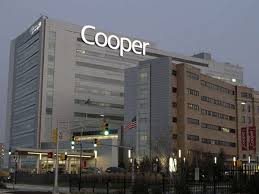
Cooper Hospital Releases Report Citing $18.8 Million In Fraud

The Camden Center’s Action Came Under Legal Pressure. Overcharges Also Were Found.

images

POSTED: November 04, 1998

Under pressure from a federal court suit, the management of Cooper Hospital-University Medical Center yesterday released an internal report that shows that the hospital has lost at least $18.8 million to fraud since 1987.

The 256-page report, which Cooper’s management had fought in court to keep secret, says publicly for the first time that the Camden hospital lost an approximate total of $21.6 million, including the $18.8 million, through a combination of fraud, overcharging and questionable contract charges. In earlier statements filed in court, the hospital had estimated it had lost $13 million to fraud, largely through the actions of two former Cooper financial executives who pleaded guilty to federal charges in 1994. Most of the lost money was taken through bills submitted to the hospital by a collection agency and a computer-assistance firm employed by the hospital, according to the report.

The two former Cooper officials convicted of fraud, P. John Lashkevich and John M. Sullivan, received a portion of the stolen money between 1987 and 1994 from one of the companies, the report says.

The report says high-ranking officials of the hospital, including chairman of the board Peter Driscoll and president Kevin Halpern, often locked horns with committee members charged with investigating the missing money. The report says some board members wanted a completely independent investigation of fraud at the hospital, while Driscoll objected.

The report says Driscoll and other hospital managers knew about a federal corruption investigation of Cooper for a year before they informed the hospital board of the investigation.

“Cooper has been the victim of a massive crime wave,” the report says. “The criminal activity which has been conclusively admitted in federal court has been both massive and pervasive. It is equally disturbing that Cooper’s own systems did not detect or were readily manipulated to permit the fraud and prevent its detection,” the report says.

The report, written by a seven-member Ad Hoc Internal Control Committee, including Driscoll and Halpern, was released to the public after a federal judge ruled that Cooper had to hand over the report to the hospital’s former outside auditors, whom Cooper has sued to recoup damages.

Driscoll and Halpern could not be reached for comment yesterday.

In a sweeping indictment of financial procedures at the hospital, the committee recommended numerous changes to avoid future fraud.

“The committee remains unconvinced that contractual debacles . . . are prevented or reliably detected by . . . Cooper’s new contract policies,” the report says.

The report, written in 1997, says there are “reasonable grounds” to investigate 10 more areas of hospital business, including about $800,000 in wire transfers. It also suggests that all outside collection agencies used during the period of the fraud should be reviewed.

The corruption at Cooper could have exceeded $18.8 million, the report says. “The fact that a potential area of subject is not discussed in this report does not mean that it has been given a `clean bill of health,’ ” the report says.

Hospital spokeswoman Peggy Leone said that “each area listed has been examined on an individual basis and evaluated on its own merit by various bodies both within and outside the institution, including our financial committee, our audit committee and our external auditors.” She said the hospital was confident that the problems had been resolved to the satisfaction of the board of trustees.

The document outlined what it called “massive fraud” by Lashkevich, Cooper’s former controller, and Sullivan, the hospital’s former executive vice president for finance. The two men pleaded guilty to money-laundering and other corruption charges in July 1994 and are in prison. They subsequently cooperated with the hospital’s internal investigation.

According to the report, the two men and some business associates were able to obtain millions in kickbacks and fraudulent payments through collection firms, finance companies and accounting firms. The report says Sullivan began taking kickbacks from a collection firm, Financial Management Corp., in 1987. Direct embezzlement began in 1989 with Lashkevich, the report says.

The men helped divert about $7.5 million through J-Jet, a collections agency employed by Cooper to collect unpaid hospital bills, according to the report.

About $2.1 million was stolen from bank accounts set up for a proposed Cooper takeover of the former Metropolitan Hospital in Philadelphia, the report says. The takeover never occurred.

The report also lists about $7.5 million lost through Flexco, a joint computer consulting venture of Cooper Hospital, and Flex/Sys, a New York data corporation. The report says $5.6 million was lost to fraud, $739,000 to contract overcharges, and $1.1 million in questionable contract charges. In July 1996, Cooper filed a civil lawsuit against the Flex entities, seeking to recoup the money. No criminal charges have been filed in the Flexco matter.

In each instance, the frauds were made possible because of a lack of financial controls, the report says.

“Virtually all of the internally generated fraudulent transactions were questionable from an accounting control perspective,” the reports says. It says Lashkevich either transferred or fired accounting staff members who attempted to warn management of problems.

In details not previously publicized, the report shows how Lashkevich and Sullivan had unsupervised control over tens of millions of dollars of Cooper funds, and manipulated the system for nearly seven years without drawing any attention from hospital administrators.

“The ability to bypass or defeat controls grew from an institutional culture that delegated and outsourced too much responsibility, without developing effective controls to regulate the delegated responsibility,” the report says.

The report says that some board members believed that Cooper’s investigating committee was not independent. The report says: “The minutes reveal a continuing concern by the Board (and an appreciation by the Board of the public’s concern) that the investigation be conducted objectively and free from conflicts of interest.”

The report says Driscoll, the board chairman, did not want a fully independent committee. The report quotes Driscoll as saying, “It would be a mistake to have a committee that did not have a commitment to Cooper and its mission.”

Cooper said it had recovered about $5 million, including restitution by Lashkevich and Sullivan. It is pursuing other civil litigation to recoup other lost money.

The internal report became public yesterday as the result of a civil lawsuit.

In 1997, Cooper Hospital sued its former accounting firm, KPMG Peat Marwick, alleging that the firm was responsible for allowing some of the fraud to go undetected at Cooper. Peat Marwick has consistently denied that accusation in court.

Lawyers for Peat Marwick sought the hospital’s internal investigation through a discovery motion in court. The motion was granted, thus making the report part of the public court record.

Cooper Health System Pays $12.6 Million To Resolve False Claims Lawsuit Over Kickbacks Paid To Referring Physicians

logo-prn

PHILADELPHIA, Jan. 24, 2013 /PRNewswire

A federal lawsuit filed by prominent Delaware Valley cardiologist Nicholas L. DePace, M.D., sparked a multi-year investigation by the United States Department of Justice and the New Jersey Attorney General’s Office that has resulted in New-Jersey based Cooper Health System, and Cooper University Hospital paying $12,600,000 to settle Medicare and Medicaid fraud allegations.

The qui tam lawsuit filed in federal district court in New Jersey in 2008 by Dr. DePace alleged that the Cooper Health System and Cooper University Hospital (collectively referred to as “Cooper”) paid millions of dollars in illegal kickbacks to physicians to induce them to refer patients to Cooper for expensive in-patient and out-patient cardiac services.  A copy of Dr. DePace’s qui tam Complaint, which both the United States and the State of New Jersey joined, along with a copy of the Settlement Agreement can be found atwww.falseclaimsact.com; and www.usdoj.gov/usao/nj/The United States and State of New Jersey did not file their own Complaint.

Details of Cooper’s Alleged Kickback Scheme

According to Dr. DePace’s Complaint, since 2004, Cooper funneled illegal kickbacks to referring physicians through an advisory board known as the Cooper Heart Institute Advisory Board (“CHIAB”).  Cooper established the CHIAB in 2004, with the stated purpose of utilizing prominent New Jersey physicians to advise the Cooper Heart Institute regarding innovative technologies, new management strategies, community needs, and appropriate educational and research initiatives.

In reality, the CHIAB was a sham, in which Cooper paid physicians with high-volume medical practices upwards of $18,500 each to do little more than watch four lectures per year hosted at an elegant banquet facility.  These lectures consisted mostly of marketing presentation on cardiac care at Cooper.  Additional lectures included generic subjects that were irrelevant to the stated mission of the CHIAB, including a 2008 lecture entitled: “The Healthcare Plans of the Two Presidential Candidates.”

Relator Dr. Nicholas L. DePace

Dr. Nicholas L. DePace is a nationally-recognized expert in cardiology, a prolific author, and noted philanthropist.  He runs a busy solo-cardiology practice with offices in Philadelphia and Sewell, New Jersey.

Dr. DePace has practiced medicine in New Jersey and Pennsylvania for more than 30 years.  He is Board Certified in both Cardiology and Internal Medicine.  He is also certified in Echocardiology, Nuclear Cardiology, and Lipidology.  Dr. DePace has, since age 33, served on the faculty of numerous medical schools, including the Medical College of Pennsylvania, Thomas Jefferson University, andDrexel University College of Medicine (formerly Hahnemann University).  He is a Fellow of the American College of Cardiology and the American College of Chest Physicians.

Dr. DePace is a prolific and widely-acclaimed author.  He has written more than 70 manuscripts, contributed to 7 medical text books, and was a co-author of the book:  “The Heart Repair Manual: The Philadelphia Formula for Preventing & Reversing Atherosclerosis,” published by W.W. Norton & Company.  Additionally, Dr. DePace has served on the Editorial Board of the American Journal of Cardiology.

Dr. DePace is also a well-known philanthropist.  He has founded several non-profit organizations in the Delaware Valley.  Dr. DePace also received national recognition when, in 2011, he aided the Order of the Sisters of Notre Dame by salvaging a failed commitment to purchase a 100-year old Honus Wagner baseball card that had been donated to the Roman Catholic religious order.  See “A Windfall in Cardboard,” New York Times, Jan. 31, 2011.  This aided in subsidizing dozens of foreign missions run by the religious order.  That card, which was later blessed by the Archbishop of Camden, New Jersey, will be included in a sports museum for public display.

Dr. DePace Exposes Cooper’s Kickback Scheme

In the spring of 2007, Cooper invited Dr. DePace to join the CHIAB.  After attending his first CHIAB lecture, Dr. DePace quickly realized that the CHIAB was a thinly-veiled kickback scheme.  Dr. DePace observed that the other CHIAB members were family physicians with high-volume practices.  These physicians were all in the position to direct millions of dollars in patient care to Cooper.

Dr. DePace also observed that the CHIAB physicians were paid $18,500 for doing nothing more than sitting and listening to marketing presentations and lectures on irrelevant topics.  The physicians did not discuss the lecture topics, and were not required to perform any additional work in exchange for the payments from Cooper.

In exchange for Cooper’s kickback payments, CHIAB physicians referred their patients to the Cooper Heart Institute for expensive in-patient and out-patient cardiac services.  At least one CHIAB member admitted to Dr. DePace that, when making referrals, he knew that Cooper, through the CHIAB, “butters his bread.”

Dr. DePace was alarmed by the CHIAB scheme because patients were being referred to Cooper because of the kickbacks paid to physicians, instead of basing that referral on the best medical interests of the patients.  Dr. DePace filed his qui tam lawsuit in 2008 in an effort to stop this kickback scheme.

Cooper’s Scheme Violated Federal and State Anti-Kickback Statutes and Physician Self-Referral Laws

Cooper’s scheme is alleged to have violated federal and state Anti-Kickback Statutes, Physician Self-Referral laws, and the federal and New Jersey False Claims Act.

The federal Anti-Kickback Statute, along with similar state laws, generally prohibits the offering or paying anything of value to induce the referral of a service or item paid for by the Medicare or Medicaid programs.  42 U.S.C. Sec.1320a-7b(b)(1) and (2), and N.J.S.A. 30:4D-17(c).

Because of the extent to which a physician controls the health care decisions of his or her patients, federal and state law regulates patient referrals between a physician and an entity in which the physician (or an immediate family member) has a financial interest.  The federal Stark Law, also referred to as the Physician Self-Referral Law, and New Jersey‘s analogous Codey Law, sets forth extensive civil prohibitions on the referrals that physicians can make to any entity in which they have a financial interest.

Details of the Government Settlement

The settlement with the United States, and the State of New Jersey, announced today, will require Cooper to pay the United States$10,000,000 and the State of New Jersey $2,600,000.  The settlement is one of the largest against a hospital for operating a kickback scheme, and is one of the largest recoveries for the State of New Jersey under its recently passed state False Claims Act.  Cooper denies that it is liable for violating federal or state laws.

As required by statute, Dr. DePace is entitled to receive a minority share of the governments’ recovery for reporting Cooper’s fraudulent kickback scheme.  In addition, the False Claims Act requires Cooper to pay Dr. DePace’s reasonable attorneys’ fees and costs expended in the investigation and prosecution of this case.

In keeping with his lifelong commitment to charity, Dr. DePace plans to donate a portion of his recovery in this case to the Sisters ofNotre Dame along with other charitable organizations.

Dr. DePace was represented by Marc S. Raspanti, Michael A. Morse, and Pamela C. Brecht, of the national whistleblower law firm of Pietragallo Gordon Alfano Bosick & Raspanti, LLP.

Attorney Marc S. Raspanti praised Dr. DePace’s courageousness in exposing Cooper’s kickback scheme, adding: “Dr. DePace exhibited tremendous courage exposing a kickback scheme run by one of the largest, most-powerful hospitals and health systems inNew Jersey. Dr. DePace’s motivation throughout this case was to ensure that decisions on patient care are based solely on the medical needs of the patient, and not because of the kickbacks Cooper paid to the referring physicians.”

Attorney Michael A. Morse commented: “The government team at the United States Department of Justice, the United StatesAttorney’s Office in New Jersey, and the New Jersey Attorney General’s Office, have done a tremendous job investigating Dr. DePace’s case and in recovering millions of dollars in taxpayer funds.  The close partnership forged between Dr. DePace, his attorneys, and the tenacious federal and state prosecutors and investigators was essential to the successful recovery reached in this complex case.  It was an honor to represent Dr. DePace throughout this important case.”

Attorney Pamela C. Brecht added: “If every doctor had the courage to do what Dr. DePace did in this case, the Medicare and Medicaid programs would be better protected against fraud, waste, and abuse.”

The Federal False Claims Act

The False Claims Act allows private persons (known as “relators”) to file a lawsuit against those business and individuals that have directly or indirectly defrauded the federal government.  The False Claims Act was enacted by Congress at the request of President Lincoln, who signed it into law on March 2, 1863.  The Act was strengthened in 1986, and again with amendments enacted in 2009 and 2010.  The Act is the government’s primary tool against fraud by its contractors, as evidenced by the recovery of more than $33 billion since 1986.

Pietragallo Gordon Alfano Bosick & Raspanti, LLP, is one of the largest and most successful whistleblower law firms in the United States.  Lawyers in the nationwide whistleblower practice group of Pietragallo Gordon Alfano Bosick & Raspanti have served for more than 25 years as lead counsel in whistleblower cases that have recovered more than $1.8 billion for federal and state taxpayers.

UMDNJ whistleblower cases cost Rutgers nearly $2M in settlements

Ted Sherman | NJ Advance Media for NJ.com
By Ted Sherman | NJ Advance Media for NJ.com
Email the author | Follow on Twitter
on April 26, 2015 at 9:05 AM, updated April 26, 2015 at 9:08 AM
NEW BRUNSWICK — Rutgers University has quietly resolved several major whistleblower cases inherited with the merger of the University of Medicine and Dentistry of New Jersey, agreeing to nearly $2 million in settlements with former high-level administrators.

The never-disclosed confidential agreements bring to an end two long-running lawsuits that charged UMDNJ, the state’s troubled former medical university, with wrongful termination over alleged fraud and illegal bidding practices.

In one case, Rutgers earlier this month reached a $1.2 million settlement with Edward Burke, the former chief financial officer of UMDNJ’s University Hospital in Newark, who said he was fired after he accused top administrators of systematically defrauding Medicaid.

And last year, Rutgers reached a $700,000 settlement with Ellen Casey, a purchasing official for UMDNJ, who claimed she was terminated after discovering that telecommunications contracts worth millions of dollars were being awarded without public bids.

Rutgers imposed strict restrictions on the disclosure of any terms of the settlements on lawyers in the two cases. NJ Advance Media, however, obtained copies of both through Open Public Records Act requests with the state university.

In a statement, Rutgers spokesman Greg Trevor said the university “is satisfied with the resolution of these cases that were filed before the integration of most of UMDNJ with Rutgers.”

Attorneys for the former employees who brought the litigation did not comment.

But Adam Henick, a one-time vice president at UMDNJ’s University Hospital who oversaw Medicaid billing for outpatient services and first discovered evidence of overbilling in 2002 before being forced out, said Rutgers “is probably trying to put UMDNJ’s sordid past to rest.”

A medical university marred by scandal

That past had included a culture of waste, fraud and abuse, including lucrative consulting contracts that went to political insiders, double-billing Medicare and Medicaid by millions of dollars, and an illegal kickback scheme that gave doctors no-show jobs in return for referring patients to the university’s faltering cardiac surgery program.

One state powerbroker, former state Sen. Wayne Bryant was eventually sentenced to four years in federal prison for using his influence in Trenton to secure a pension-padding job at UMDNJ that required little work.

UMDNJ ultimately came under the oversight of a federal monitor in 2005, following threats by then-U.S. Attorney Chris Christie to prosecute UMDNJ for allegedly overbilling the government $4.9 million for treatment of Medicare and Medicaid patients. The fraud and waste at the medical university, though, spawned more than a dozen whistleblower and wrongful termination lawsuits against UMDNJ, many settled out of court.

In 2009 UMDNJ reached a $2 million settlement with the U.S. Justice Department over the Medicare and Medicaid fraud allegations. Unsealed court records later revealed that it had been a former UMDNJ faculty member and attending physician, Steven Simring, who first alerted federal prosecutors to the illegal billing, after he filed a whistleblower complaint under the Federal False Claims Act. He received a portion of the settlement with the justice department.

After absorbing most of UMDNJ, though, Rutgers still found itself defending—and fighting—several outstanding legal cases being contested in state and federal courts.

Alleged billing fraud

In the most recent settlement, Burke, the University Hospital CFO, had accused superiors of retaliating after he accused the school of covering up its failure to comply with federal rules. According to a complaint filed in federal court in 2008, Burke alleged UMDNJ had been deliberately overpaying doctors and shifting those costs to the hospital to inflate its Medicare, Medicaid and Charity Care reimbursements.

He also claimed the UMDNJ teaching hospital had been subsidizing the private practices of faculty physicians. Burke said he was forced out because he raised the issue of physician overcompensation and potential criminal violations.

The university, in its most recent court filings, responded that Burke’s claims had been raised by others and had been addressed—calling his case an “opportunistic and parasitic suit” based on information already publicly disclosed.

“Burke attempts to walk a paved road years in the making by many others before him,” wrote university attorneys. “For the past decade, numerous litigations and extensive media coverage have discussed alleged Medicare, Medicaid and Charity Care fraudulent billing and reimbursement issues involving the University of Medicine and Dentistry.”

Earlier this month, however, Rutgers agreed to settle the matter and Burke agreed to drop his lawsuit with the payment of $1.2 million by Rutgers, paid in part by the medical school’s faculty practice group.

The settlement covered all claims by the former UMDNJ vice president, as well as any back pay, lost benefits and attorneys’ fees. Rutgers admitted no wrongdoing.

Burke’s attorney, Neil Mullin of Mullin Smith in Montclair, did not return calls or emails.

In a similar settlement, Rutgers last year also agreed to pay Casey, who had complained that telecommunications contracts worth millions of dollars were being awarded without public bids. Casey, in a lawsuit filed in the state courts in 2008, charged that UMDNJ continued to violate New Jersey bidding statutes even as a federal monitor was winding down his oversight and new controls were imposed. At one point, she said her department was forced to hire a politically connected employee for a mailroom position that did not exist.

Her attorney, James O’Donohue of Hill Wallack in Princeton, would say nothing of the settlement, only that the case “was resolved to the satisfaction of all parties.”

Meanwhile, Rutgers officials earlier this month said they were recently notified that the federal Office of the Inspector General of the U.S. Department of Health and Human Services was finally concluding its own monitoring of the medical and health science schools now under Rutgers—nearly a decade after the scandal at UMDNJ first came to light.

Ted Sherman may be reached at tsherman@njadvancemedia.com. Follow him on Twitter @TedShermanSL. Find NJ.com on Facebook.

Rutgers-Camden Law school Provides Sen. Wayne Bryant “No-Show” Position

Few faculty knew of Bryant’s status

images

Angela Delli Santi, Associated Press
POSTED: Wednesday, April 4, 2007, 3:01 AM

TRENTON – Few professors at Rutgers University-Camden knew that State Sen. Wayne Bryant was a part-time instructor there for five years, and most told the FBI they never asked him to teach their classes because they didn’t know he was on the payroll.

Of 125 academics who responded to an inquiry from a college administrator collecting data for the FBI on Bryant’s work history, only two said the senator lectured in their classes in the years he was paid as an adjunct professor, according to the responses obtained by the Associated Press through the Open Public Records Act.

Bryant, 59, was indicted last week on fraud, corruption and pension-padding charges. He and codefendant R. Michael Gallagher, a former dean at the University of Medicine and Dentistry of New Jersey who is charged with fraud, made their initial court appearances yesterday.

The indictment charges that Bryant traded on his powerful post as head of the Senate budget committee by looking out for the financial interests of UMDNJ in exchange for a no-show job. It accuses the senator of tripling his taxpayer-funded pension through the UMDNJ job and similar arrangements at the Rutgers-Camden Law School and Gloucester County Board of Social Services.

Bryant’s lawyer, Carl Poplar, has not returned repeated calls for comment.
Rugters hired Bryant in the fall of 2002 as a “distinguished adjunct professor of law and public affairs,” said Rutgers-Camden spokesman Michael Sepanic. Earlier that year, he helped pass legislation providing funding for an $11 million expansion of the Camden campus.

Bryant was supposed to help the law school recruit minority students and to lecture in law, political science and public administration.

He was paid $130,126 before his position was eliminated in 2006, though there is evidence that he did little work.

Only two professors who responded to the e-mail inquiry said Bryant lectured for them from 2004 to 2006. According to the professors, Bryant completed a total of six graduate-level lectures.

Two others said Bryant had come to their classes long before he was employed by the school. One remembered Bryant giving a lecture on welfare reform in 1990, but said the talk “wasn’t a particularly memorable performance, and I never invited him back.” Another said Bryant spoke free at a public policy colloquium sometime before 2002.

Most of the other professors who answered the associate provost’s e-mail claimed not to have known Bryant was employed by Rutgers-Camden or that he was available to guest-lecture until reading recent news accounts of the federal investigation.

“I heard he was being paid but was not doing any work because he had helped secure funding for Rutgers-Camden,” wrote one faculty member. “I heard this from several people at the law school.”

Several of the respondents said they had been interviewed by FBI agents, and a few scolded the school.

“I still haven’t heard anything official from the school,” one said.

“This is a terrible embarrassment to Rutgers,” another said.

Angela Delli Santi
Associated Press

Read more at http://www.philly.com/philly/news/politics/nj/20070404_Few_faculty_knew_of_Bryants_status.html#O1HsJfPHhBBvzmWk.99

Cooper hospital fined in Medicare fraud case

POSTED: September 25, 2008


Cooper University Hospital will pay a $3.85 million fine to settle allegations of Medicare fraud, the U.S. Justice Department announced yesterday.

The hospital was accused of increasing charges to Medicare patients to boost its reimbursement from the federal health-care program.

Cooper denied any wrongdoing and said it “did not game this system.”

The Justice Department said in a separate release that from January 2001 to August 2003, Cooper improperly inflated charges for both inpatient and outpatient care so that it could obtain higher amounts of “outlier payments.”

Those payments, the department said, are intended if the cost of care – such as that required in an intensive-care unit – is “unusually high” and are designed as an incentive to hospitals to provide those services.

Cooper, in its statement, said it performed a great amount of uncompensated charity care, “receiving notoriously poor governmental program payments,” and had actually lost money on Medicare reimbursements during the period noted in the accusations.

The civil settlement resolves allegations against Cooper originally brought in a suit by Anthony Kite. Under the False Claims Act, private citizens may bring lawsuits on behalf of the federal government. Under the settlement, Kite will receive $654,500. Charles Miller, a spokesman for the Justice Department’s Civil Division, said Kite was a financial consultant with no apparent connection to the hospital.

A PDF version of the 2011 Medicare fraud settlement can be found HERE

Camden’s Waterfront – and its Woes

N.J. vowed to revitalize the city. Today, job numbers are largely unchanged, but millions have gone to such “anchors” as Cooper, Campbell’s, and the aquarium.

images

POSTED: November 09, 2009

Second of four parts

Thanks to $25 million in recovery money, America’s poorest city now has hippos.

The landmark 2002 Municipal Rehabilitation and Economic Recovery Act that put Camden under state control set aside $175 million for dozens of city projects. And none was larger, or more emblematic, than the $25 million expansion of the 10-year-old, state-owned aquarium.

The money bought the city a privatized aquarium with hippos, sharks, and a West African aviary. But it did not affect Camden’s median income, the lowest of any medium-sized American city.

“Give us jobs, fix our schools,” said Angel Cordero, a community activist. “Don’t give us fish, let us fish.”

Camden’s residents were told the recovery would help to lift them out of poverty. The state’s “strategic revitalization plan,” the recovery’s guide, even listed jobs as the No. 1 goal.

But it didn’t turn out that way. Instead, most of the bailout money, $99 million, was allocated to the aquarium and other “anchor” institutions: tourist attractions, universities, hospitals, and government agencies.

“There was a trade-off,” said Rutgers-Camden’s Howard Gillette Jr.

“They gave some money to help expand the aquarium, but they expected something in return. They wanted private investment, and it’s come very slowly. That’s been the turnkey on each of these things – to get the private sector to do things that the public sector couldn’t do.”

Seven years later, these institutions have failed to create many jobs for residents or tax ratables for the city. Camden is far more dependent on state aid than before.

The law followed an old strategy of aiding the city by subsidizing its strengths, like the waterfront: Once the waterfront looked good, Camden’s reputation would improve, luring investors, residents, and jobs.

“The waterfront has to be the engine of economic development,” says Assembly Speaker Joseph J. Roberts Jr., a recovery-law sponsor. “That’s a gem. Patience has been tested, there’s no question about it, but I think that’s important.”

Beyond the waterfront, the city’s health and educational institutions – using an approach similar to the University of Pennsylvania’s – were to be the newest saviors, with $31 million devoted to “eds and meds,” including three colleges, two hospitals, and a planned medical school.

The expansion of two hospitals and Camden County College has clearly benefited city residents in direct ways. But it is unclear if such growth couldn’t have happened without the state’s extraordinary move of suspending the powers of the City Council and the mayor.

Roberts believes the takeover created the groundwork for the city’s growth as a center of education and health care, and it has triggered so much else, like the recent closing of the state prison in North Camden.

“Has Camden been transformed as a city? Of course it has,” he said.

Not according to the Rev. Willie Anderson.

“They’ve been giving us that crap for the last 30 years,” said Anderson, chairman of Camden Churches Organized for People, which once supported the takeover. “The city looks worse than ever.”

More than 40 percent of the population is living under the poverty line, and the tax base has shrunk.

Camden is the second most dangerous city in America and the poorest medium-sized city, according to national rankings. The city of 70,390 had 1,791 violent crimes in 2008, compared to 1,711 the year before the recovery began.

“Everybody’s still living in terror,” Anderson said, bluntly. “The communities are under siege.”

Residents don’t quibble with most of the projects that were funded. But where were the priorities?

How, they ask, can the state spend $11 million on a law school while failing to fulfill a recovery-law stipulation that unsafe homes be knocked down? And how, they wonder, can $2.3 million go to new infrastructure for an expanded Campbell Soup world headquarters when $20 million in neighborhood infrastructure work is canceled?

On the waterfront

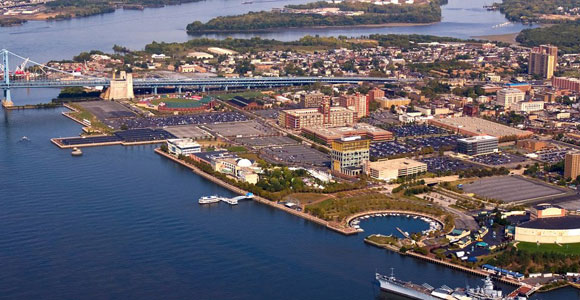
The riverfront has always been the city’s center. Ferry service to Philadelphia began in colonial times, and by the 1800s industrial factories changed Camden’s waterfront into a potent economic hub.

That way of life ended in the mid-20th century, as new highways and a post-industrial economy turned the waterfront into a symbol of decline. Ferries stopped in 1952.

Using Baltimore as a model, South Jersey politicians and activists have since sought to give Camden new life by converting the waterfront into a destination. According to Msgr. Michael Doyle, the water is the city’s “treasure.” He believes that residents of a city on a river must have access to their water.

And that’s why he supports the waterfront effort – including the aquarium expansion – even as he opposes the political takeover.

“We needed to open up this treasure we have,” he said. “It creates a stage to say, ‘We are here.’ ”

Since 1992, when the aquarium opened, ferry service has resumed and the waterfront has added the Susquehanna Bank Center concert arena, the USS New Jersey, a Children’s Garden, and the Campbell’s Field baseball stadium.

The state takeover sought to build on these existing strengths. And so if waterfront visitors today look out the car window on the way into town, they might glimpse the takeover’s winners – and losers.

Visitors from Philadelphia turn off the Ben Franklin Bridge into the historic downtown, where Rutgers-Camden Law School – thanks in part to recovery money – has opened new classrooms.

They might see the rehabilitated neighborhood of Cooper Grant, the restored Johnson Park, and maybe even the new scoreboard at Campbell’s Field, the Rutgers-owned minor-league stadium. The recovery funded all of those projects.

Then there’s the eyesore on Cooper Street with a tree growing through it – the planned Radio Lofts, awarded $2 million for condo conversion three years ago, but delayed for environmental cleanup.

Across the street is the Board of Education, which presides over some of the worst graduation rates and test scores statewide. The board is controlled by the governor, as per the recovery law, but no money was earmarked for the district.

Pass the school board and find an expanse of parking lots on the waterfront where a state trooper is often stationed to protect the tourist attractions – while the rest of the city faces an unprecedented police shortage. Waterfront lots are among six parking projects funded with millions in recovery dollars.

One lot was built for state employees at Riverfront State Prison, which is now shuttered. A sixth of the recovery money finances state entities like this – including the South Jersey Port Corp. and a new state office building.

Some parking lots were intended to be placeholders for a future Camden “town center” called Cooper’s Crossing. Steiner + Associates, a Camden County Democratic donor and Ohio-based builder that controls development rights for 30 waterfront acres until at least 2017, plans six restaurants, dozens of stores, a hotel, 1,500 residential units, a recorded-sound museum, and at least three office buildings.

So far, visitors will find only one element of Cooper’s Crossing – the Ferry Terminal Building, the first privately financed office structure in the city in nearly a half-century, and touted as a key recovery accomplishment. The building is 85 percent filled with tenants, thanks in part to recovery-funded lease incentives, but a long-awaited anchor restaurant has yet to move in.

The other parts of Cooper’s Crossing are on schedule, say Steiner and the state, and are coming soon.

The aquarium

Next door to the Ferry Terminal Building, visitors snap cell-phone pictures of the Philadelphia skyline before going through the aquarium entrance, which now faces Philadelphia instead of Camden.

Once inside, they leave the downtrodden city behind, and they never really return. The old New Jersey State Aquarium at Camden has a new name, Adventure Aquarium.

The gift-shop postcards say “Camden,” but the mugs and snow globes are branded with an aquarium logo that makes no mention of the distressed city that politicians say the aquarium is supposed to promote.

Visitors aren’t here for Camden. They’re here for the fish. You can gaze at sharks straight on or look at them upside down through a marvelous underwater tunnel. You can pet them and, believe it or not, even swim with them for $165.

“He’s having the time of his life!” beamed one man, visiting with his grandson. “What they did here is absolutely fantastic. He wants to work here!”

Large hippos press their noses against the glass and seals clap their fins while visitors feed birds with $1 cups of insects.

As for human food, visitors have no incentive to leave the premises. If there isn’t a fish tank around that corner, then there’s an aquarium vendor wearing a Hawaiian lei, listening to Bob Marley’s “One Love,” and selling Jamaican meat patties. It’s all part of the adventure.

Across the street, the manager of the upscale Victor Pub, which recovery money supported, says he gets few, if any, aquarium visitors.

The subsidized aquarium hasn’t created many jobs, either.

In Steiner’s presentation to the Camden Recovery Board in July 2003, president Barry Rosenberg promised job training for city residents. The board then unanimously approved the project.

Rosenberg said such training existed at first. But Steiner sold the aquarium operations to another company, and now only 23 percent of its employees – 28 percent during the summer – live in Camden. Before the recovery, the percentage of Camden residents employed there was 43 percent.

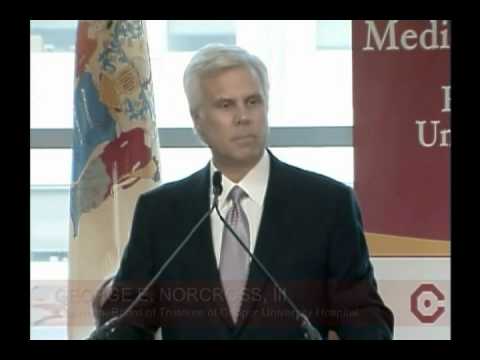
Even George Norcross III, chairman of the board of trustees of Cooper University Hospital and a political player, says the investment in the aquarium was misguided.

“When everything around you lacks security and stability,” Norcross said, “investing tens of millions in a fish tank on the waterfront does not make any sense to me whatsoever.”

Anchor of activity

The aquarium opened in 1992 as part of the state’s first attempt to save Camden through its waterfront. A plan for a new Campbell Soup waterfront headquarters was fading, so politicians employed the same philosophy they would use 10 years later – attractions would make people and businesses return to Camden, leading to jobs and prosperity. A marina and an office building opened at the same time.

The focus on the aquarium and waterfront met the same community skepticism as its expansion 10 years later. “We got two and three families living in one house and beautiful fishes in tanks by themselves,” activist Luis Galindez told The Inquirer at the time. “We could really have used that money.”

Then, as now, the aquarium and waterfront construction failed to meet expectations. It didn’t replace the jobs lost at the shuttered Campbell Soup plant, and after one year, attendance lagged. The state was subsidizing the operation with millions of dollars in debt payments and operating revenues.

In 2000, Steiner began making political donations and offering plans for the waterfront. Its first donation was to Republicans in 2001, when Republican Gov. Donald DiFrancesco considered a Camden recovery law. Its executives then donated to the Camden County Democrats, who sponsored the final law.

“They were people who we thought would be beneficial, and we supported them,” Rosenberg said. “There was no pay-to-play concept here at all.”

Rosenberg said the state approached Steiner about expanding the aquarium because of the firm’s unique expertise with such facilities, and since then the firm has worked with both parties.

Under Gov. Jim McGreevey, operations of the aquarium were deeded to Steiner, and in 2005 it opened its $57 million expansion – with $43 million in public funding. Two years later, Steiner sold the aquarium to Georgia-based Herschend Family Entertainment, but it is still responsible for development of the surrounding acres.

The stated point of the aquarium has always been to “anchor” a “critical mass” of activity to draw private, nonsubsidized development.

Camden County Freeholder Jeffrey Nash admits that the subsidized aquarium and baseball stadium “on their face don’t help the city directly.” But they are catalysts to make people feel comfortable visiting – and even living in – Camden again.

He cites the Victor, a luxury apartment building, restored without recovery money, yet considered proof of the waterfront’s potential.

“Stand on the Camden waterfront as it existed in 1950,” Nash said. “And open your eyes in that area now.”

In lieu of taxes

Sure, the waterfront looks better, say longtime residents. But how does that help the city?

Greg Charbeneau, the aquarium’s executive director, says the facility now pays sales tax to New Jersey, and the state no longer subsidizes it with $3 million a year. The aquarium doesn’t, however, pay city taxes. It makes an annual Payment In Lieu of Taxes (PILOT), which Steiner told the Camden Economic Recovery Board would be $1.5 million. Instead, it is about a quarter of that.

“That was the number I always anticipated we’d pay,” Rosenberg said. “When I threw out the number, it was maybe based on a certain number of people [visiting].”

As part of the 25-year PILOT deal, the city gets 50 cents per paid ticket, and for 2008 received $329,663.50.

Adventure Aquarium wouldn’t release its figures, but based on the PILOT, paid attendance last year was 659,327 people. In fiscal year 2004, when it was bailed out, attendance was 600,000, according to the former operator’s records.

That’s about $500 in recovery money for each new visitor to Camden.

“It’s a nice thing, but at the end of the day it doesn’t change anybody’s life, and that’s how we measure whether the recovery legislation was a success,” said Roy Jones, a community activist.

PILOTs are common in Camden for its largest institutions and companies, and intensely debated because the discounted taxes go only to municipal governments. Schools and counties get nothing.

Most of Camden is now tax-exempt; its rate is the third-highest in New Jersey.

If the aquarium was assessed taxes at the regular rate, it would be paying more than six times as much, about $2.1 million, and $409,500 would go to the schools.

Melvin “Randy” Primas, the city’s first chief operating officer, explained that the privatization happened because New Jersey wanted out of its investment.

“The aquarium was bleeding money and had to require financial assistance from the state,” Primas said. “And they looked at the money and looked at how much money it would cost. You’ve got to keep feeding the fish.”

‘Means to the end’

Other institutional investments had better results, making parts of the downtown look more vibrant – with more buildings and improved streetscaping.

“Nobody could argue that they’re bad things, but I think they’re really below what people were thinking the money was going to go for from the community perspective,” said Peter O’Connor, of the Fair Share Housing Center in Cherry Hill.

O’Connor, whose lawsuits helped to create the state’s affordable-housing laws, believes the institutions could have found money elsewhere, and a mini-city of mixed-income housing with stores and schools could have been built on the water.

The law’s direction was set, though, before the community could even lobby the Economic Recovery Board.

One of the cosponsors, former State Sen. Wayne Bryant, was directly connected to three institutions earmarked for $21 million: Camcare, a medical clinic run by Bryant’s brother, Lawnside Mayor Mark Bryant; Rutgers-Camden, where Bryant became an occasional, paid lecturer months after the law passed; and the University of Medicine and Dentistry of New Jersey, where Bryant had a job that would later result in a prison sentence. He was convicted of peddling his influence for the school while doing little work.

The impact of this money is mixed. At Rutgers-Camden law school, the $11 million for an expansion project helped to increase the hours of free legal work students provide city residents from about 30,000 to 40,000 hours a year.

The expansion’s resulting increase in student enrollment also sets the stage, the school said, for a planned dormitory in the city.

But the school’s expansion led to only one new job for a Camden resident, a custodial position.

Down the road, at a recovery-funded Rutgers business incubator in a new recovery-funded state office building, most companies do not stay in the city after graduation. Only one of the 30 companies is a major city employer; only one is owned by a Camden resident.

And at Campbell’s Field, $1.2 million was lent for improvements like a new video board and upgraded plumbing. “You’re using Camden as a conduit to fund your institutions, [but] the public impression was Camden was getting all these dollars,” said Kelly Francis, president of the Camden County NAACP and a fiscal watchdog. “The problem is it doesn’t trickle down.”

But amid these disappointments, at Camden County College there’s far more than a trickle effect.

The school used its $3.5 million toward a building with classrooms, a garage, a bookstore, and a computer lab, all of which serve students and the community. And the number of city residents attending the college has increased 50 percent, to nearly 2,000.

“The investment in the physical development, whether it be the law school at Rutgers, or us, or Cooper, is a means to the end,” said Louis Bezich, Camden County College vice president. “And the end is what it’s all about.”

Thousands more people are coming to Camden now, meaning more businesses may crop up to serve them and create jobs for residents.

The hospitals

The most palpable result of this approach can be found at Camden’s hospitals. Although Virtua canceled a plan to use $1 million for the city’s first inpatient drug-treatment facility, as promised in the law, both Our Lady of Lourdes Medical Center and Cooper University Hospital undertook major construction projects with recovery money.

In a city where nearly one in two residents visits an emergency room each year for anything from routine care to trauma, both hospitals expanded their emergency rooms. Lourdes built a new nursing school with its $4.5 million, and Cooper’s $12.35 million check helped to fund a $220 million state-of-the-art patient pavilion. Cooper also received $3 million for a neonatal unit.

“The health care now is better in Camden than it has been in decades,” said Norcross, chairman of the Cooper board of trustees, whose allies sponsored the law.

Focusing solely on the waterfront “was a misguided strategy,” Norcross said, but by supporting institutions – “pockets of excellence” – Camden can be saved.

“Has there been enough emphasis on public safety and improvements in the neighborhood? The answer is no, and I think that’s where it’s got to move to.”

According to Norcross, the eds and meds and Campbell Soup are now creating safe pockets that will spread to other parts of the city.

“When you’re walking around Campbell Soup, Cooper’s, Rutgers, there is no doubt you are as safe as in Cherry Hill, N.J.,” he said.

Campbell Soup is building a $90 million world headquarters and office park with $2.3 million in infrastructure aid from the recovery fund. The construction will change the face of the city at a main entry point, Admiral Wilson Boulevard, in the Gateway neighborhood.

“Improving the front door of the city is much the same as improving the appearance of your home,” said Anthony Sanzio, company spokesman. “In a sense, the revitalized Gateway district symbolizes a revitalized Camden.”

The revitalization fund made Cooper’s expansion possible, Norcross said. Otherwise, “Cooper Hospital would have undoubtedly expanded much faster in the suburbs.”

For the first time, Cooper pays a $247,000 “service charge” to the city. Such charges were mandated for some tax-free recipients of recovery funds, and although the money doesn’t go to schools, it funds city services. Cooper is spending $600 million on expansion. The only city redevelopment plan currently being pursued is connected to Cooper, and most of the recovery money devoted to buying vacant city buildings for redevelopment is for the neighborhoods next to the hospital. There are 265 properties to be bought and held for developers.

Cooper is luring its staff to live near the hospital in new housing, including 94 mostly market-rate units funded with $3.6 million in recovery dollars. And thanks to Corzine’s executive order last summer, Cooper is opening a four-year medical school in conjunction with Rowan University. That project is eligible for a $9 million recovery check.

Norcross said he considered taking a new Cooper Cancer Institute to the suburbs, but saw “the success that was taking place, and the momentum.”

Such momentum, proponents say, paves the way for unrelated projects on the horizon – the demolition of Riverfront State Prison, and the possible extension of Camden’s rail line to Gloucester County.

Still no new jobs

Meanwhile, almost nothing is happening on the recovery’s top goal, job growth, and not much was happening before the recession, either.

The only Camden sector growing jobs is health care, according to state labor statistics.

That’s because many of the recovery-funded institutions aren’t hiring Camden residents. Since the takeover, city jobs increased by about 1,000, but the percentage of Camden residents who held jobs in the city decreased, from 23 percent to 18 percent. Some argue that once residents get good jobs, they move to middle-class towns like Pennsauken and Winslow. But the city has been bleeding jobs for decades.

At Campbell Soup, only 3 percent of the employees are Camden residents – compared with 1989, before the plant closed, when they held a third of the 940 factory jobs.

Officials from the Camden Higher Education and Healthcare Task Force cite a 31 percent increase in residents working for the eds and meds – 400 new people making an average of $25,0000 – but it’s unclear what those jobs are and whether they are full time with health coverage.

Less than 1.5 percent of the recovery dollars were spent on workforce development and job training.

In the one notable success, Respond, a longtime city nonprofit, used $1 million to build a training center for culinary arts, carpentry, auto repair, landscaping, and HVAC installation. There’s a child-care center on site, and a class for teens from a juvenile-detention facility.

“Anyone . . . would agree that that was insufficient for the city of Camden,” said Edward Gorman, president of American Community Partnership, which received $100,000 for a training facility yet to open. If his group had received $1 million, Gorman said, he would have trained 200 Camden residents in construction, 400 in culinary arts, and 500 as nurse’s assistants.

Lack of jobs means fewer taxpayers. And by that measure, Camden has actually gone backward.

During the takeover, the city became twice as dependent on state aid – to the tune of $110 million annually, plus $308 million more for the schools. This contradicts a core mission of the law, to get Camden off the state dole.

As a self-sustaining entity, Camden barely exists.


Contact staff writer Matt Katz

at 856-779-3919 or mkatz@phillynews.com.

The Christie Political Machine Family Tree

logo
BY ALEC MACGILLIS

February 12, 2014

THE BOSSES

GEORGE NORCROSS

Controls Democratic politics in South Jersey, and increasingly the rest of the state.

JOE DIVINCENZO

The North Jersey boss avoided federal investigation in 2002 under Christie’s watch.

THE ENFORCERS

MICHAEL DREWNIAK

Christie’s famously profane spokesman; once described a Star-Ledger reporter as “such a fucking mutt.”

BILL STEPIEN

Ran the office that oversaw grants to local officials who agreed to endorse Christie. He kept tabs using color-coded dossiers.

THE TRENTON HACKS

KEVIN O’TOOLE

Christie’s point man in the legislature; has served as a link to both “Joe D.” and Norcross.

BILL BARONI

New Jersey’s top staff appointee at the Port Authority; fall guy for the bridge affair.

THE CONSIGLIERES

DAVID SAMSON

Appointed by Christie to chair the Port Authority. Also represented the developer of a big Hoboken project that benefited from a study paid for by the Port Authority.

BILL PALATUCCI

Introduced Christie to the Bushes; now works at a powerful Newark law firm.

THE GUYS FROM BACK IN THE DAY

DAVID WILDSTEIN

Statistician for Christie’s high school baseball team; dirty trickster at the center of the bridge scandal.

TODD CHRISTIE

The governor’s overeager younger brother has poured money into Republican causes.

THE CONFIDANTE

MICHELE BROWN

Longtime close aide who regularly traveled with Christie; helped pick Christie’s Sandy comeback ad that portrayed him in glowing terms.

THE CAMPAIGN-IN-WAITING

MIKE DUHAIME AND MARIA COMELLA

DuHaime, Christie’s chief strategist, managed Rudy Giuliani’s ill-fated 2008 campaign. Comella, Christie’s communications chief, served as Giuliani’s spokeswoman and guardian to Sarah Palin.

Chris Christie’s Entire Career Reeks

It’s Not Just the Bridge

logo

By Alec MacGillis @AlecMacGillis

February 12, 2014

Has there ever been a political reversal of fortune as rapid and as absolute as the one just experienced by Chris Christie? At warp speed, the governor of New Jersey has gone from the most popular politician in the country to the most embattled; from the Republicans’ brightest hope for 2016 to a man with an FBI target on his back. One minute, he was releasing jokey vanity videos starring Alec Baldwin and assorted celebrity pals; the next, he was being ridiculed by his lifelong idol, Bruce Springsteen. Mere weeks ago, Christie was a straight-talking, corruption-busting everyman. Now, he is a liar, a bully, a buffoon.

What is remarkable about this meltdown is that it isn’t the result of some deep secret that has been exposed to the world, revealing a previously unimagined side to the candidate. Many of the scandals and mini-scandals and scandals-within-scandals that the national media is salivating over have been in full view for years. Even the now-infamous Bridgegate was percolating for months before it exploded into the first major story of the next presidential race.

Case in point: Last year, just before Thanksgiving, I traveled to Trenton to see Bill Baroni, Christie’s top staff appointee at the Port Authority of New York and New Jersey, get grilled by state legislators about the closure of access lanes to the George Washington Bridge in September. It was clear that something fishy was going on. Baroni gave a command performance, defending the closures as part of a traffic study, but more than that, as a matter of justice. Discussing whether Fort Lee deserved three dedicated lanes during rush hour, Baroni demanded, “Is this fair?” His voice actually cracked with emotion. “And if it is not fair, how do you not study it?” But there were only a handful of reporters in the room to witness his melodramatics, and it was six weeks before the national media caught on to the story. Outside New Jersey, at least, it seemed inconceivable that Christie, good-government evangelist, scourge of Soprano State shenanigans, could preside over a piece of payback so outrageous and so petty.

Read More: Chris Christie’s Machine Politics Family Tree
Now, of course, we know that there was no traffic study and that the lanes were deliberately shut to punish the mayor of Fort Lee, who had declined to endorse Christie for reelection. (“Is it wrong that I’m smiling,” crowed a Christie aide in a text message, even as congestion got so dire that ambulance workers were forced to respond to an emergency on foot.) We also know that this act of retribution wasn’t an isolated incident: The mayor of Hoboken, to name just one example, has claimed that Christie’s office pressured her to approve a big development project represented by a Christie crony—or risk losing recovery aid for damage caused by Hurricane Sandy.

And yet, even post-Bridgegate, the prevailing interpretations of Christie fundamentally miss the mark. He has been so singularly successful at constructing his own mythology—as a reformer, a crusader, a bipartisan problem-solver—that people have never really seen him clearly. Over the past three months, I talked to more than 50 people who have crossed paths with Christie throughout his career—legislators, officials, Democrats, Republicans, lawyers, longtime New Jersey politicos. (Christie himself didn’t respond to a detailed request for comment.) The problem with Christie isn’t merely that he is a bully. It’s that his political career is built on a rotten foundation. Christie owes his rise to some of the most toxic forces in his state—powerful bosses who ensure that his vow to clean up New Jersey will never come to pass. He has allowed them to escape scrutiny, rewarded them for their support, and punished their enemies. All along, even as it looked like Christie was attacking the machine, he was really just mastering it.

article_inset_macgillis_1

Chris Christie
Photo Illustration by Jacqueline Mellow
WOKE UP THIS MORNING AND ALL THAT LOVE HAD GONE

To understand Chris Christie, first you have to understand that he was raised to never give an inch. He grew up in the North Jersey suburb of Livingston, to parents descended from big Newark clans—Sicilian for his mother, Sandy; Irish-German for his father, Bill. The strength of their marriage was exceeded only by the strength of their opinions. They argued constantly—about money, about politics, about pretty much everything.

Chris, the oldest child, was the family mediator—reassuring his younger brother, Todd, and adopted sister, Dawn, or barging into the fray to take his mother’s side. Not that Sandy needed any help. Funny, relentless, and willing to punctuate her point with a raised middle finger, she got her way more often than not. “They demanded a lot out of us,” Todd Christie told his brother’s biographers, Bob Ingle and Michael Symons.

Anthony Hope, the baseball coach at Livingston High School, told me about a game when Chris got picked off third base, costing his team the win. That night, all the kids headed to the town’s big Battle of the Bands, except Chris. Hope, who was chaperoning, inquired where he was. He’d been grounded—because of the game.
The Christie brothers were close, but very different. Todd was a bro in the making—“an outgoing, happy-go-lucky type,” says Hope. Chris was the serious one, the type of kid who started running for office long before his first keg party. He was known for introducing himself to other kids on the playground as if he were a first-time candidate at the Iowa State Fair. (“Hi, I’m Chris Christie.”) By the third grade, he was piping up at PTA meetings to give his opinions on field trips and fund-raisers. Whenever the neighborhood boys played cowboys and Indians, Todd once reminisced, Chris always opted to be the sheriff. At the age of 14, at Sandy’s urging, he knocked on the front door of the local assemblyman, Tom Kean, and asked for advice on how to get elected.
article_inset_macgillis_2

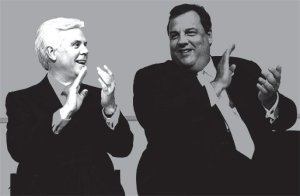
Chris Christie and George Norcross
Associated Press
During Christie’s term, Democratic boss George Norcross has become more powerful than ever.

Since fate had placed Christie in New Jersey, he was about to get a very particular kind of political education. In his senior year, he was one of two students chosen to represent New Jersey in the Hearst Foundation’s Senate Youth Program. The students were to spend a week with their home-state senators, observing the legislative process from the inside out. Unfortunately for Christie and his partner, the day before they got to Washington, news broke of a massive FBI operation in which a federal agent posing as an Arab sheik had bribed elected officials with suitcases stuffed with cash.

Thus began the season of Abscam, the elaborate sting that would eventually reel in the mayor of Camden, six members of the House of Representatives, and New Jersey’s senior senator, Harrison Williams, among others. That week, Williams went to ground, and so, while all the other students got pictures in the group yearbook with both their senators, the Jersey kids only got a photo with one—Bill Bradley. “It was an incredible embarrassment,” Christie later recalled. “We were the butt of jokes all week.” In his telling, it was the defining moment that alerted him to “the problem of corruption in New Jersey.”

To say that corruption was a problem in the Garden State was an epic understatement—its political system might as well have been expressly designed to facilitate public fraud. The state’s official history is one of legendary self-dealers: Enoch “Nucky” Johnson built and ruled Prohibition-era Atlantic City from the ninth floor of the Ritz-Carlton. The midcentury mayor of Jersey City, Frank Hague, earned a salary of $8,500 a year and yet left office with a fortune of $2 million. His signature accoutrement, according to Jersey lore, was a desk with an outward-facing drawer in which visitors would deposit their bribes. As one mayor of Newark memorably put it, “There’s no money in being a congressman, but you can make a million bucks as mayor.”

In most of the United States, the big political machines have been broken, or reduced to wheezing versions of their former selves. In New Jersey, though, they’ve endured like nowhere else. The state has retained its excessively local distribution of power—566 municipalities, 21 counties, and innumerable commissions and authorities, all of them generous repositories of contracts and jobs. The place still has bona fide bosses—perhaps not as colorful as the old ones, but about as powerful. The bosses drum up campaign cash from people and firms seeking public jobs and contracts, and direct it to candidates, who take care of the bosses and the contributors—a self-perpetuating cycle as reliable as photosynthesis.

When a brash young Christie decided to wade into this swamp, casting himself as a reformer seemed like the smart thing to do. By the time he was 31, Christie had married his college sweetheart, Mary Pat (her first impression of him was as “a student government geek”), gone on to law school, and then to a small firm where he handled medical-malpractice cases and, later, securities litigation and some state lobbying. In 1994, he ran for a seat on the Board of Chosen Freeholders in Morris County, the prosperous exurb where he and Mary Pat, a Wall Street investment banker, had settled. It was time, he declared, for an end to the cycle of campaign contributions from those who did business with local government. “I’m sick and tired of people hiring their political friends,” he said.

But even as Christie was running against Jersey’s political culture, he was willing to borrow some of its uglier tactics. One afternoon, Ed Tamm Jr., a Republican he was challenging, got a call from a friend who asked if he’d seen a Christie ad that had just aired during the Devils game, alleging that Tamm and his fellow board members were under investigation. Alarmed, Tamm called the county prosecutor, who reassured him it wasn’t true. It was the final weekend before the Republican primary, leaving no time to respond, and Christie finished first, tossing Tamm and another Republican off the board. They sued him successfully for defamation, but years later, Tamm is still dumbfounded. “Politicians get hammered all the time, but there’s got to be an element of truth to it,” he told me.

Only four weeks after taking office, Christie announced that he was thinking of challenging a veteran Republican for the state Assembly. His ambition rankled local Republicans. “A lot of people were like, who does this guy think he is?” says Rick Shaftan, the campaign manager for another candidate. (So determined was Shaftan to beat Christie that, at one point, he went to a local crawfish festival and recruited some overweight drunk guys for an ad that depicted Christie wrestling opponents in a mud pit.) Christie lost that race. Two years later, local Republicans recruited challengers to knock him off the freeholder board, too. On election night, after Christie gave his concession speech, one of his nemeses smacked his lips in his direction and explained, “That’s just me kissing your fucking career goodbye.”

Mapping Chris Christie’s Power Plays
Christie had now spent tens of thousands of his family’s money and lost two races in a row. Not long after the election debacle, he had lunch with his Assembly running mate, Rick Merkt. “It was a couple of gut punches,” Merkt says of the defeats. But he saw a path forward for his friend. He suggested to Christie that “the federal route might give him another bite at the apple.” What Merkt meant was that, instead of running for election, Christie should try to get himself appointed to an influential post. In New Jersey, that meant engaging in precisely the sort of grubby glad-handing Christie had condemned. Still, he was in his late thirties and all he had to show for his foray into public life was a middling legal career and a lot of local Republicans who hated him. And so he took Merkt’s advice.

The “federal route” turned out to be quite straight­forward. First, Christie sought the counsel of Bill Palatucci, a colleague at his firm. Years earlier, Palatucci had served as George W. Bush’s driver when he campaigned for his dad in New Jersey, and he advised Christie to raise money for Bush’s 2000 presidential campaign. Christie and Palatucci proceeded to pull in $350,000, more than enough for Christie to qualify as a Bush “Pioneer”; he and Mary Pat also personally contributed $29,000 to Bush and other Republicans between 1999 and 2001. After the election, it came time for Bush to nominate a U.S. attorney for New Jersey, one of the biggest offices in the country. Palatucci pitched Christie to Karl Rove. It was a competitive field, and Christie had zero experience in criminal law; indeed, he had never so much as filed a motion in federal court. He got the nod.

Only after the September 11 attacks did his qualifications come under any heavy scrutiny. Suddenly, it didn’t seem like a terrific idea to appoint an untested, undistinguished lawyer to the district across the river from Ground Zero. The New Jersey Federal Bar Association, the Newark Star-Ledger, and the state’s junior senator, Jon Corzine, all criticized the choice. But the power to clear the nomination for a vote belonged to the state’s senior senator, Robert Torricelli. The two men met in Torricelli’s office, and the senator told Christie that, in light of the terrorist attacks, Bush was entitled to get the post filled fast. (It was no secret that he also liked the idea of a prosecutor with Italian-American roots, to counter ethnic stereotypes.) Torricelli told me that he imposed only one condition: Christie had to hire a “professional” as his deputy—that is, someone who knew his way around federal court. A few weeks later, Christie and Torricelli saw each other at a Christmas party, hours after the Senate had approved Christie’s nomination. Christie made a beeline for Torricelli to thank him and the two embraced.
article_inset_macgillis_3

Chris Christie and Joe Vincenzo
Associated Press
Christie has boasted that Joe DiVincenzo (center) has been with him “right from day one.”

Torricelli may have had other reasons to want Christie in the job. At the time, the rakish Democrat was under investigation for illegal fund-raising during the 1996 campaign. When it came time for Christie to select his “professional,” his first pick was a former federal prosecutor and close Torricelli confidante. Then it emerged that Christie’s choice had not been candid about a visit he paid to Torricelli’s home while it was under FBI surveillance, and Christie had to find someone else.

Soon afterward, Christie reshuffled the top staff in Newark. One of the apparent losers was Michael Guadagno, the head of the frauds division who had led the initial investigation into Torricelli. Christie sent Guadagno down to the satellite office in Trenton, a demotion that some in top legal and political circles linked to Guadagno’s work on the Torricelli case. “Christie exiled him to Trenton,” says one New Jersey legal veteran. (The case against Torricelli was dropped after he decided not to run for reelection. He told me he had “no knowledge” of Guadagno’s involvement and praised Christie’s performance as prosecutor: “Chris kept the commitment that he made to me.”)

It wasn’t the cleanest beginning. But Christie had a plan for quashing any doubts about how he got the job: He would unleash the full might of his office against corruption. Fighting public fraud, he announced, would be his office’s top priority after terrorism. “Corrupt politicians will steal your trust, your taxes, and your hope,” he told a New Jersey crowd in 2007. The problem was not, he noted, “an insufficient number of targets.”

Soon after Christie took office, Essex County’s Republican executive, Jim Treffinger, was out walking his dog when seven police cruisers surrounded him. Treffinger knew he was under investigation for awarding no-show jobs to friends and extorting campaign donations in exchange for contracts. He had repeatedly offered to surrender to authorities when the time came. Instead, his wife and daughter watched from the house as he was thrown up against a car and frisked, an image that appeared in the next day’s Star-Ledger, which had been tipped off to the arrest.

At first, Christie said the arrest had been left to the marshals. But later, he cast Treffinger’s treatment in moral terms. Corrupt officials, he said, shouldn’t be coddled—they were “worse than the street criminal because the street criminal never pretends to be anything but what he or she is.” (Local lawyers wondered whether the public shaming might be linked to Treffinger’s observation, caught on a wiretap, that Christie was a “fat fuck” who “wouldn’t know a law book from a cookbook.”) “The perception was that the U.S. attorney was sending a message,” one lawyer told me.

The next seven years unfolded like a never-ending perp walk, as Christie racked up more than 130 convictions and guilty pleas for elected and appointed officials. He had a knack for extracting the maximum p.r. from every arrest or indictment. “The office leaked like a sieve,” one Democratic operative recalls. “I had reporters calling me at four in morning and saying, [so and so] is going to get pinched.”

Democrats howled that Christie was on a partisan witch-hunt, since he targeted so many more Ds than Rs. But it was hard to take such accusations very seriously. After all, New Jersey’s power structure was dominated by Democrats, and Christie was uncovering undeniable cases of abuse. One state senator pleaded guilty for accepting a low-show job at a medical school in exchange for state grants, another to accepting a $25,000 “success fee” for helping a mining company obtain permit approvals. Longtime Newark Mayor Sharpe James got 27 months on charges stemming from the sale of steeply discounted city properties to an ex-girlfriend. (James’s successor, Cory Booker, is the first mayor of Newark not to be indicted since 1962.)

Besides, to accuse Christie of protecting Republicans over Democrats was missing the point. True, his office had knocked out a swath of New Jersey’s biggest Democratic power brokers and weakened their organizations in crucial parts of the state. But that meant the bosses left standing had only grown stronger.

In 2002, an insurance firm in Mt. Laurel received an unexpected e-mail from a man named George Norcross. Congratulations, Norcross told the firm: It had won a big contract for the Delaware River Port Authority, which oversees four bridges in the Philadelphia area. The e-mail was unexpected because the firm hadn’t bid for the job. But there was no need for thanks. The company was simply expected to send Norcross’s insurance company $410,000 over the next few years, as a “finder’s fee.”

This is how things work in the world of George Norcross III. Officially, he is the supremely wealthy chairman of Conner Strong & Buckelew, one of the largest insurance firms in the nation; the chairman of Cooper University Hospital in Camden; and, as of last year, the majority owner of The Philadelphia Inquirer. Unofficially, he is the most powerful man in New Jersey never to have held elected office. Close observers of state politics have estimated that more than 50 elected officials in South Jersey owe their positions to Norcross (including his brother, a state senator). Much of the money he raises for candidates comes from people and companies eager to secure government work or development deals, as documented over the years by his local paper, the Courier-Post, among others. Norcross’s own firm holds sway over New Jersey’s large municipal insurance market. (He declined to comment for this article.) “George is probably the smartest politician we have now in the state of New Jersey,” says former Republican State Senator John Bennett. “He knows where the power is and goes to the power. Whether that power is a Republican or Democrat.”

One reason that Norcross is so good at working the machine is that he was born into it. His father, George Norcross Jr.—“Big George”—was a much-loved union chieftain, and he would bring “Young George” along to meetings around the state with governors, state legislators, and CEOs. Young George would go on to drop out of college—Rutgers wasn’t teaching him anything about politics he didn’t already know—and start selling insurance out of a basement office. In 1989, after Big George was snubbed for a spot on the New Jersey Racing Commission, Norcross entered politics, motivated by a specific grudge against the legislator who’d stiffed his father and a more generalized resentment over the slighting of South Jersey. Thanks to Big George’s lessons and his own hyper-confidence, it wasn’t long before he gained control of Camden’s Democratic organization and set his sights on the rest of South Jersey. Today, Norcross is silver-haired and impeccably dressed and runs his operation out of well-appointed boardrooms. He is only foul-mouthed in private.

One Jersey Democrat described to me the first time he experienced the Norcross treatment. Not long after this politician announced his candidacy, he was summoned to a meeting with the man himself. Norcross was all magnanimity. “He said, ‘You don’t need to do anything. I’ll raise all the money. You just go out there and meet people,’ ” the candidate recalled.

There was no need for Norcross to spell out the rest of the arrangement: The fate of those who cross him is well known. When Bennett dared to oppose state financing for the arena of a minor-league hockey team Norcross co-owned, Norcross got in a shoving match with him at the State House. In the following months, a stream of critical stories about Bennett appeared in a paper edited by a Norcross friend, contributing to Bennett’s 2003 reelection loss. “He does everything in his power to go after you,” Bennett told me, almost admiringly. “He said, ‘I’m going to get you,’ and then he gets you.”

On numerous occasions, Norcross’s operation has come under legal scrutiny—from the Securities and Exchange Commission (SEC), state investigators, and the FBI. The cases are labyrinthine, but they all involve some dubious overlap of his many public and private interests. One case in particular threatened to get real traction. In the early 2000s, several New Jersey attorneys general investigated whether he had pressured a Palmyra councilman to fire a city solicitor, Ted Rosenberg, who wasn’t cooperating with the machine. Wiretaps offered a rare glimpse of a man completely convinced of his power. “[Rosenberg] is history and he is done, and anything I can do to crush his ass, I wanna do cause I think he’s just a, just an evil fuck,” Norcross said. In another conversation, referring to then-top Jersey Democrats, he declared, “I’m not going to tell you this to insult you, but in the end, the McGreeveys, the Corzines, they’re all going to be with me. Not because they like me, but because they have no choice.” While discussing plans to remove a rival, he exclaimed: “Make him a fucking judge, and get rid of him!”

In February 2003, Norcross met Christie for a steak dinner at Panico’s in New Brunswick. It was, to put it mildly, highly unorthodox for a U.S. attorney to sit down with a political boss who was the subject of state and SEC attention. But Christie brushed off the criticisms. “I’m very careful with who I would go out with,” he said. “If I’m looking at somebody, I’d try to stay away from them.”

That, to the skeptics, was just the issue. His corruption squad was scrutinizing dozens of lower-profile figures, all the way down to an Asbury Park councilman charged for getting his driveway paved for free. Why wasn’t he looking at Norcross? And didn’t he realize that he might have to in future? Sure enough, the following year the state attorney general referred the Palmyra case to Christie’s office.

Two years later, Christie issued a scathing six-page letter announcing that he would not bring any charges against Norcross. It was a remarkable document. Not only did Christie openly declare a controversial figure to be home free, but he accused the state prosecutors of bungling the case so badly that they may have been shielding Norcross. “The allegation of some bad motive on the part of the state prosecutors is very unusual,” says Andrew Lourie, a former chief of the Public Integrity Section of the Department of Justice.

High-ranking legal sources in the state view the letter as the ultimate Machiavellian maneuver. They agree that there may not have been a strong case to bring against Norcross in the Palmyra case after so much time had lapsed. But by publicly accusing his state counterparts of protecting Norcross, Christie was inoculating himself against accusations of favoritism. One of the former attorneys general who’d handled the case, John Farmer, who went on to become senior counsel to the 9/11 Commission and is now dean of Rutgers Law School, told me: “The statements and insinuations contained in that letter were, as I said at the time, utter nonsense. The passage of time has only magnified their essential absurdity.”

Norcross may have been the most formidable player to escape Christie’s net, but he wasn’t the only one. Another was Brian Stack, a state legislator and Union City mayor who exemplifies a Jersey tradition Christie had long railed against: holding paid elected office at both the state and local levels. Stack maintains his constituents’ loyalty with acts of largesse such as doling out 15,000 free turkeys at Thanksgiving. He is rewarded with Soviet-style vote totals. (His slate won 92 percent in 2010.) In 2007, Christie conducted a massive investigation into legislative earmarks. It found that Stack had secured $200,000 in state grants that benefited a day-care center run by his then-wife. Charges were brought against other legislators for directing money to entities in which they held a personal interest, but not Stack.

There was also Joe DiVincenzo Jr., lumbering and gregarious, the protégé of legendary Newark community leader Steve Adubato Sr. In 2002, “Joe D.” ran to replace Treffinger as executive of Essex County, the largest source of Democratic votes in the state. Rumors raged that he, too, was under investigation, for conflicts between his freeholder duties and his job (one of four he held at the time) at a produce company with a county contract. Then, right in the heat of the primary, Christie released a statement denying that Joe D. was under investigation. “It was totally unprecedented. I’ve never seen that done by a sitting U.S. attorney,” said DiVincenzo’s opponent, now-Assemblyman Tom Giblin. “Trying to get a letter out of the U.S. attorney’s office is usually like pulling a wisdom tooth.” After Joe D. took office, he invited Christie to give county workers a symposium on ethics.

Finally, there was Glenn Paulsen of Burlington County, who had become the most powerful Republican power broker in the state in part because of his symbiotic détente with Norcross. Norcross got a lot of business for his insurance firm in Burlington County, while Paulsen’s law firm got plenty of municipal work in Norcross territory. In 2006, Christie’s office secured a guilty plea from a Republican operative, Robert Stears, for hugely overbilling several million dollars of lobbying work for the Burlington County Bridge Commission. According to one person with knowledge of the matter, it seemed likely that more revelations would follow and that an investigation of the commission’s spending could draw in Paulsen, and perhaps even Norcross. Stears, according to Christie’s announcement, was cooperating with an “ongoing criminal investigation.” In court, he explained that he had been “sucked into a corrupt group of people” and that he had been directed how much to bill the commission and how much to donate to the county Republican Party, which had been led by Paulsen. “Everyone was waiting for the second shoe to drop,” David Von Savage, the former GOP chairman in Cape May County, told me. It never did. “Chris essentially dumped that investigation—he absolutely dumped it,” says one lawyer, who asked to remain anonymous for fear of retribution. “As a favor to these guys, he tanked the investigation completely.”

By taking down some of the state’s bosses while leaving others off-limits, Christie had effectively turned the supposedly apolitical role of prosecutor into that of kingmaker. It was a brilliant strategy. New Jersey offered such a target-rich environment that Christie was able to get credit for taking down a slew of crooked officials and build alliances with some of the most powerful bosses in the state at the same time. Christie’s allies insist that he wasn’t playing favorites. “I can’t imagine Christie would suggest in any way, ‘I want you to lay off of this guy or go after this guy.’ It’s inconceivable to me,” says Ed Stier, a former federal and state prosecutor. Still, by the end of his tenure, Christie began showing up to administer the swearing-in ceremonies of town officials who were replacing the ones he’d pursued. No one could recall a prosecutor doing so, says one longtime Jersey hand: “It was like he was giving them his blessing.”

Meet the Christie Machine
In 2004, Todd Christie started showing up at state GOP functions—at one, he distributed boxes of “Christie’s Popcorn” in a not-so-subtle attempt to build his brother’s brand. By now, Chris’s name was regularly surfacing as a potential gubernatorial candidate, although protocol prevented him from openly campaigning. Given this restriction, Todd proved to be a useful surrogate. A Wall Street trader, he had made $60 million when his firm was sold to Goldman Sachs. Not long before Christie’s nomination as U.S. attorney, he gave tens of thousands of dollars to county Republican organizations; not long afterward, he gave $225,000 to a subset of the Republican National Committee. Todd’s generosity won him entrée to exclusive events at the 2004 GOP convention—an ideal venue to talk up his brother. “You want to do everything you can to stay active at a time when he can’t,” he told a reporter. “I’m not shy in saying I’m one of the people who chirps in his ear that I think he would make a great governor.”

Even though Chris was prevented from overtly running for anything, there were ways he could use his position to quietly lay the groundwork. In 2007, Christie announced a $311 million settlement of a probe into kickbacks given by five manufacturers of knee and hip replacements. Rather than pressing charges, Christie opted for deferred prosecution agreements, under which the companies would pay a fine and accept outside monitors. This approach saved courtroom costs, but it also handed Christie the keys to what amounted to a lucrative patronage system.

In an unusual step for a prosecutor, he flew around the country meeting with the companies’ boards. The handful of people he selected as monitors all had one qualification in common: a personal connection with Chris Christie. John Ashcroft, Bush’s first attorney general and Christie’s former boss, got a contract worth as much as $52 million for 18 months of work. Another went to David Samson, a former Republican state attorney general and founder of one of the state’s most connected law firms. Yet another, for $10 million, went to Christie’s mentor, Herbert Stern, and his friend John Inglesino. Even Christie’s alma mater, Seton Hall Law School, got in on the act: Bristol-Myers Squibb endowed a $5 million professorship as part of its agreement.

There was one monitoring contract that was especially eye-catching. Here’s the backstory: In 2005, the SEC issued civil charges against 20 Wall Street floor traders, alleging that they had illegally traded for their firms’ accounts ahead of those of their customers. Todd Christie was among the 20. The U.S. attorney for the Southern District of New York, David Kelley, followed up with criminal charges: 15 traders were marched across a plaza in downtown Manhattan in cuffs. But five of the people named in the SEC action were spared the public humiliation and the threat of a criminal conviction. Todd was one of them.

Todd’s absence from the criminal indictment puzzles lawyers on the case to this day. Unlike some of the traders who had been charged, he had handled his trades personally rather than relying on an assistant. And under the formula that authorities used to quantify the suspect trades, he ranked quite high—people both above and below him on the list were charged. “It had us scratching our heads,” said Julian Solotorovsky, who represented one of the accused traders.

Over time, the criminal cases crumbled. On the civil side, however, the traders agreed to a range of SEC settlements. Todd’s company paid a fine, and he acknowledged that he had engaged in “inappropriate trading.” Other lawyers from the case dismissed the notion that Todd Christie had gotten special treatment, saying there were plausible legal explanations for why he’d been spared a criminal charge. “David Kelley,” attorney Henry Putzel told me, “is as straight as they come.”

Two years after Kelley moved to private practice in late 2005, Chris Christie decided to award him one of the monitoring contracts. “What happened with [Todd] Christie was very fishy,” one of the skeptical lawyers told me. “When they skipped over him, I was stunned. And then I heard the other stuff [about the contract for Kelley], and I was like, Holy shit, it’s so blatant. In my opinion, [Todd] definitely got a pass because of his brother. I can’t think of any other reason.” Kelley rejected this suggestion, telling me: “If anybody tries to draw the inference that there was anything untoward in my appointment, they’re being silly and irresponsible and unknowing of the facts.”

House Democrats in Washington would eventually call a hearing on Christie’s use of deferred-prosecution agreements, and Christie was asked whether there was a “perception of a quid pro quo” when Kelley was awarded a contract after having let Todd off the hook. “No, sir, because my brother committed no wrongdoing and was found not to have committed any wrongdoing, both by the Southern District of New York and the SEC,” he answered. The answer begged for a follow-up. The SEC had found wrongdoing, and it was precisely the Southern District’s finding of no wrongdoing in his instance that was at issue1. But the lawmakers didn’t get a chance to press the matter, because moments later, Christie abruptly announced that he had to catch a train and walked out. “It was a strange hearing,” Tennessee Representative Steve Cohen told me. “He just got up and left.”

article_inset_macgillis_4

Todd Christie
Associated Press
Todd Christie (right) is one of his brother’s most deep-pocketed boosters.

In late 2008, Christie announced his campaign for governor. His image as an enemy of cronyism served him well against Jon Corzine, who was widely derided as a creature of Wall Street. And behind the scenes, his years as U.S. attorney paid off in other ways. Brian Stack was conspicuously slow to endorse Corzine, while Norcross did not hide his lack of enthusiasm for the incumbent. Christie later recounted a telling encounter on the night of his first debate with Corzine, five weeks before he would win the race by four points. After the event, Christie was approached by Democratic State Senator Steve Sweeney, Norcross’s childhood friend who had become a linchpin of his machine. Sweeney told Christie: “I look forward to working with you.”

New Jersey’s governorship is the most powerful in the nation. It is the only statewide elected office, since the governor nominates attorneys general and treasurers. The governor also determines the size of the budget, fills hundreds of well-paying slots on the state’s many commissions and authorities, and doles out aid to its hundreds of towns and cities. No governor in modern memory has worked these levers as skillfully as Christie.

First, Christie filled top posts in his administration with loyalists from the U.S. attorney’s office. The most controversial hire was Michele Brown, a longtime close aide who had accompanied Christie on business trips as a prosecutor. During the campaign, it was revealed that Christie had given her a $46,000 loan and failed to disclose it on his tax returns. Christie named her his appointments secretary, a $140,000 post, and put her in the office directly outside his own, a spot typically reserved for the chief counsel. The proximity got tongues wagging, and in 2012, Christie installed Brown as director of the Economic Development Authority, a $225,000 post in an office a block away. (Christie joked that he had been forced to rely on former colleagues because so few people answered his ad: “Wanted: People willing to work for a moody, passive-aggressive, demanding, outspoken, unreasonable, fat bully—to make miracles happen in Trenton.”)

Next, Christie hit the road to sell his ambitious plan to clean up the state’s finances—slashing wasteful spending, cutting unsustainable benefits for public employees, and reining in absurdly high property taxes. In the process, he perfected a political persona that was somehow enormously appealing in spite of itself. Christie could be charming when he felt like it: Sometimes, he would pace the stage, stand-up comedian-style, dispensing observational humor about public pensions. More often, though, he was just plain aggressive. At one meeting, as one teacher rose to earnestly question his agenda, Christie sloughed off his suit jacket as if it were a boxer’s robe. “If what you want to do is put on a show and giggle every time I talk, then I have no interest in answering your question,” he said. The crowd swooned; the clip got 1.3 million hits on YouTube. (“I love the guy!” said a township committeeman afterward.) Insults that Christie has publicly hurled at his antagonists—reporters, lawmakers, citizens, little old ladies—include, but are not limited to: “stupid,” “jerk,” “idiot,” “hack,” “ignoramuses,” “thugs,” “big shot,” “losers,” and “numb-nuts.”

It’s no easy feat to become a political hero by yelling at schoolteachers, and yet Christie has managed it. Just as he carefully cultivated his image as an anti-corruption crusader while he was U.S. attorney, as governor, Christie has presented himself as the implacable enemy of fiscal irresponsibility. Even his weight, so often the subject of disparaging speculation among national reporters, has worked to his advantage in these settings. Christie utterly dominates a room—planted center stage, an immovable force. His willingness to get in the face of his critics, his refusal to budge—it all gives the impression of a rare politician who cannot be co-opted or cowed.

And yet right from the outset, Christie was working as closely with the machine as any recent governor. Well before his election, the Democratic bosses had met at the U.S. Open in Queens to divvy up the leadership spoils. Sheila Oliver, who worked under Joe D. in Essex County, would become the speaker of the Assembly. Sweeney would get the Senate presidency. Sweeney was a union man—an ironworker—but he was a Norcross man first and foremost.* When it came time for the vote on Christie’s proposal to cut public-employee pensions and health benefits, Sweeney delivered the numbers. It was a coup for Christie—national pundits hailed him as a politician more interested in getting results than scoring partisan points.

In hindsight, what is notable is how openly Christie embraced the bosses. He sent massive resources in their direction; when they came under fire, he vouched for them. In early 2011, it emerged that Stack’s wife, now estranged, had been allowed to use city SUVs for personal use and fill up for free at the city’s natural gas pumps. Christie defended him: “I have no reason to question Brian Stack’s integrity.” (Stack returned the compliment, calling Christie “the greatest governor the state has ever had.”) On paper, Union City embodies the kind of waste that Christie has vowed to eliminate—it paid its police chief a handsome $248,000 in 2011 and provides health benefits to part-time elected officials. And yet it has been showered with cash from Trenton—about $12 million per year in discretionary “transitional aid.”

Christie’s bond with DiVincenzo was just as overt. Corzine’s attorney general had led an investigation into voter fraud by election workers in Essex County, after reams of absentee ballots were filled out to benefit Joe D.-approved candidates. Following Christie’s election, the case was quickly wrapped up with a handful of light sentences for low-level workers. During his term, Essex County has been deluged with millions for big capital projects. The relationship has thrived despite 2012 revelations by The Star-Ledger that Joe D., who makes $153,000 per year on top of a $68,000 pension for the same job (via a legal loophole), has claimed an astonishing list of reimbursements from his campaign funds for personal expenses, such as a trip to Puerto Rico and more than 100 meals over the course of three months. In 2011, Christie observed that Joe D. had been with him “right from day one.”

As for George Norcross, he is more powerful than ever. “It’s not just South Jersey anymore. Now it’s way beyond that,” says the longtime Jersey hand. Christie consented to Norcross’s pick to lead the patronage goldmine that is the Delaware River Port Authority.* The following year, the authority gave a $6 million grant to a cancer center at Norcross’s Cooper University Hospital. Next, Christie pushed through a controversial measure that granted Norcross his desired merger between Rutgers-Camden and nearby Rowan University.2 The result was a well-funded university that will further expand the Norcross empire—boosting beleaguered Camden, yes, but also putting even more jobs, money, and development projects at his disposal. (A former Navy SEAL attending Rutgers-Camden challenged the merger at a town-hall meeting. As he was escorted out by police, Christie hollered after him: “After you graduate from law school, you conduct yourself like that in a courtroom, your rear end is going to be thrown in jail, idiot!”)

Christie’s administration had set out to change the way Trenton did business. But its behavior has turned out to be all too familiar. Those with close ties to the governor have thrived. According to one senior lawyer, it was made clear to supplicants that their prospects would improve if they hired the lobbying firms that employed Samson (now the Port Authority chairman) and Palatucci (the Bush connection). A Louisiana company that wanted to win the $68 million contract for overseeing Sandy relief funds brought on Glenn Paulsen, the GOP power broker from Burlington County. Last May, Paulsen’s law firm made a $25,000 donation to the Republican Governors Association, which Christie leads, and soon afterward the Louisiana company got the Sandy job. Torricelli, too, has flourished as a lobbyist in the Christie era.

Any hard feelings Michael Guadagno might have had about his 2002 move to Trenton would seem to have been allayed: Christie named Guadagno’s wife to be his running mate in 2009 and he himself was elevated to an appellate judgeship three years later.* But there was no lenience for those who bucked the system. Take Democratic State Senator and former Acting Governor Richard Codey, a Norcross nemesis. First, Christie slashed funding for an anti-postpartum-depression program founded by Codey’s wife. Then, Codey’s former chief of staff lost his state job and Codey’s cousin was fired from his high-paying post at the Port Authority. A personnel report on the cousin’s sexual harassment of another man, years earlier, was leaked to the press. Legislators told me of seeing GOP colleagues who had threatened to defy Christie on key votes leaving his office in tears or drenched with sweat.

In early 2013, as Christie’s reelection neared, the operation kicked into overdrive. Christie was fixated on securing Democratic endorsements to bolster his image as a Republican with crossover appeal. It didn’t matter that he was expected to waltz back into office—people needed to get on the list. The administration’s intergovernmental-affairs staff, who knew which mayor or county official had gotten which grant, was moved almost wholesale to the campaign. Christie himself made repeated calls to mere county-level officers: clerks, sheriffs, registers of deeds.

For those who got behind the governor, there were incentives. To give but one example: The close-knit Orthodox community in Lakewood had endorsed Corzine in 2009. In March, a coalition of the town’s rabbis and businessmen announced it would be backing Christie this time around. Two months later, the state granted $10.6 million in building funds to an Orthodox rabbinical school in Lakewood, one of the largest expenditures for any private college in the state. (The yeshiva was not exactly cash-strapped: A copy of its application I obtained noted that its endowment “far exceeded” the $1.84 million it was expected to contribute to the project.)

As Election Day neared, you could be forgiven for mistaking Christie for a Democrat. State Republicans were frozen out; candidates were told not to include his name or picture on their literature. “We didn’t get the support,” says George Wagoner, a losing Assembly candidate. Meanwhile, the weight of the Democratic machine swung behind the Republican governor. More than 50 Democratic elected officials endorsed Christie, including Brian Stack (who was hit with a $68,725 fine in July for failing to properly disclose campaign spending) and Joe D. (who also has a large fine looming). In photos and media appearances, Christie kept showing up smiling alongside Sweeney and other prominent Democrats. Norcross didn’t formally endorse Christie, but he made his approval clear. At one event, Norcross said he’d recently seen a man in a “Chris Christie: too big to fail” t-shirt. He told Christie: “You’re not too big to fail—you’re too good and too important to fail us.”

Meanwhile, Barbara Buono, the state senator who had volunteered to challenge Christie when more prominent Democrats, such as Cory Booker, declined, was unable to raise anywhere near enough money for a credible campaign. Numerous Democratic donors refused to give above the $300 threshold where their names would be disclosed, fearing Christie’s retribution. “I’d say to people, ‘What is going on?’ ” Buono recalls. “This is an election, not a military junta.” She attended one campaign rally in a North Jersey church, at which Sheila Oliver, once a reliable ally of the bosses, railed against unnamed powerful people who were supporting Christie only because he had a “dossier” on them. A month before the election, a picture surfaced on Twitter of Christie and Norcross, arm in arm at a Cowboys-Eagles game in Philadelphia. “I didn’t think [Norcross] would embrace me,” says Buono. “But I didn’t think he’d work directly against me.” In the end, Christie won by 22 points and Republicans gained not a single seat in the state Senate.

And now we come to the national uproar over the mother of all traffic jams in Fort Lee. Christie has denied any knowledge of the ruse. But it has become increasingly hard to credit his ignorance, given how deeply involved he had been in his team’s political outreach to local officials, not to mention that the names of many of his closest aides were surfacing in communications about the closures. Among national Republicans, even some of Christie’s most vocal backers have started to waver. One Republican strategist told me: “No one’s rushing out there to defend him, because they don’t know where this could go next.”

The Democratic bosses, though, are standing by their man. Norcross declared that, instead of obsessing over the bridge, national Democrats should be “pretty concerned about circumstances involving the implementation of Obamacare right now.” Joe D. struck a blasé tone: “Every place I go, people say, ‘What do I care? Why are we talking about it?’ ” And Brian Stack blasted the claim that Christie had threatened to withhold Sandy aid from Hoboken as “far-fetched.” “My relationship with the governor and his staff and this administration has been one of the best,” Stack said—as if that wasn’t part of the problem.

What Bridgegate has laid bare is the skill and audacity with which Christie constructed his public image. “It’s almost like people were in a trance,” Buono told me. Christie may have been misunderstood for so long because his transactionalism diverted from the standard New Jersey model. He wasn’t out to line his own pockets, or build a business empire. He wasn’t even seeking to advance a partisan agenda. And yet it was transactionalism all the same. Christie used a corrupt system to expand his own power and burnish his own image, and he did it so artfully that he nearly came within striking distance of the White House. When he got cozy with Democratic bosses, people only saw a man willing to work across the aisle. When he bullied his opponents, they only saw a truth-teller. It was one of the most effective optical illusions in American politics—until it wasn’t.

Alec MacGillis is a senior editor at The New Republic.

*Corrections: This article initially misstated Steve Sweeney’s former trade. The title of the Delaware River Port Authority official whom Gov. Christie consented to keeping on, John Mattheussen, was CEO, not chairman. And Michael Guadagno’s promotion to an appellate judgeship was made by the state’s chief judge, a gubernatorial appointee.
(1) I interviewed Kelley in connection with this story. Soon after it was published, he called to clarify details about the investigation. Kelley says it is not accurate to say his prosecutors found no wrongdoing. Rather, they did not find sufficient evidence of wrongdoing that would allow them to bring a criminal case. He says they forwarded their findings to the SEC.
(2) Opponents of Norcross’ push to merge Rutgers-Camden and Rowan note that they succeeded in limiting the new alliance to the health sciences arms of the institutions.

Read More at: http://www.newrepublic.com/article/116601/chris-christies-rise-and-fall

In New Jersey, Leader of an Agency Under Investigation Is Given a Judge’s Robe

By MICHAEL POWELL


Gov. Chris Christie recently paused in his war over traffic cones, gargantuan traffic jams and accusations of political retribution to nominate a few men as judges on the state’s Superior Court.

His nomination of John J. Matheussen, a fellow Republican, caught my eye. These are important, not to mention pleasant, jobs carrying salaries of at least $165,000 and the possibility of lifetime tenure.

Mr. Matheussen served a decade as the chief executive of the Delaware River Port Authority, a vast bistate fief that governs four major bridges to Pennsylvania and a mass transit system. There is no arguing that his was a complex job.

But unfortunate facts quickly crowd in.

In Philadelphia, a federal prosecutor is investigating the Delaware River Port Authority and its unchecked spending on development projects. These projects, without fail, came tethered to the authority’s commissioners and to Mr. Matheussen, who made $220,000 and had to sign off on every deal. The prosecutor sent out the most recent round of subpoenas last month.

I scratched a little further and read a 77-page report issued by the New Jersey comptroller in 2012. It turns out the agency, with the explicit knowledge of Mr. Matheussen, doled out a spectacular number of loans and grants to politically connected organizations, pitching the authority deep into debt. The comptroller’s investigators pored through the authority’s files and reported that, without fail, every project was missing required documentation.
A few authority projects came accompanied by almost nothing. No formal application, no specs, no work plan, nothing. The money invariably was paid out.

“In every area we looked at, we found people who treated D.R.P.A. like a personal A.T.M., from commissioner to private vendors to community organization,” noted A. Matthew Boxer, the state comptroller.

At this point a reasonable observer might inquire of the governor: Say what?

I wondered if the governor saw hidden strengths in his nominee. I put these questions to Colin Reed, a spokesman for Governor Christie, sending him a detailed email on Friday, and another on Monday. I am still waiting to hear back.

Not to worry. The New Jersey State Senate offers a constitutional check. It is controlled by the Democrats and they can push, prod, ask tough questions and reject nominations if they so desire.

They did not. The Democrats on the Judiciary Committee, with one abstention, voted for Mr. Matheussen’s nomination. (The full Senate approved the nomination that same day.)

Reporters asked the State Senate president, Stephen M. Sweeney, a Democrat, if Mr. Matheussen came with more ethical dents than a demolition derby hot rod.

“I’ve known John for many years, and he’s proven to be a dedicated public servant with exceptional ability,” Mr. Sweeney replied. Mr. Sweeney is well acquainted with the authority. His brother, Richard, serves as a commissioner on the Delaware River Port Authority and has received a subpoena in the federal investigation.

Which leads me to this point:

Governor Christie loves to emphasize his bipartisan credentials (It apparently was in search of bipartisan cred that his staff turned Fort Lee into a parking lot). When it comes to the southern half of the state, he is undoubtedly correct.

Governor Christie has struck a wonderfully accommodating partnership with George E. Norcross III, who is chairman of a powerful medical center in Camden and runs a politically wired insurance agency — Mr. Norcross arranged to get another insurance agency an authority contract, and it in turn gave his firm a $455,000 taste of that commission. Mr. Norcross long ago took out a lifetime mortgage on ownership of the Democratic Party in southern New Jersey.

Mr. Sweeney, a childhood friend of Mr. Norcross, is a brigadier in this organization.

Years ago, Mr. Norcross convinced Mr. Matheussen to give up his State Senate seat and become chief executive of the Delaware River Port Authority. This allowed Mr. Norcross and the Democrats to take control of the State Senate. In exchange, he worked out a deal that allowed Mr. Matheussen to keep his state pension even as he moved over to the authority, in that way quadrupling its value.

This is known as New Jersey win-win.

Which brings me to the point of this tale: “Christie’s totally fortified the boss system,” noted a prominent Republican in Trenton, who spoke on condition of anonymity as he saw no percentage in voicing such unpleasant thoughts on the record. “He’s strengthened and empowered it.”

Mr. Matheussen came to embrace the virtues of bipartisanship. At the authority, a reform-minded staff member asked him why Mr. Norcross’s insurance company, among others, received payments even though it had no contract with the authority.

The comptroller discovered the staffer’s email, in which she described what happened next.

“All I ever got was a closed door meeting where I was told ‘you don’t want to get in the middle of this,’ ” she wrote, adding that it was as if she was dealing with the mob “or somethin’.”

Two Republican state senators voted against the nomination of Mr. Matheussen. Their reasoning was old fashioned.

“I view becoming a Superior Court judge as the capstone of an impeccable professional career,” State Senator Mike Doherty said. “When a report says you and others used a public agency as an A.T.M. and you didn’t do anything to stop the abuses, you don’t deserve a pat on the back.”

As it happened, on Friday I reached Mr. Matheussen. I asked about his decade running an agency now under federal investigation. The judge demurred.

“I think that’s a question you would have to ask those who nominated me,” he said.

The judge should be credited with offering excellent advice.

Email: powellm@nytimes.com

Twitter: @powellnyt

Inquirer Editor Reinstatement Case Brings Out the Powerful and Connected

Pennsylvania Record Report

Nov. 14, 2013, 11:33am

It was an interesting dichotomy in Judge Patricia McInerney’s sixth-floor

courtroom at Philadelphia City Hall on Wednesday, as veteran newspapermen and women sat near high-profile attorneys and the politically connected, with many of the latter serving as subjects in the journalists’ past news stories.

What brought everyone together on this day, however, was a lawsuit initiated last month by two members of the parent company that owns the Philadelphia Inquirer who are suing other controlling members over the firing of editor William Marimow.

Lewis Katz, who made his money in parking lots, and H.F. “Gerry” Lenfest, a well-known philanthropist, are two members of Interstate General Media, an investors’ group that last April purchased the Inquirer, the Philadelphia Daily News and the website Philly.com.

They are suing their counterpart, George Norcross, and the limited liability company itself over allegations that they were left out of the decision to terminate Marimow’s employment.

Katz in particular takes issue with the firing since he and Norcross are supposedly equals, with each having ponied up the same amount of money to buy the newspapers and website, and each serving as members on a management committee that have equal say on hiring’s and firings.

On Wednesday, what began as a mere procedural hearing turned into a daylong event, as witness after witness took the stand to offer testimony in the case.

McInerney, who late last month ruled the litigation could proceed at Philadelphia’s Common Pleas Court, despite the fact that Interstate General Media was incorporated in the State of Delaware, is proceeding over an injunction request in which the plaintiffs seek Marimow’s reinstatement as editor.

The plaintiffs also seek declaratory judgment that Robert Hall, the man who canned Marimow, is no longer publisher of the Inquirer.

(Hall’s name still appears as publisher on the Inquirer’s masthead).

At the heart of the lawsuit is the contention by Katz and Lenfest that Norcross and his camp breached a partnership agreement in not informing the plaintiffs of the decision to fire Marimow, who, despite not being a party to the litigation, testified during Wednesday’s proceeding.

The plaintiffs, who are being represented by veteran Philadelphia attorney and octogenarian Richard Sprague, also both testified Wednesday about their involvement with the Inquirer’s still fledgling parent company.

“Our pledge was we would not interfere,” Katz testified.

Katz and Lenfest claim that Norcross broke that pledge to not get involved in the editorial operations of the newspaper.

Norcross says Hall singlehandedly made the decision to fire Marimow.

The defense claims the plaintiffs are the ones who stuck their noses in newsroom business.

On the stand, Lenfest said he never approved of Marimow’s termination.

“I objected to the termination of Bill Marimow,” Lenfest testified.

Lenfest maintains that his colleague, Katz, needed to approve of the firing as per the terms of the management agreement because of Katz’s seat alongside Norcross on the management committee.

(Norcross, who didn’t testify on Wednesday, was accompanied to court by former U.S. Homeland Security Secretary Michael Chertoff. The relationship between the two was unclear, although one individual in court said Chertoff is part of Norcross’s inner circle).

Norcross is perhaps best known for his strong political ties to the Democratic Party in South Jersey.

His brother is New Jersey State Sen. Donald Norcross.

On the stand, Katz said he always wanted to ensure that he and Norcross shared equal power because both had shucked out the same number of dollars to purchase the newspapers and Philly.com.

Katz testified that the reason behind the decision to institute a hands-off approach when it came to newsroom operations and editorial decisions was that some in the community, including reporters themselves, shared concerns that Interstate General Media members would influence news stories because of their political ties.

Katz testified that he had wanted to hire the best editor he could find to help alleviate some of those concerns.

And that man was Marimow, a Pulitzer Prize-winning journalist who was teaching at Arizona State University when he got the call about returning to Philadelphia in the spring of 2012 to run its newsroom.

Hall, the publisher, who ended up firing Marimow on Oct. 7, had told Marimow that 60 to 70 percent of the newsroom staff had opposed the editor’s return to the paper, Marimow testified.

“I wondered whether I made a mistake in accepting the job,” he said on the witness stand.

Marimow said he was assured by Katz that Katz and Norcross had power over hiring and firing, not Hall.

At the time of his termination, Marimow said he told Hall, “I don’t think that what you’re doing is legal or proper.

“He said, ‘I have my legal opinion and you have your legal opinion,’” Marimow testified.

Marimow said he initially agreed to return to the newspaper to help alleviate some of the tension.

“I care deeply about the Inquirer and this community,” he said. “I knew I could be effective in returning.”

It has been alleged that Hall fired Marimow because of the editor’s refusal to fire top newsroom staff.

In court on Wednesday, Marimow said he believed that the firings were unnecessary to make room for new hires, which is what the publisher gave as the reason for terminating three deputy editors in particular.

It has been said that Hall fired Marimow because Marimow was not on board with the company’s goal of focusing more on local news coverage, rather than something like investigative reporting, which is what the paper is perhaps best known for.

Marimow disputed the notion that he was not on board with the local news focus goal, testifying that he “treasured local news.

“Mr. Hall, I think, knows I love local news,” he said.

Nevertheless, Marimow testified, Hall continued to press the editorial firings.

It was not immediately clear when McInerney, the judge, would rule on the injunction request seeking Marimow’s reinstatement and Hall’s ouster.

“If we desire respect for the law, we must first make the law respectable.” – U.S. Supreme Court Justice Louis D. Brandeis