
Category Archives: Civil Liberties


Corporations Spy on Nonprofits With Impunity


By Ralph Nader, Consumer advocate, lawyer and author
Posted: 08/22/2014 8:16 pm EDT Updated: 10/22/2014 5:59 am EDT
Here’s a dirty little secret you won’t see in the daily papers: Corporations conduct espionage against U.S. nonprofit organizations without fear of being brought to justice.
Yes, that means using a great array of spycraft and snoopery, including planned electronic surveillance, wiretapping, information warfare, infiltration, dumpster diving and so much more.
The evidence abounds.
For example, six years ago, based on extensive documentary evidence, James Ridgeway reported in Mother Jones on a major corporate espionage scheme by Dow Chemical focused on Greenpeace and other environmental and food activists.
Greenpeace was running a potent campaign against Dow’s use of chlorine to manufacture paper and plastics. Dow grew worried and eventually desperate.
Ridgeway’s article and subsequent revelations produced jaw-dropping information about how Dow’s private investigators, from the firm Beckett Brown International (BBI), hired:
• An off-duty DC police officer who gained access to Greenpeace trash dumpsters at least 55 times;
• a company called NetSafe Inc., staffed by former National Security Agency (NSA) employees expert in computer intrusion and electronic surveillance; and,
• a company called TriWest Investigations, which obtained phone records of Greenpeace employees or contractors. BBI’s notes to its clients contain verbatim quotes that they attribute to specific Greenpeace employees.
Using this information, Greenpeace filed a lawsuit against Dow Chemical, Dow’s PR firms Ketchum and Dezenhall Resources, and others, alleging trespass on Greenpeace’s property, invasion of privacy by intrusion, and theft of confidential documents.
Yesterday, the D.C. Court of Appeals dismissed Greenpeace’s lawsuit. In her decision, Judge Anna Blackburne-Rigsby notes that “However Greenpeace’s factual allegations may be regarded,” its “legal arguments cannot prevail as a matter of law” because “the common law torts alleged by Greenpeace are simply ill-suited as potential remedies.” At this time Greenpeace has not decided whether to appeal.
The Court’s opinion focused on technicalities, like who owned the trash containers in the office building where Greenpeace has its headquarters and whether the claim of intrusion triggers a one year or three year statute of limitations. But, whether or not the Court’s legal analyses hold water, the outcome — no legal remedies for grave abuses — is lamentable.
Greenpeace’s lawsuit “will endure in the historical record to educate the public about the extent to which big business will go to stifle First Amendment protected activities,” wrote lawyer Heidi Boghosian, author of Spying on Democracy. “It is crucially important that organizations and individuals continue to challenge such practices in court while also bringing notice of them to the media and to the public at large.”
This is hardly the only case of corporate espionage against nonprofits. Last year, my colleagues produced a report titled Spooky Business, which documented 27 sets of stories involving corporate espionage against nonprofits, activists and whistleblowers. Most of the stories occurred in the US, but some occurred in the UK, France and Ecuador. None of the U.S.-based cases has resulted in a verdict or settlement or even any meaningful public accountability. In contrast, in France there was a judgment against Electricite de France for spying on Greenpeace, and in the UK there is an ongoing effort regarding News Corp/News of the World and phone hacking.
Spooky Business found that “Many of the world’s largest corporations and their trade associations — including the U.S. Chamber of Commerce, Walmart, Monsanto, Bank of America, Dow Chemical, Kraft, Coca-Cola, Chevron, Burger King, McDonald’s, Shell, BP, BAE, Sasol, Brown & Williamson and E.ON — have been linked to espionage or planned espionage against nonprofit organizations, activists and whistleblowers.”
Three examples:
• In 2011, the U.S. Chamber of Commerce, its law firm Hunton & Williams, and technology and intelligence firms such as Palantir and Berico were exposed in an apparent scheme to conduct espionage against the Chamber’s nonprofit and union critics.
• Burger King was caught conducting espionage against nonprofits and activists trying to help low-wage tomato pickers in Florida.
• The Wall Street Journal reported on Walmart’s surveillance tactics against anti-Walmart groups, including the use of eavesdropping via wireless microphones.
Here’s why you should care.
This is a serious matter of civil liberties.
The citizen’s right to privacy and free speech should not be violated by personal spying merely because a citizen disagrees with the actions or ideas of a giant multinational corporation.
Our democracy can’t function properly if corporations may spy and snoop on nonprofits with impunity. This espionage is a despicable means of degrading the effectiveness of nonprofit watchdogs and activists. Many of the espionage tactics employed appear illegal and are certainly immoral.
Powerful corporations spy on each other as well, sometimes with the help of former NSA and FBI employees.
How much? We’ll never begin to know the extent of corporate espionage without an investigation by Congress and/or the Department of Justice.
While there is a congressional effort to hold the NSA accountable for its privacy invasions, there is no such effort to hold powerful corporations accountable for theirs.
Nearly 50 years ago, when General Motors hired private investigators to spy on me, it was held to account by the U.S. Senate. GM President James Roche was publicly humiliated by having to apologize to me at a Senate hearing chaired by Senator Abraham Ribicoff (D-CT). It was a memorable, but rare act of public shaming on Capitol Hill. GM also paid substantially to settle my suit for compensation in a court of law (Nader v. General Motors Corp., 307 N.Y.S.2d 647).
A public apology and monetary settlement would have been a fair outcome in the Greenpeace case too.
But in the intervening half-century our Congress has been overwhelmed by lethargy and corporate lobbyists. Today, Congress is more lapdog than watchdog.
Think of the Greenpeace case from the perspective of executives at Fortune 500 companies.
They know that Dow Chemical was not punished for its espionage against Greenpeace, nor were other US corporations held to account in similar cases.
In the future, three words may well spring to their minds when contemplating whether to go after nonprofits with espionage: Go for it. Unless the buying public votes with its pocketbook to diminish the sales of these offending companies.
Follow Ralph Nader on Twitter: www.twitter.com/RalphNader
More information about the Center for Corporate Policy is available at www.corporatepolicy.org.
The Spooky Business report is available at: http://www.corporatepolicy.org/spookybusiness.pdf.
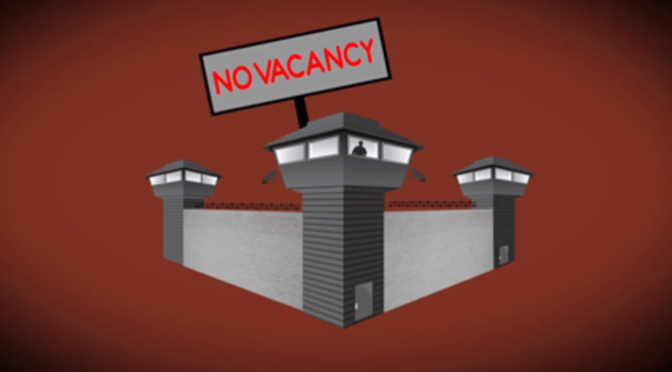
Private prisons: How US corporations make money out of locking you up
The Wal-Mart Model: Not Just for Retail, Now It’s for Private Prisons Too!

SEPTEMBER 29, 2014 | 12:02 PM
The nation’s biggest and baddest for-profit prison company suddenly cares about halfway houses – so much so, that they want in on the action.
About a year after acquiring a smaller firm that operates halfway houses and other community corrections facilities, Corrections Corporation of America (CCA) CEO Damon Hininger announceda few weeks ago that “[r]eentry programs and reducing recidivism are 100 percent aligned with our business model.”
Wait, what?
High recidivism rates mean more people behind bars, and CCA depends on more and more incarceration to make its billions. Since when do they actually want people to do well after they get out, instead of being sucked back into the system?
It’s tempting to be hopeful. Is this a long-overdue acknowledgment that it’s morally bankrupt to make money off of imprisoning human beings? Is the nation’s largest for-profit prison company really admitting that mass incarceration has destroyed too many communities and that locking fewer people behind bars is a good thing?
Come on. It’s CCA. We can’t afford to be naïve. The motivation behind this announcement is where it always is for CCA: the bottom line.
If you read Hininger’s speech carefully, he hints at a long-term corporate strategy that could eventually become even more lucrative than CCA’s prison business: The Wal-Martification of reentry.
Currently, post-prison reentry programs, such as halfway houses and day reporting centers, are largely run by local nonprofit organizations or, in some cases, smaller for-profit companies. Hininger notes the small, local nature of reentry services in his speech – and then claims that CCA can use its size and resources to “provide consistency and common standards” in different facilities, rapidly make new arrangements with multiple agencies “on an as-needed basis,” and “scale” (i.e, grow rapidly). These claims – bigger, faster, cheaper – echo those often made by Wal-Mart supporters to explain why the company is superior to local businesses.
CCA’s plan to become the Wal-Mart of reentry may be good for its investors, but it should alarm the rest of us. First, the for-profit prison industry’s history of abuse, neglect, and mismanagement raises serious questions about what kinds of abuses would occur if we hand over control of even more elements of our criminal justice system to CCA and similar profit-driven companies. Second, CCA fights aggressively toshield its operations from public scrutiny – even though incarceration and rehabilitation are some of the government responsibilities where transparency and accountability are most important.
At their best, halfway houses and day reporting centers can provide much-needed support, psychological help, educational services, and substance abuse treatment during a difficult period of transition between full-scale incarceration and post-sentence release to the community. But at their worst, they can fester with violence and sexual abuse as well as fail to address the serious needs of the people in their care. Given CCA’s track record, we should be worried that vital reentry services are under threat.
No matter how much CCA executives protest that reducing recividism is “100 percent aligned” with the company’s business model, an inherent conflict exists between CCA’s duty to enrich its shareholders and this asserted commitment to successful rehabilitation: The company can keep increasing its profits only by ensuring an ever-greater flow of human beings into the criminal justice system. That flow is maintained by the same bad policies that fuel our national mass incarceration epidemic: the War on Drugs, extreme sentencing practices, and systemic failures to address problems like mental illness, substance abuse disorders, and homelessness outside of the criminal justice system.
For the past four decades, our country has relentlessly expanded the size of our criminal justice system, allowing companies like CCA to reap tremendous profits out of human misery. But the ACLU is committed toending this colossal waste of lives and taxpayer dollars – and in the process, defeating CCA’s plan for the Wal-Mart-ification of reentry.
Learn more about private prisons and other civil liberty issues: Sign up for breaking news alerts,follow us on Twitter, and like us on Facebook.

Salvador Dalí
Salvador Dalí (1904-1989) was a prominent Spanish Surrealist painter and is one of the most celebrated artists of the 20th Century. Dalí was a leading figure in the French Surrealist Art Movement and his fiercely technical, yet highly unconventional paintings, sculptures and public behavior ushered in a new generation of imaginative expression. Continue reading Salvador Dalí

The Century of the Self (2002)
An award winning BBC documentary series which explores the progression of social engineering in the United states through the use of Psychoanalysis. The four part series raises important ethical questions about whether the utilization of psychological conditioning techniques to direct group behaviors is consistent with Democratic ideals.
The film can be viewed FREE online at: http://topdocumentaryfilms.com/the-century-of-the-self/

Thomas Jefferson: The Progressive Libertarian
Thomas Jefferson’s last testament to his political, religious, and educational ideology is encapsulated by his self-ascribed epitaph: “Here lies Thomas Jefferson, Author of the Declaration of American Independence, of the Statute of Virginia for Religious Freedom, and father of the University of Virginia.” [1]. Fittingly, these three accomplishments are the culmination of Thomas Jefferson’s lifework, and reflect the progress he made in affecting American attitudes in each of these areas. Continue reading Thomas Jefferson: The Progressive Libertarian

The Minerva Initiative: Are Student Activists Being Targeted by U.S. Universities?
How many Rutgers students have heard of the Minerva Initiative? If University administrators and the Department of Defense had their choice, none of them would. The Minerva Initiative is a joint research project between the DOD and US universities which receive funding to study social movements to identify trigger events which may lead to civil unrest. [1]. Rutgers University is a project participant. [2].
The program was implemented in 2008 to formulate a strategy for identifying social movements and undermining their efforts to organize. Minerva was initiated over concerns that the economic crisis triggered by the mortgage collapse had the potential to lead to mass civil unrest such as occurred with the Arab Spring movement and the riots in France. The DOD asked University researchers to examine social media trends to identify “tipping points” which could ignite mass civil protests and to develop strategies for immobilizing potential threats.
It has been reported by the Guardian [3] and the Partnership for Civil Justice Fund [4] that these strategies were utilized by the FBI Joint Terrorism Task Force in response to the Occupy Wall Street Movement in 2011. The FBI identified leaders of the OWS movement in the months prior to the group occupying Zucotti Park by tracking the activity of group organizers on social media sites. The JTTF then formulated a joint national response among local police departments and corporate security personnel aimed at suppressing the protests. Furthermore, the ACLU has reported that this type of data mining has been regularly used by the F.B.I. and cooperating law enforcement agencies to target journalists, whistle-blowers and activists for engaging in First Amendment speech. [5].
The practical effect of the Minerva Initiative has been that paranoid University administrators, fueled with fear propaganda supplied by the DOD and law enforcement agencies, are currently monitoring student’s electronic activity on their networks to identify “potential threats.” This has led to a number of socially concious students who are too politically outspoken being labeled as agitators. These students are then monitored, targeted and harassed by University police and administrators seeking to neutralize the threat and deter student protests.
This, coupled with the Snowden revelations over the NSA mass domestic surveillance programs, raises legitimate concerns over the potential for abuse within the US intelligence community’s domestic surveillance network. The NSA has admitted that their mass surveillance and data collection programs have not led to the prevention a single act of domestic terrorism in the US. [6]. However, the program has created a culture of paranoia and retaliation against political dissidents deemed to pose a threat. This has created a noticeable chilling effect on individuals discussing controversial subject material or questioning the underlying motivations behind public policy decisions.
More information about the Minerva Initiative can be found at: minerva.dtic.mil.
The FBI documents obtained by the Partnership for Civil Justice Fund in their 2012 Freedom of Information Act request can be found at: http://www.justiceonline.org/fbi_files_ows#document.
More information about the crackdown on journalists, whistleblowers and activists can be found at: https://www.aclu.org/sites/default/files/assets/unleashed-and-unaccountable-fbi-report.pdf.
Lawrence Christopher Skufca (2015)
Bibliography
[1] Stable URL: http://minerva.dtic.mil/overview.html. [accessed 6/15/2015].
[2] Stable URL: http://minerva.dtic.mil/funded.html [accessed 6/15/2015].
[3] Stable URL: http://www.theguardian.com/commentisfree/2012/dec/29/fbi-coordinated-crackdown-occupy [accessed 6/15/2015].
[4] Stable URL: http://www.justiceonline.org/fbi_files_ows [accessed 6/15/2015].
[5] Stable URL: https://www.aclu.org/sites/default/files/assets/unleashed-and-unaccountable-fbi-report.pdf [accessed 6/15/2015].
[6] Stable URL: https://www.washingtonpost.com/world/national-security/nsa-phone-record-collection-does-little-to-prevent-terrorist [accessed 6/15/2015].
 Camden Civil Rights Project