Category Archives: Articles

Letter from Birmingham Jail

Dr. Martin Luther King, Jr.

16 April 1963

My Dear Fellow Clergymen:

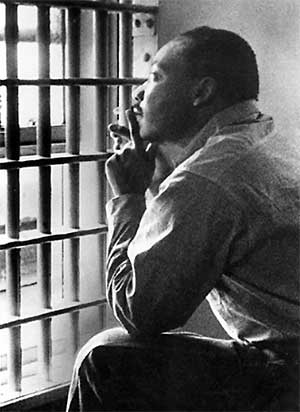
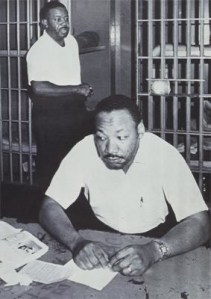
While confined here in the Birmingham city jail, I came across your recent statement calling my present activities “unwise and untimely.” Seldom do I pause to answer criticism of my work and ideas. If I sought to answer all the criticisms that cross my desk, my secretaries would have little time for anything other than such correspondence in the course of the day, and I would have no time for constructive work. But since I feel that you are men of genuine good will and that your criticisms are sincerely set forth, I want to try to answer your statement in what I hope will be patient and reasonable terms.

I think I should indicate why I am here in Birmingham, since you have been influenced by the view which argues against “outsiders coming in.” I have the honor of serving as president of the Southern Christian Leadership Conference, an organization operating in every southern state, with headquarters in Atlanta, Georgia. We have some eighty five affiliated organizations across the South, and one of them is the Alabama Christian Movement for Human Rights. Frequently we share staff, educational and financial resources with our affiliates. Several months ago the affiliate here in Birmingham asked us to be on call to engage in a nonviolent direct action program if such were deemed necessary. We readily consented, and when the hour came we lived up to our promise. So I, along with several members of my staff, am here because I was invited here. I am here because I have organizational ties here.

But more basically, I am in Birmingham because injustice is here. Just as the prophets of the eighth century B.C. left their villages and carried their “thus saith the Lord” far beyond the boundaries of their home towns, and just as the Apostle Paul left his village of Tarsus and carried the gospel of Jesus Christ to the far corners of the Greco Roman world, so am I compelled to carry the gospel of freedom beyond my own home town. Like Paul, I must constantly respond to the Macedonian call for aid.

Birmingham-CharlesMoore

Moreover, I am cognizant of the interrelatedness of all communities and states. I cannot sit idly by in Atlanta and not be concerned about what happens in Birmingham. Injustice anywhere is a threat to justice everywhere. We are caught in an inescapable network of mutuality, tied in a single garment of destiny. Whatever affects one directly, affects all indirectly. Never again can we afford to live with the narrow, provincial “outside agitator” idea. Anyone who lives inside the United States can never be considered an outsider anywhere within its bounds.

You deplore the demonstrations taking place in Birmingham. But your statement, I am sorry to say, fails to express a similar concern for the conditions that brought about the demonstrations. I am sure that none of you would want to rest content with the superficial kind of social analysis that deals merely with effects and does not grapple with underlying causes. It is unfortunate that demonstrations are taking place in Birmingham, but it is even more unfortunate that the city’s white power structure left the Negro community with no alternative.

In any nonviolent campaign there are four basic steps: collection of the facts to determine whether injustices exist; negotiation; self purification; and direct action. We have gone through all these steps in Birmingham. There can be no gainsaying the fact that racial injustice engulfs this community. Birmingham is probably the most thoroughly segregated city in the United States. Its ugly record of brutality is widely known. Negroes have experienced grossly unjust treatment in the courts. There have been more unsolved bombings of Negro homes and churches in Birmingham than in any other city in the nation. These are the hard, brutal facts of the case. On the basis of these conditions, Negro leaders sought to negotiate with the city fathers. But the latter consistently refused to engage in good faith negotiation.
aa_king_jail_1_e

Then, last September, came the opportunity to talk with leaders of Birmingham’s economic community. In the course of the negotiations, certain promises were made by the merchants–for example, to remove the stores’ humiliating racial signs. On the basis of these promises, the Reverend Fred Shuttlesworth and the leaders of the Alabama Christian Movement for Human Rights agreed to a moratorium on all demonstrations. As the weeks and months went by, we realized that we were the victims of a broken promise. A few signs, briefly removed, returned; the others remained. As in so many past experiences, our hopes had been blasted, and the shadow of deep disappointment settled upon us. We had no alternative except to prepare for direct action, whereby we would present our very bodies as a means of laying our case before the conscience of the local and the national community. Mindful of the difficulties involved, we decided to undertake a process of self purification. We began a series of workshops on nonviolence, and we repeatedly asked ourselves: “Are you able to accept blows without retaliating?” “Are you able to endure the ordeal of jail?” We decided to schedule our direct action program for the Easter season, realizing that except for Christmas, this is the main shopping period of the year. Knowing that a strong economic-withdrawal program would be the by product of direct action, we felt that this would be the best time to bring pressure to bear on the merchants for the needed change.

Then it occurred to us that Birmingham’s mayoral election was coming up in March, and we speedily decided to postpone action until after election day. When we discovered that the Commissioner of Public Safety, Eugene “Bull” Connor, had piled up enough votes to be in the run off, we decided again to postpone action until the day after the run off so that the demonstrations could not be used to cloud the issues. Like many others, we waited to see Mr. Connor defeated, and to this end we endured postponement after postponement. Having aided in this community need, we felt that our direct action program could be delayed no longer.

You may well ask: “Why direct action? Why sit ins, marches and so forth? Isn’t negotiation a better path?” You are quite right in calling for negotiation. Indeed, this is the very purpose of direct action. Nonviolent direct action seeks to create such a crisis and foster such a tension that a community which has constantly refused to negotiate is forced to confront the issue. It seeks so to dramatize the issue that it can no longer be ignored. My citing the creation of tension as part of the work of the nonviolent resister may sound rather shocking. But I must confess that I am not afraid of the word “tension.” I have earnestly opposed violent tension, but there is a type of constructive, nonviolent tension which is necessary for growth. Just as Socrates felt that it was necessary to create a tension in the mind so that individuals could rise from the bondage of myths and half truths to the unfettered realm of creative analysis and objective appraisal, so must we see the need for nonviolent gadflies to create the kind of tension in society that will help men rise from the dark depths of prejudice and racism to the majestic heights of understanding and brotherhood. The purpose of our direct action program is to create a situation so crisis packed that it will inevitably open the door to negotiation. I therefore concur with you in your call for negotiation. Too long has our beloved Southland been bogged down in a tragic effort to live in monologue rather than dialogue.
download (1)

One of the basic points in your statement is that the action that I and my associates have taken in Birmingham is untimely. Some have asked: “Why didn’t you give the new city administration time to act?” The only answer that I can give to this query is that the new Birmingham administration must be prodded about as much as the outgoing one, before it will act. We are sadly mistaken if we feel that the election of Albert Boutwell as mayor will bring the millennium to Birmingham. While Mr. Boutwell is a much more gentle person than Mr. Connor, they are both segregationists, dedicated to maintenance of the status quo. I have hope that Mr. Boutwell will be reasonable enough to see the futility of massive resistance to desegregation. But he will not see this without pressure from devotees of civil rights. My friends, I must say to you that we have not made a single gain in civil rights without determined legal and nonviolent pressure. Lamentably, it is an historical fact that privileged groups seldom give up their privileges voluntarily. Individuals may see the moral light and voluntarily give up their unjust posture; but, as Reinhold Niebuhr has reminded us, groups tend to be more immoral than individuals.

We know through painful experience that freedom is never voluntarily given by the oppressor; it must be demanded by the oppressed. Frankly, I have yet to engage in a direct action campaign that was “well timed” in the view of those who have not suffered unduly from the disease of segregation. For years now I have heard the word “Wait!” It rings in the ear of every Negro with piercing familiarity. This “Wait” has almost always meant “Never.” We must come to see, with one of our distinguished jurists, that “justice too long delayed is justice denied.”

We have waited for more than 340 years for our constitutional and God given rights. The nations of Asia and Africa are moving with jetlike speed toward gaining political independence, but we still creep at horse and buggy pace toward gaining a cup of coffee at a lunch counter. Perhaps it is easy for those who have never felt the stinging darts of segregation to say, “Wait.” But when you have seen vicious mobs lynch your mothers and fathers at will and drown your sisters and brothers at whim; when you have seen hate filled policemen curse, kick and even kill your black brothers and sisters; when you see the vast majority of your twenty million Negro brothers smothering in an airtight cage of poverty in the midst of an affluent society; when you suddenly find your tongue twisted and your speech stammering as you seek to explain to your six year old daughter why she can’t go to the public amusement park that has just been advertised on television, and see tears welling up in her eyes when she is told that Funtown is closed to colored children, and see ominous clouds of inferiority beginning to form in her little mental sky, and see her beginning to distort her personality by developing an unconscious bitterness toward white people; when you have to concoct an answer for a five year old son who is asking: “Daddy, why do white people treat colored people so mean?”; when you take a cross county drive and find it necessary to sleep night after night in the uncomfortable corners of your automobile because no motel will accept you; when you are humiliated day in and day out by nagging signs reading “white” and “colored”; when your first name becomes “nigger,” your middle name becomes “boy” (however old you are) and your last name becomes “John,” and your wife and mother are never given the respected title “Mrs.”; when you are harried by day and haunted by night by the fact that you are a Negro, living constantly at tiptoe stance, never quite knowing what to expect next, and are plagued with inner fears and outer resentments; when you are forever fighting a degenerating sense of “nobodiness”–then you will understand why we find it difficult to wait. There comes a time when the cup of endurance runs over, and men are no longer willing to be plunged into the abyss of despair. I hope, sirs, you can understand our legitimate and unavoidable impatience. You express a great deal of anxiety over our willingness to break laws. This is certainly a legitimate concern. Since we so diligently urge people to obey the Supreme Court’s decision of 1954 outlawing segregation in the public schools, at first glance it may seem rather paradoxical for us consciously to break laws. One may well ask: “How can you advocate breaking some laws and obeying others?” The answer lies in the fact that there are two types of laws: just and unjust. I would be the first to advocate obeying just laws. One has not only a legal but a moral responsibility to obey just laws. Conversely, one has a moral responsibility to disobey unjust laws. I would agree with St. Augustine that “an unjust law is no law at all.”
mlk-birmingham

Now, what is the difference between the two? How does one determine whether a law is just or unjust? A just law is a man made code that squares with the moral law or the law of God. An unjust law is a code that is out of harmony with the moral law. To put it in the terms of St. Thomas Aquinas: An unjust law is a human law that is not rooted in eternal law and natural law. Any law that uplifts human personality is just. Any law that degrades human personality is unjust. All segregation statutes are unjust because segregation distorts the soul and damages the personality. It gives the segregator a false sense of superiority and the segregated a false sense of inferiority. Segregation, to use the terminology of the Jewish philosopher Martin Buber, substitutes an “I it” relationship for an “I thou” relationship and ends up relegating persons to the status of things. Hence segregation is not only politically, economically and sociologically unsound, it is morally wrong and sinful. Paul Tillich has said that sin is separation. Is not segregation an existential expression of man’s tragic separation, his awful estrangement, his terrible sinfulness? Thus it is that I can urge men to obey the 1954 decision of the Supreme Court, for it is morally right; and I can urge them to disobey segregation ordinances, for they are morally wrong.

Let us consider a more concrete example of just and unjust laws. An unjust law is a code that a numerical or power majority group compels a minority group to obey but does not make binding on itself. This is difference made legal. By the same token, a just law is a code that a majority compels a minority to follow and that it is willing to follow itself. This is sameness made legal. Let me give another explanation. A law is unjust if it is inflicted on a minority that, as a result of being denied the right to vote, had no part in enacting or devising the law. Who can say that the legislature of Alabama which set up that state’s segregation laws was democratically elected? Throughout Alabama all sorts of devious methods are used to prevent Negroes from becoming registered voters, and there are some counties in which, even though Negroes constitute a majority of the population, not a single Negro is registered. Can any law enacted under such circumstances be considered democratically structured?

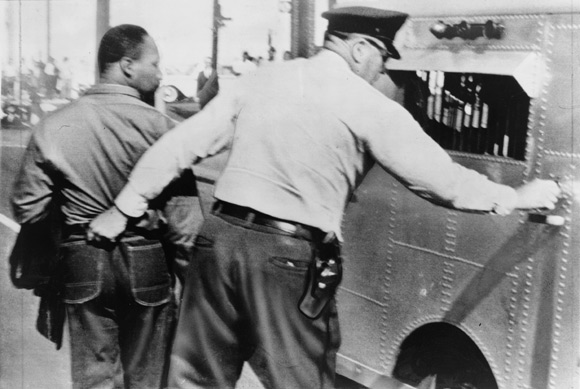
Sometimes a law is just on its face and unjust in its application. For instance, I have been arrested on a charge of parading without a permit. Now, there is nothing wrong in having an ordinance which requires a permit for a parade. But such an ordinance becomes unjust when it is used to maintain segregation and to deny citizens the First-Amendment privilege of peaceful assembly and protest.

I hope you are able to see the distinction I am trying to point out. In no sense do I advocate evading or defying the law, as would the rabid segregationist. That would lead to anarchy. One who breaks an unjust law must do so openly, lovingly, and with a willingness to accept the penalty. I submit that an individual who breaks a law that conscience tells him is unjust, and who willingly accepts the penalty of imprisonment in order to arouse the conscience of the community over its injustice, is in reality expressing the highest respect for law.

Letter_from_a_Birmingham_Jail_fs

Of course, there is nothing new about this kind of civil disobedience. It was evidenced sublimely in the refusal of Shadrach, Meshach and Abednego to obey the laws of Nebuchadnezzar, on the ground that a higher moral law was at stake. It was practiced superbly by the early Christians, who were willing to face hungry lions and the excruciating pain of chopping blocks rather than submit to certain unjust laws of the Roman Empire. To a degree, academic freedom is a reality today because Socrates practiced civil disobedience. In our own nation, the Boston Tea Party represented a massive act of civil disobedience.

We should never forget that everything Adolf Hitler did in Germany was “legal” and everything the Hungarian freedom fighters did in Hungary was “illegal.” It was “illegal” to aid and comfort a Jew in Hitler’s Germany. Even so, I am sure that, had I lived in Germany at the time, I would have aided and comforted my Jewish brothers. If today I lived in a Communist country where certain principles dear to the Christian faith are suppressed, I would openly advocate disobeying that country’s antireligious laws.

I must make two honest confessions to you, my Christian and Jewish brothers. First, I must confess that over the past few years I have been gravely disappointed with the white moderate. I have almost reached the regrettable conclusion that the Negro’s great stumbling block in his stride toward freedom is not the White Citizen’s Counciler or the Ku Klux Klanner, but the white moderate, who is more devoted to “order” than to justice; who prefers a negative peace which is the absence of tension to a positive peace which is the presence of justice; who constantly says: “I agree with you in the goal you seek, but I cannot agree with your methods of direct action”; who paternalistically believes he can set the timetable for another man’s freedom; who lives by a mythical concept of time and who constantly advises the Negro to wait for a “more convenient season.” Shallow understanding from people of good will is more frustrating than absolute misunderstanding from people of ill will. Lukewarm acceptance is much more bewildering than outright rejection.

I had hoped that the white moderate would understand that law and order exist for the purpose of establishing justice and that when they fail in this purpose they become the dangerously structured dams that block the flow of social progress. I had hoped that the white moderate would understand that the present tension in the South is a necessary phase of the transition from an obnoxious negative peace, in which the Negro passively accepted his unjust plight, to a substantive and positive peace, in which all men will respect the dignity and worth of human personality. Actually, we who engage in nonviolent direct action are not the creators of tension. We merely bring to the surface the hidden tension that is already alive. We bring it out in the open, where it can be seen and dealt with. Like a boil that can never be cured so long as it is covered up but must be opened with all its ugliness to the natural medicines of air and light, injustice must be exposed, with all the tension its exposure creates, to the light of human conscience and the air of national opinion before it can be cured.
kinginjail

In your statement you assert that our actions, even though peaceful, must be condemned because they precipitate violence. But is this a logical assertion? Isn’t this like condemning a robbed man because his possession of money precipitated the evil act of robbery? Isn’t this like condemning Socrates because his unswerving commitment to truth and his philosophical inquiries precipitated the act by the misguided populace in which they made him drink hemlock? Isn’t this like condemning Jesus because his unique God consciousness and never ceasing devotion to God’s will precipitated the evil act of crucifixion? We must come to see that, as the federal courts have consistently affirmed, it is wrong to urge an individual to cease his efforts to gain his basic constitutional rights because the quest may precipitate violence. Society must protect the robbed and punish the robber. I had also hoped that the white moderate would reject the myth concerning time in relation to the struggle for freedom. I have just received a letter from a white brother in Texas. He writes: “All Christians know that the colored people will receive equal rights eventually, but it is possible that you are in too great a religious hurry. It has taken Christianity almost two thousand years to accomplish what it has. The teachings of Christ take time to come to earth.” Such an attitude stems from a tragic misconception of time, from the strangely irrational notion that there is something in the very flow of time that will inevitably cure all ills. Actually, time itself is neutral; it can be used either destructively or constructively. More and more I feel that the people of ill will have used time much more effectively than have the people of good will. We will have to repent in this generation not merely for the hateful words and actions of the bad people but for the appalling silence of the good people. Human progress never rolls in on wheels of inevitability; it comes through the tireless efforts of men willing to be co workers with God, and without this hard work, time itself becomes an ally of the forces of social stagnation. We must use time creatively, in the knowledge that the time is always ripe to do right. Now is the time to make real the promise of democracy and transform our pending national elegy into a creative psalm of brotherhood. Now is the time to lift our national policy from the quicksand of racial injustice to the solid rock of human dignity.

You speak of our activity in Birmingham as extreme. At first I was rather disappointed that fellow clergymen would see my nonviolent efforts as those of an extremist. I began thinking about the fact that I stand in the middle of two opposing forces in the Negro community. One is a force of complacency, made up in part of Negroes who, as a result of long years of oppression, are so drained of self respect and a sense of “somebodiness” that they have adjusted to segregation; and in part of a few middle-class Negroes who, because of a degree of academic and economic security and because in some ways they profit by segregation, have become insensitive to the problems of the masses. The other force is one of bitterness and hatred, and it comes perilously close to advocating violence. It is expressed in the various black nationalist groups that are springing up across the nation, the largest and best known being Elijah Muhammad’s Muslim movement. Nourished by the Negro’s frustration over the continued existence of racial discrimination, this movement is made up of people who have lost faith in America, who have absolutely repudiated Christianity, and who have concluded that the white man is an incorrigible “devil.”

0e1857167_blog-mlkheader

I have tried to stand between these two forces, saying that we need emulate neither the “do nothingism” of the complacent nor the hatred and despair of the black nationalist. For there is the more excellent way of love and nonviolent protest. I am grateful to God that, through the influence of the Negro church, the way of nonviolence became an integral part of our struggle. If this philosophy had not emerged, by now many streets of the South would, I am convinced, be flowing with blood. And I am further convinced that if our white brothers dismiss as “rabble rousers” and “outside agitators” those of us who employ nonviolent direct action, and if they refuse to support our nonviolent efforts, millions of Negroes will, out of frustration and despair, seek solace and security in black nationalist ideologies–a development that would inevitably lead to a frightening racial nightmare.

Oppressed people cannot remain oppressed forever. The yearning for freedom eventually manifests itself, and that is what has happened to the American Negro. Something within has reminded him of his birthright of freedom, and something without has reminded him that it can be gained. Consciously or unconsciously, he has been caught up by the Zeitgeist, and with his black brothers of Africa and his brown and yellow brothers of Asia, South America and the Caribbean, the United States Negro is moving with a sense of great urgency toward the promised land of racial justice. If one recognizes this vital urge that has engulfed the Negro community, one should readily understand why public demonstrations are taking place. The Negro has many pent up resentments and latent frustrations, and he must release them. So let him march; let him make prayer pilgrimages to the city hall; let him go on freedom rides -and try to understand why he must do so. If his repressed emotions are not released in nonviolent ways, they will seek expression through violence; this is not a threat but a fact of history. So I have not said to my people: “Get rid of your discontent.” Rather, I have tried to say that this normal and healthy discontent can be channeled into the creative outlet of nonviolent direct action. And now this approach is being termed extremist. But though I was initially disappointed at being categorized as an extremist, as I continued to think about the matter I gradually gained a measure of satisfaction from the label. Was not Jesus an extremist for love: “Love your enemies, bless them that curse you, do good to them that hate you, and pray for them which despitefully use you, and persecute you.” Was not Amos an extremist for justice: “Let justice roll down like waters and righteousness like an ever flowing stream.” Was not Paul an extremist for the Christian gospel: “I bear in my body the marks of the Lord Jesus.” Was not Martin Luther an extremist: “Here I stand; I cannot do otherwise, so help me God.” And John Bunyan: “I will stay in jail to the end of my days before I make a butchery of my conscience.” And Abraham Lincoln: “This nation cannot survive half slave and half free.” And Thomas Jefferson: “We hold these truths to be self evident, that all men are created equal . . .” So the question is not whether we will be extremists, but what kind of extremists we will be. Will we be extremists for hate or for love? Will we be extremists for the preservation of injustice or for the extension of justice? In that dramatic scene on Calvary’s hill three men were crucified. We must never forget that all three were crucified for the same crime–the crime of extremism. Two were extremists for immorality, and thus fell below their environment. The other, Jesus Christ, was an extremist for love, truth and goodness, and thereby rose above his environment. Perhaps the South, the nation and the world are in dire need of creative extremists.

f1a4b79e2

I had hoped that the white moderate would see this need. Perhaps I was too optimistic; perhaps I expected too much. I suppose I should have realized that few members of the oppressor race can understand the deep groans and passionate yearnings of the oppressed race, and still fewer have the vision to see that injustice must be rooted out by strong, persistent and determined action. I am thankful, however, that some of our white brothers in the South have grasped the meaning of this social revolution and committed themselves to it. They are still all too few in quantity, but they are big in quality. Some -such as Ralph McGill, Lillian Smith, Harry Golden, James McBride Dabbs, Ann Braden and Sarah Patton Boyle–have written about our struggle in eloquent and prophetic terms. Others have marched with us down nameless streets of the South. They have languished in filthy, roach infested jails, suffering the abuse and brutality of policemen who view them as “dirty nigger-lovers.” Unlike so many of their moderate brothers and sisters, they have recognized the urgency of the moment and sensed the need for powerful “action” antidotes to combat the disease of segregation. Let me take note of my other major disappointment. I have been so greatly disappointed with the white church and its leadership. Of course, there are some notable exceptions. I am not unmindful of the fact that each of you has taken some significant stands on this issue. I commend you, Reverend Stallings, for your Christian stand on this past Sunday, in welcoming Negroes to your worship service on a nonsegregated basis. I commend the Catholic leaders of this state for integrating Spring Hill College several years ago.

But despite these notable exceptions, I must honestly reiterate that I have been disappointed with the church. I do not say this as one of those negative critics who can always find something wrong with the church. I say this as a minister of the gospel, who loves the church; who was nurtured in its bosom; who has been sustained by its spiritual blessings and who will remain true to it as long as the cord of life shall lengthen.

When I was suddenly catapulted into the leadership of the bus protest in Montgomery, Alabama, a few years ago, I felt we would be supported by the white church. I felt that the white ministers, priests and rabbis of the South would be among our strongest allies. Instead, some have been outright opponents, refusing to understand the freedom movement and misrepresenting its leaders; all too many others have been more cautious than courageous and have remained silent behind the anesthetizing security of stained glass windows.

In spite of my shattered dreams, I came to Birmingham with the hope that the white religious leadership of this community would see the justice of our cause and, with deep moral concern, would serve as the channel through which our just grievances could reach the power structure. I had hoped that each of you would understand. But again I have been disappointed.

MLK

I have heard numerous southern religious leaders admonish their worshipers to comply with a desegregation decision because it is the law, but I have longed to hear white ministers declare: “Follow this decree because integration is morally right and because the Negro is your brother.” In the midst of blatant injustices inflicted upon the Negro, I have watched white churchmen stand on the sideline and mouth pious irrelevancies and sanctimonious trivialities. In the midst of a mighty struggle to rid our nation of racial and economic injustice, I have heard many ministers say: “Those are social issues, with which the gospel has no real concern.” And I have watched many churches commit themselves to a completely other worldly religion which makes a strange, un-Biblical distinction between body and soul, between the sacred and the secular.

I have traveled the length and breadth of Alabama, Mississippi and all the other southern states. On sweltering summer days and crisp autumn mornings I have looked at the South’s beautiful churches with their lofty spires pointing heavenward. I have beheld the impressive outlines of her massive religious education buildings. Over and over I have found myself asking: “What kind of people worship here? Who is their God? Where were their voices when the lips of Governor Barnett dripped with words of interposition and nullification? Where were they when Governor Wallace gave a clarion call for defiance and hatred? Where were their voices of support when bruised and weary Negro men and women decided to rise from the dark dungeons of complacency to the bright hills of creative protest?”

Yes, these questions are still in my mind. In deep disappointment I have wept over the laxity of the church. But be assured that my tears have been tears of love. There can be no deep disappointment where there is not deep love. Yes, I love the church. How could I do otherwise? I am in the rather unique position of being the son, the grandson and the great grandson of preachers. Yes, I see the church as the body of Christ. But, oh! How we have blemished and scarred that body through social neglect and through fear of being nonconformists.

There was a time when the church was very powerful–in the time when the early Christians rejoiced at being deemed worthy to suffer for what they believed. In those days the church was not merely a thermometer that recorded the ideas and principles of popular opinion; it was a thermostat that transformed the mores of society. Whenever the early Christians entered a town, the people in power became disturbed and immediately sought to convict the Christians for being “disturbers of the peace” and “outside agitators.”‘ But the Christians pressed on, in the conviction that they were “a colony of heaven,” called to obey God rather than man. Small in number, they were big in commitment. They were too God-intoxicated to be “astronomically intimidated.” By their effort and example they brought an end to such ancient evils as infanticide and gladiatorial contests. Things are different now. So often the contemporary church is a weak, ineffectual voice with an uncertain sound. So often it is an archdefender of the status quo. Far from being disturbed by the presence of the church, the power structure of the average community is consoled by the church’s silent–and often even vocal–sanction of things as they are.

mlk-553x290

But the judgment of God is upon the church as never before. If today’s church does not recapture the sacrificial spirit of the early church, it will lose its authenticity, forfeit the loyalty of millions, and be dismissed as an irrelevant social club with no meaning for the twentieth century. Every day I meet young people whose disappointment with the church has turned into outright disgust.

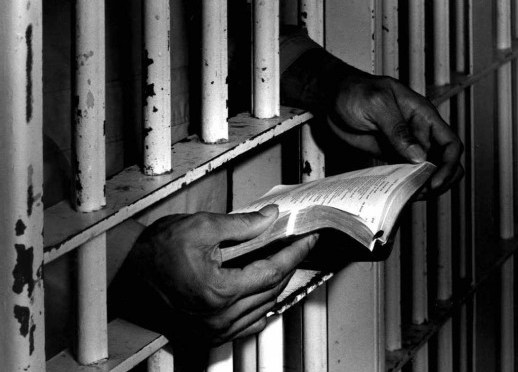
Perhaps I have once again been too optimistic. Is organized religion too inextricably bound to the status quo to save our nation and the world? Perhaps I must turn my faith to the inner spiritual church, the church within the church, as the true ekklesia and the hope of the world. But again I am thankful to God that some noble souls from the ranks of organized religion have broken loose from the paralyzing chains of conformity and joined us as active partners in the struggle for freedom. They have left their secure congregations and walked the streets of Albany, Georgia, with us. They have gone down the highways of the South on tortuous rides for freedom. Yes, they have gone to jail with us. Some have been dismissed from their churches, have lost the support of their bishops and fellow ministers. But they have acted in the faith that right defeated is stronger than evil triumphant. Their witness has been the spiritual salt that has preserved the true meaning of the gospel in these troubled times. They have carved a tunnel of hope through the dark mountain of disappointment. I hope the church as a whole will meet the challenge of this decisive hour. But even if the church does not come to the aid of justice, I have no despair about the future. I have no fear about the outcome of our struggle in Birmingham, even if our motives are at present misunderstood. We will reach the goal of freedom in Birmingham and all over the nation, because the goal of America is freedom. Abused and scorned though we may be, our destiny is tied up with America’s destiny. Before the pilgrims landed at Plymouth, we were here. Before the pen of Jefferson etched the majestic words of the Declaration of Independence across the pages of history, we were here. For more than two centuries our forebears labored in this country without wages; they made cotton king; they built the homes of their masters while suffering gross injustice and shameful humiliation -and yet out of a bottomless vitality they continued to thrive and develop. If the inexpressible cruelties of slavery could not stop us, the opposition we now face will surely fail. We will win our freedom because the sacred heritage of our nation and the eternal will of God are embodied in our echoing demands. Before closing I feel impelled to mention one other point in your statement that has troubled me profoundly. You warmly commended the Birmingham police force for keeping “order” and “preventing violence.” I doubt that you would have so warmly commended the police force if you had seen its dogs sinking their teeth into unarmed, nonviolent Negroes. I doubt that you would so quickly commend the policemen if you were to observe their ugly and inhumane treatment of Negroes here in the city jail; if you were to watch them push and curse old Negro women and young Negro girls; if you were to see them slap and kick old Negro men and young boys; if you were to observe them, as they did on two occasions, refuse to give us food because we wanted to sing our grace together. I cannot join you in your praise of the Birmingham police department.

It is true that the police have exercised a degree of discipline in handling the demonstrators. In this sense they have conducted themselves rather “nonviolently” in public. But for what purpose? To preserve the evil system of segregation. Over the past few years I have consistently preached that nonviolence demands that the means we use must be as pure as the ends we seek. I have tried to make clear that it is wrong to use immoral means to attain moral ends. But now I must affirm that it is just as wrong, or perhaps even more so, to use moral means to preserve immoral ends. Perhaps Mr. Connor and his policemen have been rather nonviolent in public, as was Chief Pritchett in Albany, Georgia, but they have used the moral means of nonviolence to maintain the immoral end of racial injustice. As T. S. Eliot has said: “The last temptation is the greatest treason: To do the right deed for the wrong reason.”
thekings01

I wish you had commended the Negro sit inners and demonstrators of Birmingham for their sublime courage, their willingness to suffer and their amazing discipline in the midst of great provocation. One day the South will recognize its real heroes. They will be the James Merediths, with the noble sense of purpose that enables them to face jeering and hostile mobs, and with the agonizing loneliness that characterizes the life of the pioneer. They will be old, oppressed, battered Negro women, symbolized in a seventy two year old woman in Montgomery, Alabama, who rose up with a sense of dignity and with her people decided not to ride segregated buses, and who responded with ungrammatical profundity to one who inquired about her weariness: “My feets is tired, but my soul is at rest.” They will be the young high school and college students, the young ministers of the gospel and a host of their elders, courageously and nonviolently sitting in at lunch counters and willingly going to jail for conscience’ sake. One day the South will know that when these disinherited children of God sat down at lunch counters, they were in reality standing up for what is best in the American dream and for the most sacred values in our Judaeo Christian heritage, thereby bringing our nation back to those great wells of democracy which were dug deep by the founding fathers in their formulation of the Constitution and the Declaration of Independence.

Never before have I written so long a letter. I’m afraid it is much too long to take your precious time. I can assure you that it would have been much shorter if I had been writing from a comfortable desk, but what else can one do when he is alone in a narrow jail cell, other than write long letters, think long thoughts and pray long prayers?

If I have said anything in this letter that overstates the truth and indicates an unreasonable impatience, I beg you to forgive me. If I have said anything that understates the truth and indicates my having a patience that allows me to settle for anything less than brotherhood, I beg God to forgive me.

I hope this letter finds you strong in the faith. I also hope that circumstances will soon make it possible for me to meet each of you, not as an integrationist or a civil-rights leader but as a fellow clergyman and a Christian brother. Let us all hope that the dark clouds of racial prejudice will soon pass away and the deep fog of misunderstanding will be lifted from our fear drenched communities, and in some not too distant tomorrow the radiant stars of love and brotherhood will shine over our great nation with all their scintillating beauty.

Yours for the cause of Peace and Brotherhood,

Martin Luther King, Jr.

Further Reading

Rieder, Jonathan. “The Day President Kennedy Embraced Civil Rights—and the Story Behind It.The Atlantic,  June 11, 2013.

Game Theory and Social Emotions

logo4replacecolors

by Richard Landes

Game theory examines the ways that various people “play” their interactions with others. All games take place on at least two levels. The first is material gain or loss (often quantifiable, and the focus of most formal game theory), and the second, psychological perception of having won or lost (rarely quantifiable until recently, ignored). In honor-shame cultures, the perception of others’ actions plays a much stronger role than “rational” concerns about material gain and loss regardless of relative advantage which, in principle, governs civil society behavior (rational choice theory). Rational choice theory, focused on quantifiable self-interest as a motivation, tends to downplay emotional components of game playing. It discusses fixed- and variable-sum games. The following discussion analyzes the cultural and emotional dimensions of a player’s preference for one strategy over another, and focuses on zero-, positive- and negative-sum games.

ZERO-SUM GAMES are games in which one side wins and the other loses. Hard zero-sum insists that only when the other loses can one win. Hard zero-sum reflects an emotional demand that a victory can only be savored when the defeated one knows himself to be defeated. All sports and gambling games are zero-sum. War, theft and raiding are hard zero-sum. The dominating imperative: “rule or be ruled” takes zero-sum relations at a political level as axiomatic. I must dominate lest you do the same. “Do onto others before they do onto you.” The joke about the peasant whom the genie offers one wish, but whatever he asks for his neighbor gets double illustrates the zero-sum mentality to perfection: “Poke out one of my eyes.”

POSITIVE-SUM GAMES are games in which both sides win. In closed positive-sum transactions, although both parties may “win”, one side is guaranteed a significantly greater victory (noblesse oblige, or British imperialism). Open-ended positive-sum is based on a voluntary agreement to interact (contract, joint venture, constitution) on rules that apply equally to both sides, and an agreement that whatever results from the interaction, both sides will accept no matter how diverse the end result (civil society, meritocracy). Rationality and “rational choice theory” assume that actors will work to maximize their own advantage, with minimal concern for how it might help someone else even more. As opposed to the mutilated kingship and dominion of zero-sum, democracy and civil society derive from the extremely rare accomplishment of a positive-sum mentality among a critical mass of citizens.

NEGATIVE-SUM GAMES are games in which both sides lose. This represents the height of irrationality to positive-sum players, but it proves a surprisingly durable choice of game-players. The self-destructive element in conjunction with aggression often derives from losing a hard zero-sum game and not accepting an offer to switch to positive-sum. In terms of the zero-sum genie joke above, negative-sum thinking — illustrated with deep poignancy by the Palestinian ruling elites — runs along the lines of “poke out both of my eyes if only I can get one of my enemy’s.”

THE EMOTIONS AND LOGIC OF ZERO-SUM: I win, you lose; or, you win, I lose. In modern society, these interactions get played out in sports. When played out in economic life, however, zero-sum assumes a fixed set of resources (no economic growth). Therefore, whatever has worked to the advantage of the other has diminished the self. In its harshest forms, zero-sum holds that not only does one person win and the other lose, but in order for one to win, the other must lose. Zero-sum emotions include:

  • total scarcity — if you gain (wealth, status), I lose
  • Schadenfreude — your misfortune brings me gladness;
  • envy — your success diminishes me;
  • triumphalism — I’m bigger because you are smaller; and
  • resentment — as long as you have more success than me, I despise you, if necessary in secret.

The appeal of these emotions — risking all to feel triumphalism and dominion — is well-nigh universal. Hence, in civil societies, zero-sum games are delegated to sports and gambling. In prime divider societies, they invade the realm of real life: “war is the sport of kings.”

In order to understand this mentality, we have to put aside cognitive egocentrism. We are raised in a culture that places heavy emphasis on positive-sum relations, or on the notion of mutually beneficial win-win. We consider positive-sum so obviously appropriate that it is virtually synonymous with rationality. When our economists assume rationality as their axiomatic understanding of individual decision-making, they reflect this widespread cultural assumption that, at least formally, dates back to Adam Smith. And not surprisingly, the mentality of zero-sum – one wins, one loses – strikes us, as self-destructive.

Let us consider the nature and logic of zero-sum interactions, especially in terms of the emotional pay-offs. The basic rule of human interaction in many honor-shame cultures holds that honor is a limited commodity, that one person’s honor means the loss of honor of another. Politically this leads to what Eli Sagan has termed the “paranoid imperative”: rule or be ruled. “If I don’t rule over you, you will rule over me. I must therefore try to dominate you lest you dominate me. If you win, I lose; in order for me to win, you must lose.”

(I prefer the designation “dominating imperative” for this set of beliefs. The paranoid imperative I prefer to reserve for: exterminate or be exterminated. Hence the distinction in matters of Judeophobia between, for example, zero-sum anti-Judaism and paranoid anti-Semitism.)

This attitude of rule-or-be-ruled justifies what Mao used to call “pre-emptive retaliation strikes.” They happen all the time, from international relations to familial ones. The classic expression of this attitude comes in two forms: 1) the more basic “honor-shame” culture of the tribal warrior, where honor comes from dominion (that is, the Germanic, Celtic, and Mediterranean subterranean levels of European culture), and 2) the “civilized empires” in which a certain degree of restraint in the exercise of immediate dominion opened up both a space for an expanding “middle class”, largely urban, and for a much wider range of conquest and dominion for a small elite.

As the Romans liked to tell themselves, the first Romans quickly understood that they could either be masters or slaves, so they chose to be masters, and did it so well that they conquered the world. Rome is the poster boy forlibido dominandi (the lust to dominate). Roman imperialism illustrates the accuracy of the Athenian remark to the Melians ca. 416 BCE that it had been a law long before their time and would be long after, “that those who can do what they will and those who can’t suffer what they must.”

This statement helps us understand the emotional and strategic logic of zero-sum in what seemed like a negative-sum choice in the genie-peasant joke cited above: “Poke out one of my eyes.” If this were a chess move (i.e. a zero-sum game) rather than a joke, you’d put two exclamation points after it. In one deft move, this man has turned around a painful dilemma into a spectacular “win” for himself. The peasant’s dilemma was that anything that benefited him, made his neighbor twice as well off: a thousand head of cattle for him meant two thousand for his neighbor. In the world of the dominating imperative, one assumes that if one’s neighbor is twice as wealthy as oneself, that neighbor will use his superiority to try to control you. Our peasant resolves the dilemma with a dramatic queen sacrifice: “in the kingdom of the blind, the one-eyed is king.” He has bought his dominion at the price of his self-mutilation. Envy unchecked is one of the key components of a culture of impoverishment.

THE LOGIC AND EMOTIONS OF POSITIVE-SUM: The logic of positive-sum seems clear to people brought up in civil society. Compromise is the essence of democracy; going for hard zero-sum blights growth and mutual prosperity. But the emotions of zero-sum can be quite demanding. In order to neutralize Schadenfreude, especially in a modern society where individuals’ conditions change rapidly, one has to learn to tolerate, even take pleasure in other people’s success, even success in direct comparison with one’s own choices. The “rational” response to the genie’s dilemma — one might call it the modern liberal’s response — is to say, “give me ten million bucks and good for my neighbor who gets twenty.” But being rational is not that easy.

To accept defeat without scape-goating, cheating, or using force to redress the imbalance, to accept the occasional public humiliation for the sake of integrity rather than saving face at the cost of honesty, requires a commitment to fair-play and self-criticism (e.g., to accepting the “bad” news that one has lost). This generous attitude towards others and modesty towards oneself are not easy and natural emotions. They must be fostered. Both civil society and demotic millennialism nurture these emotions, and great men like the Englishman William Blake can “root” for the Americans in their support of experiments in freedom even against their “own side.”

The emotional dimensions that determine these two worlds of social interaction also substantiate the emotional attachments some of us have either to the Politically-Correct Paradigm (PCP (we are all committed to positive-sum games) or the Honor-Shame Jihad Paradigm (JP) (they are, alas, committed to hard zero-sum desires). Our ironic dilemma is that the more those who favor the naturally generous view of positive-sum adhere to PCP, the more they contribute to the zero-sum behavior of demopaths and the hard-zero-sum players, whose intentions they systematically misinterpret. Without understanding the interplay between the logic and emotions of zero- and positive-sum strategies, we will have difficulty figuring a way out of the current dilemma of the thrash of cultures.

Further Reading

Alexander, J. McKenzie, “Evolutionary Game Theory“, The Stanford Encyclopedia of Philosophy (Fall 2009 Edition), Edward N. Zalta (ed.). Stable URL: http://plato.stanford.edu/entries/game-evolutionary/

Wormuth, Francis D, “The Politics of Bedlam“, Bulletin of the Atomic Scientists (December 1963).

Original Source: http://www.theaugeanstables.com/reflections-from-second-draft/game-theory-and-social-emotions/

(Artwork: Schizophrenia by Mimika Papadimitriou)

Unmasking the Motives of the Good Samaritan

download (1)

By Claire Andre and Manuel Velasquez

“Even at our best, we are only out for ourselves” claim many people, including many eminent psychologists. Everything we do–from the considerate to the heroic, we do ultimately for our own benefit. In some instances, the personal gain is obvious, such as when we reap public admiration or praise. In other instances, it’s not so obvious. Consider this:

You’re walking down a quiet road one evening and suddenly come upon a horrible scene. Ahead of you is a truck turned on its side and lying on the pavement is the driver, a young man. His face is bloody and he is barely moving. What do you do? You help. But why do you help? What, exactly, is your motive?

You are likely to reply that you helped because you wanted to reduce the man’s distress. But many psychologists would offer a different explanation: When we see someone in distress, we ourselves experience feelings of distress, such as shock, alarm, worry, or fear. This unpleasant emotional arousal leads us to want to increase our own well being by reducing these feelings. One way to this goal is to reduce the other’s distress. Helping, then, is only a means to reducing our own distress. What appears to be altruistically motivated behavior is really only self interest in disguise.

The view that human beings act from self-interest and from self interest alone is not new. It has long been the dominant view in psychology and in much of Western thought. Thomas Hobbes, the seventeenth century philosopher, believed that human beings always acted from self-interest. On one occasion Hobbes was seen giving money to a beggar. When asked why, he explained that he was trying to relieve his own discomfort at seeing the beggar in need.

But if it is true that human beings always act from egoistic motives, then it’s difficult to talk about ethics. First, ethics as traditionally conceived is supposed to override self-interest: if we have a moral obligation to do something, we ought to do it even when it’s not in our own interests to do so. It makes no sense, however, to tell people that they ought to act contrary to self-interest if they can act only in terms of self-interest. Moreover, an important traditional element in ethical decision-making is an impartial consideration of the interests of others. The moral point of view goes beyond self-interest to a standpoint that takes everyone’s interests into account. Ethics, then, assumes that self interest is not the basis for all human behavior, although some philosophers, e.g., Hobbes, have tried to base ethics on self-interest. Their efforts, however, have not been widely accepted. While egoism may be a strong motivator of human behavior, ethics traditionally assumes that human beings are also capable of acting from a concern for others that is not derived from a concern for their own welfare.

One challenge to the Hobbesian view of human beings comes from recent studies in psychology by Dr. C. Daniel Bateson of the University of Kansas. Bateson and his colleagues have performed a number of experiments to examine how people respond to others in need. He hypothesized that if people were motivated to help others only out of self-interest, e.g., to relieve their own distress, they would help only when helping was the easiest way to accomplish this goal. If they could easily escape the situation and thereby escape whatever was causing them distress, they would do that instead. By contrast, if people were motivated to help out of a genuine concern for another in need, their ultimate goal would be to reduce the other’s distress, which could only be accomplished by helping the person, whether or not other ways of reducing their own discomfort were available.

Through a series of experiments, Bateson found that when subjects encountered someone in need, they typically reported experiencing two distinct kinds of emotions: personal distress (alarm, worry, or grief) or empathy (sympathy, compassion, or tenderness). While subjects experiencing either of the emotions helped the person in need, the underlying motivations differed according to which emotion was present. When escape was made easy, 67% of subjects reporting feelings of distress escaped rather than helped. However, only 17% of the subjects reporting feelings of empathy escaped; the overwhelming majority of them stayed to help the person in need, even though they could have easily escaped. Feelings of empathy, Bateson claims, appear to arouse a genuinely altruistic motivation to help that is not derived from self interest, a finding contrary to the Hobbesian point of view.

The motives which lie behind our behaviors are often mixed and complex. But studies such as these are among the challenges to the long held view that even at our best, we are only out for ourselves. Rather, at our best, we may only be out for others.

“. . . there is some benevolence, however small, . . . some particle of the dove kneaded into our frame, along with elements of the wolf and serpent.” –David Hume

Further reading:

C. D Bateson, B. D. Duncan, P. Ackerman, T. Buckley, and K. Birtch, “Is Empathetic Emotion A Source of Altruistic Motivation?Journal of Personality and Social Psychology, Vol. 40 (February 1981), pp. 290-302.

C Daniel Batson, L. Dyck, J. R. Brandt, J. G. Batson, A. L. Powell, M. R. McMaster, and C. Griffitt, “Five Studies Testing Two New Egoistic Alternatives to the Empathy-Altruism Hypothesis,” Journal of Personality and Social Psychology, Vol. 55 (July 1988), pp. 52-77.

AIfe Kohn, “Beyond Selfishness,” Psychology Today, Vol. 22 (October 1988) pp. 34-38.

Original Source: http://www.scu.edu/ethics/publications/iie/v2n1/samaritan.html

A New Way for Tech Firms to Fight Orders to Unlock Devices

Wired_logo-500x143

ALTHOUGH THE FEDERAL government recently backed down on its efforts to compel tech companies to install backdoors on their electronic devices, it doesn’t mean the government has given up on getting access to protected phones and other devices.

A ruling unsealed by a federal magistrate judge in New York last week has shone a light on a 200-year-old legal remedy prosecutors have dusted off in an attempt to force companies like Apple to unlock its customers’ devices. Last year, a District Court in California ordered Apple to unlock an iPhone for investigators. Similarly, the District Court in Manhattan ordered an unnamed phone manufacturer to do the same.

But last week a federal magistrate in New York declined to fall in step with the government’s demand to access an Apple device(.pdf) seized by investigators, fanning the flames of a national debate that has been playing out in the media and in the halls of the executive branch with no resolution to date.

Magistrate Judge James Orenstein, in the Eastern District of New York, didn’t reject the request outright, but instead asked Apple to respond this week about whether it would even be technically possible to disable the security lock on the device in question. He also asked Apple if doing so would be unduly burdensome for the company. This may be a moot point if it turns out the device in question is not, as the Washington Post reported this weekend, an iPhone running an older version of iOS, which has built-in capabilities for Apple to unlock it, as opposed to the new iOS 8, which locks even Apple out of devices.

But by burdensome, Orenstein didn’t just mean how much effort Apple would have to expend to unlock the device. He also meant how significant of a cost the company might bear in the marketplace for capitulating to government demands to unlock its customers’ devices.

Apple may have concluded that failing to provide its customers with privacy protection ‘would have long-term costs’ on its business prospects.
This raises interesting new issues around surveillance that have only come into play in the wake of the Edward Snowden revelations and the public’s changing views about government surveillance.

Few details around the New York case are known, since all documents, except the magistrate’s response to the government’s motion to compel, are sealed in the case. But that documented response reveals that the government invoked the All Writs Act to make its case to compel Apple to unlock an unspecified device. The All Writs Act is a part of the 1789 Judiciary Act, which was established centuries ago to give federal courts the power to issue writs when appropriate to compel third parties to help execute another court order—for example, a search warrant. The writs aren’t intended to be an end-run around existing statutes but simply to give courts a tool to enforce existing statutory authorities, particularly when there might be a gap in what the statutes cover.

“The general idea is this is a supplemental authority, and it does allow them to call on third parties to help them execute a search warrant or a valid court order,” says Andrew Crocker, staff attorney with the Electronic Frontier Foundation.

The government asserted in a motion to the New York court that it had the authority, under the All Writs Act, to compel Apple to unlock a device investigators had seized. But Orenstein wasn’t so sure.
He noted that the Supreme Court has asserted that courts can’t use a writ if an existing law already covers the issue at hand. Nor can a writ be used simply when compliance with existing statutory procedures is “inconvenient or less appropriate.” The Supreme Court has also ruled that a court could issue an order to compel only as long as the order did not impose an unreasonable burden on the third party being compelled.

After examining the case at hand, Orenstein concluded that prosecutors were asking the court to give them authority that Congress has so far specifically chosen not to give them—that is, the authority to compel a company to unlock a protected device.

Lawmakers and the public, he noted, are still wrestling with the issue. The fact that no statute currently exists specifically giving courts the authority to compel a company to unlock a device can’t be interpreted as an oversight on the part of lawmakers, or a sign that the courts should step in to fill the gap left by the absence of a statute, Orenstein argued. Instead, the lack of a clear statute seems to indicate lawmakers’ ambivalence on whether such a law compelling companies is appropriate or necessary. Issuing an order to compel Apple to unlock the device would assume an intent on the part of lawmakers that isn’t there.

“[T]he question becomes whether the government seeks to fill in a statutory gap that Congress has failed to consider, or instead seeks to have the court give it authority that Congress chose not to confer,” Orenstein ponders in the document.

In fact, he notes, Sen. Ron Wyden (D-Oregon) and a bipartisan group of Congressional lawmakers introduced bills in 2015 that would specifically preclude the government from forcing a private entity like Apple to compromise data security in the way the government is seeking. Although the bills have not advanced as of yet, they signal at the very least an ambivalence and lack of consensus around granting the authority to compel that prosecutors in this case are seeking.

It’s not the first time Orenstein has pushed back against government surveillance. In 2005, in a different case involving the All Writs Act, he ruled that cell-site location data is protected under the Fourth Amendment and therefore investigators need a warrant to obtain it. Orenstein called the government’s attempt to use the All Writs Act in that case a “Hail Mary play” and denied it on grounds that granting the executive branch authority to use investigative techniques that were explicitly denied it by the legislative branch was inappropriate. A decade later, the government is using the same playbook, and Orenstein is still resisting.

To bolster its request in the current case, the government cited United States v. New York Tel. Co, a 1977 Supreme Court case in which the judges ruled that a court could use the All Writs Act to compel New York Telephone Company to install a pen register at its facilities to assist in executing a search warrant. The phone company, the court argued, was a public utility that had a duty to serve and already regularly used pen registers, therefore no burden would be placed on it to install the requested surveillance tool. The court also noted that a writ was important because there was no other method for investigators to acquire the information they needed.
Orenstein rejected this argument, however, saying it didn’t fit the present circumstances. Apple, as a private commercial entity, is not a public utility with a duty to serve and is “free to choose to promote its customers’ interest in privacy over the competing interest of law enforcement.” And Apple, unlike the New York Telephone Company, does not own the equipment the government wants to unlock. What’s more, the government can obtain the information it wants in another way—it can compel the device owner, through the court, to unlock the device instead of compelling Apple.

The government argued that Apple has unlocked phones in the past under court order, and therefore, like the New York Telephone Company, it would suffer no burden to do so under another court order.

But the deciding argument may lie in how burdensome it would be for Apple to unlock the device. Orenstein has given Apple until October 15th to respond to his question about whether it is technically feasible to unlock the device without undue burden.

If the device is indeed using an older version of software prior to iOS 8, then there would be no technological hurdle for Apple. But he seems to have left open the possibility for a different kind of burden that unlocking the device might entail—economic and market burden.

Orenstein writes that in the past the burden on a third party had been presumed to be “limited to the physical demands and immediate monetary costs of compliance.” Likewise, he notes, that the government in the current case has indicated that Apple is not likely to suffer any unreasonable burden in meeting the request.

“I am less certain,” Orenstein writes in his remarkable conclusion. “The decision to allow consumers to encrypt their devices in such a way that would be resistant to ready law enforcement access was likely one that Apple did not make in haste, or without significant consideration of the competing interests of public safety and the personal privacy and data security of its customers.”

He goes on to say that Apple may have concluded that failing to provide its customers with privacy protection “would have long-term costs” on its business prospects.

It’s possible, Crocker acknowledges, that Apple could argue that even though it has the ability to unlock the phone and in fact has done so in the past, the political environment and public support for surveillance has changed since the device was sold and by extension the economic consequences of unlocking a device have also changed. Where previously it might not have been a burden to comply, it is now.

“I don’t see why Apple couldn’t raise that argument,” says the EFF’s Crocker. “It sounds like they would get a sympathetic reading from Orenstein [if they did].”

Hackers Can Silently Control Siri From 16 Feet Away

Wired_logo-500x143

SIRI MAY BE your personal assistant. But your voice is not the only one she listens to. As a group of French researchers have discovered, Siri also helpfully obeys the orders of any hacker who talks to her—even, in some cases, one who’s silently transmitting those commands via radio from as far as 16 feet away.

A pair of researchers at ANSSI, a French government agency devoted to information security, have shown that they can use radio waves to silently trigger voice commands on any Android phone or iPhone that has Google Now or Siri enabled, if it also has a pair of headphones with a microphone plugged into its jack. Their clever hack uses those headphones’ cord as an antenna, exploiting its wire to convert surreptitious electromagnetic waves into electrical signals that appear to the phone’s operating system to be audio coming from the user’s microphone. Without speaking a word, a hacker could use that radio attack to tell Siri or Google Now to make calls and send texts, dial the hacker’s number to turn the phone into an eavesdropping device, send the phone’s browser to a malware site, or send spam and phishing messages via email, Facebook, or Twitter.

‘The sky is the limit here. Everything you can do through the voice interface you can do remotely and discreetly through electromagnetic waves.’
“The possibility of inducing parasitic signals on the audio front-end of voice-command-capable devices could raise critical security impacts,” the two French researchers, José Lopes Esteves and Chaouki Kasmi, write in a paper published by the IEEE. Or as Vincent Strubel, the director of their research group at ANSSI puts it more simply, “The sky is the limit here. Everything you can do through the voice interface you can do remotely and discreetly through electromagnetic waves.”

The researchers’ work, which was first presented at the Hack in Paris conference over the summer but received little notice outside of a few French websites, uses a relatively simple collection of equipment: It generates its electromagnetic waves with a laptop running the open-source software GNU Radio, a USRP software-defined radio, an amplifier, and an antenna. In its smallest form, which the researchers say could fit inside a backpack, their setup has a range of around six and a half feet. In a more powerful form that requires larger batteries and could only practically fit inside a car or van, the researchers say they could extend the attack’s range to more than 16 feet.

IMG_24828-1024x765
The experimental setup Kasmi and Esteves used to hijack smartphones’ voice commands with radio waves. JOSÉ LOPES ESTEVES

Here’s a video showing the attack in action: In the demo, the researchers commandeer Google Now via radio on an Android smartphone and force the phone’s browser to visit the ANSSI website. (That experiment was performed inside a radio-wave-blocking Faraday cage, the researchers say, to abide by French regulations that forbid broadcasting certain electromagnetic frequencies. But Kasmi and Esteves say that the Faraday cage wasn’t necessary for the attack to work.)

The researchers’ silent voice command hack has some serious limitations: It only works on phones that have microphone-enabled headphones or earbuds plugged into them. Many Android phones don’t have Google Now enabled from their lockscreen, or have it set to only respond to commands when it recognizes the user’s voice. (On iPhones, however, Siri is enabled from the lockscreen by default, with no such voice identity feature.) Another limitation is that attentive victims would likely be able to see that the phone was receiving mysterious voice commands and cancel them before their mischief was complete.

Then again, the researchers contend that a hacker could hide the radio device inside a backpack in a crowded area and use it to transmit voice commands to all the surrounding phones, many of which might be vulnerable and hidden in victims’ pockets or purses. “You could imagine a bar or an airport where there are lots of people,” says Strubel. “Sending out some electromagnetic waves could cause a lot of smartphones to call a paid number and generate cash.”
Although the latest version of iOS now has a hands-free feature that allows iPhone owners to send voice commands merely by saying “Hey Siri,” Kasmi and Esteves say that their attack works on older versions of the operating system, too. iPhone headphones have long had a button on their cord that allows the user to enable Siri with a long press. By reverse engineering and spoofing the electrical signal of that button press, their radio attack can trigger Siri from the lockscreen without any interaction from the user. “It’s not mandatory to have an always-on voice interface,” says Kasmi. “It doesn’t make the phone more vulnerable, it just makes the attack less complex.”

Of course, security conscious smartphone users probably already know that leaving Siri or Google Now enabled on their phone’s login screen represents a security risk. At least in Apple’s case, anyone who gets hands-on access to the device has long been able to use those voice command features to squeeze sensitive information out of the phone—from contacts to recent calls—or even hijack social media accounts. But the radio attack extends the range and stealth of that intrusion, making it all the more important for users to disable the voice command functions from their lock screen.

The ANSSI researchers say they’ve contacted Apple and Google about their work and recommended other fixes, too: They advise that better shielding on headphone cords would force attackers to use a higher-power radio signal, for instance, or an electromagnetic sensor in the phone could block the attack. But they note that their attack could also be prevented in software, too, by letting users create their own custom “wake” words that launch Siri or Google Now, or by using voice recognition to block out strangers’ commands. Neither Google nor Apple has yet responded to WIRED’s inquiry about the ANSSI research.

Without the security features Kasmi and Esteves recommend, any smartphone’s voice features could represent a security liability—whether from an attacker with the phone in hand or one that’s hidden in the next room. “To use a phone’s keyboard you need to enter a PIN code. But the voice interface is listening all the time with no authentication,” says Strubel. “That’s the main issue here and the goal of this paper: to point out these failings in the security model.”

Original Source: http://www.wired.com/2015/10/this-radio-trick-silently-hacks-siri-from-16-feet-away/

The Past and Future of America’s Social Contract

In the 20th century, the United States moved from an economy based on high wages and reliable benefits to a system of low wages and cheap consumer prices, to the detriment of workers. What’s next?

download

By JOSH FREEDMAN AND MICHAEL LIND

The problem of low pay has dominated headlines this year thanks to striking fast food workers, tone-deaf employers, and a spate of successful campaigns to raise state and local minimum wages.

Behind the news cycle, however, there’s a deeper issue than what Walmart or McDonald’s pay their workers today. Americans are once again wrestling with what they fundamentally want from the social contract—the basic bargain most of us can expect from the economy throughout our lives.

A generation ago, the country’s social contract was premised on higher wages and reliable benefits, provided chiefly by employers. In recent decades, we’ve moved to a system where low wages are supposed to be made bearable by low consumer prices and a hodgepodge of government assistance programs. But as dissatisfaction with this arrangement has grown, it is time to look back at how we got here and imagine what the next stage of the social contract might be.
The story of the modern social contract can be divided into two parts, with the first beginning in the aftermath of the Great Depression. The New Deal era of the 1930s through the 1970s was largely defined by high and rising wages, which were pushed up by strong unions, limited global competition, low energy and commodity prices, and more stringent regulations on businesses. At the same time, the ability to automate and innovate in the dominant manufacturing sector made it possible to offer workers high pay while keeping prices on consumer goods low.

But the social contract didn’t just encompass paychecks. During the mid-century boom, many employers—led by industrial giants like General Motors and General Electric—acted as “welfare capitalists” that were also primarily responsible for providing benefits like a pension to workers and their families. Part of the motivation was cultural: Before the notion of shareholder capitalism took root in the 1980s, companies viewed it as part of their mission to act in the interests of all of their stakeholders, including workers and their communities, rather than in the interests of investors alone. However, companies also favored the arrangement because providing benefits to workers directly gave them some leverage against labor unions. Ultimately, the welfare-capitalist social contract became the norm.

Starting in the 1980s, however, the social contract underwent a profound change. Deregulation of industry, increasing global competition, and the increasing cost and volatility of raw materials all led companies to move away from the New Deal era consensus. In its place grew what we term the “low-wage social contract” that has dominated through the current day.

After the New Deal, a Worse Deal

The low-wage social contract seeks to balance poor private sector pay with cheap consumer goods, low taxes, and government subsidies that boost after-tax incomes. What does this mean in practice? Cheap imports from countries like China are one big part of it, as are policies like the Earned Income Tax Credit and Child Tax Credit that allow Washington to supplement low-income workers’ pay through the tax code.
Proponents of the low-wage social contract on both the left and the right have argued that the combination of inexpensive goods and low taxes should give consumers more spending power than they would have in a high-wage, high-price economy. In a famous paper entitled “Wal-Mart: A Progressive Success Story,” Jason Furman, now Chairman of the President’s Council of Economic Advisors, argued that the low-wage model actually made low-income consumers better off overall.

For many, though, the bargain has clearly failed. It is true that tax credits and cheap goods have boosted the standard of living for otherwise impoverished workers. Yet, according to the Census Bureau’s Supplemental Poverty Measure, which takes into account wage subsidies and additional costs like taxes and medical costs, almost 10 percent of the total working population still lives in poverty. This includes roughly 5 million Americans who work full-time, year-round.

A key reason for this is that the low-wage social contract does not do much to help families in the areas they need most. Clothing, food, and other items found at Wal-Mart might be cheap for low-wage workers. But other necessary services—health care, daycare, eldercare, and college—have simultaneously become less affordable and more important as most mothers work outside of the home and the wage premium for college remains high. In 1960, the average family spent about $12,000 in inflation-adjusted dollars on childcare, education, and healthcare over the course of 17 years raising a child. Four decades later, the average family spends almost $63,000 per child. Medical out-of-pocket expenses now push more people below the poverty line than tax credits can lift above it.
The low-wage social contract has also contributed to a lack of aggregate demand. Because workers are also consumers, and because low-income households spend more of their money than do wealthier households, the low wage system limits the power of workers to help the economy grow by purchasing goods and services.

The Next Social Contract

That’s how we got here—but what might lie ahead?

While the “low wage” social contract may not be much of a bargain for many workers, there’s no pretending we can go back to the New Deal-era system of old. The combination of conditions that allowed for high wages, high profits, and low prices no longer exists in a service-based economy with more unstable employment and in which the declining number of manufacturing jobs are more subject to global competition. And while the welfare capitalist model did benefit many in the middle class, it often excluded African-American workers and was reliant on a family model based on a sole male breadwinner. The next social contract needs to adapt to these new economic conditions and further the huge strides we have made toward equality for women and minorities in the workforce.

What, then, would a better social contract look like?

First, we could accept the basic shape of the low-wage economy while softening its edges by asking government to do even more. With higher taxes on the wealthy, Washington could use the tax code to provide poor and middle-class families more generous means-tested subsidies to pay for childcare, education, and healthcare. Since the Clinton era, much of the Democratic Party has embraced this version of the social contract. It is essentially the model behind Obamacare.
The downside, besides the challenge of raising taxes, is that subsidies don’t guarantee affordability. They can even encourage industries to raise their prices; see, for example, the proliferation of cheap student loans, which have not made college much more affordable. What’s more, means-tested programs for the poor often lack the political support needed to keep them strong.

Another possibility, which would please many progressives, would be to nudge the economy toward a social democratic model such as that of Scandinavia. This social contract would entail high wages, a high cost of living, and a universal welfare state paid for with high, relatively flat taxes.

But transplanting the Nordic model as a whole to the U.S. would be difficult in the face of fierce resistance to higher levels of spending. It would also be hard to import a system of benefits paid for by broad and flat taxes, like payroll taxes and consumption taxes, on a country like the U.S. with much greater inequality.

In our own work at the New America Foundation, we have outlined a third idea we call the “middle-income social contract.” It assumes that many service industries won’t be able to offer their workers middle-income salaries, which means that, in addition to raising wages somewhat, the government will have to take a more active role in making essential services like education, child care and health care more affordable. The best way to do this is to provide these programs directly, such as through universal Pre-K, single-payer health insurance, or subsidies to the states for taking care of the elderly. Policymakers can begin to build a middle-income social contract by raising the federal minimum wage closer to a true living wage and expanding public early education, both of which are widely popular proposals.

The current low-wage social contract between American workers, employers, and the government has been a raw deal for most Americans. Just as the New Deal contract shifted to the low wage model, we need to shift once again to a system more suited to the current economy and needs of workers and citizens. The options for the next social contract are many—we just have to choose the right one.

The Crisis Within Activism is a Crisis Within Democracy

lonovocarta

June 3, 2015

“ACTIVISM IN CRISIS”

Micah White Interview with CartaCapital

maxresdefault_42

“We are living through a period with the largest protests in human history. But they are not working. And when you reach that point, instead of repeating the traditional protest behaviors, screaming and holding posters, you have to innovate.”

Micah White, co-founder of Boutique Activist Consultancy and co-creator of Occupy Wall Street.

CartaCapital: Is there a crisis in today’s representative democracies?

Micah White: Absolutely. In addition to a crisis in representative democracy, there is a crisis in the model of activism, how people protest. There is a crisis in the power of people to force governments to do what they want. We live in a time when there appears to be no way for ordinary people to influence their governments through protest… This means there is no democracy.

CC: Does this mean that the democratic system does not work anymore?

MW: I do not think in any way that the dream of democracy is dead. The dream of democracy has been going on since the beginning of civilization and humans have always been fighting for democracy. For five thousand years we’ve been overthrowing pharaohs, kings and tyrants in a struggle for democracy. Now we’re in one of those moments in history when we have a low point of democracy, but there will be a high point of democracy soon. This requires, however, a kind of innovation within our concepts of activism.

CC: How is it possible to reduce the power of corporations in government?

MW: The only way to remove the power of corporations in our society would be to create a social movement capable of winning elections in multiple countries to carry out a unified agenda. As movements and as activists, we have avoided the only solution, which is: we have to build social movements that can also function as political parties. This is a need that we do not want to hear. We think we can just organize large protests and get really angry. Occupy Wall Street was a once in a lifetime event and it did not work because we were chasing a false theory of how social change happens. We believe, or wanted to believe, that a large number of people going to the streets can cause changes in their governments, but when we achieved a historical social movement, we realized this story of change is not true. Now it is clear that the only way to win power is to create a hybrid between a social movement and a political party. Something that does not have leaders, but has spokespeople and an organizational structure that lasts more than six months.

CC: How is it possible to achieve social change through protests?

MW: Today, social movements ask their participants do very basic and small actions: to take to the streets, holding posters and shouting. These are very basic behaviors and no longer have a political effect. Occupy Wall Street and the 15M in Spain, brought more complex behaviors, such as participating in general assemblies or utilizing hand gestures, but these are still very simple behaviors. I think we have to ask more of social movement participants. We must show that social movements require difficult behaviors like, winning elections, drafting legislation, governing our cities … We need to demand a greater investment than just show up. The Internet allows us to ask for more. Thanks to social networks, it’s time to treat participants as capable of developing sophisticated behaviors and teach each other how to to spread these actions globally.

CC: Do social networks have a new role in organizing and promoting protests?

MW: Absolutely. I think the role of the Internet is spreading contagious emotions. If we look at the Arab Spring and Occupy Wall Street, it seems that the trigger was a mood that spread all over the world and was basically a sensation of losing one’s fear. People said “I do not care about the risks, this is the time to act” and went to the streets. That’s what social networks do: they allow us to transfer that contagious mood of rebellion to the whole world.  The other power of the Internet is in allowing us to innovate our tactics in real time. From the moment when a new tactic emerges in one city, it can be deployed in another city. So it was with Occupy Wall Street.

CC: Can the internet become something more than a network in which feelings are spread?

MW: There is a hope that perhaps the Internet allows us an electronic democracy. That’s the idea of the 5 Star Movement in Italy. Participants use the internet to decide on legislation and to select candidates for the elections. The idea of the Internet enabling collective decision-making is very interesting, but difficult to achieve.

CC: Some people prefer digital activism to the street. What do you think?

MW: In the early stages, the Internet is very important for social movements. However, over time, the Internet becomes harmful because things start to look better online than in real life. This happened with Occupy. The protest looked better on Facebook than it did in the streets. This is negative because people start to prefer the online experience to the real world. So the Internet is a double-edged sword. The internet is a weapon that is not fully under our control, and it is very difficult to wield effectively.

CC: Do you believe that the advance of neoliberalism has helped reduce the importance of social movements around the world?

MW: Protests are a form of war and war is politics by other means. Protests are ways of influencing the political system by unconventional methods. And the revolution is a change in the legal regime. It is transforming what is legal into something illegal or making what is illegal legal. If social movements are a form of warfare then it is clear that the forces that are in power will use all possible means to destroy social movements. The problem is activists do not see their protests in the context of war. We see them as a big party or something, while the other side realizes the importance of the event.  Above all, however, it is crucial not blame others. We must blame ourselves. Social movements do not fail because the police are very strong. Throughout history, people have overthrown governments with a much stronger police, either because they found a way to defeat them in the streets or because they managed to get the police to change sides. So when our protests fail it is because our theory of change was wrong and not because the other side was stronger.

CC: Occupy Wall Street was born in 2011 and influenced many movements around the world. To date, we have several social movements emerging in Europe also influenced by 15M or Occupy. What is the role of the internet?

MW: What happened is that a new tactic emerged and it worked, so it spread worldwide. Occupy Wall Street combined tactics in Egypt with those of Spain and applied them to the United States. The police could not anticipate this new protest strategy and that’s why the movement worked. Once the police discovered how to respond to our encampments, they destroyed all the movements worldwide in the same way. Protest is a constant war of new attack strategies and counter-attack. Interestingly, at the moment we are increasing the frequency of protests. This is very good, but on the other hand, we must be skeptical because we are living through a period with the largest protests in human history, but they are not working.

CC: Do you believe that we can be in a historic moment of rupture?

MW: What I imagine is the birth of a social movement that wins elections in a country and then begins to win elections in multiple countries. Then you will see Syriza or the 5 Star Movement in three, seven or ten different countries. Yeah … I really think it’s about this storyline of a global social movement.

CC: You do not think that is too optimistic?

MW: I think we live in a time when activists are so focused on what seems possible that we do not achieve anything. We need to disturb the power and not act only in safe ways. That’s what Occupy Wall Street and the Arab Spring did. The best activism is the one that does the things we fear.

Source: http://www.cartacapital.com.br/politica/a-…
Learn more about Micah White at: http://endofprotest.com/news/activism-in-crisis

Protest Innovation or Protest Irrelevance

August 10, 2015

Chuck Mertz of the This is Hell! radio program interviews Micah White, PhD, co-creator of Occupy Wall Street

Chuck Mertz: Occupy Wall Street was a failure. Okay, it was a constructive failure. But are we looking at the end of protest as we know it? Let’s hope so. Here to tell us what we can learn from Occupy and the potential future of protest: Micah White, who is credited with being the co-creator and the only American creator of the original idea for the Occupy Wall Street protest.

An honor to have you on This is Hell!, Micah.

Micah White: Thank you for having me, Chuck.

CM: Micah’s new book The End of Protest: A New Playbook for the Revolution comes out next March. His writing will cover the future of activism, global social movements, the paradigms of protest, and the influence of media on the mental environment. Micah is the co-founder of Boutique Activist Consultancy, a social change consultancy specializing in impossible programs. Their motto is “We win lost causes.”

You are the co-creator of Occupy Wall Street. And you argue Occupy failed. but call it a constructive failure, and we’ll get to that in a moment. Let’s start with the beginning of Occupy. Some people may not even know that Occupy was actually created by a couple of people at an anti-consumerist magazine in Vancouver. So how did you and Kalle create Occupy Wall Street? And more to the point, what was your idea in creating it? Did you foresee what it was going to become? Because it’s a leaderless movement, so I would think you wouldn’t know what direction it was going to go in.

MW: Right. I mean, those are all really excellent questions. I think one of the reasons Occupy Wall Street worked so well is because very few people actually even knew where it came from. It kind of just seemed to emerge spontaneously, all of a sudden. But what really happened is that—if you go back into that time, you’ll remember that in 2010-2011, there were these uprisings happening. The Arab Spring was going on; there was an uprising in Tahrir Square in Cairo, where millions of people were gathering in the square and making the demand that Mubarak step down. And then on May 15th of 2011 there was a Spanish uprising where all of these citizens started going into their squares and holding general assemblies where they started using consensual decisionmaking processes.

So what Adbusters did is we wrote a tactical briefing where we suggested to the world, “Hey, everyone, let’s combine the model of the Egyptian uprising (go to a place of symbolic importance) with what’s happening in Spain (the idea of these general assemblies) and then let’s take that to America and do that in Wall Street. Let’s occupy Wall Street and have these general assemblies.

download (1)

The poster that started it all

And we made a surrealist poster of a ballerina dancing on the Wall Street bull. And we basically wrote a two-page tactical briefing explaining why this would be the next tactical breakthrough that could trigger a revolution.

The moment was just so ripe that 24 hours after we sent that out to our email list and then started posting it on the internet, it got taken up by people in New York City. It got taken up by a computer programmer named Justine Tunney, who started coding the Occupy Wall Street website that became the central hub. And people in New York City took the idea and they ran with it. They started holding weekly meetings in Tompkins Square Park, and that’s how it unfolded.

CM: So this is the thing that I don’t understand. There are two aspects of this. One is that all of the major TV networks—ABC, NBC, CBS—they’re out there interviewing people at Zuccotti Park, and they are annoyed by two things. One is that it’s a leaderless movement, and the movement needs a celebrity; they want to have the charismatic personality that they can have on GMA the next day. So that was one thing they really hated. And the other thing that they didn’t like was the lack of demands, apparently. Because they couldn’t create a story, they couldn’t create a narrative. They couldn’t create a storyline.

So this is the thing that I don’t understand: why did they say this is a leaderless movement, when at any point, ABC, NBC, CBS, PBS, FOX, CNN could have interviewed you or Kalle Lasn on TV and said, “Okay, explain to me what’s going on here and what this is about.” It wouldn’t take that much research. It would take thirty seconds of research to figure out that you and Kalle were behind this, because it goes right back to Adbusters magazine.

To you, what explains this unwillingness to find not necessarily the leaders of the movement, but this unwillingness to find the people who created the movement?

MW: Well, the simple answer is that we made the decision, Kalle and I, to turn down all television interviews. So there were no television interviews because especially Kalle didn’t feel that we should accept them. So there was a kind of rejection of the media.

But about the question of demands—if you look at the original tactical briefing that we wrote, it actually does have a demand. It says that we think Occupy Wall Street should demand that President Obama set up a presidential commission to investigate the influence of money on politics. And that didn’t get taken up, because of the activist culture of New York City. So you have to also take into account what the pre-exisiting activist culture of New York City was, which was pre-figurative anarchism. They wanted to reject the use of demands.

But the second thing about why weren’t on television is that we refused that role. I turned down all interviews from network television. It was not easy to interview Kalle or I about Occupy Wall Street. And whenever journalists would get in touch with Adbusters about interviewing about Occupy Wall Street, then we would refer them to the local activists. I referred them to a local activists who then referred them on to other local activists. So we kind of stayed in the shadows intentionally, and the only real article that was written about Occupy Wall Street that interviewed both Kalle and I and revealed the origins was for the New Yorker. So the New Yorker article is basically the definitive account of the origins of Occupy Wall Street.

CM: How much of an obstacle to the success of Occupy Wall Street—what you would see as a success of Occupy Wall Street—was New York City activism’s embrace of anarchism?

MW: Well, I think the embrace of anarchism was good. But I think that there was a specific kind of anarchism, this idea called pre-figurative anarchism, the idea that you don’t make demands of the society, instead you try to create the society you want to live in and somehow magically it will just work. There was this magical thinking, which was that we can just set up this encampment in Wall Street and somehow that will be the microcosm of the ideal society, and then the bad society around us will somehow crumble and everything will be great. And that kind of obviously turned out to be a failure.

But on the other hand, I think the reason why I call Occupy Wall Street a constructive failure is because it revealed our false assumptions about activism. And so on the one hand it revealed the falseness of pre-figurative anarchism, but I think on the other hand it also revealed the falseness of the ideas underpinning Adbusters’ approach, which was that if you can bring millions of people into the street making a large, unified demand, and if they were able to stay dignified under police repression, then somehow the government would be forced to listen to them.

But I think it’s very significant that that’s not true. President Obama didn’t even mention Occupy Wall Street until after the Zuccotti camp was evicted. So he didn’t mention the movement until the movement was defeated. And so I think that we’ve learned that it’s so easy to blame other people, but I think we also have to blame ourselves. Occupy was a constructive failure because all contemporary breeds of activism were false, not just because pre-figurative anarchism is false but also because of this idea of mass spectacles in the streets that are somehow supposed to influence elected representatives.

CM: You were just saying how Occupy failed—in the beginning you were talking about how you were influenced by both the Arab Spring as well as the Indignados movement. But there are a lot of people who really believe that this came out of nowhere. At least people in the media; I’m not saying that progressives or people who are activists who are paying attention to this—they may have known about the Indignados movement. Obviously they would have seen the results of the Arab Spring online. But they may not have ever heard of the Indignados movement.

Do we miss something in understanding Occupy when we do not put it into the historical context of activism at that point in time? Because I kind of see—and tell me if I’m wrong—I kind of see Occupy in this bigger arc of protest that maybe goes back to the beginning of NAFTA and the Zapatistas, and then goes through the anti-globalization protest at the Battle of Seattle and then goes to the anti-World Bank and IMF protests that were taking place in April of 2000 before the war, and then the antiwar protests and so forth. And afterwards, even Black Lives Matter and what’s happening with protests in Ferguson and around the country when it comes to police violence—I kind of see these all as one larger context, but I don’t know if that’s necessarily if that’s a correct thing to do.

Should it be placed in the historical context of all these protests, as a new kind of protest that started in the mid-nineties?

MW: Yeah, I mean I think that Occupy was another chapter in a very long story that goes—like you just said—goes back to the anti-globalization movement. But I think it goes back even to the dawn of civilization. People have been rising up against kings and tyrants since ancient Egypt and before. Occupy is part of a long storyline that people have been acting out for a very long time, for thousands of years.

But I agree with you, in the more recent past—if you go back and read the original tactical briefing that inspired it, Occupy was very consciously created as the synthesis of the Arab Spring and the Indignados, and we situated it within the context of an ongoing revolutionary moment that was happening worldwide. And that’s why it succeeded. It didn’t come out of nowhere. Instead, it succeeded because we were able to integrate it into an ongoing social movement storyline.

And I agree with you that what is—and we learned a lot from the previous tactics that had been happening. So there is a kind of destruction of movement knowledge or activist knowledge that happens when we divorce these things from where they came out of. I mean, that’s a kind of way that the status quo neutralizes our ability to create these things again. Because people don’t realize that.

I had lived in Egypt for nine months a few years before the Tahrir uprising, so I was very aware of how unique and special the uprising against Mubarak was and how historic it was, and I was very aware that this was some sort of historical rupture moment that could bleed into America in some way. And Kalle knew that too, and we talked about it on the phone, very consciously. And so Occupy was—yeah, Occupy was very consciously integrated into that story.

CM: How much—you were talking about how protest hasn’t worked…that is, you talk about in one of your speeches that I was watching online—you were talking about how tens of millions of people take to the streets in India and nothing changes; how millions around the world take to the streets in order to stop the Iraq War, and nothing changes.

So all these people take to the streets. The numbers of people in the street are supposed to motivate politicians; they see votes out there and they’re supposed to have an impact on their policy and they’re supposed to change policy. And as you point out, changing the law is really what a revolution is. Getting social change is really through changing the law.

But we have this concept that that kind of protest works because—whether it’s true or not—millions of people went into the streets against the Vietnam War, and that’s what ended the Vietnam War.

So how much does that idea—that the Vietnam War was ended by a mass popular uprising here in the United States and protests on the street—how much does that idea undermine the efficacy of today’s protest?

MW: That’s an excellent question. What happens in human history is that a new tactic will arrive, and it’ll suddenly unlock the passion and the anger and the desire for greater freedom among people. A perfect example is 1848. In 1848, there was a European-wide insurrection that toppled the king of France, spread to Germany, every country in Europe. And the reason it happened is because they created this new method of using barricades to lock down the urban streets in order to have protests. That use of barricades spread everywhere, and the police, the authorities, didn’t know how to respond.

But as soon as they figured out how to respond—which was by using cannonfire and destroying the barricades with cannons—they ended the revolution across Europe within about a month. Ever since then in human history, whenever barricades have been used (for example in the Paris Commune of 1871), they have failed. The same thing happens with other tactics like mass marches.

So a great tactic only works once, and one of the lessons for contemporary activists is that we always need to protest in different ways. We should never protest in the same way twice. Same thing with occupying. Occupying was very effective for about two months. Police didn’t know how to deal with these encampments that were spreading all over the world so quickly. But as soon as they figured out, basically, the Bloomberg model of using paramilitary police forces to just forcefully evict the encampments, then all of the encampments were evicted within a week, basically. And occupying never became effective again.

That’s why whenever we see ourselves repeating a tactic nostalgically, whether it’s mass marches in the streets like in the sixties or occupying like in 2011 or other things, then we know we’re making a mistake. I mean, the interesting thing about it, though, is that sometimes very old tactics can become useful again. So in a certain sense, maybe building barricades would work with some tactical twist to it, because in a certain sense the authorities forget how to respond. But still, the larger point is the idea that when we follow the pattern or the script of protest, then our protests are no longer effective. Then they just become part of the ritual, and even though they’re exciting, they’re not going to achieve the social change we want.

So “the end of protest” doesn’t mean the absence of protest. The end of protest means the proliferation of ineffective protest.

CM: One of the things that American culture is into is very quick gratification. You argue that Occupy Wall Street was a failure, but at least a constructive failure. Can we even say it was a constructive failure up to this point in time? Because maybe this social movement will take decades, or I would even argue this: why isn’t “changing the narrative” enough? After all, terms and concepts like the 1% are now in dinner table conversations, assuming people still have dining tables, and still have enough money to eat dinner.

Why isn’t the degree to which the narrative has changed, due to Occupy, enough to say Occupy was a success?

MW: Well I think there are two sides of time. There is slow time and fast time. I think in the long, slow time perspective, I agree that Occupy will have a tremendous influence on our culture. There might even be a revolutionary moment some time in the future, whether it’s one year, ten years, or a hundred years, that directly maybe will even be called Occupy or will reference Occupy. And in that sense, Occupy in the long term might be effective.

But there’s also this fast time perspective, which is when we protest in the streets, we are trying to create an effective event in our own lifetimes, in the present moment. And so I think that it might be —for example, Christians had to wait three hundred years for their protest to effectively win by converting Constantine. And it might be that social movements do need to adopt that larger perspective. Like some people have argued that all revolutions take three generations.

So social movements do need to adopt a long-term perspective, but at the same time, these “fast” protest techniques that we’re developing, the techniques that get people into the streets or are intended to create those events that then fit into a large slow-time narrative—I think those are what are not working.

But it’s complicated. Social change and revolution is probably one of the most sophisticated and complicated phenomena of human society.

CM: You said, “Our tactic was synonymous with our movement, so when occupying quit working, Occupy ended.” I was just saying how people should be careful when it comes to the situation with Sandra Bland; that you cannot make the movement about the individual because what happens if more news or more information comes out that reveals something else about the situation? Her mother was on a local news station here in Chicago, and she was saying that she is not on anybody’s agenda. Her whole deal was she’s on “God’s agenda,” for God to reveal the information that she needs to know, and in the meantime she doesn’t want anybody causing any harm against other people. And so she was pointing out how we shouldn’t just be focusing on her daughter.

On the other hand, maybe you should be talking about injustice in this country. Can you make the same statement about making the tactic synonymous with the movement—can you say the same thing about making a person synonymous with a movement? Because it seems some of the Black Lives Matter momentum was hurt by what was eventually claimed about Michael Brown.

MW: Yeah, I mean, I think the greatest challenge for social movements is to be able to adapt and change in mid-course. And so it was very obvious—I mean, Occupy started on September 17th, and Zuccotti Park was evicted on November 15th. So within two months it was obvious to people who were paying attention that encampments were over.

d17

Poster from the failed D17 re-occupation attempt in NYC.

But you know, Occupy still was not able to change, and it persisted on December 17th by trying to occupy another space, and ever since then it’s still about, “Oh, we have to occupy another space…” And so it’s very difficult for a movement to change course in that way. And I think that that’s actually one of the greatest challenges and what we’re going to have to see are social movements that adopt tactics but then abandon tactics when they stop being effective, in order to create new tactics.

And I think it’s similar with this question of over-identifying with certain people and this kind of thing. It’s the same problem, which is that whenever your tactic relies exclusively on one approach, you end up being defeated. We’ve experienced this—the International Solidarity Movement in Palestine experienced this because they had this idea that internationals wouldn’t be harmed by the Israeli military, therefore they could do acts of nonviolent resistance. But then the Israeli military started harming international activists and they murdered Rachel Corrie. So that tactic ceased working.

It’s a constant game. It’s an arms race, basically, between protesters and power.

CM: You’ve said, “For me, the main thing we need to see is activists abandoning a materialistic explanation of revolution—the idea that we need to put people in the streets—and starting to think about how to spread an epiphany mood, how to make people see the world in fundamentally different ways. That’s about it. The future of activism is not about pressing our politicians through synchronized public spectacles.

Do you believe that protest is far too geared toward having an impact on electoral democracy?

MW: I personally think that the next generation of social movements will be a hybrid between a social movement and a political party. It’ll be a kind of social movement that is able to win elections in multiple countries in order to carry out a unified global agenda. For example, the situation in Greece: imagine if SYRIZA didn’t just have the prime minister of Greece but also won elections in Germany and became the Chancellor of Germany and was able to negotiate with itself because it was a global social movement.

I think that electoral politics are a key battleground for social movements, and I think that social movements will probably be able to defeat traditional electoral parties.

But at a deeper philosophical level of What Is Activism? and What is Protest? there is a kind of materialist secular conception that has dominated activism since Marxist historical materialism. And that materialist perspective says that the only forces that matter are the material forces.

Well, one thing that we learned during the Arab Spring that was very important, is that revolutions are actually caused by a change in mood within a society. The Arab Spring, for example, was triggered by someone setting themselves on fire. And then more people started setting themselves on fire, basically in this demonstration of a sudden loss of fear. They were willing to sacrifice themselves to demonstrate the injustices in society.

And that fearlessness spread throughout the entire world. All of the sudden we were all swept up in this revolutionary mood of losing our fears. “I don’t care if I lose my job, I’m going to the encampment,” and all this kind of stuff.

So revolutions are actually caused by a spiritual kind of awakening that happens within people. And that’s not a material process. That’s a deep inner process. And what I’ve just described is the foundation ofAdbusters’ approach to activism. We were conscious of that. When I used to work there, we talked constantly about “creating epiphanies” within people and that kind of thing. That was consciously our approach to activism, and I think that’s why we were able to spark Occupy Wall Street, is because we did see it as a kind of awakening within people.

What I would basically say is how to create an awakening within people that also translates into the ability to win elections in multiple countries and make complex decisions and these kinds of things. It’s a real challenge.

CM: So, is fear and—we were talking to Chase Madar at the beginning of the show, and he was talking about people with Conceal and Carry and people arming themselves to the teeth because they need to “protect their home from crime,” even though crime historically low. Then we talked to Sarah Kendzior about the “I am not afraid” campaign that’s going on in Uzbekistan, with Uzbeks standing up against their very oppressive and brutal dictatorship that disappears people on a regular basis.

So my question is, how much is fear not just the enemy of activism and protest—but how much does it actually help activism and protest in getting people out on the streets? Is fear both an obstacle to activism as well as the fuel for activism?

MW: Yeah, exactly. I think that’s a really excellent insight. There’s one notion of activism which is that there is a ladder of engagement, and you need to lead people from the lowest, lamest levels of activism (like clicking links) to the highest levels of activism (like direct action). I think that approach is completely misguided. Instead it seems to me that what really triggers a revolutionary moment is that you ask people to do something that’s really scary.

For example with Occupy Wall Street, we said, “Hey, let’s camp in Wall Street. Let’s camp in the middle of lower Manhattan!” Which is actually a terrifying thing to do. I don’t know. Sleeping on the streets in an urban area is not something that most people are comfortable with. And so a lot of people—that gave them a little bit of butterflies in the belly, a little bit of fear. But when they saw other people doing it, all of a sudden they felt inspired. They lost their fear, and then it became a contagious kind of thing.

I think that the true activism is always something that is a little bit edgy. You ask someone to do something that’s a little bit scary. But when they do it and they display their courage, then other people start to lose their fear, and they start to do those behaviors, and then it becomes a spiral behavior.

But at the same time, fear is a weapon that’s used against us. The most effective way to break street protests is just to brutally beat up protesters, because the average person cannot withstand—we saw this in Oakland—the average person cannot witness police violence more than two or three times before they say, “I’m staying home.” It’s traumatizing to see people get beat up by police, to have sound grenades and tear gas fired at you. And most people will not—or cannot—deal with that more than two or three times. And police know that. That’s why they use those techniques against us.

So fear is a double-edged sword. On the one hand, you want to use fear in order to motivate people, because when they experience the loss of it, it’s a tremendously uplifting experience. And on the other hand, you do need to be—we need to protect ourselves from being overexposed to fear and getting traumatized by the police.

CM: You have said, “Studies suggest that protests that use violence are more effective than those that do not. I think violence is effective, but only in the short term, because you end up developing a kind of organized structure that is easy for police to infiltrate. In the long run it is much better to develop nonviolent tactics that allow you to create a stable and lasting social movement.”

So do you believe that while violence may be more quickly and temporarily effective, it’s not as sustainable? Does violence work in the short run but is not a good continued strategy?

MW: I mean, this is one of the most controversial topics within contemporary activism. I got a lot of pushback for even suggesting that we think about violence at all. Because I believe in nonviolence, but I want to have a kind of critical perspective on violence and what is its use, and what is it? And a lot of people in the movement want to refuse that discussion completely.

But I actually don’t believe in the structuralist approach either. I think there is another option, which is subjectivist. The idea that if we change our minds, then somehow we also change reality. And then there is a fourth option, which is that revolutions are actually some sort of process outside of human control but non-materialist. They are divine interventions. So for me, protest is a form of war. The definition that Clausewitz—he says that war is politics by other means. And I think you can say the same for protest. Protest is politics by other means, it’s a way of influencing or changing our laws and creating social change by unconventional means, instead of lobbying we protest in the streets. We use forms of direct action and pressure.

So it’s a form of war, so what kind of war is it? That’s really the question. It seems to me that violence —in the seventies there was a study called the Strategy of Social Protest where they did this empirical study of protest movements between 1850 and 1940, and they tried to figure out: is there anything that we can see in the data that determines their success? And this guy, William Gamson, saw that groups that used violence seemed to be more effective than groups that didn’t.

And that was extremely controversial then, as it is now. In the 1970s of course, they had all the urban guerilla movements and all this kind of stuff. So I think that looking back historically we’ve learned that groups that made violence one of their core organizing strategies completely failed. If you look at the experience of Che Guevara in Bolivia where he died trying to use the tactic of mobile guerilla units in a rural environment. It was a complete failure. If you look at the urban guerilla that were used by the Red Army Faction in Germany or the experiences of Italy or Japan, which all developed their own kinds of leftist terrorism—complete failure.

So it’s not that we want to advocate violence. Instead, it seems that violence, if it’s effective, only seems to be effective in the short term, and what you want to do is you want to develop a much larger, broad-based movement that is able to adapt and change.

Groups that pursue violence ultimately lose because they become so insular. The Red Army Faction, in the end, only had about twenty-five members, ever. It’s laughable how small it was.

I guess what I’m trying to say is that we need to reject violence, but we also need to understand why we’re rejecting violence. When people don’t understand why we’re rejecting violence or why we’re doing this or that, then you just fall into uncriticalness that leads to more ineffective protests.

CM: You argue that the current model of protest just doesn’t work. But at times, and in limited ways, I would argue that they do cause change, although they may not cause the larger change one might want. For instance, the protests in Ferguson are not going to end institutionalized racism and white supremacy and all the problems within the justice system within that region. But it did clean house in Ferguson’s police department.

When you say, “The story we tell ourselves on social change through protest isn’t true,” is it true that when the target is small and even possibly a political distraction from the real issue at hand—can then protest be a success?

MW: It really depends on what you define as success. I think that the thing is—anything that happens, anything that is an event has consequences, creates some sort of change. It’s kind of like dropping a pebble into a lake. Obviously there are ripple effects, and we can go back and say, “Well, Occupy Wall street changed the discourse,” or it created a next generation of activists, and that kind of thing.

But the goal of Occupy Wall Street wasn’t to create these reformist changes. It was to have a revolution. It was to have a regime change in America where we got rid of the power of money over our elections, where we overthrew the supremacy of the corporation, where we changed the very way in which we live.

So protest is not effective right now in the sense of creating these revolutionary changes. Whether or not when people go into the streets and make lots of noise—whether or not there are results that happen in the sense of…”things happen…” Yeah, of course, when you drop a pebble in a lake, there are ripple effects. But it’s not a tsunami.

It’s easy for the movement to sometimes just settle for these lower feel-good ways of analyzing what happened. There’s an industry that promotes that perspective. There’s an industry of ineffective activism that actually benefits from ineffective activism by building their email list, by getting donations from people, by elongating their institutional existence. I think we need to be really critical of those stories, and say, yeah, of course, things happened after the protest. It’s not like history just stopped. And it’s not like the protest was completely erased from history.

Things happened, and it altered things. The reality after the protest is different than reality would have been without the protest. But are we having revolutions? Are we creating social change? That’s the real question we’re getting towards. And how do we have a real revolution? Because what we need right now is a fundamental reorientation in the way that we live. And that seems to be what is most elusive.

CM: You define revolution, as I was saying earlier, as making something legal illegal, or making something illegal legal. And with Occupy, you wanted to change the law around money in politics. When I was taking beginning journalism classes, every instructor told me that the most important beat anyone can have, and the most important news story, is always Supreme Court decisions. The real news is made at the Supreme Court, because that is what makes law and that is what makes news.

So can confronting the law—if that’s where revolution resides—is that the next step that protesters are too often unwilling to take? That they want change, but they want it within the law or the agreed upon rules of the game?

MW: Yeah. I mean, there are all these different definitions of revolution that float around, and they really strain our concept of what we’re trying to achieve. And I think one definition that’s been floating around for a long time is basically that a revolution is only what happened in 1917 in Russia, or what happened in Communist China. Revolutions are these communist takeovers of the state. That’s what a revolution is.

I think that a broader definition is more helpful. That broader definition, like you said, is when we change the legal regime. When we make something that’s illegal legal or when we make something that’s legal illegal. And so I do think that the challenge is once you identify that that’s really what a revolution is, is a change in the legal regime, then you start to think through, well, what are the ways in which that can happen?

And I think one of the most important ways that can happen is by becoming the legislature. By becoming the sovereign who decides what the law is. And that would be the ultimate revolution, if the people became the sovereign government. That would be democracy. If we restored democracy, and the people started to be able to dictate the laws that we live under, that would be a true revolution.

I do think that activists have shied away from confronting the more difficult challenges in favor of a kind of culture of dissent that just celebrates protesting in the streets as an end in itself because it felt good to march or whatever, or they adopt a kind of radical posture which is just kind of like liking certain bands while liking certain ways of protest, too. It’s a cultural front.

And it does seem like the larger challenge is how is the 99% actually going to gain power, actually going to carry through and change the laws and have a real revolution? That’s the real challenge that we need to confront.

CM: You talk about other concepts on protest, for instance you talk about structuralism, that is protest as a natural phenomenon, as you point out was the case with the Arab Spring being about rising food prices caused by climate change. In other words, there’s no need to actually organize protest; protests will naturally, organically happen when the public is confronted with hardship.

We got so many angry emails, Micah, about our interview with Slavoj Žižek back in October. We also got a lot of angry emails before he ever came on, that we shouldn’t have him on This is Hell! We also got angry emails about historian Ian Morris being on to discuss his book Foragers, Farmers, and Fossil Fuels. Listeners didn’t want Žižek on because his book, Event, kind of embraces this structural approach in that there is something happening in the background until circumstances take place and we have an Event. And Morris says we didn’t become a democracy because we were intellectually evolving, as much as we were reacting to the fuel we were using and the best system for that industrialization is democracy.

Is a structuralist approach bad for an activist’s ego, in that it implies you are reacting not to some injustice but to the fact that you have less money or there has been some technological innovation?

MW: I love that question. There’s basically like four paradigms of activism that we operate under. And the dominant paradigm, the dominant theory is called voluntarism. Voluntarism thinks that human action is the most important determining factor in revolution. Revolutions happen when humans act. It’s a very—it feels great to believe in voluntarism, because it often starts with this idea of “if only everyone would do x, then there would be a revolution.” I get emails all the time, like, “Hey! Hey, I have a great idea. If only everyone would do this idea I have, then we would have a revolution.” That’s the core of voluntarism’s assumptions. And it feels great, because it celebrates human agency.

There’s another perspective, which is structuralism. And that’s the idea that revolutions are the result of forces outside of human control. And this is actually really interesting, because there have been these studies that looked at food prices. And it turns out that if the Food Price Index, which is this index of food prices compiled by the UN—if it reaches a certain point, then uprisings seem to be much more likely. And that point coincided with the Arab Spring. And as soon as it dropped below that point, that coincided with the decline of Occupy Wall Street and the global movement. And since that time, the Food Price Index has continued to decline. Now it’s at the lowest level it’s been at for several years. And so at this time it actually seems like possibly the revolution is farther away than ever.

I think it’s a mixture of all four of these things, and all four are true. But coming back to the thing about structuralism: the most important insight about structuralism is that—and I think Engels and Marx understood this—if you’re not living in a revolutionary moment, and also if your actions don’t actually create revolution, then it’s actually very liberating, because as an activist you are freed to act in any way that you want. If you have the same chance of having a revolution if you protest in the streets as if you plant a community garden or feed homeless people or create art, and each of those is equally protest, then you just do the one that expresses your inner self the most. And that will be the most revolutionary behavior.

So I think structuralism actually kind of liberates us from the voluntarist assumptions that force people to think that the only way to be a protester is to be an urban militant, which is a faulty notion. Structuralism says, instead, “Hey, look! It’s out of our control anyway! All you have to do is be recognized as protesting, and that can take many forms, so be your best self.”

CM: How much does representative democracy undermine the ability for protest to change the law? Wouldn’t—it would seem like there would be a lot more ability for protest to change the law if we had a direct democracy, because then you would have a direct impact on the people that you’re trying to have a direct impact on.

So how much of an obstacle to the ability of protest to change the law is representative democracy?

MW: If you look at it, I think the defining defeat of democracy happened on February 15th , 2003. On that day, the entire world, millions and millions of people, in every country—if people don’t remember this they need to look it up on the internet, because it’s an amazing example of activism— basically in every country in the world, millions of people went into the streets and protested against the Iraq War. They had one simple demand. If you look at the pictures from the UK, it’s amazing: everyone’s just holding up a sign that says “NO.” No to the war, no to the war.

Everyone in the entire world protested and said “No!” to the Iraq war on the exact same day. But it did not stop the war. No government, no representative democracy listened to the protests. That, I think, was the defeat of our concept of democracy today.

Instead what we need to do is stop thinking that mobilizing the “collective will” will somehow force our representatives to listen, and realize that actually for the last decade or more that is no longer true. We need to base our actions on a whole different kind of conception. And where I see us going now is this idea of a global democracy. I think that there’s a lot of challenges there, too, which how are you going to make decisions as a global democratic movement? How would a social movement that won elections in multiple countries—how would local manifestations differ? How would it make decisions among the people? How would it avoid authoritarianism? All these kinds of questions.

But opening up and solving those questions seems to be the most productive route, rather than maintaining these kind of nostalgic views that somehow, if we can rally the constituents, that elected representatives somehow will listen or cave or bend.

CM: So just a couple more questions for you, Micah. You’ve said how “people don’t protest when they think it doesn’t work. They will if things are seen to be possibly changing.”

How do you prove to prospective and potential protesters that your protest, this one, will actually cause change, this time?

MW: That’s a really good question. People don’t vote for the strongest horse, they vote for the horse they think is going to win. And I think that’s really a little bit where the mystery of social movements comes in. People have an intuitive sense of what might be an effective moment to join a protest. I think before a protest—before Occupy started, people were not able to recognize it as being something that would be successful. The media ignored us. The many people I told the idea to beforehand dismissed it. Only 200 people showed up to the organizing meetings in New York City, for example, if you think about how large the activist community is in New York—the idea was shunned by the traditional activist community.

So before an event happens, people don’t really know if it’s going to be success or not. But as it unfolds, they seem to have a kind of intuitive sense of, “Wow, this is really going in an interesting direction.” I think a lot of activism pretends as if people have no memory. It pretends as if the only protesters are 20-year-olds who have never seen a movement before. Anyone who’s older, 30, 40, or 50 years old now, has seen multiple protests and has seen multiple social movements, and has a sense of which ones follow a pattern and which one is really breaking out and going a different direction.

So it is a really interesting challenge to think about. What is it that makes people suddenly believe in a social movement? What was that moment that made people suddenly believe in Occupy Wall Street? And for Occupy, it seemed to be triggered by accident. The first accident that woke people up was when some women were pepper sprayed about a week after Occupy started. That got John Stewart’s attention and was broadcast over the news, and all of a sudden people were like, “Whoa, this is kind of strange what’s happening there.”

And the second event that woke up the entire world was when 700 people were arrested on the Brooklyn Bridge. It was the largest nonviolent civil disobedience arrest in American history since the Civil Rights era. So when those 700 people were methodically arrested while being peaceful, that suddenly woke people up. They suddenly realized, “Wow, I have not seen 700 people be arrested in this country in a nonviolently militant way like that, since the Civil Rights era. This is really something special.”

And within 24 hours, I remember, there were a thousand encampments around the world within 24 hours after that event. And that’s when all the traditional activist organizations in New York also joined and started to pretend as if they had been there from the beginning and all that kind of game.

But I think it’s about that kind of giving people that sense that, wow, this is really something different. This is really something magical that could really change things.

CM: Micah, I’ve got one last question for you. We do this with all of our guests: it’s the Question from Hell, the question we hate to ask, you might hate to answer, or our audience is going to hate your response. You say how the most common understanding of activism is that you’re trying to cause change. During the 2008 presidential campaign, the right—Sarah Palin, FOX News—they were making fun of the term “community activist” as it was applied to Barack Obama. That said, by 2010 FOX News and the right are embracing the Tea Party, which they argue is a grassroots movement (of course never using the words “community activism,” although it did cause change).

Was the Tea Party a more effective social movement than Occupy Wall Street? And if so, what can the left learn from the right when it comes to social change?

MW: You’re throwing me in hot water here. I believe—and I advocated at the very beginning of Occupy Wall Street—that Occupy should have teamed up with the Tea Party. I believe that the 99% is neither 100% left nor 100% right, and that the kind of leftist factionalism that refuses to even create a coalition with the right is one of the things that’s holding us back.

So whether or not the Tea Party was more effective than Occupy, I think it just represents different organizing styles. I think at the beginning the Tea Party was a legitimate movement that became coopted by corporate forces. Occupy in the beginning was a legitimate movement that also, less successfully, was co-opted by institutional activist forces. And what’s really going on here is that there are millions of people all over the world, billions of people, who are demanding change and waking up, and I think that we overemphasize whether or not they—we overemphasize how they express that dissent, and then we judge them. Are they using the words of the left or the words of the right?

I believe that a global coalition will always need to be some sort of blend of left and right, and that’s probably one of the least popular opinions on the left right now.

CM: Micah, I really appreciate you being on the show this week. Really a fantastic conversation. I’m looking forward to your book coming out, and I will bug you like crazy to have you back on the show in March when it does come out. I’m hoping that you will put out some more stuff between now and then so we can have you back on! Biggest mistake you ever made was giving me your email address.

MW: Thank you, Chuck, it was wonderful.

Interview source: This is Hell! Radio
Transcription by: Antidote Zine

The End of Protest: A New Playbook for Revolution

download

Justin Campbell at the Los angeles Review of Books interviews Micah White, PhD, co-creator of Occupy Wall Street

uqNQmxaJ

WHEN A FRIEND PULLED A COPY OF ADBUSTERS out of a black plastic bag and showed it to me, I felt like what we were doing was wrong. We were sitting in the parking lot of our small Christian high school. For a black kid who grew up in a conservative, Republican home, this felt like crossing a line: for me to be readingAdbusters might as well have been the same as looking at porn. 

As I started collecting copies of my own, I was afraid my parents would find them, hidden under T-shirts in my dresser drawers. I didn’t fully get what the magazine was trying to do then, really — what it meant to call yourself an “anti-capitalist”; I just thought it felt edgy, and allowed me to question the narratives I was being told. Years later, the same magazine was the catalyst for a movement that would surge through every major city in the world.

Micah White, along with the cofounder of Adbusters Kalle Lasn, began one of the most powerful social movements of the 21st century with an email — calling all who were concerned about our current political state to combine the tactics of the Tahrir Square uprisings with the Spanish anti-austerity general assemblies and bring their voices in order that they might occupy Wall Street. The name stuck, and soon, the entire world was watching as encampments popped up all over, demonstrating that citizens of all governments were tired of their voices going unheard.

Since then, activists have been asking what effective social movements look like and how social change comes about in a post-Occupy world. This is something Micah has been hard at work thinking about, ever since police in riot gear drove protesters out of public parks all over the world at the end of the Occupy Wall Street protests.

As we see new movements come on the scene, like Black Lives Matter, we must continue to ask: What can we learn from the past to avoid the same mistakes that ultimately prevented previous movements from achieving their revolutionary potential. 

I interviewed Micah White by phone for the Los Angeles Review of Books. He spoke with me from his small rural town of Nehalem, Oregon, while I was in Los Angeles. We covered a wide array of topics, ranging from the future of protest and politics, race in America, and the future of our species. The following contains the majority of our conversation. Micah White’s book

The End of Protest: A New Playbook for Revolution will be published in March 2016 by Penguin Random House Canada.

¤

JUSTIN CAMPBELL: Would you mind by first telling us about your childhood? 

MICAH WHITE: I grew up in Maryland and Michigan. The defining feature of my childhood was that my dad is black and my mom is white. My parents were middle class and that meant that I grew up in the suburbs. One thing that’s really important about American history is that intermarriage between races was illegal until 1967. My parents would tell me about how even though it wasn’t technically illegal for them to get married by the time they got married, it had only been a few years since you could be imprisoned in some states for what they did. They would tell stories about how they went to certain restaurants and how they wouldn’t be served and how they faced discrimination. They were also hippie, antiwar type people, which means that I was raised on a lot of stories about activism in the ’60s.

That’s interesting you mention being biracial; I think that’s a huge component when we think about the demographics of the next few generations. Scholar and activist john a. powell has said that mixed race people are the fastest growing demographic in America. In regards to your upbringing from a political standpoint, was there an event in your childhood that triggered your activism?

Really, for me, activism has always been my passion. I’ve been doing activism since I was 13 years old. In high school, the earliest successful campaigns that I did was around atheism in Michigan. I started an atheist club at my high school which lead to me writing an op-ed in The New York Times which led to my being on Bill Maher’sPolitically Incorrect on ABC-TV. That was the earliest expression of my activism. In short, I’ve always been an activist who never really received much institutional support, but at the same time was constantly doing my own thing and innovating my own approach.

It’s obvious that your passion for activism led you in 2011, as the senior editor of Adbusters, to be a part of starting one of the most significant social movements of the 21st century. In your opinion, where does Occupy Wall Street stand today? Is there something next for the movement that you’re involved with or that other people should be involved with? 

So I usually start by calling Occupy a constructive failure. For me, that means that in failing it taught us a lot about some of the failed tactics used by contemporary activists. I think that Occupy Wall Street on the one hand changed the whole argument. It changed the discourse and brought a lot of prominence to certain types of activist organizations that now benefit from a new protest pool. It made activism cool again. That’s one story line that exists out there: Occupy didn’t really fail, it splintered in a thousand shards of light.

I think that that’s the kind of false positive outlook that underlies a lot of contemporary activism and leads us astray. The reality is that, actually, Occupy failed to achieve its revolutionary potential because the movement was based on a false notion of what creates social change. A lot of people want to hold on to the nostalgia of Occupy, but for me, it’s easy to say that it was a constructive failure, as opposed to a total failure. It did good things; it had a positive effect, but it didn’t succeed. It’s no longer real, it no longer exists anymore, and it hasn’t existed since the May Day general strike of 2012. Part of what happened is that because of social media accounts, we have the sense that things go on forever. But imagine if Twitter existed in 1968; would there still be an SDS account on Twitter? Would there still be a Weathermen account on Twitter? There’s still Occupy accounts that exist and Facebook accounts and all this kind of stuff, but they’re essentially just walking ghosts.

How do you feel about Occupy being a creative failure as opposed to a revolutionary success? 

For me, I’m okay with seeing Occupy as a failure because I think that humans are part of a many thousand-year struggle that goes back to the dawn of inegalitarian civilization. We’ve been overthrowing kings and tyrants for thousands of years. Occupy was just another episode in that long storyline of uprisings. There will be another one. At the same time, there will only be able to be another one if we’re able to let go of our nostalgia for the past. We have to let go of Occupy in order to create another Occupy.

That’s an interesting insight in light of what’s being said about the relationship between the Civil Rights movement of the ’60s and the Black Lives Matter movement. Essential contemporary black activists are arguing that we have to let go of our nostalgia for the former to be able to achieve real change with the latter.

I would agree with that.

So in reading a lot of your pre-Occupy Adbusters work, it seems as though there is a kind of prophetic expectancy for revolution in America in your early writings. Do you feel like there is a system, political, religious, or otherwise that will save us from ourselves? I guess another way to put it is, post-Occupy, is there hope for humanity? Or are we just doomed? 

There is absolutely hope for humanity. I think one of the signs of that is the kind of apocalyptic tone that’s dominated leftist activism for a long time is coming to an end and ought to be abandoned. The kind of tone I worked on at Adbusters and promoted there is no longer sufficient.

I’ve been thinking a lot about how near the end of his life, Martin Heidegger, the great German philosopher, was interviewed by Der Spiegel and he said, “Only a god can save us now.” And people have really wondered, “What does that mean?” As a kind of theoretical perspective, I think that’s also the situation we’re in right now. Only a god can save us now means that only a kind of divine intervention can shift humanity off the course that it’s going. Only a kind of magical or supernatural occurrence can really knock us out of our patterns that we’ve set and put us onto a new path. I think that could happen at any time; any sort of moment could arise that gets us off that path to destruction. That’s the kind of abstract perspective.

In terms of the concrete perspective — and I think this is really important in terms of Black Lives Matter — one of the gifts of Occupy Wall Street is that it demonstrated the absolute necessity and practicality of having a global, as opposed to national or local, social movements. During the height of Occupy Wall Street, not only were there Occupys in 82 countries, but we were communicating with protesters in the Arab Spring; we were linked up with Spanish indignados and we were all part of the same social uprising, all over the world at the exact same time.

I believe that the future of social change is going to be a kind of World Party: a hybrid between a social movement and a political party that will be able to win elections in multiple countries in order to carry out a unified geopolitical agenda. In terms of how we get there, I think it’s going to have to be some sort of divine or magical intercession into our lives that really shifts the human perspective.

For you, is divine intervention something that can be brought about by human will or human force? Or do we just have to kind of prepare and wait for this to happen?

So the core thing to understand about activism is that there are basically four competing visions or paradigms for what creates social change. I promote a kind of theory of revolution that unifies the four competing paradigms. This is something I get into more in my book, The End of Protest: A New Playbook for Revolution. But briefly, one theory of revolution is called voluntarism. This is the belief that the actions of humans create social change. Another perspective is structuralism. This means that economic forces, outside of human control, such as food prices, cause revolution. The third perspective is that revolutions are an inner process inside of the individual only; this is called subjectivism. In this perspective, revolutions are actually a change of mind and we just need to meditate and change our perspective on reality. How we see reality actually changes and that becomes a revolutionary shift. The fourth is that revolution is a supernatural process that doesn’t involve humans at all. This is known as theurgism; it’s the idea that revolution is a divine intervention. I think that what you want to do is balance all four of those together. It’s not that you can create a divine intervention, but you can be ready for it, you can tell stories about it coming, you can do other things and that’s where the human action element, in terms of voluntarism, comes into play. I think that one of the critiques that I would levy against the Black Lives Matter movement is that it overemphasizes the voluntarism side of activism. In fact, voluntarism is the dominant conception of activism and it’s this idea that all we need is to do physical actions and that will create change.

It seems too that many of these four ways of thinking could be applied and seen in the worship rituals of different religious traditions. I say this because, at the first street protest that I went to, my friend and I couldn’t help but notice how similar the street protest felt to a church service, specifically a service you would find in the black church. What I’m referring to here is the call and response, the passion, the “spirit” moving through the crowd. Do you think comparing religion to protest is appropriate? Do you think that the communal spiritual energy that we felt is part of the draw of protest movements in general, whether that be in Zuccotti Park or Ferguson?

I think that what you observed is absolutely true. When my wife and I went to the Oakland port shut down during Occupy, there was a point, after the crowd of 30,000 people, people who were our neighbors and friends, were there in the streets and it was a beautiful thing. We looked around and we were just in awe. Everyone was just glowing with this inner beauty. In other words, I believe that Occupy was a spiritual experience. It was, in the words that we used at Adbusters, a spiritual insurrection. It was a kind of inner awakening for people where, all of a sudden, people started following their dreams, rather than their fears.

Revolutions, real revolutionary moments, exceed material explanation. The force of the crowd during Occupy Wall Street exceeded the number of people there; there was this shared spirit and shared intensity. So absolutely I think the spiritual part of revolution is one of the greatest and most important parts. That being said, it’s also one of the parts that contemporary activism has the most difficulty talking about or thinking about because of a kind of secular legacy from Marxism.

That totally makes sense, when you think about the fact that specifically within anarchist circles, you find an aversion to religion and therefore an aversion to supernaturalism. How do you sell supernaturalism to folks that are skeptical of systems of religion?

I think part of the way we push back against that aversion is by challenging the dominant theories of social change. I think that one of the mistakes that a lot of contemporary anarchists make is that they confuse symptoms with cause. For example, what they say is that during a revolution, bank windows get smashed; therefore if I smash a bank window, then that automatically means a revolution is happening at that moment the window breaks. But that’s faulty thinking; it’s confusing the symptom with the cause. During revolutions, people smash bank windows, but they also do a lot of other things too. Just because you smash a bank window doesn’t mean a revolution has been created.

Revolutions happen through a kind of collective awakening. The challenge is, how do we create that collective awakening? I think sometimes anarchism figures out how to achieve this awakening, and some kinds of volunteerist theories get to it as well. For example, with Che Guevara and Latin American Revolutionary theory, they talked about having mobile guerrilla units who did acts of violence that somehow would awaken the larger public through their spectacular acts of violence. Ultimately it didn’t work, but they were still getting at the idea that there needs to be something that awakens people.

Whether or not people agree that spirituality plays a role in social revolution, they still benefit from the spiritual nature of social change movements. They can deny that spirituality has a role in social revolutions, but at the same time, they’re benefiting from the fact that spirituality is causing and playing a major role in social revolution.

And perhaps that’s part of why people are drawn to these movements in the first place.

Right.

So I want to go back a little bit to this idea of theories of protest. I think that one of the fundamental premises of protest is that the status quo can be changed. Do you feel that this is a realistic notion? Or is the idea that we can change the world, as Simon Critchley writes, “quaintly passé, laughably unrealistic or dangerously misguided”?

Let me start by saying that I have the highest respect for Simon Critchley; he’s one of the writers I recruited forAdbusters and I always think about what he says very deeply. From my perspective, we know for a fact if we look at the last 2,000 years of human society, we see that revolution is a recurring phenomenon. It seems to be one of the strangest and most complex human phenomena that exist. No one quite knows what causes revolution, but we do know that every once in a while, all of a sudden, people go into the streets, overthrow kings, and institute wild new social reforms.

A good example of this is the French Revolution: they guillotined the king and all of a sudden, they’re shooting all the clocks and changing how time is supposed to be structured; they redid the calendar. So revolution is a phenomenon that we know exists and that we know happens. But at the same time, there is a disconnect because we know that it exists but we don’t know how to create it. That’s where we are right now. Contemporary activism actually doesn’t know how to create a revolutionary social moment. That’s kind of the horrible situation that we find ourselves in. That being said, I don’t think that we should stop believing the possibility of social change. At the same time, I do think we should be self-critical of all the methods that we’re pursuing on that path toward social change.

I agree with you in the sense of thinking about the Civil Rights movement for example, of saying, well there’s a model that Dr. King et al. used that worked then, so therefore that’s what we should be doing now. The first question we should be asking is did the method actually work and what does it even mean to have “worked” in the first place? What did it accomplish? Then, if we decide it didn’t really work, then we shouldn’t be modeling it wholesale without discerning what worked and what didn’t work. I don’t even think King was as uncritical of his methodologies as some would want us to be now; he was always critiquing the movement himself. 

Let me put it this way. I think that one way to help us rethink the way we do protest, is think of protest as a form of warfare. I say that because one definition of war is that “war is politics by other means.” Protest is a form of warfare that’s designed to change our political realities using unconventional methods. Once you realize that protest is a form of warfare, then you’re able to say that just because a certain weapon or fighting technique may have worked in the past, obviously it wouldn’t work today. They used to have a cavalry, but we don’t bring out the cavalry out against tanks today. The methods of warfare have changed throughout history. That’s why protest has to be constantly innovating. The grand marches of the Civil Rights era may have worked then, or maybe they didn’t, but it would be a mistake to assume that we can transport them from that time to our time. That’s, I think, the grand challenge of protest in our time.

Since we are thinking about Dr. King, one thing he often talked about was that protest was a means of pricking the consciences of whites through exposing the physical brutality of racism. I see his notion as the ideological precursor to your idea of the collective epiphany. I think we’ve been taught that that’s what happened in Selma. There was a collective national epiphany after whites saw Southerners beating black folks on the bridge and people from the North and pretty soon there were thousands and thousands of people walking across the bridge in Selma. 

The reality is that, as Rev. Sekou likes to say, if all the people alive today who said they were on the bridge were on the bridge, the whole thing would have probably collapsed. Thinking about this moment in history, would you classify what happened, in say Selma, as a collective epiphany? If it is, how did that movement lose the energy of that collective epiphany? My take is that people lost interest once the marches were over. If you weren’t a black person, you had the ability to lose interest without that affecting your life. What happens when we have collective epiphanies, but the interest dies out? 

One of the recurring features of revolutionary moments is that there’s this sudden overwhelming peak that seems to grow exponentially. During Occupy Wall Street, within 48 hours of the Brooklyn Bridge arrests, there were 900 encampments all over the world. It was growing at such a rate that we couldn’t even conceive of what was going to happen next. It was impossible to predict what was going to happen with all of these sudden manifestations. You can’t maintain that exponential growth forever; people get burned out. That’s just not how energy works, you know? That sudden peaking has to somehow be locked in, some way of giving it a structure that is able to persist. Looking at where we need to go today in terms of social movements, we need to be able to combine the sudden peaking of a social movement with the ability to create structures that give it a permanence. That’s why I talk a lot about the hybridization between social movements and political parties.

That’s also how I view the Civil Rights era. You can only go so far when you make demands on the people in power. What you ultimately need to do is become the people in power. If you look at Occupy Wall Street, the reason why we had those encampments is because we believed that holding the general assemblies would give us some kind of democratic sovereignty over our government. Somehow because we were a consensus-based general assembly, the police couldn’t evict us.

That turned out to not be true. We learned again that actually if you want to have sovereignty in this world, you have to either be elected or you have to militarily overthrow the sovereign. I think that right now the only practical or viable option is to become elected. I don’t think you could actually realistically conceive of a military overthrow. I think you’d just end up with a situation like Libya or Syria where it just degrades into a proxy war between nation-states. And so we have to win elections. Social movements have to win elections. That’s a real challenge because you can’t rely on leaders and at the same time you can’t rely on national party politics. You have to be a global social movement that wins elections in multiple countries. That’s the real challenge before us.

Can one be an anarchist and still want to be in politics?

Absolutely! I think that what we’re trying to achieve ultimately is sovereignty. We’re trying to achieve a situation where the people, the collective, say, “We want X,” and then X actually happens because when the people say they want X that’s what happens. Right now, we have a world system where if you hold certain positions and you say certain words, that’s what happens, due to the power of your position. For example, if you’re a governor and you say, “I pardon this death row inmate,” they’re pardoned! They’re off death row. But if you’re the people and you have a protest at the prison and try to pardon that person, it doesn’t work. So I think that if anarchism means trying to gain sovereignty over one’s life or the community gaining sovereignty over itself, then there has to be some process of self-governance that is viable. I think there’s a kind of childish or infantile anarchism that doesn’t even want to engage with the problems of self-governance. But if we’re not going to govern ourselves, then somebody else is going to. And then you’re stuck in a position of just complaining and arguing with this person in power, instead of being the ones in power.

When we read Mattathias Schwartz’s piece on the Occupy Movement in The New Yorker, we see it speaking about the challenges of consensus model for getting stuff done. I wonder too, do you feel as though in the current system there really is no reason for an elected official to listen to a protester? They don’t have to listen to us, and that’s part of the reason Occupy didn’t get as much stuff done as it could have? 

One of the greatest stories that we tell ourselves as activists is that if only I can get one million or 10 million or 100 million people into the street, then there will be social change. The reason why we tell ourselves that story is because we believe that we live in a democracy and we believe that means that when large numbers of people go into the streets, the so-called elected representatives have to listen to them. The fact is that that’s not true. This is the core insight of contemporary activism: elected representatives do not have to listen to street protests. We know this because of the February 15, 2003, global antiwar march. On the same day, there were antiwar marches in every single country. There were people in every major city with signs that said no to the war. President Bush went on television and said, “Well I don’t have to listen to those protests because I don’t listen to focus groups.” He called the protests a focus group! Millions of people are in the street and he called them a focus group! That was a defining moment because after that, Western Democracy didn’t even have to pretend that to listen to social movement protest. And so you get into the situation then, where you start doing ridiculous things like having a People’s Climate March that’s destined to failure because everyone knows that synchronized global marches don’t work. They’re designed to get publicity for large nonprofits and NGOs. They’re designed to get more donations and these kinds of things. These actions are not designed to actually succeed because if they were designed to succeed, then we would start from the assumption that, “Well that’s not gonna work; let’s figure out something new.” If you look at it objectively, you can only have one or two large social mobilizations per year. More like one, really. The People’s Climate March was a waste of effort. When you look back at 2014, there was nothing else. You only get one chance to get everyone in the streets.

And can get disillusioned as well. I experienced this a little bit myself with a protest this past April. A buddy of mine and I went to Downtown LA for it. The march was flanked by the police almost like a parade. We ended up going through Skid Row, the poor parts of Downtown LA. That’s where we spent most of our time marching. My buddy and I were looking at each other thinking, “Why aren’t we going to the financial district? Why are we not going to financial district? Why are we not going to the hipster areas? Why are we not going to these places that would not be aware?” The people in Skid Row know about police brutality. They know about poverty. They don’t need to be convinced of anything. I think that’s a prime example of what you’re talking about, where protest just becomes a ritual that everybody does to make themselves feel better, but it doesn’t actually change anything. 

Right, that’s absolutely true. On the one hand, there is the benign view that says people are being naïve and public street protest is a compulsive behavior where people say, “Well it didn’t work the last 20 times I did this, but I’m just going to do it again.” That’s the naïve approach. But I think there’s also the possibility of a sinister approach, a sinister perspective, and that’s that they’re intentionally doing this behavior. During Occupy Wall Street, it’s important to remember that there was something called the 99% Spring which was an intentional effort by the progressive community to dissipate the energy of the movement.

Another example for me is that I remember that on the general strike day in Occupy Oakland, they took everyone from Oscar Grant Plaza and we marched all the way out into the middle-of-nowhere Oakland. By then, everyone was completely exhausted. I went back to Oscar Grant Plaza, and meanwhile, while we were gone, the whole area had been surrounded by police with armored personnel carriers. It was obvious that whoever was leading that march was, to me, probably in cahoots with the police. I mean, who are these people who decide the march route, and why can’t we start to suspect that they’re working for the police? I think that’s kind of the problem, which is that it’s systemic. We have activist organizations in this country who are front groups; groups designed to dissipate the energy of revolutionary movements, who receive money and resources and whose people are promoted into high positions within social movements in order to turn them and ruin them. That’s one of the theories that I have that’s difficult to prove but that people need to speak about, that it’s a possibility.

It’s not new either. COINTELPRO demonstrated that this way of operating was the way the FBI dealt with revolutionary movements. Even going back to what you were saying politicians not listening: Nixon ignored a large portion of the nation coming out and saying, “End the war,” and said that instead of listening to the protests, he was going to listen to the silent majority. That’s swinging it, in that direction. That’s an interesting kind of thing to recognize about how our protests are perceived by the “mainstream.”

Definitely.

And so, when Patrisse Cullors, cofounder of Black Lives Matter, recently said that we are living in the land of creative protest, and here I think she’s referring to some of the most recent protests involving Bernie Sanders and other presidential candidates, she’s saying that we’re living in a time in which groups like Black Lives Matter are moving beyond ineffective protest tactics of the past. Do you agree with this assessment? 

So I really respect what she’s doing and in my heart, of course, the Black Lives Matter movement, I want as a black person, for it to succeed. At the same time, it’s very easy to fall into the kind of critical or negative perspective. But if I could give some gentle criticism, it would be that, if Black Lives Matter is living in the time of creative protest, then I would say they were only being creative around one theory of social change, which is the voluntarist model. They are too focused on the idea that we need to innovate the specific human actions that we do. I think that’s fine, but there needs to be innovation within the other three perspectives on revolution, that I mentioned earlier. You can’t just maintain a kind of materialist, disruptive perspective on protest. That would be the point that I would make. Innovation needs to happen in all the different kinds of ways we think about activism. Simply changing the ways we are disruptive, doesn’t in itself really solve the fundamental problem, which is, how are we going to become sovereign? If you want to police violence, if you want to stop police from killing black people, killing other people, then you need to be in a position where you’re appointing the police, where you’re picking the police commissioner, where you’re actually picking who the police chief is going to be in each city. If you want to change the police or abolish the police or become the boss of the police, then you have to win elections, you have to be in power. You can’t just be disruptive at the end of the day.

So when Patrisse talks about how we have to protest the police because we live in a police and prison state, and that’s why we have to protest them, is that kind of what you’re referring to when you say we shouldn’t protest police? 

I’ll say this. There’s this really great military strategist named B. H. Liddell Hart and he lays out these principles of military strategy. One of the principles that he says is that you should never attack an opponent who is on guard, waiting for your attack. This is the nature of the police. The police are a force designed to be waiting for your attack. That’s why they’re wearing riot gear and armored gear and they have shields and helmets. That’s why they’re allowed to hit you and you’re not allowed to hit them. The police are like a mirror of our own inner reality; they’re just a distraction. They’re a phantasm. They’re designed to distract. They’re bullies who are designed to take your blows and hit back harder than you’re able to hit them.

I think that if you want to defeat the police, if you’re asking, how do I defeat the police in actuality, and that’s your real campaign objective, taking a step back from what I just said, if you want to defeat the police, there is a way to do it.

I think we can take a historical lesson from Arminius. He was a Germanic chief who united the German tribes in 9 AD and ambushed the Roman legion in the Battle of the Teutoburg Forest. He carried out the greatest defeat of the Roman legion ever; he destroyed them all. It was such a shock that the news spread to Rome, and the Roman empire never again tried to occupy Germanic territory beyond the Rhine. If you want to defeat the police, what you would need to do is have a single decisive victory that so shocked, at a psychological level, the establishment that they would never again try to do the behaviors that lead to that overwhelming defeat. I guess what I’m trying to say is that if you’re going to protest against the police, then only protest against the police once. But when you do, do it in a grand, spectacular way. But in actuality, you know, it’s not about the police; it’s about who’s appointing the police. The challenge is to become the people who appoint police.

That’s a fascinating thought, when you talk about Arminius, and I think it leads us directly to the violence vs. nonviolence debate. When we think about the revolutionary founding of this country and you mentioned the French Revolution and Che Guevara — what all these movements had in common was the fact that they were violent revolutions. In your opinion, must a revolution be violent to be successful? What are the chances that we will see a war on American soil, be it revolutionary, civil, or otherwise?

That’s an excellent question. It’s important to really tread carefully, of course, on this topic of violence. In one interview that I gave, I talked just a little bit about the question of violence. I received tremendous pushback. One well-known Occupy publication said that they’d never publish anything that I write if I talk about violence. This is absurd! There’s a censorship within the movement around even discussing or thinking about the question of violence and the connection to revolution. This is very bad because then what you do is you allow a kind of naïve perspective on violence to persist, rather then having a nuanced nonviolent perspective. That said, the question about violence, again, I think it gets back to a confusion between symptom and cause. During the American Revolution, during the French Revolution, during all revolutions, there is violence. Violence is a symptom of the breakdown of the normal social structures. Again, it’s a symptom of the revolution, but it’s not the cause of the revolution.

Political organizations that have believed that violence is the cause of the revolution and then try to use violence to cause a revolution have always failed. I’m thinking about the Red Army Faction or all these urban terrorist organizations in the 1970s. Even Che Guevara was killed in Bolivia because he believed he could use sporadic violence with his guerilla forces to cause a revolution in Bolivia. It not only failed miserably, he himself was killed and died trying to do this. The thing is that the American Revolution was not caused by violence orcaused by a war. Instead, it was caused by a new method of warfare. The reason why the American Revolution succeeded was because the Americans were fighting in nontraditional methods. They were using guerilla warfare: hiding behind trees and shooting at the British soldiers rather than getting in a line. They were using all kinds of new kinds of warfare that the British soldiers couldn’t deal with. And so the core insight is that revolutions happen when the weaker side uses unconventional methods. Those unconventional methods don’t necessarily have to be violent. You can use unconventional methods, but they don’t necessarily have to be violent.

On whether or not there’s going to be a kind of violent uprising in America, I think the only possible scenario that I see for that, is a kind of split between the urban and the rural area of this country. I think that this country is so urban-centric in its culture, in its outlook, in its perspective, that the rural areas, like where I live, are basically neglected or seen as a kind of storehouse for national resources, where they can come in and clear cut our forests and extract our natural wealth. And plus there’s a lot of poverty out here. So I see a possibility for an urban-rural conflict where the urban areas go their own way and the rural folks go their own way. Ultimately, what we need to move toward is a world Party and a world government. The specter of civil war ultimately needs to be avoided because no one really wins civil war scenarios. When civil war seems to break out, it seems to signal the death of any genuine revolution.

So going back to what you were saying about how you defeat the police, what I hear you saying is that there shouldn’t be a massacre of police officers, but rather that’s where the creativity needs to come in; we need to be thinking about creative ways to make this mass spectacle happen nonviolently.

Absolutely. I don’t think that you have to harm the police at all. What I’m imagining would be a kind of humiliating defeat that’s all the more humiliating because it’s not violent. For example, if you look at police tactics of warfare, they always march forward toward the protesters. They hate having anyone behind them and they absolutely do not want to be surrounded. Sometimes I imagine or visualize what would happen if a protest surrounded a large number of police officers and forced them to give up their badges, their weapons, throw them in a fire or whatever, film the whole thing on YouTube and then just walked away. I think it would be all the more humiliating if it were nonviolent. I would definitely advocate thinking about a nonviolent thing. I think when you look at Arminius, nonviolence wasn’t an option. If you nonviolently protested against the Roman Empire, it was called an insurrection and you were crucified. I think we fortunately live in a situation, due to the evolution of civilization, where we now see a distinction between nonviolent civilian protest and armed military intervention.

That’s really interesting, that we’re talking so much about agendas and demands because critics of Occupy have always said that there was no demand. The New Yorker piece talked about how vagueness was a virtue of the community in the park in Zuccotti Square and so therefore the movement doesn’t stand for anything. BLM is getting accused of the same thing. What’s your take on framing protest movements as directionless? How do you respond to the notion that Occupy stood for nothing?

So what happened with Occupy, or if you look back at how we created Occupy Wall Street, I think it’s important for people to transport themselves back into that time, because it was not the same time that we live in right now. What was going on in that time was very special and it was very different from where we’re living right now. What was going on in 2011 was the Arab Spring. In February 2011, the protesters in Tahrir Square beat back people who were thugs sent to kill them; people were shooting guns at them and the protesters defeated those people and forced Mubarak to step down. And then in May of 2011, the Spanish went into the square and started having these general assemblies protesting anti-austerity measures. At Adbusters, we saw the revolutionary potential of this moment. A lot of people did; a lot of people wanted to start a revolution in America. We were the ones who were somewhat successful. What we did is that we sent out an email to our network and said, let’s combine the tactical models of the Tahrir uprising with the general assemblies and bring it to Wall Street. We then need to hold a general assembly and decide on our one demand. And if you look at that tactical briefing, we even suggested a demand. We said that Occupy Wall Street should demand that President Obama set up a presidential commission to investigate the influence of money on politics. We actually called for something; we called for a presidential commission to investigate the influence on money on politics.

When we put that out, I was based in Berkeley, California, and Adbusters and its cofounder were based in Vancouver, British Columbia, so that meant we were relying on activists in New York City to take this idea and make it their own. When we did that, the people who took it up, the culture that took it up, was prefigurative anarchism. They believed you should not make demands of the elected representatives; instead you should build this microcosm of the ideal society and that, somehow, out of that microcosm of the ideal society, the bad society around them would collapse. The purity and goodness of our general assembly would cause the rest of the society to collapse somehow in this magical process. Well that turned out to be not true.

At the same time that it’s not true — that Occupy was never able to develop the kind of complex decision making processes that would have allowed it to settle on one demand or would have allowed it to move toward negotiating with the elected representatives and actually becoming the people in power — it’s also an illusion to say that Occupy didn’t have a core demand. Everyone knew that the core demand was “money out of politics.” We are the 99 percent; we want control over our government. The story that is told now is just one of those stories deployed against social movements.

I think the best response that people can give to that story, the story being, “Well if you guys had a clear demand, then you would have succeeded,” is to refer naysayers back to the February 15, 2003, anti-Iraq war protest, where there was a single demand that was obvious; no one suspects that Bush didn’t know what the demand was. And it also didn’t work. I think that what we need to do is be self-critical and we need to not make demands on the people in power; we need to be the people in power. So the mistake of prefigurative anarchism wasn’t that we needed to not make demands; the real mistake was thinking that we don’t have to be the people in power. We can just build our sovereignty collectively through general assembly. That turned out to be not true. I suspect that President Obama very clearly understood that the Occupy protest was about the question of the influence of money on politics. If he didn’t understand that, it would have been obvious because he would have tried to figure out what these protests were about. Part of the signal that he understood was that he didn’t try to figure out what they were about. He knew what we were about.

That’s interesting because Citizens United had just happened and that’s partially what allowed him to be elected in terms of money. There’s a kind of self-implication that would have occurred if he had listened to the demands and put a commission in place, which was kind of the point.

Right!

So what would be your advice to BLM in terms of having demands?

My first bit of advice for any social movement is to never protest the same way twice. The biggest mistake that we made with Occupy Wall Street was that our movement was synonymous with our tactics. So once occupying stopped working, then the Occupy Movement stopped working. Once we were no longer able to occupy squares, we were no longer able to grow as a movement

In terms of Black Lives Matter, in terms of demands, we need to start challenging ourselves as social movements to do the greatest and most difficult tasks because that’s what’s actually going to save us. What’s actually going to save black people from being killed by the police is by becoming the force that’s appointing or abolishing the police in our communities. Where I live, for example, there are no police. We have a sharing agreement with the nearby town. It’s not inconceivable that social movements could become so powerful that they could be elected into positions of power to actually abolish the police in their own communities, or institute a different form of policing or appoint a new police chief that’s not from the police. There’s so many ways to imagine it once you’re the one who gets to decide. I think that’s the core thing: How do we get to be the ones who decide, without falling into the trap where you rely on leaders and party politics?

There’s also a sense though in which there’s a counterargument that says, “But look at Baltimore! They have a black mayor, a black police chief, and nothing has changed for black folks and their communities. Therefore, becoming the elected officials in power doesn’t really change anything.” So perhaps change must go deeper then race; it’s about ideologies. Part of the question too is, what are the things you have to do to get elected that make you part of the problem, like the money stuff. How do we get around that? This is the question that Bernie Sanders and also Donald Trump are presenting. As we even think about 2016 election, in the post-Obama administration, what are some of the most pressing issues America faces? Is it race? Is it economics? 

One of the things that Occupy really did was that it was a global movement. I think that’s also one of the ways that Black Lives Matter represents a micro-regression away from that, in that it’s very much a national movement, or an insular movement focused on America. I think that after 2016, rather than seeing a retreat into American politics, and an obsession with activists in America, that we need to see a return to thinking about a global political situation, a global political party, a global political social movement. These are the real things that we’re facing. I think that on the one hand, it’s the challenge of how to create a social movement that can exert global, social, political power.

I think also on a personal level, I see a growing conflict between the urban and the rural areas. Living in a rural area has really shown me that America is far too urban-centric. Culture is oriented around New York City, and out here we don’t really have newspapers or magazines to orient people’s cultures. That being said, there’s something very important happening in the rural areas as we represent an alternative to the kind of urban-centric mindset. For example, we don’t have a police force, so there isn’t the same tension. In my tiny little town of 280 people, we don’t have any banks, we don’t have any large corporate offices, there aren’t any of these forces that activists have been so obsessed with fighting against. It’s a practical solution that is, moving to rural areas and gaining political sovereignty. That’s one thing I think BLM should think about. Why not gain political sovereignty of small town communities? If you come out here, you realize that the average age is 50 or 60 years old and people are actually excited about the idea of change and passing on the torch to another generation. They’re sad to see their rural communities age out and be abandoned by their youth.

That being said, are there any political action groups that rarely receive mainstream media attention that we should know about?

That’s a really good question. I think that in general, one of the things that’s really important for activists is to constantly be searching the edges of politics, looking for the tactics that are being used by minor movements that aren’t necessarily being effective at that time, but if they are transposed into a new domain, might become effective. Even with Occupy, the occupation tactic emerged out of the student occupations of 2009. Or look at the antiglobalization movement: they used these lockbox tactics that were created in the forests and anti-abortion activism. For me, it’s important to be constantly looking at the edges to see what’s coming up.

But in terms of specific movements or things that I think are interesting, for me, again it comes back to the rural situation. One of the things that’s fascinating about the rural communities is that we’re surrounded by forests, but these forests are actually tree farms, and these tree farms are no longer owned by single corporations. Instead they’re owned by these large real estate investment trusts. These real estate investment trusts are actually traded on the stock market. This means that our forests are being pulped. They’re clear cutting our forests and sending them to China! So the global economic situation therefore has a tremendous impact on our own tiny rural community of 280 people. The stock prices of these timber investment trusts that large institutions and universities are invested in, they’re putting their stock portfolios in companies that own large parts of our forest. That has an impact on our community. What I find fascinating is, how do you fight back against something like that that’s so powerful? I think that the environmental movement is just like Occupy, in that it’s under a period of constructive failure where it needs to reassess. I think that a return to the rural communities could be a kind of trigger for a new kind of generation of tactical thinking. Even by just trying to challenge clear cutting in my community, they’re coming up again against Wall Street in these real estate investment trusts.

I guess my main thing is that activists need to stop being so urban-focused and start looking at the other parts of America and exposing themselves to what’s going on out here.

I agree. When you think about how in the ’20s and ’30s and even before, there were blacks who went to places like Oklahoma and Florida and tried to start their communities. The only reason they did not succeed is because they were torn down by white supremacy. So there’s a model that could be reused without that kind of state-sanctioned white supremacist reaction that occurred then. As we end, I guess I’m curious about whether you see yourself being in politics.

I think that life is long and so I’d never foreclose possibilities for myself. I’m fascinated by the intersection of social movements with social parties. For example, I went to Italy and met with a movement called the Five Star Movement. Within five years, they had become the third largest political party in Italy, and yet they don’t call themselves a political party, they call themselves a social movement. When I met with one of the cofounders of this movement, one of the first questions he asked me was, “Are you a politician?” I told him, no, I’m an activist. And so, I feel that I’m an activist as opposed to a politician. I feel that the future of social change requires social movements to gain political power in our communities, and so whether or not I would specifically run for office, I sometimes think about doing that, but I think that I am more interested in figuring out the deeper question of like, what would be the tactics that would be needed to create that social movement that could become that planetary political party? Those are the challenges that I’m particularly passionate about. I would only run for office if there was an absolute necessity for me in particular.

It might be, though, like the Five Star Movement. The founder abstains from running for office. It might be that the next iteration of social movements are able to be political parties; it might be that their founders don’t run for office to resist that kind of leadership. We saw with Syriza, that once Alexis Tsipras became the leader of this anti-austerity party, then he could renounce anti-austerity and sell everyone down the river. So it might be that it’s not possible for me to run for office because of those views.

Syriza is a great and fascinating case study in the political-social movement hybrid you’ve been talking about. In closing, if you could describe, in a couple of sentences, what kind of world you want your son to grow up in, how would you describe it? 

I want my son to grow up in a world where he can freely travel across borders. Where he can go to places in a world that’s heterogeneous. I want him to be able to go to some places that still have indigenous culture and then go to other places where people are living in some kind of virtual reality, cybernetic future, and that they he experience the full range of the human experience, and then be able to kind of travel freely without destroying the heterogeneity of the human experience.

I imagine a world in which there’s one state and it’s called Earth and we’re all on it. People who are refugees are given free passage to move to other places. I was just reading about how Japan’s population is so substantially declining. Why can’t we just let people from all the climate-hit places of Africa go to Japan and meld with that culture? That’s the kind of world I’m imagining: cosmopolitan, in the sense that we’re all citizens of the universe, citizens of the world. I’m a globalist. Only social movements with a global perspective can succeed. Any social movement that doesn’t start from a global perspective is already dead on arrival.

Source: https://lareviewofbooks.org/interview/the-…

Snowden Willing to go to prison, waiting on answer from U.S.

(CNN) Edward Snowden says he’s offered “many times” to go to prison in the United States as part of a deal to return from exile in Russia but is still waiting for an answer from the American government.

https://www.youtube.com/watch?v=cKi2enIH4Qk

The former National Security Agency contractor who leaked documents about top secret mass surveillance programs told the BBC in an interview he would be willing to reach a plea bargain with U.S. authorities.

“I’ve volunteered to go to prison with the government many times. What I won’t do is I won’t serve as a deterrent to people trying to do the right thing in difficult situations,” Snowden said in the interview in Moscow, where he took refuge two years ago after his revelations about the scale of the NSA’s snooping activities sent shock waves around the globe.

“So far, they’ve said they won’t torture me, which is a start, I think, but we haven’t gotten much further than that,” he said.

Asked whether he and his lawyers were actively discussing a deal with the government, Snowden replied, “We’re still waiting for them to call us back.”

U.S. authorities have long said they would be open to a plea deal with him, but finding common ground between the two sides appears challenging. Snowden didn’t say how long he had proposed to spend in prison.

Justice Department seeking prosecution

Former Attorney General Eric Holder generated headlines in July when he told Yahoo News that the “possibility exists” for the Justice Department to cut a deal that would allow Snowden to return to the United States.

Holder, who left office in April, also said Snowden’s disclosures “spurred a necessary debate” about the program to collect in bulk phone records on tens of millions of Americans. That program was curtailed in June when Congress passed a law requiring the U.S. government to obtain a warrant in order to get phone metadata from telecommunications companies.

But following Holder’s comments, the Justice Department said that its stance on the matter hadn’t changed and that Snowden would face criminal prosecution were he to return to the United States.

Later in July, the White House rejected a petition that had gathered more than 167,000 signatures calling for President Obama to pardon Snowden, who has been charged with three felony counts, including violations of the U.S. Espionage Act.

‘I feel blessed’

Snowden told the BBC he didn’t think the charges were fair.

“The Espionage Act finds anyone guilty who provides any information to the public, regardless of whether it is right or wrong,” he said. “You aren’t even allowed to explain to a jury what your motivations were for revealing this information. It is simply a question of ‘did you reveal information?’ If yes, you go to prison for the rest of your life.”

He said he doesn’t regret his decision to bring the hidden surveillance programs to light.

“I regret I didn’t come forward sooner, because the longer you wait with programs like this, the more deeply entrenched they become,” Snowden said. “I have paid a price but I feel comfortable with the decisions that I have made. If I’m gone tomorrow, I’m happy with what I had. I feel blessed.”