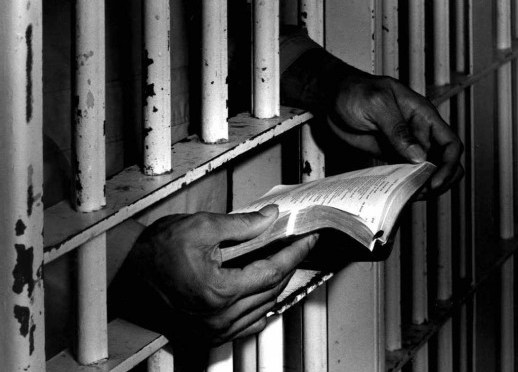
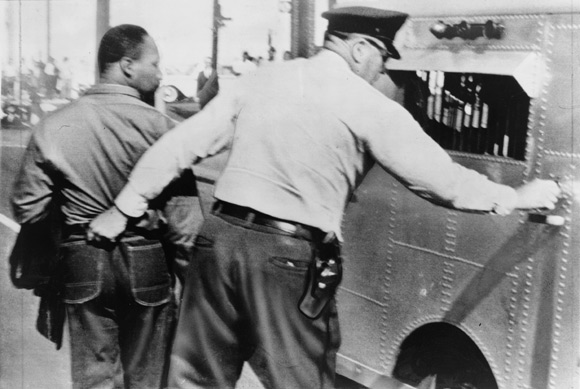
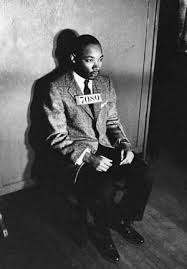
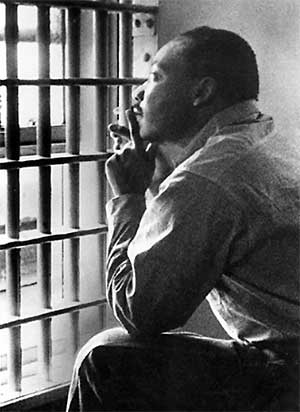
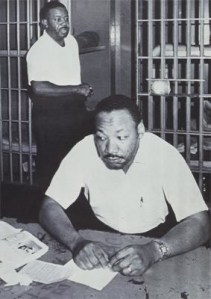
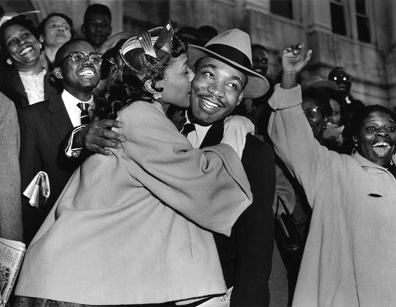
Synopsis: Martin Luther King, Jr. speaks on Meet The Press one week after leading his historic five-day march from Selma to Montgomery, Alabama, to draw attention to the humiliating conditions in Alabama which included state enforced segregation, police brutality and racially-motivated murder. Dr. King asserts, “An individual who breaks a law that conscience tells him is unjust, and who willingly accepts the penalty of imprisonment in order to arouse the conscience of the community over its injustice, is in reality expressing the highest respect for the law.”
Category Archives: Activism
The Crazy Ones
https://www.youtube.com/watch?v=Rzu6zeLSWq8
Here’s to the crazy ones. The misfits. The rebels. The troublemakers. The round pegs in the square holes. The ones who see things differently. They’re not fond of rules. And they have no respect for the status quo. You can quote them, disagree with them, glorify or vilify them. About the only thing you can’t do is ignore them. Because they change things. They push the human race forward. And while some may see them as the crazy ones, we see genius. Because the people who are crazy enough to think they can change the world, are the ones who do.
― Rob Siltanen
The Right to Record
In this age of citizen activism, recording devices, such as cellphones, tabs and digital video/audio recorders are essential tools for collecting evidence and preserving information about conversations, interviews, and phone calls in which you participate. It is also a good way to document what takes place in a court hearing or public meeting, whether for personal reference or later broadcast over news or social media networks. A number of laws affect your ability to use a recording device in these contexts. Here are some practical tips to help you avoid legal trouble when recording conversations, phone calls, public hearings, and protests. Continue reading The Right to Record
On the Duty of Civil Disobedience (1849)
Thoreau’s classic essay popularly known as “Civil Disobedience” was first published as “Resistance to Civil Government” in Aesthetic Papers (1849). Thoreau has no objection to government taxes for highways and schools, which make good neighbors. But government, he charges, is too often based on expediency, which can permit injustice in the name of public convenience. The individual, he insists, is never obliged to surrender conscience to the majority or to the State. If a law “is of such a nature that it requires you to be the agent of injustice to another,” he declares, “then, I say, break the law.” The essay makes it clear that this stance is not a matter of whim but a demanding moral principle.
The appeal of civil disobedience in the North grew in the wake of the Compromise of 1850, which included the hated Fugitive Slave Law, requiring all citizens to aid in the return of escaped slaves to their owners. Though civil disobedience is usually associated with passive resistance, Thoreau came to endorse the more direct action of John Brown, whose ill-fated raid on Harpers Ferry, Virginia, was intended to incite a slave insurrection.
Thoreau’s essay has had a profound influence on reformers worldwide, from Tolstoy in Russia and Gandhi in South Africa and India; to Martin Luther King, Jr’s civil rights movement and the opposition to the Vietnam War in the United States; to recent demonstrations for civil rights in the former Soviet Union and China.
A downloadable PDF version of the essay may be found HERE
A printer friendly version of the essay may be found HERE
Hashtag Activism Isn’t a Cop-Out
An organizer of Ferguson protests argues that social-media tools encourage demonstrations, rather than deflating them.
Mainstream-media figures often portray social media as a buzzing hive of useless outrage. Thinkpieces present hashtag activism as vanity activism, in which narcissistic pronouncements substitute for actual engagement, and anger is leveraged at best for petty entertainment and at worst for coordinated harassment.
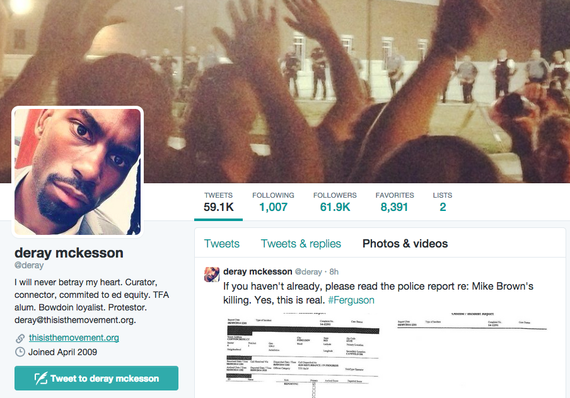
Yet activists themselves often argue that social media is important to their work. DeRay Mckesson, who has emerged as one of a number of leading organizers and activists against police brutality, has spoken on his feed about how vital Twitter is for boosting a movement. When he first drove from his home in Minneapolis—where he works as a school administrator, traveling for protests mainly on weekends—to Ferguson to participate in the protests, Mckesson knew no one; he didn’t even know where he would sleep. Facebook networks found him a couch, and social media was vital in connecting him with the community of protestors. Mckesson reports live from protests through Twitter, where his following has ballooned from 800 followers to more than 61,000 since he began his activism. He’s also used social networks to raise awareness and to organize, by for example creating a text-message alert that informed thousands the instant the grand jury in Ferguson returned a no-indictment verdict in the Michael Brown case.
I talked to Mckesson about social media, protest, and the connections between the two. This interview has been edited for length and clarity.
Noah Berlatsky: What role has social-media activism played in the movement against police brutality that started in Ferguson?
DeRay Mckesson: Missouri would have convinced you that we did not exist if it were not for social media. The intensity with which they responded to protestors very early—we were able to document that and share it quickly with people in a way that we never could have without social media. We were able to tell our own stories.
The history of blackness is also a history of erasure. Everybody has told the story of black people in struggle except black people. The black people in the struggle haven’t had the means to tell the story historically. There were a million slaves but you see very few slave narratives. And that is intentional. So what was powerful in the context of Ferguson is that there were many people able to tell their story as the story unfolded.
The other thing I will add is that Twitter specifically has been interesting because we’re able to get feedback and responses in real time. If we think about this as community building, and we think of community building as a manifestation of love, and we think about love being about accountability, and accountability about justice, what’s interesting is that Twitter has kept us honest. There’s a democracy of feedback. I’ve had really robust conversations with people who aren’t physically in the space, but who have such great ideas. And that’s proven to be invaluable.
Berlatsky: The civil-rights movement of the ’60s obviously didn’t have Twitter or social media or the Internet, but it was able to get its message out to the media in other ways. Why wouldn’t traditional media be adequate now?
Mckesson: Ferguson exists in a tradition of protest. But what is different about Ferguson, or what is important about Ferguson, is that the movement began with regular people. There was no Martin, there was no Malcolm, there was no NAACP, it wasn’t the Urban League. People came together who didn’t necessarily know each other, but knew what they were experiencing was wrong. And that is what started this. What makes that really important, unlike previous struggle, is that—who is the spokesperson? The people. The people, in a very democratic way, became the voice of the struggle.
Our access to information is also so much greater than in the past. For instance, there’s an officer in Ferguson who is really aggressive with protestors for no reason. And I was able to take a picture of him—he would cover his badge with his hand, he would not show his name. So I took a picture of him, put it online, and within 30 minutes they knew everything about him. And that’s a different way of empowering people.
Berlatsky: It sounds like you’re saying that Twitter allowed the movement to be a lot more decentralized. Is that an advantage or a disadvantage? It seems like it might be a disadvantage in terms of settling on specific goals, for example.
Mckesson: It is not that we’re anti-organization. There are structures that have formed as a result of protest, that are really powerful. It is just that you did not need those structures to begin protest. You are enough to start a movement. Individual people can come together around things that they know are unjust. And they can spark change. Your body can be part of the protest; you don’t need a VIP pass to protest. And Twitter allowed that to happen.
I think that what we are doing is building a radical new community in struggle that did not exist before. Twitter has enabled us to create community. I think the phase we’re in is a community-building phase. Yes, we need to address policy, yes, we need to address elections; we need to do all those things. But on the heels of building a strong community.

Berlatsky: You also publish—along with Johnetta (Netta) Elzie—an online newsletter about the protest movement called Words to Action. Do you see yourself as a journalist? Or as an activist? Or both? How important is social media to those roles, or to combining them?
Mckesson: I see myself as a protestor who is also telling the story as it happens. The newsletter started—I remember when Trayvon died, I wanted to follow the case, but I didn’t know what was fact or fiction. I didn’t want that to be the story of Mike Brown. There was so much news; there was so much stuff that was unclear. There were so many questions. The goal was to create a space where people could go to get true news.
Now the movement has spread beyond St. Louis, we cover stories from around the country. So the goal was to be a hub of information. I think the first newsletter that went out had 400 subscribers, and we’re at a little bit less than 14,000 now. And we did a text-message alert for the no-indictment—you could sign up to get a text when the decision came out. And 21,000 people signed up in 10 days, which was wild. So the work is focused on, how can we use the tools we have access to in order to create infrastructure for the movement.
And that’s what Netta and I have been focused on. None of this takes away from our protesting. We don’t put the newsletter out when we’re out until 4 in the morning protesting. The trade-off always veers in the favor of protest. It’s rooted in the confrontation and disruption that is protest. We want to make structures to empower people. The newsletter is a way to empower people. Because we believe that the truth is actually so damning that we can just tell you all the news that’s happening and you should be radicalized. We believe that.
Berlatsky: I saw you talking about Iggy Azalea and issues of appropriation on Twitter a little bit back. That’s the sort of cultural issue that I think many people would say is just a distraction, or is just a way for people to express outrage without working for social change. Do you see cultural conversations around Iggy, or similar issues, as a distraction from your work as an organizer? Or are they complementary?
Mckesson: Good lord. Iggy. (laughs) You’re really trying to get me in trouble.
When people think about protest, they think that protest is always confrontation, protest is always disruption. But protest is also intellectual confrontation and disruption. So part of what we do when the police speak is that we question. The thing about people like Iggy is that we also question. We question what it means to have your success be on a medium and a platform that was born of black struggle, like hip-hop or rap, and what does it mean that you identify with everything but the struggle part? Which is the Iggy issue.
We question these issues of race and struggle and white privilege, because we know that those issues are real, and because those issues have real implications in black communities. And white supremacy is not only dangerous but it is deadly. We know this to be true.
Berlatsky: Do you get a lot of harassment on social media?
Mckesson: Yeah, the death threats aren’t fun. They put my address out there, that’s not fun. I get called a nigger more than I’ve ever been called that in my entire life. I’ve blocked over 9,000 people, so I don’t personally see it as much anymore, but my friends do. So that sort of stuff I don’t love.
But what social media has done is that it has exposed the intensity of hatred in America. People who you wouldn’t expect to be racist … some of the tweets are from people who are well-intentioned but racist. And I appreciate that that’s exposed. People now understand where you’re coming from. And it’s deeply problematic. But we don’t have to guess anymore; we get it.
The harassment is never a good thing. But there’s something valuable in making sure you’re not surrounded by people who think like you. It helps you understand what you think better. And I appreciate that about Twitter. It’s a cacophony of voices. Even when you don’t agree, you at least understand different perspectives. The medium itself sets that up.
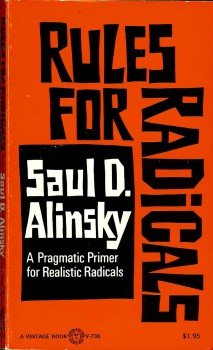
Rules for Radicals: A Pragmatic Primer for Realistic Radicals
Rules for Radicals, written by Saul Alinsky is a classic treatise on grassroots organizing. The first paragraph of Alinsky’s seminal work is as confrontational as his tactics:
“What follows is for those who want to change the world from what it is to what they believe it should be. The Prince was written by Machiavelli for the Haves on how to hold power. Rules for Radicals is written for the Have-Nots on how to take it away.”
Alinsky championed new ways to organize the poor and powerless which created a backyard revolution in cities across America. In the 1950s, he succeeded in organizing Chicago’s African-American ghettos, which ignited similar movements in New York City, Detroit, MI, Oakland, CA, and dozens of other affected communities. His strategies were later adopted by young, counterculture-era organizers to challenge racial segregation and the U.S. war efforts in Vietnam. Conservative author William F. Buckley has credited Alinsky with being “very close to an organizational genius.”
For Alinsky, community organizing was the process of highlighting the problem to be solved, then convincing individuals change was possible. Alinsky recognized that If individuals do not believe they can change their circumstances, they will simply ignore the problem. Therefore, a movement must be sustained through hope and encouragement that the desired outcome can be achieved.
Alinsky advocated a form of militant diplomacy which forces power to respond to the activist. Some of his suggestions included:
“Ridicule is man’s most potent weapon. There is no defense. It’s irrational. It’s infuriating. It also works as a key pressure point to force the enemy into concessions.” (Rule #5)
and
“Pick the target, freeze it, personalize it, and polarize it.” Cut off the support network and isolate the target from sympathy. Go after people and not institutions; people hurt faster than institutions.” (Rule #12)
Alinsky’s controversial tactics are not for everyone, but anyone who is serious about social change should read his book. It is an essential primer for understanding and preparing against the tactics you can expect to face when challenging the status quo.
A free .pdf version of the book can be found here:
Click to access Rules_for_Radicals.pdf
A reformation means that masses of our people have reached the point of disillusionment with past ways and values. They don’t know what will work but they do know that the prevailing system is self-defeating, frustrating, and hopeless. They won’t act for change, but won’t strongly oppose those who do. The time is then ripe for revolution. — Rules for Radicals: A Pragmatic Primer for Realistic Radicals, p. xxii
Curiosity and irreverence go together. Curiosity cannot exist without the other. Curiosity asks, “Is this true?” “Just because this has always been the way, is the best or right way of life, the best or right religion, political or economic value, morality?” To the questioner, nothing is sacred. He detests dogma, defies any finite definition of morality, rebels against any repression of a free, open search of ideas no matter where they may lead. He is challenging, insulting, agitating, discrediting. He stirs unrest.
The organizer becomes a carrier for the contagion of curiosity, for a people asking “why” are beginning to rebel.
Society has good reason to fear the radical. Every shaking advance of mankind toward equality and justice has come from the radical. He hits, he hurts, he is dangerous.
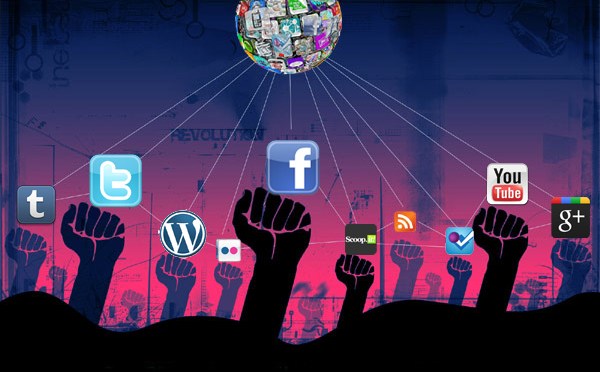
Social Media as a Tool for Protest
FEBRUARY 3, 2011 | 09:54 GMT
By Marko Papic and Sean Noonan
Internet services were reportedly restored in Egypt on Feb. 2 after being completely shut down for two days. Egyptian authorities unplugged the last Internet service provider (ISP) still operating Jan. 31 amid ongoing protests across the country. The other four providers in Egypt — Link Egypt, Vodafone/Raya, Telecom Egypt and Etisalat Misr — were shut down as the crisis boiled over on Jan. 27. Commentators immediately assumed this was a response to the organizational capabilities of social media websites that Cairo could not completely block from public access.
The role of social media in protests and revolutions has garnered considerable media attention in recent years. Current conventional wisdom has it that social networks have made regime change easier to organize and execute. An underlying assumption is that social media is making it more difficult to sustain an authoritarian regime — even for hardened autocracies like Iran and Myanmar — which could usher in a new wave of democratization around the globe. In a Jan. 27 YouTube interview, U.S. President Barack Obama went as far as to compare social networking to universal liberties such as freedom of speech.
Social media alone, however, do not instigate revolutions. They are no more responsible for the recent unrest in Tunisia and Egypt than cassette-tape recordings of Ayatollah Ruholla Khomeini speeches were responsible for the 1979 revolution in Iran. Social media are tools that allow revolutionary groups to lower the costs of participation, organization, recruitment and training. But like any tool, social media have inherent weaknesses and strengths, and their effectiveness depends on how effectively leaders use them and how accessible they are to people who know how to use them.
How To Use Social Media
The situations in Tunisia and Egypt have both seen an increased use of social networking media such as Facebook and Twitter to help organize, communicate and ultimately initiate civil-disobedience campaigns and street actions. The Iranian “Green Revolution” in 2009 was closely followed by the Western media via YouTube and Twitter, and the latter even gave Moldova’s 2009 revolution its moniker, the “Twitter Revolution.”
Foreign observers — and particularly the media — are mesmerized by the ability to track events and cover diverse locations, perspectives and demographics in real time. But a revolution is far more than what we see and hear on the Internet — it requires organization, funding and mass appeal. Social media no doubt offer advantages in disseminating messages quickly and broadly, but they also are vulnerable to government counter-protest tactics (more on these below). And while the effectiveness of the tool depends on the quality of a movement’s leadership, a dependence on social media can actually prevent good leadership from developing.
The key for any protest movement is to inspire and motivate individuals to go from the comfort of their homes to the chaos of the streets and face off against the government. Social media allow organizers to involve like-minded people in a movement at a very low cost, but they do not necessarily make these people move. Instead of attending meetings, workshops and rallies, un-committed individuals can join a Facebook group or follow a Twitter feed at home, which gives them some measure of anonymity (though authorities can easily track IP addresses) but does not necessarily motivate them to physically hit the streets and provide fuel for a revolution. At the end of the day, for a social media-driven protest movement to be successful, it has to translate social media membership into street action.
The Internet allows a revolutionary core to widely spread not just its ideological message but also its training program and operational plan. This can be done by e-mail, but social media broaden the exposure and increase its speed, with networks of friends and associates sharing the information instantly. YouTube videos explaining a movement’s core principles and tactics allow cadres to transmit important information to dispersed followers without having to travel. (This is safer and more cost effective for a movement struggling to find funding and stay under the radar, but the level of training it can provide is limited. Some things are difficult to learn by video, which presents the same problems for protest organizers as those confronted by grassroots jihadists, who must rely largely on the Internet for communication.) Social media can also allow a movement to be far more nimble about choosing its day of action and, when that day comes, to spread the action order like wildfire. Instead of organizing campaigns around fixed dates, protest movements can reach hundreds of thousands of adherents with a single Facebook post or Twitter feed, launching a massive call to action in seconds.
With lower organizational and communications costs, a movement can depend less on outside funding, which also allows it to create the perception of being a purely indigenous movement (without foreign supporters) and one with wide appeal. According to the event’s Facebook page, the April 6 Movement in Egypt had some 89,250 people claiming attendance at a Jan. 28 protest when, in fact, a much smaller number of protesters were actually there according to STRATFOR’s estimates. The April 6 Movement is made up of the minority of Egyptians who have Internet access, which the OpenNet Initiative estimated in August 2009 to be 15.4 percent of the population. While this is ahead of most African countries, it is behind most Middle Eastern countries. Internet penetration rates in countries like Iran and Qatar are around 35 percent, still a minority of the population. Eventually, a successful revolutionary movement has to appeal to the middle class, the working class, retirees and rural segments of the population, groups that are unlikely to have Internet access in most developing countries. Otherwise, a movement could quickly find itself unable to control the revolutionary forces it unleashed or being accused by the regime of being an unrepresentative fringe movement. This may have been the same problem that Iranian protesters experienced in 2009.
Not only must protest organizers expand their base beyond Internet users, they must also be able to work around government disruption. Following the Internet shutdown in Egypt, protesters were able to distribute hard-copy tactical pamphlets and use faxes and landline telephones for communications. Ingenuity and leadership quickly become more important than social media when the government begins to use counter-protest tactics, which are well developed even in the most closed countries.
Countering Social Media
Like any other tool, social media have their drawbacks. Lowering the costs of communication also diminishes operational security. Facebook messages can be open for all to see, and even private messages can be viewed by authorities through search warrants in more open countries or pressure on the Internet social media firms in more closed ones. Indeed, social media can quickly turn into a valuable intelligence-collection tool. A reliance on social media can also be exploited by a regime willing to cut the country off from Internet or domestic text messaging networks altogether, as has been the case in Egypt.
The capability of governments to monitor and counteract social media developed alongside the capability of their intelligence services. In order to obtain an operating license in any country, social networking websites have to come to some sort of agreement with the government. In many countries, this involves getting access to user data, locations and network information. Facebook profiles, for example, can be a boon for government intelligence collectors, who can use updates and photos to pinpoint movement locations and activities and identify connections among various individuals, some of whom may be suspect for various activities. (Visible Technologies, a software firm that specializes in monitoring social media has received funding from In-Q-Tel, the CIA’s venture capital firm, and many Western intelligence services have start-up budgets to develop Internet technologies that will enable even deeper mining of Internet-user data.)
In using social media, the trade-off for protest leaders is that they must expose themselves to disseminate their message to the masses (although there are ways to mask IP addresses and avoid government monitoring, such as by using proxy servers). Keeping track of every individual who visits a protest organization’s website page may be beyond the capabilities of many security services, depending on a site’s popularity, but a medium designed to reach the masses is open to everyone. In Egypt, almost 40 leaders of the April 6 Movement were arrested early on in the protests, and this may have been possible by identifying and locating them through their Internet activities, particularly through their various Facebook pages.
Indeed, one of the first organizers of the April 6 Movement became known in Egypt as “Facebook Girl” following her arrest in Cairo on April 6, 2008. The movement was originally organized to support a labor protest that day in Mahalla, and organizer Esraa Abdel Fattah Ahmed Rashid found Facebook a convenient way to organize demonstrations from the safety of her home. Her release from prison was an emotional event broadcast on Egyptian TV, which depicted her and her mother crying and hugging. Rashid was then expelled from the group and no longer knows the password for accessing the April 6 Facebook page. One fellow organizer called her “chicken” for saying she would not have organized the protest if she had thought she would be arrested. Rashid’s story is a good example of the challenges posed by using social media as a tool for mobilizing a protest. It is easy to “like” something or someone on Facebook, but it is much harder to organize a protest on the street where some participants will likely be arrested, injured or killed.
Beyond monitoring movement websites, governments can also shut them down. This has been common in Iran and China during times of social unrest. But blocking access to a particular website cannot stop tech-savvy Internet users employing virtual private networks or other technologies to access unbanned IP addresses outside the country in order to access banned sites. In response to this problem, China shut down Internet access to all of Xinjiang Autonomous Region, the location ofethnic Uighur riots in July 2009. More recently, Egypt followed the same tactic for the entire country. Like many countries, Egypt has contracts with Internet service providers that allow the government to turn the Internet off or, when service providers are state-owned, to make life difficult for Internet-based organizers.
Regimes can also use social media for their own purposes. One counter-protest tactic is to spread disinformation, whether it is to scare away protesters or lure them all to one location where anti-riot police lie in wait. We have not yet witnessed such a government “ambush” tactic, but its use is inevitable in the age of Internet anonymity. Government agents in many countries have become quite proficient at trolling the Internet in search of pedophiles and wannabe terrorists. (Of course, such tactics can be used by both sides. During the Iranian protests in 2009, many foreign-based Green Movement supporters spread disinformation over Twitter to mislead foreign observers.)
The most effective way for the government to use social media is to monitor what protest organizers are telling their adherents either directly over the Internet or by inserting an informant into the group, counteracting the protesters wherever and whenever they assemble. Authorities monitoring protests at World Trade Organization and G-8 meetings as well as the Republican and Democratic national conventions in the United States have used this successfully. Over the past two years in Egypt, the April 6 Movement has found the police ready and waiting at every protest location. Only in recent weeks has popular support grown to the point where the movement has presented a serious challenge to the security services.
One of the biggest challenges for security services is to keep up with the rapidly changing Internet. In Iran, the regime quickly shut down Facebook but not Twitter, not realizing the latter’s capabilities. If social media are presenting a demonstrable threat to governments, it could become vital for security services to continually refine and update plans for disrupting new Internet technology.
Quality of Leadership vs. Cost of Participation
There is no denying that social media represent an important tool for protest movements to effectively mobilize their adherents and communicate their message. As noted above, however, the effectiveness of the tool depends on its user, and an overreliance can become a serious detriment.
One way it can hurt a movement is in the evolution of its leadership. To lead a protest movement effectively, an organization’s leadership has to venture outside of cyberspace. It has to learn what it means to face off against a regime’s counterintelligence capabilities in more than just the virtual world. By holding workshops and mingling among the populace, the core leadership of a movement learns the different strategies that work best with different social strata and how to appeal to a broad audience. Essentially, leaders of a movement that exploits the use of social media must take the same risks as those of groups that lack such networking capability. The convenience and partial anonymity of social media can decrease the motivation of a leader to get outside and make things happen.
Moreover, a leadership grounded in physical reality is one that constructs and sticks to a concerted plan of action. The problem with social media is that they subvert the leadership of a movement while opening it to a broader membership. This means that a call for action may spread like wildfire before a movement is sufficiently prepared, which can put its survival in danger. In many ways, the Iranian Green Revolution is a perfect example of this. The call for action brought a self-selected group of largely educated urban youth to protest in the streets, where the regime cracked down harshly on a movement it believed was not broad enough to constitute a real threat.
A leadership too reliant on social media can also become isolated from alternative political movements with which it may share the common goal of regime change. This is especially the case when other movements are not “youth movements” and therefore are not as tech savvy. This can create serious problems once the revolution is successful and an interim government needs to be created. The Serbian Otpor (Resistance) movement was successful in the 2000 Serbian democratic revolution precisely because it managed to bring together a disparate opposition of pro-Western and nationalist forces. But to facilitate such coalition building, leaders have to step away from computers and cell phones and into factories, rice paddies and watering holes they normally would never want to enter. This is difficult to do during a revolution, when things are in flux and public suspicion is high, especially of those who claim to be leading a revolution.
Even when a media-savvy leader has a clear plan, he or she may not be successful. For instance, Thaksin Shinawatra, the former prime minister of Thailand and telecommunications magnate, has used his skills to hold video conference calls with stadiums full of supporters, and launched two massive waves of protests involving some 100,000 supporters against the Thai government in April 2009 and April and May 2010, yet he still has not succeeded in taking power. He remains a disembodied voice, capable of rocking the boat but incapable of taking its helm.
diffusing
Shutting down the Internet did not reduce the numbers of Egyptian protesters in the streets. In fact, the protests only grew bigger as websites were shut down and the Internet was turned off. If the right conditions exist a revolution can occur, and social media do not seem to change that. Just because an Internet-based group exists does not make it popular or a threat. There are Facebook groups, YouTube videos and Twitter posts about everything, but that does not make them popular. A neo-Nazi skinhead posting from his mother’s basement in Illinois is not going to start a revolution in the United States, no matter how many Internet posts he makes or what he says. The climate must be ripe for revolution, due to problems like inflation, deflation, food shortages, corruption and oppression, and the population must be motivated to mobilize. Representing a new medium with dangers as well as benefits, social media do not create protest movements; they only allow members of such movements to communicate more easily.
Other technologies like short-wave radio, which can also be used to communicate and mobilize, have been available to protesters and revolutionaries for a long time. In reality, so has the Internet, which is the fundamental technological development that allows for quick and widespread communications. The popularity of social media, one of many outgrowths of the Internet, may actually be isolated to international media observation from afar. We can now watch protest developments in real time, instead of after all the reports have been filed and printed in the next day’s newspaper or broadcast on the nightly news. Western perceptions are often easily swayed by English-speaking, media-savvy protesters who may be only a small fraction of a country’s population. This is further magnified in authoritarian countries where Western media have no choice but to turn to Twitter and YouTube to report on the crisis, thus increasing the perceived importance of social media.
In the Middle East, where Internet penetration is below 35 percent (with the exception of Israel), if a movement grows large enough to effect change it will have been joined through word of mouth, not through social networking. Still, the expansion of Internet connectivity does create new challenges for domestic leaders who have proved more than capable of controlling older forms of communication. This is not an insurmountable challenge, as China has shown, but even in China’s case there is growing anxiety about the ability of Internet users to evade controls and spread forbidden information.
Social media represent only one tool among many for an opposition group to employ. Protest movements are rarely successful if led from somebody’s basement in a virtual arena. Their leaders must have charisma and street smarts, just like leaders of any organization. A revolutionary group cannot rely on its most tech-savvy leaders to ultimately launch a successful revolution any more than a business can depend on the IT department to sell its product. It is part of the overall strategy, but it cannot be the sole strategy.
Original Source: https://www.stratfor.com/weekly/20110202-social-media-tool-protest
Suggested Reading
Tkacheva, Olesya, Lowell H. Schwartz, Martin C. Libicki, Julie E. Taylor, Jeffrey Martini and Caroline Baxter. “Internet freedom and political space.” Santa Monica, CA: RAND Corporation, 2013. http://www.rand.org/pubs/research_reports/RR295. Also available in print form.
Kelly, Terrence K., Seth G. Jones, James E. Barnett, Keith Crane, Robert C. Davis and Carl Jensen. A Stability Police Force for the United States: Justification and Options for Creating U.S. Capabilities. Santa Monica, CA: RAND Corporation, 2009. http://www.rand.org/pubs/monographs/MG819. Also available in print form.
Revolution: Immunity for Democracies?
PATRICK M. REGAN
Binghamton University
DANIEL JUST
New York University
AIDA PASKEVICIUTE
University of Essex, U.K.
While social revolutions have been the focus of considerable scholarly attention over the past quarter century, little effort has been made to consider the prospects for revolution in the industrialized West. This odd fact exists in spite of Goldstone’s claim that the present-day United States exhibits some of the factors consistent with historical causes of revolution, and that we “ignore the past at our peril” (1991: 497). Drawing on a wide range of scholarly perspectives, this study is designed to show that while the theoretical potential for revolutionary movements does exist in the industrialized West, it has been effectively disabled by the lack of political alternatives to the status quo and the difficulties in mobilizing contemporary societies. Our analysis suggests, however, that given recent changes in the patterns of social and economic dislocations as well as deepening ethnic, racial, or religious cleavages around the world, there is no reason to assume that Western democracies will remain immune to revolutionary changes.
Perhaps the most important and obvious but also most neglected fact about successful revolutions is that they do not occur in democratic political systems. This is not to argue that formally democratic governments are immune to revolutions.
Samuel P. Huntington (1994: 44)
Social revolutions have been the focus of considerable attention over the past quarter century. The linkages that lead to revolution generally consist of some variant of either relative deprivation, inequality, class conflict, political mobilization, or elite defection, though a more recent trend is to model the decision to participate in revolts from the perspective of a rationally calculating actor. Most of the empirical work has involved the likelihood of revolution in either a group of developing countries, or the eighteenth and the nineteenth-century Europe. Little effort has been made, however, to consider the prospects for revolution in the industrial democracies of the West. This odd fact exists in spite of Goldstone’s claim that the present-day United States exhibits some of the factors consistent with historical causes of revolution, and that we “ignore the past at our peril” (1991: 497). This essay poses two questions: a) whether there is a potential for social revolution in the industrialized countries of the West, and b) whether we might be able to evaluate the conditions under which any such revolutionary movement might gain momentum.
There are two things striking about this theoretical inquiry. First, one of the virtues of sound reasoning should be that it is widely applicable, and second, one of the objectives of both sociology and political science as scientific endeavors should be our ability to predict social changes. So if what appears to be a rather coherent body of theoretical work contributes broadly to our understanding of the workings of the political world, then it should offer insights into what the world of politics will hold. Democracy might not be the saving grace, for as Huntington (1968: 275) argues, political democracy is not the vaccine to prevent revolutions, even though Goodwin and Skocpol (1989) believe that the ballot box has in fact been the “coffin of revolutionary movements.” But predicting the onset of a revolution is supposed to be akin to predicting the next earthquake, something long sought after yet rarely if ever achieved (Eckstein 1990). Tilly (1975: 183) sets this out as a critical challenge to social scientists; we evaluate the merits of the challenge.
The thrust of this essay departs from those who attempt to predict the specific onset of a revolution, or those who seek to demonstrate the mechanisms that lead to a specific level of protest.[1] While trying to predict the actual level of protest, the timing of its onset, or the point at which protest gives way to successful revolution is a worthwhile endeavor, particularly in highly unstable countries, this essay targets a much broader level: rather than focusing on the point at which social dislocations give rise to revolutionary movements, we ask whether the theoretical linkages that tie social and structural factors to revolutionary politics are generalizable to the industrial West, and if so, if we can use this knowledge to evaluate the potential for revolution in this category of countries. In this sense, it is necessary to invoke Marx’s dictum that it is not only unstable countries but also highly advanced and industrially developed countries that are potentially prone to a social revolution. The question then is not so much when it will happen, but whether it is thinkable. If the relative stability in the industrialized democracies is interpreted in terms of a gradual alleviation of social and political oppositions, then Fukuyama’s (1992) concept of the “end of history” may be applicable across the political, economic, and social strata of societies. But if such stability proves to conceal deeper contradictions then it would be precisely the Western democracies where we would look for the threads of social revolution.
But why might one raise doubts about the apparent stability in the industrialized world? Two factors stand out: a) deepening cleavages among ethnic and racial groups, and b) changing patterns in social and economic dislocations. These two trends are often linked, and a cursory look at each should suffice to make the issue clear. Throughout the 1990s and into the early part of this century unemployment rates have been increasing across Western democracies. France, Spain, Italy, Belgium, and Finland have in the last generation rarely had unemployment rates below 10 percent (World Bank 2003). What is more, presently nearly one out of thirteen members of the workforce are officially unemployed in many leading industrial countries (Economist 2004a). Those without double-digit unemployment figures have structural unemployment resting at about seven percent, and the number of underemployed leaves countless additional workers falling far short of their potential. The effects of recent efforts to “privatize” the world’s economy appear to have quite starkly favored the wealthy at the expense of the poor and middle classes. What is more, “outsourcing” of the jobs to places like China and India and the flow of immigrants have been the cause of increasing tensions and insecurity in the labor force of Western democracies. At the same time the ability and willingness of states to temper the effects of these difficult economic times has come under rising strain. Access to education and the expanding role of technology and the Internet seems to widen the gap between rich and poor even further.
The extent of these structural problems is often exacerbated by racial and ethnic cleavages, with urban areas and minority groups suffering more severely. For example, in spite of the upward mobility of many African Americans in the United States, urban centers tend to be populated overwhelmingly by members of this racial community. And it is in these urban areas where unemployment is highest, educational facilities the poorest, teenage pregnancy most prevalent, and drug abuse nearly epidemic.
The United States is not the only country where racial and ethnic tensions and socio-economic dislocations have been on the rise. In Britain, the inflow of immigrants from its former colonies led to increasing racial tensions and a number of race riots. The budding neo-nazi movement in Germany and the anti-Muslim violence in the Netherlands is testament to the resentment felt by the majority for minority ethnic groups. German unification was similarly accompanied by a surge of violence against foreigners and the emergence of the xenophobic Republikaner Party. Tensions between the French and North Africans have erupted into violence also in southern France, fueling electoral support for the anti-immigrant National Front Party (e.g., Dalton 2002: 104). In short, at least some conditions that are theoretically linked to revolution are prevalent in the most modern countries of the world.
HOW WE THINK ABOUT REVOLUTIONS
What is meant by revolution has been a subject of intense debates in the scholarly literature. Most definitions of revolution emphasize factors such as time, class, and violence, with a consequent realignment of social, economic, and political bonds that tie societies together (Skocpol 1979, Hagopian 1993, Sztompka 1993). Skocpol’s (1979: 4) definition of revolution as a class-based revolt from below that brings rapid transformation of society’s state and class structure has been very influential in this respect. However, the problem with this definition is simply that it is outdated—revolutions from the late seventies on have not been necessarily an outcome of only internal economic problems. In the era of globalization and a low-level state intervention in capital accumulation in the West, both the state and the class become rather elusive categories. If revolution is a transformation of the social structure of the state—and not just a political transformation resulting either in a gradual democratization and opening up of the enclosed polity, or in an authoritarian monopolization of politics—then the challenge revolutions face in modern democracies is not only impeded mobilization and frustrated coalition-formation but also the vagueness of their target.
In spite of the variety of conditions that influenced revolutionary outcomes, students of social revolutions usually agreed that some form of interplay between relative deprivation, inequality/class conflict, and mobilization had to be in place for the revolution to occur. Even though the tendency now is to question sufficiency of these determinants and to point to the role of elites, scholars still believe that linkages tying social-economic conditions to revolutionary behavior cannot dismiss the role of relative deprivation, inequality, and mobilization.[2]
RELATIVE DEPRIVATION
In the late sixties and early seventies, relative deprivation was a common point of departure for many studies on social revolutions. Davies (1962), for instance, argued that a gap between value expectations and value achievements would account for the onset of revolutionary behavior. Since the expectation was a continued increase in the satisfaction of economic and social needs, any sharp or sudden decline from that trend would result in an intolerable gap between expectations and achievements. Gurr (1970) outlined the social determinants of relative deprivation and made more explicit the criteria with which to evaluate the desires and achievements of a social group. Tanter and Midlarsky (1967) found some empirical support for the hypothesis that a “revolutionary gap” contributes to the onset of revolution, though others were unable to confirm the basic tenets of this theory (Miller et al. 1977).
The concept of relative deprivation as a cause of revolution is grounded in the relationship between frustration and aggression, and has its antecedents far beyond those mentioned above. De Tocqueville and Marx each related the onset of revolution to the gap between what people were led to expect, and what they were subsequently able to achieve. On the one hand, Marx (1988) argued that it was a long historical process in which the labor class was continually impoverished by the exploits of the capitalists, leading eventually to the rising up of the proletariat to overthrow the bourgeoisie. De Tocqueville (1955), on the other hand, claimed that the French revolution was precipitated, in part, by economic and social advancements that left the French masses expecting more while the industrialization process was leading them toward increasing immiseration.
INEQUALITY
There is a rather long tradition linking patterns of inequality to revolutionary behavior, suggesting that the gap between the haves and the have-nots would perhaps play some role in revolution. Structural inequality has been linked to the mass political violence characteristic of revolutionary movements in the developing world, though the evidence is mixed as to whether it is income or land inequality that is of greatest importance (Russett 1964, Midlarsky and Roberts 1985, Midlarsky 1988, Muller and Seligson 1987). The inequality—either land or income—generates discontent among those who go without, possibly resulting in large-scale political violence, which, if coupled with the fall out of powerful elites from the state, can lead to revolution. As with evidence pertaining to relative deprivation as a cause of revolution, inequality as an explanation rests on strong theoretical foundations though the evidence is mixed (Brockett 1992). Moreover, it is clear that neither relative deprivation nor inequality can stand on their own as causes of revolutions. At the most, they can serve as a motivating force for social change.
The difference between relative deprivation and inequality as explanations for revolutions may seem subtle at first, but the underlying mechanisms are profoundly different. In the former instance, the perceived deprivation is a psychological process where judgement is made relative to one’s own expectations. The mechanisms of inequality work differently: rather than individuals judging their situation relative to their own expectations and achievements, inequality is evaluated relative to others within society. Both conditions are likely to be evident concurrently, and it would be difficult to imagine one condition existing without at least some of the other. But those who argue for inequality as the causal mechanism are implicitly positing that issues of social and economic justice generate the motives behind revolutionary movements. If inequality and injustice are considered as significant components of revolutionary impulses, their role gains a momentum only if these individual concerns can reach the level of the group.
MOBILIZATION
The ability to mobilize is key to revolutionary movements (Tilly 1978). Given that there are structural conditions for expressing discontent, it is the ability to mobilize resources that determines revolutionary behavior. To Tilly (1978), this is conceived of as groups contending over political issues, while Huntington (1968) argues that it is the incongruity between political mobilization—meaning political modernization—and political institutions that results in revolution.
Since revolutions require, among other things, revolutionary strategies, strategists are expected not only to articulate alternatives but also to mobilize the masses. Using a game-theory approach, Lichbach (1990) shows that a rational person would not rebel against inequality. But if a rational person would not rebel against situations he or she finds intolerable, then we can deduce from Lichbach’s findings that either revolution is an irrational behavior, or that revolutionary strategists are required to mobilize the masses and in doing so change the expected payoff from participation in revolutionary action. Overcoming the collective action problem appears to be a critical link in mobilizing mass action, with selective incentives appearing to be a necessary ingredient (Lichbach 1994), even though others dismiss the role of the collective goods problem in social movements altogether (Tarrow 1994). One way to conceive of a solution to the collective goods puzzle is in terms of revolutionary strategists being able to deflect some of the costs associated with participation in revolutionary politics and therefore change the potential payoff to the masses.
TOWARD SYNTHESIS
Social dislocations associated with inequality or deprivation can never, on their own, lead to the mobilization of the masses behind a revolutionary agenda. Assuming that mobilization is crucial for the revolutionary process, the important question is what facilitates the mobilization of masses. If we can identify conditions that are necessary for political mobilization, we can then develop a more comprehensive model of revolution by integrating them with other necessary organizational and structural factors. As Tarrow (1994) points out, without some form of social movement, talk of revolutionary politics is beyond the pale because only social movements mount challenges to elite authority out of which revolutions may give rise. DeNardo’s (1985) work is critical in understanding the move from issues that increase the motivation behind the mobilization of support for revolutionary behavior. DeNardo argues that both strategists and alternatives to the status quo are necessary because first, the ruling coalition has a strong incentive to repress those who advocate revolutionary politics, and, second, the masses are generally unwilling to take the risk associated with the organizational process. However, although strategists may be necessary, they are not sufficient for public mobilization—alternatives to the status quo must be presented to the discontented in order to stimulate their involvement in the struggle for changes.
From this perspective, discontent could be conceived as working through strategists who mobilize and political philosophers who articulate alternative conceptions of society. And if the two intervening factors are sufficiently strong then mobilization is possible, maybe even likely. On the one hand, El Salvador, Nicaragua, Eritrea, Vietnam, Peru, and Poland all had traces of large-scale mobilizations against the ruling coalition. In each case the mobilization of discontented masses around some alternative form of social organization was quite common. On the other hand, there are a number of societies where the conditions for discontent appear to be quite evident, yet efforts to mobilize the masses are tentative and ineffective. Two questions keep recurring: Why are alternatives and strategists not as ubiquitous as the conditions contributing to discontent? And why are successful revolutions so rare? Is it only because the level of discontent is insufficient to generate mass upheaval, or because the articulation of alternatives and the development of strategies are constrained by the ruling elite?
If repression is an effective tool to stifle the development of a revolutionary organization, the prevalence of repressive practices should help to account for the relatively low incidence of revolutions. But this does not add much to our understanding of the likelihood of revolutions in the industrial democracies of the West, where overt and violent repression is hardly the norm. Even though repression in the West relies on more subtle mechanisms such as media compared to less democratic countries, the marginalization of individuals or groups is, nevertheless, quite effective at suppressing organizers. In the past, this was done largely by identifying potential revolutionaries and discrediting their alternatives to the general public. Communism or the political organizations of religious states, for instance, have been sufficiently ideologically laden to serve as an object of disdain over the past 50 years. This distrust of the communist path permitted the wholesale purge of those who attempted to articulate alternatives, as well as those who attempted to strategize and organize revolutionary movements. The more despicable the existing alternative the easier it becomes to repress those who might facilitate the mobilization process. Furthermore, in such a climate the repression needs not be as overt as witnessed in much of the developing world. The label of “a communist” could suffice to restrict the capabilities of those willing to take the risks, and if the risk takers are constrained, then the masses will be extremely hesitant. The McCarthy era and the resulting “red files” in the United States serve as poignant examples, but the effect was much more widely felt (Whitfield 1991, Ginsberg 1986).
Through much of the Cold War, a political opponent did not even have to be articulating Marxist ideas to be labeled a Communist; any political alternative could suffice to brand one as a Communist dissident. This image of the enemy proved to have been very efficient in uniting people for their common cause, leading them thus away from any revolutionary ideas. The demise of this imaginary enemy, the Soviet Union, had to be a shock to the system. Since the West has organized much of its society in active resistance to the Soviet threat for the better part of the last half of the century, the sudden removal of that threat caught most of the attentive public by surprise. Although the fall of the Soviet Block has been celebrated as the victory of democracy, cross-national surveys conducted in early 1994 indicated that a majority of Americans, Germans, and Britons believed the world had become a more dangerous place since the end of the Cold War (Dalton 2002: 114). To give a face to this amorphous danger, a new enemy had to be invented. Terrorism and Islamic fundamentalism as axis of evil and enemy of democracy have become a target of a pre-emptive strike against potential revolutionary mobilization.
WHAT CAN WE LEARN FROM THE MORE RECENT THIRD WORLD REVOLUTIONS?
Skocpol (1979), and more recently by Lachmann (1997), demonstrated that deprivation and inequality, even if successful in gaining collective recognition by the masses and leading to a violent conflict buttressed by new ideology, have only a small chance to be carried through if not supported by elites. In French, Russian, and Chinese revolutions, either the dominant class or the army defected from the state. It was only because of this division of the ruling coalition, or its repressive forces, that popular discontent could be transformed into an organized revolution. This division could be either a direct intention of elites to initiate revolution (when the elites deem the state unable to meet their expectations) or an indirect facilitation of revolution by their withdrawal of support from the state. Highly vulnerable states at times of social tension contribute significantly to success in organizing a populist-based movement. Other factors, such as widely accepted new ideological goals and the likelihood of international support or opposition, also play their roles. The democratic uprising in Czechoslovakia in 1968, for instance, had been staged by the elites that defected from the existing regime and was widely supported by the population. What it lacked, however, was world attention and support. International pressure during the Cold War allowed the elites favoring the status quo to seek Soviet military intervention, which was unlikely to be contested by the forces from beyond the Iron Curtain.
Recent research on Third World revolutions of the twentieth century demonstrates the role of elite behavior in revolutionary politics. Drawing on the evidence from Iran, Nicaragua and the Philippines, Parsa (2000, 1989) argues that what is crucial for the overthrow of the state in the developing countries are class coalitions. Class antagonism does not produce revolution by itself, and “intense conflict may actually reduce the likelihood of revolutions.” In repressive regimes with high state intervention in capital accumulation like Iran, Nicaragua and the Philippines, the state was an easy target to locate. The difficulty, however, was, first, in finding ways to escape the radars of repression while organizing popular opposition, and, second, to find an ideological ground for different groups to agree upon. In the developing world, too strong class antagonism and a too specific extremist ideology, as Parsa concludes, are likely to prevent a coalition-formation and thus obstruct revolutionary path. The question remains as to whether these arguments inform us about the prospects for social revolution in the advanced industrial democracies, that is, whether the coffin of revolutions there is really nailed shut.
What implications for political stability in the West can we derive from our general understanding of revolutions? If we can rule out revolutionary change then we must infer one of two other processes for change: 1) that these political systems remain stable and unchanging over time, or 2) any change must come by dint of evolutionary processes or by defeat in war. We see no compelling logic that defines a particular path to change, nor any reason to speculate that the end of political history is upon us and that stability will last in perpetuity. Theory should provide guidance for thinking about future political transformations.
PROSPECTS FOR REVOLUTION IN THE WEST
A cultural perspective on political change might suggest that traditional models of deprivation and mobilization must be tempered by the decreasing vulnerability of the state. Modern forms of capital accumulation diffuse attention from the state to the firm and therefore reduce the propensity for revolutionary change. But why would our current culture be any different from the previous forms of culture? Is not the current cultural shortsightedness an expression of our society in the same way previous cultures were expressions of their own social forms?
While Theodor Adorno (1973, 2002), among other social theorists, argued that capitalism has an inherent tendency to transform everything into commodities, other theorists point to political possibilities opened by the current social situation of Western democracies. In an attempt to overcome Adorno’s pessimism, Ernesto Laclau (1990: 82), for instance, argues that counter-hegemonic struggles have now become possible in many more areas and that particular issues enjoy greater autonomy. It is not always clear, however, how, according to Laclau, the masses could be mobilized in the environment of increasing social fragmentation and atomization prevalent in the advanced industrial democracies. Does the “dislocated agent” really matter on the political level? It is perhaps not a coincidence that instead of theorizing revolution, Laclau talks about a gradual process of democratic reforms. Endorsing a slow accumulation of minor adjustments, these local revolts are the means of letting the steam out, so to speak. In the era of the mass media setting up the by now widely accepted opposition between democracy and dictatorship (ethnic and religious fundamentalism, totalitarianism, etc.), any radical change, i.e. revolution, is in advance dismissed as leading to dictatorship. Rather than threatening, limited demands for emancipation serve to rejuvenate the system—they make democracy look more democratic and help to show its openness to questions, strengthening thus its difference from dictatorship (Žižek 2000: 182). This means that at the cultural level both perceptions of deprivation and the ability to mobilize are worked out through the system such that evolutionary change is more likely.
Working counter to this system-dampening process, Western societies are now facing a number of serious economic difficulties. Over the last several decades, they have been experiencing growing market volatility, increasing strains on their governments’ ability to regulate economy, as well as growing job insecurity and high levels of unemployment (Economist 2004b) . Of the major European countries, France, Italy, Finland, and Spain throughout the 1990s all had official unemployment rates of over 10 percent, with Spanish unemployment climbing to 22.7 percent in 1995 (World Bank 2003). Belgium, Austria, Canada, Greece, have maintained average unemployment between 8.4 and 9.1 percent over the last decade. According to data collected by the British government and reported in their annual publication, Social Trends, the gap between the rich and the poor in the United Kingdom has been growing since 1994/5, with ethnic minorities disproportionately concentrated among the poor (Office for National Statistics 2004). This trend is confirmed by data from the other Western democracies including the United States: according to the Economist (2001), economic recession in the United States hit the poor the hardest, and, more significantly, has sharply increased the gap between high-wage earners and those in the middle.
This shift in wealth and employment patterns comes at a time when direct transfer payments to the socially dislocated have also come under increasing strain, and in many instances the level of welfare provisions have been cut substantially. This is evident in the United States where the federal government has shifted much of the burden for social assistance down to the level of state governments, which in many cases are unable to cope with the increased demand. Globalization and increasing economic interdependence has lead to dismantling of the welfare state, eroding the social democratic bargain, and bolstering the interests of capital at the expense of labor (e.g., Kitschelt et al. 1999, Keohane and Milner 1996). The path that Goldstone (1991), for instance, suggests as a way out of these social dislocations is increasing productivity to a sustained level that surpasses inflation—a task that currently appears to be difficult to achieve. With a considerable concentration of economic and political wealth in the hands of the few, the cultural constraints might be significantly weakened, making any call for social change ready to find a fertile ground in the United States. These two competing pressures force us to consider the impact of political dynamics on the process of revolutionary versus evolutionary change.
One argument against the idea of revolutionary change in industrialized democracies might be that the political processes that underlie democratic politics will be flexible enough to forestall any movement toward radical change. This may be entirely correct. The logic of the argument follows that political parties, sensing popular disaffection with the status quo would be able to adapt to the will of the public. Anthony Down’s (1957) work quite clearly buttresses this proposition. Political parties in two party systems seeking to get reelected could move toward the center of public preferences, and if this is so, their policy positions will always represent moderate rather than extreme policy choices. In the long term, we would then expect incremental change, if at all, but not revolution. At first blush the logic of these arguments seem sound enough to obscure the prospects for revolutionary pressures, but on closer inspection there still appears to be countervailing forces at work.
Although Downs made a strong theoretical case for why we should expect party convergence to equilibrium policy positions, empirical evidence does not always support this claim (e.g., Adams 2001, Budge 1994). What is more, parties have also become large organizations that have developed entrenched interests in the current distribution of resources. As Olsen (1982) argued, large distributional coalitions are inefficient at providing a collective good because they increase the complexity of government and seek to limit the diversity of membership. If Olsen’s logic of collective action is correct, then we might not expect to see the established political parties moving toward the center of mass preferences, but rather a flourishing of small vanguard parties that champion new causes. The new organizations, or parties, may be able to provide the selective incentives necessary to woo people from the center of the spectrum out closer toward the peripheries (Lichbach 1994).
The United States can serve again as an example of how the tendency towards an incremental change in modern democracies can become their Achilles heal. With the same party dominating both the U.S. Senate and the House of Representatives, the opposition is left more or less powerless. If one of the preconditions of successful revolutions is an elite-defection, the usual reason for leaders to defect is a prolonged loss of all political influence. In such cases, a deprived elite might try to regain its position by supporting a mass mobilization. Even though nothing indicates this in the policies of the recent administration in the United States, the growing economic problems coupled with political frustration can certainly make a significant part of population wonder if incremental changes do not always lead from the desired reforms. After all, the solution to the recent problems of economic growth, poverty, and distribution of wealth in the United States has been a top down “growth” oriented strategy, one that catered considerably more to the elite than the masses. If democracy relies on its ability to implement preferred changes by incremental transformations, and if these lead away from the changes desired by the mass public, pressure for dramatic change may find favor and in doing so facilitate the mobilization of strategists and the articulation of alternative models of political and economic organization.
The core of Parsa’s (2000: 294) arguments is that the likelihood of revolutions is lower if: 1) the country develops “democratic institutions that expand polity and permit moderate political organizations access to the state,” thus diminishing “the likelihood of coalition formation among reformist and revolutionary challengers”, and 2) governments are less interventionist and allow market forces to determine capital allocation. With figures clearly showing that average public share of fixed capital expenditure in developing countries is around 45-50%, whereas in the developed ones it is around 14%, the low profile of the state in the developed world makes the capitalist elites less likely to coalesce with other social groups. The decentralized, depoliticized, and self-regulating market diffuses and limits conflicts with the civil society. In spite of this low level of intervention, the West nevertheless developed a surprisingly small capitalist class: the percentage of employers or self-employed in the West in 1990 was on average under 10% (U.K. 7.5%, U.S. 8.1%, Germany 8.3%), whereas in the developing countries it was around 30% (going as high as 70%) (International Labor Office 1989, 1990). This suggests that the potential for revolution in democratic countries is diminished by virtue of the organization of the economic system. As bad as it might be for some, the mechanisms for anything but gradual, system-induced, change are unavailable.
These figures, however, also strengthen the relevance of the socio-economic and political indicators that point to a deep divide in Western societies. Economic inequality and polarization of political influence are, among other factors, a result of the fact that fewer people control wealth and the means of production. A smaller capitalist class is less likely to defect from the status quo but it is also more likely to intensify the already present socio-economic and political problems—an increasingly smaller group of people will control a growing level of wealth and political power. With the current problem of outsourcing, the distribution of wealth is becoming more polarized as workers lose jobs while a small class of capitalists makes more profit by using cheaper labor and favorable tax conditions abroad.
If – or as – society polarizes along political and economic fault lines the forces of politics and those of culture may collide. The atomized state and the diffusion of targets may impede mobilization, all the while the efficient working of political groups may strive to overcome these obstacles. Logic provides no reason to expect that industrial democracies are immune to these competing tensions, and no reason to expect the political and economic world we occupy is unchangeable. It is hard to assess today which force is likely to dominate this struggle, but neither is there any reason to a priori dismiss the possibility of revolutionary change. In fact, the absence of a common enemy of the advanced industrial democracies should make easier for philosophers and strategists to articulate and organize around alternative conceptions of a political, economic, and social world.
If all these forces were to lead toward a revolutionary challenge in the West, how would it look like? First, sweeping change of revolutionary proportions need not be violent. While historically violence was associated with many revolutionary cases, it is not a necessary condition for revolutionary change, particularly in modern industrial societies where participatory forms of government can accommodate – and possibly facilitate – sweeping changes without violence (Sztompka 1993: 305). This was made evident by the recent revolutions in East Central Europe and the Soviet Union. Second, the process may start slowly, almost imperceptibly to most. The prominent work of Marx and Engles was preceded by the Owenites and the St. Simon movements – experiments in collective living – by at least a generation. The Saint Simon and the Owenite movements laid the foundation for the articulation of a society organized around the social needs of the masses upon which Marx and Engels were able to build the tenets of the Communist movement. Had Saint Simon and Owens been repressed at an early stage, and had Owens been prevented from carrying out his ‘social experiments’, the philosophy of Marx and Engels might have never seen the light of day. The change itself may be sudden, but the ground for it could play out over an extended period of time. And finally, the outcome itself could represent a short-term disaster or a long sought after search for social and economic equity. The key is that revolutionary change is neither inevitable nor impossible, but it behooves us to think about the prospects for our future. Admittedly, however, to theorize about the onset of a revolution is a bit like predicting the next earthquake, and to imagine how it would look is, of course, even more of a speculation.
CONCLUSION
As this argument stands, it is merely an attempt to link our understanding of the causes of revolution to the prospects for social stability in a domain that remains heretofore unchallenged. In light of the breakdown of the Soviet empire, the apparent threat from Islamic terrorists, and the continuing struggle in “pacifying” Iraq, this seems like a worthwhile endeavor. At this juncture any inferences represent at best an exercise in counterfactual judgment, but thinking about the seemingly unthinkable is useful in spite of the lack of evidence. It was only a bit more than a decade ago that many would have denied the possibility of the collapse of the largest political empire in a century. Few at that time could think about the unthinkable. The argument we provide suggests that, in spite of the rhetoric of the “end of history” and in spite of the increased difficulties to mobilize for radical changes in recent times, the theoretical potential for revolution does exist in the industrialized West.
For the truly cautious and skeptical, we leave with one closing thought. As any homeowner in an industrial democracy is all too aware, insurance companies—those whose job it is to insure against loss for a given level of risk—exclude coverage for damage incurred as a result of war, acts of God, and revolution. To the God-fearing the Apocalypse is sufficient grounds to exempt the insurance companies; and acts of war are far too common in this world to hold an insurance company liable. But why would insurance companies insist on indemnity from damage resulting from revolutions, if industrial democracies were immune from such events? We think that they might be the only ones who think seriously about the prospects for social revolution in the markets in which they engage.
REFERENCES
Adams, James. 2001. Party Competition and Responsible Party Government. Ann Arbor, MI: University of Michigan Press.
Adorno, Theodor W. 1973. Negative Dialectics, translated by E.B. Ashton. New York: Seabury Press.
Adorno, Theodor W., and Max Horkheimer. 2002. Dialectic of Enlightenment: Philosophical Fragments, translated by E. Jephcott. Stanford, CA: Stanford University Press.
Brockett, Charles D. 1992. “Measuring Political Violence and Land Inequality in Central America.” American Political Science Review 86(1): 169-178.
Budge, Ian. 1994. “A New Theory of Party: Competition: Uncertainty, Ideology, and Policy Equilibria Viewed Comparatively and Temporarily.” British Journal of Political Science 24(4): 443-467.
Dalton, Russell J. 2002. Citizen Politics: Public Opinion and Political Parties in Advanced Industrial Democracies. 3rd ed. New York, London: Chatham House Publishers.
Davies, James C. 1962. “Toward a Theory of Revolution.” American Sociological Review 27(1): 5-19.
DeNardo, James. 1985. Power in Numbers: The Political Strategy of Protest and Rebellion. Princeton, NJ: Princeton University Press.
Eckstein, Harry. 1990. “More about Applied Political Science”. PS: Political Science and Politics 23(1): 54-56.
Economist. 2004a. “Economic and Financial Indicators.” 3 January: 72-73.
Economist. 2004b. “Pay or Decay.” 24 January: 12.
Economist. 2001. “The Widening Gap.” 3 February: 30.
Francisco, Ronald A. 1993. “Theories of Protest and the Revolutions of 1989.” American Journal of Political Science 37(3): 663-680.
Fukuyama, Francis. 1992. The End of History and the Last Man. London: Hamish Hamilton.
Ginsberg, Benjamin. 1986. The Captive Public: How Mass Opinion Promotes State Power. New York: Basic Books.
Goldstone, Jack A. 1991. Revolution and Rebellion in the Early Modern World. Berkeley: University of California Press.
Goodwin, Jeff, and Theda Skocpol. 1989. “Explaining Revolutions in the Contemporary World”. Politics and Society 17(4): 489-509.
Gurr, Ted Robert. 1970. Why Men Rebel. Princeton, NJ: Princeton University Press.
Gurr, Ted Robert, and Mark Irving Lichbach. 1986. “Forecasting Internal Conflict: A Competitive Evaluation of Empirical Theories.” Comparative Political Studies 19(1): 3-38.
Hagopian, Mark N. 1974. The Phenomenon of Revolution. New York: Harper & Row.
Huntington, Samuel P. 1994. “Revolution and Political Order.” Pp: 37-44 in Revolutions: Theoretical, Comparative, and Historical Studies, edited by J. A. Goldstone. Fort Worth, TX: Harcourt Brace & Company.
——. 1968. Political Order in Changing Societies. New Haven: Yale University Press.
International Labor Office. 1989-1990. Yearbook of Labor Statistics. Geneva: ILO.
Keohane, Robert O., and Helen V. Milner. Eds. 1996. Internationalization and Domestic Politics. Cambridge: Cambridge University Press.
Kitschelt, Herbert, Peter Lange, Gary Marks, and John D. Stephens. Eds. 1999. Continuity and Change in Contemporary Capitalism. Cambridge: Cambridge University Press.
Lachmann, Richard. 1997. “Agents of Revolution: Elite Conflicts and Mass Mobilization from Medici to Yeltsin.” Pp. 73-101 in Theorizing Revolutions, edited by J. Foran. New York: Routledge.
Laclau, Ernesto. 1990. New Reflections on the Revolution of Our Time. Translated by J. Barnes. London, New York: Verso.
Lichbach, Mark I. 1994. “What Makes Rational Peasants Revolutionary? Dilemma, Paradox, and Irony in Peasant Collective Action.” World Politics 46(3): 383-418.
——. 1990. “Will Rational People Rebel Against Inequality? Samson’s Choice.” American Journal of Political Science 34(4): 1049-1076.
Marx, Karl. 1988. The Communist Manifesto, edited by F.L. Bender. New York, London: W.W. Norton & Co.
Midlarsky, Manus I. 1988. “Rulers and the Ruled: Patterned Inequality and the Onset of Mass Political Violence.” American Political Science Review 82(2): 491-509.
Midlarsky, Manus I., and Kenneth Roberts. 1985. “Class, State, and Revolution in Central America: Nicaragua and El Salvador Compared.” Journal of Conflict Resolution 29(2): 163-193.
Miller, Abraham H., Louis H. Bolce, and Mark Halligan. 1977. “The J-Curve Theory and the Black Urban Riots: An Empirical Test of Progressive Relative Deprivation Theory.” American Political Science Review 71(3): 964-982.
Moshiri, Farrokh. 1991. “Revolutionary Conflict Theory in an Evolutionary Perspective.” Pp. 4-36 in Revolutions of the Late Twentieth Century, edited by J.A. Goldstone, T.R. Gurr, and F. Moshiri. Boulder, CO: Westview.
Muller, Edward N., Henry A. Dietz, and Steven E. Finkel. 1991. “Discontent and the Expected Utility of Rebellion.” American Political Science Review 85(4): 1261-1282.
——, and Mithchell A. Seligson. 1987. “Inequality and Insurgency.” American Political Science Review 81(2): 425-452.
Office for National Statistics (ONS) 2004. Social Trends 34. On-line edition. U.K.
Olsen, Mancur. 1982. The Logic of Collective Action. Cambridge, MA: Harvard University Press.
Parsa, Misagh. 2000. States, Ideologies and Social Revolutions: A Comparative Analysis of Iran, Nicaragua and the Philippines. Cambridge, U.K., New York: Cambridge University Press.
——. 1989. Social Origins of the Iranian Revolution. New Brunswick: Rutgers University Press.
Russett, Bruce M. 1964. “Inequality and Instability: The Relation of Land Tenure to Politics.” World Politics 16(3): 442-454.
Skocpol, Theda. 1979. States and Social Revolutions: A Comparative Analysis of France, Russia, and China. Cambridge, New York: Cambridge University Press.
Sztompka, Piotr. 1993. The Sociology of Social Change. Oxford, U.K., Cambridge, MA: Blackwell.
Tanter, Raymond, and Manus Midlarsky. 1967. “A Theory of Revolution.” Journal of Conflict Resolution 11(3): 264-280.
Tarrow, Sidney G. 1994. Power in Movement: Social Movements, Collective Action and Politics. Cambridge, U.K., New York: Cambridge.
Tilly, Charles. 1978. From Mobilization to Revolution. Reading, MA: Addison-Wesley.
——. 1975. “Revolutions and Collective Violence” Pp. 483-547 in Handbook of Political Science, Volume 3: Macropolitical Theory, edited by F. I. Greenstein and N. W. Polsby. Reading, MA: Addison-Wesley.
Tocqueville, Alexis de. 1955. The Old Regime and the French Revolution. Translated by S. Gilbert. Garden City: Doubleday.
Whitfield, Stephen J. 1991. The Culture of the Cold War. Baltimore, MD: Johns Hopkins University Press.
World Bank. 2003. World Development Indicators. CD-ROM. Washington, D.C.: The World Bank.
Žižek, Slavoj. 2000. “Postface: Georg Lukács as the Philosopher of Leninism.” Pp. 151- 182 in A Defense of History and Class Consciousness: Tailism and the Dialectic, edited by G. Lukács. London: Verso.
[1] Examples of attempts to predict the onset of revolutions include Gurr and Lichbach (1986) and Francisco (1993). For an example of efforts to demonstrate the level of protests see Muller et al. (1991).
[2] For discussion on relative deprivation see Gurr (1970), Davies (1962); for issues of inequality and class conflict see Midlarsky (1988), Midlarsky and Roberts (1985), Muller and Seligson (1987), Moshiri (1991). For discussion on mobilization see Tilly (1978), Huntington (1968), DeNardo (1985), and for structural factors see Skocpol (1979), and Goldstone (1991).
Letter from Birmingham Jail
Dr. Martin Luther King, Jr.
16 April 1963
My Dear Fellow Clergymen:
While confined here in the Birmingham city jail, I came across your recent statement calling my present activities “unwise and untimely.” Seldom do I pause to answer criticism of my work and ideas. If I sought to answer all the criticisms that cross my desk, my secretaries would have little time for anything other than such correspondence in the course of the day, and I would have no time for constructive work. But since I feel that you are men of genuine good will and that your criticisms are sincerely set forth, I want to try to answer your statement in what I hope will be patient and reasonable terms.
I think I should indicate why I am here in Birmingham, since you have been influenced by the view which argues against “outsiders coming in.” I have the honor of serving as president of the Southern Christian Leadership Conference, an organization operating in every southern state, with headquarters in Atlanta, Georgia. We have some eighty five affiliated organizations across the South, and one of them is the Alabama Christian Movement for Human Rights. Frequently we share staff, educational and financial resources with our affiliates. Several months ago the affiliate here in Birmingham asked us to be on call to engage in a nonviolent direct action program if such were deemed necessary. We readily consented, and when the hour came we lived up to our promise. So I, along with several members of my staff, am here because I was invited here. I am here because I have organizational ties here.
But more basically, I am in Birmingham because injustice is here. Just as the prophets of the eighth century B.C. left their villages and carried their “thus saith the Lord” far beyond the boundaries of their home towns, and just as the Apostle Paul left his village of Tarsus and carried the gospel of Jesus Christ to the far corners of the Greco Roman world, so am I compelled to carry the gospel of freedom beyond my own home town. Like Paul, I must constantly respond to the Macedonian call for aid.
Moreover, I am cognizant of the interrelatedness of all communities and states. I cannot sit idly by in Atlanta and not be concerned about what happens in Birmingham. Injustice anywhere is a threat to justice everywhere. We are caught in an inescapable network of mutuality, tied in a single garment of destiny. Whatever affects one directly, affects all indirectly. Never again can we afford to live with the narrow, provincial “outside agitator” idea. Anyone who lives inside the United States can never be considered an outsider anywhere within its bounds.
You deplore the demonstrations taking place in Birmingham. But your statement, I am sorry to say, fails to express a similar concern for the conditions that brought about the demonstrations. I am sure that none of you would want to rest content with the superficial kind of social analysis that deals merely with effects and does not grapple with underlying causes. It is unfortunate that demonstrations are taking place in Birmingham, but it is even more unfortunate that the city’s white power structure left the Negro community with no alternative.
In any nonviolent campaign there are four basic steps: collection of the facts to determine whether injustices exist; negotiation; self purification; and direct action. We have gone through all these steps in Birmingham. There can be no gainsaying the fact that racial injustice engulfs this community. Birmingham is probably the most thoroughly segregated city in the United States. Its ugly record of brutality is widely known. Negroes have experienced grossly unjust treatment in the courts. There have been more unsolved bombings of Negro homes and churches in Birmingham than in any other city in the nation. These are the hard, brutal facts of the case. On the basis of these conditions, Negro leaders sought to negotiate with the city fathers. But the latter consistently refused to engage in good faith negotiation.
Then, last September, came the opportunity to talk with leaders of Birmingham’s economic community. In the course of the negotiations, certain promises were made by the merchants–for example, to remove the stores’ humiliating racial signs. On the basis of these promises, the Reverend Fred Shuttlesworth and the leaders of the Alabama Christian Movement for Human Rights agreed to a moratorium on all demonstrations. As the weeks and months went by, we realized that we were the victims of a broken promise. A few signs, briefly removed, returned; the others remained. As in so many past experiences, our hopes had been blasted, and the shadow of deep disappointment settled upon us. We had no alternative except to prepare for direct action, whereby we would present our very bodies as a means of laying our case before the conscience of the local and the national community. Mindful of the difficulties involved, we decided to undertake a process of self purification. We began a series of workshops on nonviolence, and we repeatedly asked ourselves: “Are you able to accept blows without retaliating?” “Are you able to endure the ordeal of jail?” We decided to schedule our direct action program for the Easter season, realizing that except for Christmas, this is the main shopping period of the year. Knowing that a strong economic-withdrawal program would be the by product of direct action, we felt that this would be the best time to bring pressure to bear on the merchants for the needed change.
Then it occurred to us that Birmingham’s mayoral election was coming up in March, and we speedily decided to postpone action until after election day. When we discovered that the Commissioner of Public Safety, Eugene “Bull” Connor, had piled up enough votes to be in the run off, we decided again to postpone action until the day after the run off so that the demonstrations could not be used to cloud the issues. Like many others, we waited to see Mr. Connor defeated, and to this end we endured postponement after postponement. Having aided in this community need, we felt that our direct action program could be delayed no longer.
You may well ask: “Why direct action? Why sit ins, marches and so forth? Isn’t negotiation a better path?” You are quite right in calling for negotiation. Indeed, this is the very purpose of direct action. Nonviolent direct action seeks to create such a crisis and foster such a tension that a community which has constantly refused to negotiate is forced to confront the issue. It seeks so to dramatize the issue that it can no longer be ignored. My citing the creation of tension as part of the work of the nonviolent resister may sound rather shocking. But I must confess that I am not afraid of the word “tension.” I have earnestly opposed violent tension, but there is a type of constructive, nonviolent tension which is necessary for growth. Just as Socrates felt that it was necessary to create a tension in the mind so that individuals could rise from the bondage of myths and half truths to the unfettered realm of creative analysis and objective appraisal, so must we see the need for nonviolent gadflies to create the kind of tension in society that will help men rise from the dark depths of prejudice and racism to the majestic heights of understanding and brotherhood. The purpose of our direct action program is to create a situation so crisis packed that it will inevitably open the door to negotiation. I therefore concur with you in your call for negotiation. Too long has our beloved Southland been bogged down in a tragic effort to live in monologue rather than dialogue.
One of the basic points in your statement is that the action that I and my associates have taken in Birmingham is untimely. Some have asked: “Why didn’t you give the new city administration time to act?” The only answer that I can give to this query is that the new Birmingham administration must be prodded about as much as the outgoing one, before it will act. We are sadly mistaken if we feel that the election of Albert Boutwell as mayor will bring the millennium to Birmingham. While Mr. Boutwell is a much more gentle person than Mr. Connor, they are both segregationists, dedicated to maintenance of the status quo. I have hope that Mr. Boutwell will be reasonable enough to see the futility of massive resistance to desegregation. But he will not see this without pressure from devotees of civil rights. My friends, I must say to you that we have not made a single gain in civil rights without determined legal and nonviolent pressure. Lamentably, it is an historical fact that privileged groups seldom give up their privileges voluntarily. Individuals may see the moral light and voluntarily give up their unjust posture; but, as Reinhold Niebuhr has reminded us, groups tend to be more immoral than individuals.
We know through painful experience that freedom is never voluntarily given by the oppressor; it must be demanded by the oppressed. Frankly, I have yet to engage in a direct action campaign that was “well timed” in the view of those who have not suffered unduly from the disease of segregation. For years now I have heard the word “Wait!” It rings in the ear of every Negro with piercing familiarity. This “Wait” has almost always meant “Never.” We must come to see, with one of our distinguished jurists, that “justice too long delayed is justice denied.”
We have waited for more than 340 years for our constitutional and God given rights. The nations of Asia and Africa are moving with jetlike speed toward gaining political independence, but we still creep at horse and buggy pace toward gaining a cup of coffee at a lunch counter. Perhaps it is easy for those who have never felt the stinging darts of segregation to say, “Wait.” But when you have seen vicious mobs lynch your mothers and fathers at will and drown your sisters and brothers at whim; when you have seen hate filled policemen curse, kick and even kill your black brothers and sisters; when you see the vast majority of your twenty million Negro brothers smothering in an airtight cage of poverty in the midst of an affluent society; when you suddenly find your tongue twisted and your speech stammering as you seek to explain to your six year old daughter why she can’t go to the public amusement park that has just been advertised on television, and see tears welling up in her eyes when she is told that Funtown is closed to colored children, and see ominous clouds of inferiority beginning to form in her little mental sky, and see her beginning to distort her personality by developing an unconscious bitterness toward white people; when you have to concoct an answer for a five year old son who is asking: “Daddy, why do white people treat colored people so mean?”; when you take a cross county drive and find it necessary to sleep night after night in the uncomfortable corners of your automobile because no motel will accept you; when you are humiliated day in and day out by nagging signs reading “white” and “colored”; when your first name becomes “nigger,” your middle name becomes “boy” (however old you are) and your last name becomes “John,” and your wife and mother are never given the respected title “Mrs.”; when you are harried by day and haunted by night by the fact that you are a Negro, living constantly at tiptoe stance, never quite knowing what to expect next, and are plagued with inner fears and outer resentments; when you are forever fighting a degenerating sense of “nobodiness”–then you will understand why we find it difficult to wait. There comes a time when the cup of endurance runs over, and men are no longer willing to be plunged into the abyss of despair. I hope, sirs, you can understand our legitimate and unavoidable impatience. You express a great deal of anxiety over our willingness to break laws. This is certainly a legitimate concern. Since we so diligently urge people to obey the Supreme Court’s decision of 1954 outlawing segregation in the public schools, at first glance it may seem rather paradoxical for us consciously to break laws. One may well ask: “How can you advocate breaking some laws and obeying others?” The answer lies in the fact that there are two types of laws: just and unjust. I would be the first to advocate obeying just laws. One has not only a legal but a moral responsibility to obey just laws. Conversely, one has a moral responsibility to disobey unjust laws. I would agree with St. Augustine that “an unjust law is no law at all.”
Now, what is the difference between the two? How does one determine whether a law is just or unjust? A just law is a man made code that squares with the moral law or the law of God. An unjust law is a code that is out of harmony with the moral law. To put it in the terms of St. Thomas Aquinas: An unjust law is a human law that is not rooted in eternal law and natural law. Any law that uplifts human personality is just. Any law that degrades human personality is unjust. All segregation statutes are unjust because segregation distorts the soul and damages the personality. It gives the segregator a false sense of superiority and the segregated a false sense of inferiority. Segregation, to use the terminology of the Jewish philosopher Martin Buber, substitutes an “I it” relationship for an “I thou” relationship and ends up relegating persons to the status of things. Hence segregation is not only politically, economically and sociologically unsound, it is morally wrong and sinful. Paul Tillich has said that sin is separation. Is not segregation an existential expression of man’s tragic separation, his awful estrangement, his terrible sinfulness? Thus it is that I can urge men to obey the 1954 decision of the Supreme Court, for it is morally right; and I can urge them to disobey segregation ordinances, for they are morally wrong.
Let us consider a more concrete example of just and unjust laws. An unjust law is a code that a numerical or power majority group compels a minority group to obey but does not make binding on itself. This is difference made legal. By the same token, a just law is a code that a majority compels a minority to follow and that it is willing to follow itself. This is sameness made legal. Let me give another explanation. A law is unjust if it is inflicted on a minority that, as a result of being denied the right to vote, had no part in enacting or devising the law. Who can say that the legislature of Alabama which set up that state’s segregation laws was democratically elected? Throughout Alabama all sorts of devious methods are used to prevent Negroes from becoming registered voters, and there are some counties in which, even though Negroes constitute a majority of the population, not a single Negro is registered. Can any law enacted under such circumstances be considered democratically structured?
Sometimes a law is just on its face and unjust in its application. For instance, I have been arrested on a charge of parading without a permit. Now, there is nothing wrong in having an ordinance which requires a permit for a parade. But such an ordinance becomes unjust when it is used to maintain segregation and to deny citizens the First-Amendment privilege of peaceful assembly and protest.
I hope you are able to see the distinction I am trying to point out. In no sense do I advocate evading or defying the law, as would the rabid segregationist. That would lead to anarchy. One who breaks an unjust law must do so openly, lovingly, and with a willingness to accept the penalty. I submit that an individual who breaks a law that conscience tells him is unjust, and who willingly accepts the penalty of imprisonment in order to arouse the conscience of the community over its injustice, is in reality expressing the highest respect for law.
Of course, there is nothing new about this kind of civil disobedience. It was evidenced sublimely in the refusal of Shadrach, Meshach and Abednego to obey the laws of Nebuchadnezzar, on the ground that a higher moral law was at stake. It was practiced superbly by the early Christians, who were willing to face hungry lions and the excruciating pain of chopping blocks rather than submit to certain unjust laws of the Roman Empire. To a degree, academic freedom is a reality today because Socrates practiced civil disobedience. In our own nation, the Boston Tea Party represented a massive act of civil disobedience.
We should never forget that everything Adolf Hitler did in Germany was “legal” and everything the Hungarian freedom fighters did in Hungary was “illegal.” It was “illegal” to aid and comfort a Jew in Hitler’s Germany. Even so, I am sure that, had I lived in Germany at the time, I would have aided and comforted my Jewish brothers. If today I lived in a Communist country where certain principles dear to the Christian faith are suppressed, I would openly advocate disobeying that country’s antireligious laws.
I must make two honest confessions to you, my Christian and Jewish brothers. First, I must confess that over the past few years I have been gravely disappointed with the white moderate. I have almost reached the regrettable conclusion that the Negro’s great stumbling block in his stride toward freedom is not the White Citizen’s Counciler or the Ku Klux Klanner, but the white moderate, who is more devoted to “order” than to justice; who prefers a negative peace which is the absence of tension to a positive peace which is the presence of justice; who constantly says: “I agree with you in the goal you seek, but I cannot agree with your methods of direct action”; who paternalistically believes he can set the timetable for another man’s freedom; who lives by a mythical concept of time and who constantly advises the Negro to wait for a “more convenient season.” Shallow understanding from people of good will is more frustrating than absolute misunderstanding from people of ill will. Lukewarm acceptance is much more bewildering than outright rejection.
I had hoped that the white moderate would understand that law and order exist for the purpose of establishing justice and that when they fail in this purpose they become the dangerously structured dams that block the flow of social progress. I had hoped that the white moderate would understand that the present tension in the South is a necessary phase of the transition from an obnoxious negative peace, in which the Negro passively accepted his unjust plight, to a substantive and positive peace, in which all men will respect the dignity and worth of human personality. Actually, we who engage in nonviolent direct action are not the creators of tension. We merely bring to the surface the hidden tension that is already alive. We bring it out in the open, where it can be seen and dealt with. Like a boil that can never be cured so long as it is covered up but must be opened with all its ugliness to the natural medicines of air and light, injustice must be exposed, with all the tension its exposure creates, to the light of human conscience and the air of national opinion before it can be cured.

In your statement you assert that our actions, even though peaceful, must be condemned because they precipitate violence. But is this a logical assertion? Isn’t this like condemning a robbed man because his possession of money precipitated the evil act of robbery? Isn’t this like condemning Socrates because his unswerving commitment to truth and his philosophical inquiries precipitated the act by the misguided populace in which they made him drink hemlock? Isn’t this like condemning Jesus because his unique God consciousness and never ceasing devotion to God’s will precipitated the evil act of crucifixion? We must come to see that, as the federal courts have consistently affirmed, it is wrong to urge an individual to cease his efforts to gain his basic constitutional rights because the quest may precipitate violence. Society must protect the robbed and punish the robber. I had also hoped that the white moderate would reject the myth concerning time in relation to the struggle for freedom. I have just received a letter from a white brother in Texas. He writes: “All Christians know that the colored people will receive equal rights eventually, but it is possible that you are in too great a religious hurry. It has taken Christianity almost two thousand years to accomplish what it has. The teachings of Christ take time to come to earth.” Such an attitude stems from a tragic misconception of time, from the strangely irrational notion that there is something in the very flow of time that will inevitably cure all ills. Actually, time itself is neutral; it can be used either destructively or constructively. More and more I feel that the people of ill will have used time much more effectively than have the people of good will. We will have to repent in this generation not merely for the hateful words and actions of the bad people but for the appalling silence of the good people. Human progress never rolls in on wheels of inevitability; it comes through the tireless efforts of men willing to be co workers with God, and without this hard work, time itself becomes an ally of the forces of social stagnation. We must use time creatively, in the knowledge that the time is always ripe to do right. Now is the time to make real the promise of democracy and transform our pending national elegy into a creative psalm of brotherhood. Now is the time to lift our national policy from the quicksand of racial injustice to the solid rock of human dignity.
You speak of our activity in Birmingham as extreme. At first I was rather disappointed that fellow clergymen would see my nonviolent efforts as those of an extremist. I began thinking about the fact that I stand in the middle of two opposing forces in the Negro community. One is a force of complacency, made up in part of Negroes who, as a result of long years of oppression, are so drained of self respect and a sense of “somebodiness” that they have adjusted to segregation; and in part of a few middle-class Negroes who, because of a degree of academic and economic security and because in some ways they profit by segregation, have become insensitive to the problems of the masses. The other force is one of bitterness and hatred, and it comes perilously close to advocating violence. It is expressed in the various black nationalist groups that are springing up across the nation, the largest and best known being Elijah Muhammad’s Muslim movement. Nourished by the Negro’s frustration over the continued existence of racial discrimination, this movement is made up of people who have lost faith in America, who have absolutely repudiated Christianity, and who have concluded that the white man is an incorrigible “devil.”
I have tried to stand between these two forces, saying that we need emulate neither the “do nothingism” of the complacent nor the hatred and despair of the black nationalist. For there is the more excellent way of love and nonviolent protest. I am grateful to God that, through the influence of the Negro church, the way of nonviolence became an integral part of our struggle. If this philosophy had not emerged, by now many streets of the South would, I am convinced, be flowing with blood. And I am further convinced that if our white brothers dismiss as “rabble rousers” and “outside agitators” those of us who employ nonviolent direct action, and if they refuse to support our nonviolent efforts, millions of Negroes will, out of frustration and despair, seek solace and security in black nationalist ideologies–a development that would inevitably lead to a frightening racial nightmare.
Oppressed people cannot remain oppressed forever. The yearning for freedom eventually manifests itself, and that is what has happened to the American Negro. Something within has reminded him of his birthright of freedom, and something without has reminded him that it can be gained. Consciously or unconsciously, he has been caught up by the Zeitgeist, and with his black brothers of Africa and his brown and yellow brothers of Asia, South America and the Caribbean, the United States Negro is moving with a sense of great urgency toward the promised land of racial justice. If one recognizes this vital urge that has engulfed the Negro community, one should readily understand why public demonstrations are taking place. The Negro has many pent up resentments and latent frustrations, and he must release them. So let him march; let him make prayer pilgrimages to the city hall; let him go on freedom rides -and try to understand why he must do so. If his repressed emotions are not released in nonviolent ways, they will seek expression through violence; this is not a threat but a fact of history. So I have not said to my people: “Get rid of your discontent.” Rather, I have tried to say that this normal and healthy discontent can be channeled into the creative outlet of nonviolent direct action. And now this approach is being termed extremist. But though I was initially disappointed at being categorized as an extremist, as I continued to think about the matter I gradually gained a measure of satisfaction from the label. Was not Jesus an extremist for love: “Love your enemies, bless them that curse you, do good to them that hate you, and pray for them which despitefully use you, and persecute you.” Was not Amos an extremist for justice: “Let justice roll down like waters and righteousness like an ever flowing stream.” Was not Paul an extremist for the Christian gospel: “I bear in my body the marks of the Lord Jesus.” Was not Martin Luther an extremist: “Here I stand; I cannot do otherwise, so help me God.” And John Bunyan: “I will stay in jail to the end of my days before I make a butchery of my conscience.” And Abraham Lincoln: “This nation cannot survive half slave and half free.” And Thomas Jefferson: “We hold these truths to be self evident, that all men are created equal . . .” So the question is not whether we will be extremists, but what kind of extremists we will be. Will we be extremists for hate or for love? Will we be extremists for the preservation of injustice or for the extension of justice? In that dramatic scene on Calvary’s hill three men were crucified. We must never forget that all three were crucified for the same crime–the crime of extremism. Two were extremists for immorality, and thus fell below their environment. The other, Jesus Christ, was an extremist for love, truth and goodness, and thereby rose above his environment. Perhaps the South, the nation and the world are in dire need of creative extremists.

I had hoped that the white moderate would see this need. Perhaps I was too optimistic; perhaps I expected too much. I suppose I should have realized that few members of the oppressor race can understand the deep groans and passionate yearnings of the oppressed race, and still fewer have the vision to see that injustice must be rooted out by strong, persistent and determined action. I am thankful, however, that some of our white brothers in the South have grasped the meaning of this social revolution and committed themselves to it. They are still all too few in quantity, but they are big in quality. Some -such as Ralph McGill, Lillian Smith, Harry Golden, James McBride Dabbs, Ann Braden and Sarah Patton Boyle–have written about our struggle in eloquent and prophetic terms. Others have marched with us down nameless streets of the South. They have languished in filthy, roach infested jails, suffering the abuse and brutality of policemen who view them as “dirty nigger-lovers.” Unlike so many of their moderate brothers and sisters, they have recognized the urgency of the moment and sensed the need for powerful “action” antidotes to combat the disease of segregation. Let me take note of my other major disappointment. I have been so greatly disappointed with the white church and its leadership. Of course, there are some notable exceptions. I am not unmindful of the fact that each of you has taken some significant stands on this issue. I commend you, Reverend Stallings, for your Christian stand on this past Sunday, in welcoming Negroes to your worship service on a nonsegregated basis. I commend the Catholic leaders of this state for integrating Spring Hill College several years ago.
But despite these notable exceptions, I must honestly reiterate that I have been disappointed with the church. I do not say this as one of those negative critics who can always find something wrong with the church. I say this as a minister of the gospel, who loves the church; who was nurtured in its bosom; who has been sustained by its spiritual blessings and who will remain true to it as long as the cord of life shall lengthen.
When I was suddenly catapulted into the leadership of the bus protest in Montgomery, Alabama, a few years ago, I felt we would be supported by the white church. I felt that the white ministers, priests and rabbis of the South would be among our strongest allies. Instead, some have been outright opponents, refusing to understand the freedom movement and misrepresenting its leaders; all too many others have been more cautious than courageous and have remained silent behind the anesthetizing security of stained glass windows.
In spite of my shattered dreams, I came to Birmingham with the hope that the white religious leadership of this community would see the justice of our cause and, with deep moral concern, would serve as the channel through which our just grievances could reach the power structure. I had hoped that each of you would understand. But again I have been disappointed.
I have heard numerous southern religious leaders admonish their worshipers to comply with a desegregation decision because it is the law, but I have longed to hear white ministers declare: “Follow this decree because integration is morally right and because the Negro is your brother.” In the midst of blatant injustices inflicted upon the Negro, I have watched white churchmen stand on the sideline and mouth pious irrelevancies and sanctimonious trivialities. In the midst of a mighty struggle to rid our nation of racial and economic injustice, I have heard many ministers say: “Those are social issues, with which the gospel has no real concern.” And I have watched many churches commit themselves to a completely other worldly religion which makes a strange, un-Biblical distinction between body and soul, between the sacred and the secular.
I have traveled the length and breadth of Alabama, Mississippi and all the other southern states. On sweltering summer days and crisp autumn mornings I have looked at the South’s beautiful churches with their lofty spires pointing heavenward. I have beheld the impressive outlines of her massive religious education buildings. Over and over I have found myself asking: “What kind of people worship here? Who is their God? Where were their voices when the lips of Governor Barnett dripped with words of interposition and nullification? Where were they when Governor Wallace gave a clarion call for defiance and hatred? Where were their voices of support when bruised and weary Negro men and women decided to rise from the dark dungeons of complacency to the bright hills of creative protest?”
Yes, these questions are still in my mind. In deep disappointment I have wept over the laxity of the church. But be assured that my tears have been tears of love. There can be no deep disappointment where there is not deep love. Yes, I love the church. How could I do otherwise? I am in the rather unique position of being the son, the grandson and the great grandson of preachers. Yes, I see the church as the body of Christ. But, oh! How we have blemished and scarred that body through social neglect and through fear of being nonconformists.
There was a time when the church was very powerful–in the time when the early Christians rejoiced at being deemed worthy to suffer for what they believed. In those days the church was not merely a thermometer that recorded the ideas and principles of popular opinion; it was a thermostat that transformed the mores of society. Whenever the early Christians entered a town, the people in power became disturbed and immediately sought to convict the Christians for being “disturbers of the peace” and “outside agitators.”‘ But the Christians pressed on, in the conviction that they were “a colony of heaven,” called to obey God rather than man. Small in number, they were big in commitment. They were too God-intoxicated to be “astronomically intimidated.” By their effort and example they brought an end to such ancient evils as infanticide and gladiatorial contests. Things are different now. So often the contemporary church is a weak, ineffectual voice with an uncertain sound. So often it is an archdefender of the status quo. Far from being disturbed by the presence of the church, the power structure of the average community is consoled by the church’s silent–and often even vocal–sanction of things as they are.
But the judgment of God is upon the church as never before. If today’s church does not recapture the sacrificial spirit of the early church, it will lose its authenticity, forfeit the loyalty of millions, and be dismissed as an irrelevant social club with no meaning for the twentieth century. Every day I meet young people whose disappointment with the church has turned into outright disgust.
Perhaps I have once again been too optimistic. Is organized religion too inextricably bound to the status quo to save our nation and the world? Perhaps I must turn my faith to the inner spiritual church, the church within the church, as the true ekklesia and the hope of the world. But again I am thankful to God that some noble souls from the ranks of organized religion have broken loose from the paralyzing chains of conformity and joined us as active partners in the struggle for freedom. They have left their secure congregations and walked the streets of Albany, Georgia, with us. They have gone down the highways of the South on tortuous rides for freedom. Yes, they have gone to jail with us. Some have been dismissed from their churches, have lost the support of their bishops and fellow ministers. But they have acted in the faith that right defeated is stronger than evil triumphant. Their witness has been the spiritual salt that has preserved the true meaning of the gospel in these troubled times. They have carved a tunnel of hope through the dark mountain of disappointment. I hope the church as a whole will meet the challenge of this decisive hour. But even if the church does not come to the aid of justice, I have no despair about the future. I have no fear about the outcome of our struggle in Birmingham, even if our motives are at present misunderstood. We will reach the goal of freedom in Birmingham and all over the nation, because the goal of America is freedom. Abused and scorned though we may be, our destiny is tied up with America’s destiny. Before the pilgrims landed at Plymouth, we were here. Before the pen of Jefferson etched the majestic words of the Declaration of Independence across the pages of history, we were here. For more than two centuries our forebears labored in this country without wages; they made cotton king; they built the homes of their masters while suffering gross injustice and shameful humiliation -and yet out of a bottomless vitality they continued to thrive and develop. If the inexpressible cruelties of slavery could not stop us, the opposition we now face will surely fail. We will win our freedom because the sacred heritage of our nation and the eternal will of God are embodied in our echoing demands. Before closing I feel impelled to mention one other point in your statement that has troubled me profoundly. You warmly commended the Birmingham police force for keeping “order” and “preventing violence.” I doubt that you would have so warmly commended the police force if you had seen its dogs sinking their teeth into unarmed, nonviolent Negroes. I doubt that you would so quickly commend the policemen if you were to observe their ugly and inhumane treatment of Negroes here in the city jail; if you were to watch them push and curse old Negro women and young Negro girls; if you were to see them slap and kick old Negro men and young boys; if you were to observe them, as they did on two occasions, refuse to give us food because we wanted to sing our grace together. I cannot join you in your praise of the Birmingham police department.
It is true that the police have exercised a degree of discipline in handling the demonstrators. In this sense they have conducted themselves rather “nonviolently” in public. But for what purpose? To preserve the evil system of segregation. Over the past few years I have consistently preached that nonviolence demands that the means we use must be as pure as the ends we seek. I have tried to make clear that it is wrong to use immoral means to attain moral ends. But now I must affirm that it is just as wrong, or perhaps even more so, to use moral means to preserve immoral ends. Perhaps Mr. Connor and his policemen have been rather nonviolent in public, as was Chief Pritchett in Albany, Georgia, but they have used the moral means of nonviolence to maintain the immoral end of racial injustice. As T. S. Eliot has said: “The last temptation is the greatest treason: To do the right deed for the wrong reason.”
I wish you had commended the Negro sit inners and demonstrators of Birmingham for their sublime courage, their willingness to suffer and their amazing discipline in the midst of great provocation. One day the South will recognize its real heroes. They will be the James Merediths, with the noble sense of purpose that enables them to face jeering and hostile mobs, and with the agonizing loneliness that characterizes the life of the pioneer. They will be old, oppressed, battered Negro women, symbolized in a seventy two year old woman in Montgomery, Alabama, who rose up with a sense of dignity and with her people decided not to ride segregated buses, and who responded with ungrammatical profundity to one who inquired about her weariness: “My feets is tired, but my soul is at rest.” They will be the young high school and college students, the young ministers of the gospel and a host of their elders, courageously and nonviolently sitting in at lunch counters and willingly going to jail for conscience’ sake. One day the South will know that when these disinherited children of God sat down at lunch counters, they were in reality standing up for what is best in the American dream and for the most sacred values in our Judaeo Christian heritage, thereby bringing our nation back to those great wells of democracy which were dug deep by the founding fathers in their formulation of the Constitution and the Declaration of Independence.
Never before have I written so long a letter. I’m afraid it is much too long to take your precious time. I can assure you that it would have been much shorter if I had been writing from a comfortable desk, but what else can one do when he is alone in a narrow jail cell, other than write long letters, think long thoughts and pray long prayers?
If I have said anything in this letter that overstates the truth and indicates an unreasonable impatience, I beg you to forgive me. If I have said anything that understates the truth and indicates my having a patience that allows me to settle for anything less than brotherhood, I beg God to forgive me.
I hope this letter finds you strong in the faith. I also hope that circumstances will soon make it possible for me to meet each of you, not as an integrationist or a civil-rights leader but as a fellow clergyman and a Christian brother. Let us all hope that the dark clouds of racial prejudice will soon pass away and the deep fog of misunderstanding will be lifted from our fear drenched communities, and in some not too distant tomorrow the radiant stars of love and brotherhood will shine over our great nation with all their scintillating beauty.
Yours for the cause of Peace and Brotherhood,
Martin Luther King, Jr.
Further Reading
Rieder, Jonathan. “The Day President Kennedy Embraced Civil Rights—and the Story Behind It.” The Atlantic, June 11, 2013.
The Most Wanted Man in the World
BY JAMES BAMFORD
THE MESSAGE ARRIVES on my “clean machine,” a MacBook Air loaded only with a sophisticated encryption package. “Change in plans,” my contact says. “Be in the lobby of the Hotel ______ by 1 pm. Bring a book and wait for ES to find you.” ¶ ES is Edward Snowden, the most wanted man in the world. For almost nine months, I have been trying to set up an interview with him—traveling to Berlin, Rio de Janeiro twice, and New York multiple times to talk with the handful of his confidants who can arrange a meeting. Among other things, I want to answer a burning question: What drove Snowden to leak hundreds of thousands of top-secret documents, revelations that have laid bare the vast scope of the government’s domestic surveillance programs? In May I received an email from his lawyer, ACLU attorney Ben Wizner, confirming that Snowden would meet me in Moscow and let me hang out and chat with him for what turned out to be three solid days over several weeks. It is the most time that any journalist has been allowed to spend with him since he arrived in Russia in June 2013. But the finer details of the rendezvous remain shrouded in mystery. I landed in Moscow without knowing precisely where or when Snowden and I would actually meet. Now, at last, the details are set.
I am staying at the Hotel Metropol, a whimsical sand-colored monument to pre-revolutionary art nouveau. Built during the time of Czar Nicholas II, it later became the Second House of the Soviets after the Bolsheviks took over in 1917. In the restaurant, Lenin would harangue his followers in a greatcoat and Kirza high boots. Now his image adorns a large plaque on the exterior of the hotel, appropriately facing away from the symbols of the new Russia on the next block—Bentley and Ferrari dealerships and luxury jewelers like Harry Winston and Chopard.
I’ve had several occasions to stay at the Metropol during my three decades as an investigative journalist. I stayed here 20 years ago when I interviewed Victor Cherkashin, the senior KGB officer who oversaw American spies such as Aldrich Ames and Robert Hanssen. And I stayed here again in 1995, during the Russian war in Chechnya, when I met with Yuri Modin, the Soviet agent who ran Britain’s notorious Cambridge Five spy ring. When Snowden fled to Russia after stealing the largest cache of secrets in American history, some in Washington accused him of being another link in this chain of Russian agents. But as far as I can tell, it is a charge with no valid evidence.
I confess to feeling some kinship with Snowden. Like him, I was assigned to a National Security Agency unit in Hawaii—in my case, as part of three years of active duty in the Navy during the Vietnam War. Then, as a reservist in law school, I blew the whistle on the NSA when I stumbled across a program that involved illegally eavesdropping on US citizens. I testified about the program in a closed hearing before the Church Committee, the congressional investigation that led to sweeping reforms of US intelligence abuses in the 1970s. Finally, after graduation, I decided to write the first book about the NSA. At several points I was threatened with prosecution under the Espionage Act, the same 1917 law under which Snowden is charged (in my case those threats had no basis and were never carried out). Since then I have written two more books about the NSA, as well as numerous magazine articles (including two previous cover stories about the NSA for WIRED), book reviews, op-eds, and documentaries.
But in all my work, I’ve never run across anyone quite like Snowden. He is a uniquely postmodern breed of whistle-blower. Physically, very few people have seen him since he disappeared into Moscow’s airport complex last June. But he has nevertheless maintained a presence on the world stage—not only as a man without a country but as a man without a body. When being interviewed at the South by Southwest conference or receiving humanitarian awards, his disembodied image smiles down from jumbotron screens. For an interview at the TED conference in March, he went a step further—a small screen bearing a live image of his face was placed on two leg-like poles attached vertically to remotely controlled wheels, giving him the ability to “walk” around the event, talk to people, and even pose for selfies with them. The spectacle suggests a sort of Big Brother in reverse: Orwell’s Winston Smith, the low-ranking party functionary, suddenly dominating telescreens throughout Oceania with messages promoting encryption and denouncing encroachments on privacy.
Of course, Snowden is still very cautious about arranging face-to-face meetings, and I am reminded why when, preparing for our interview, I read a recent Washington Post report. The story, by Greg Miller, recounts daily meetings with senior officials from the FBI, CIA, and State Department, all desperately trying to come up with ways to capture Snowden. One official told Miller: “We were hoping he was going to be stupid enough to get on some kind of airplane, and then have an ally say: ‘You’re in our airspace. Land.’ ” He wasn’t. And since he disappeared into Russia, the US seems to have lost all trace of him.
I do my best to avoid being followed as I head to the designated hotel for the interview, one that is a bit out of the way and attracts few Western visitors. I take a seat in the lobby facing the front door and open the book I was instructed to bring. Just past one, Snowden walks by, dressed in dark jeans and a brown sport coat and carrying a large black backpack over his right shoulder. He doesn’t see me until I stand up and walk beside him. “Where were you?” he asks. “I missed you.” I point to my seat. “And you were with the CIA?” I tease. He laughs.
Snowden is about to say something as we enter the elevator, but at the last moment a woman jumps in so we silently listen to the bossa nova classic “Desafinado” as we ride to an upper floor. When we emerge, he points out a window that overlooks the modern Moscow skyline, glimmering skyscrapers that now overshadow the seven baroque and gothic towers the locals call Stalinskie Vysotki, or “Stalin’s high-rises.” He has been in Russia for more than a year now. He shops at a local grocery store where no one recognizes him, and he has picked up some of the language. He has learned to live modestly in an expensive city that is cleaner than New York and more sophisticated than Washington. In August, Snowden’s temporary asylum was set to expire. (On August 7, the government announced that he’d been granted a permit allowing him to stay three more years.)
Entering the room he has booked for our interview, he throws his backpack on the bed alongside his baseball cap and a pair of dark sunglasses. He looks thin, almost gaunt, with a narrow face and a faint shadow of a goatee, as if he had just started growing it yesterday. He has on his trademark Burberry eyeglasses, semi-rimless with rectangular lenses. His pale blue shirt seems to be at least a size too big, his wide belt is pulled tight, and he is wearing a pair of black square-toed Calvin Klein loafers. Overall, he has the look of an earnest first-year grad student.
Snowden is careful about what’s known in the intelligence world as operational security. As we sit down, he removes the battery from his cell phone. I left my iPhone back at my hotel. Snowden’s handlers repeatedly warned me that, even switched off, a cell phone can easily be turned into an NSA microphone. Knowledge of the agency’s tricks is one of the ways that Snowden has managed to stay free. Another is by avoiding areas frequented by Americans and other Westerners. Nevertheless, when he’s out in public at, say, a computer store, Russians occasionally recognize him. “Shh,” Snowden tells them, smiling, putting a finger to his lips.
DESPITE BEING THE subject of a worldwide manhunt, Snowden seems relaxed and upbeat as we drink Cokes and tear away at a giant room-service pepperoni pizza. His 31st birthday is a few days away. Snowden still holds out hope that he will someday be allowed to return to the US. “I told the government I’d volunteer for prison, as long as it served the right purpose,” he says. “I care more about the country than what happens to me. But we can’t allow the law to become a political weapon or agree to scare people away from standing up for their rights, no matter how good the deal. I’m not going to be part of that.”
Meanwhile, Snowden will continue to haunt the US, the unpredictable impact of his actions resonating at home and around the world. The documents themselves, however, are out of his control. Snowden no longer has access to them; he says he didn’t bring them with him to Russia. Copies are now in the hands of several news organizations, including: First Look Media, set up by journalist Glenn Greenwald and American documentary filmmaker Laura Poitras, the two original recipients of the documents; The Guardian newspaper, which also received copies before the British government pressured it into transferring physical custody (but not ownership) to The New York Times; and Barton Gellman, a writer for The Washington Post. It’s highly unlikely that the current custodians will ever return the documents to the NSA.
Edward Snowden explains in his own words why he decided to reveal secret details of the domestic surveillance being conducted by US intelligence services. PLATON
That has left US officials in something like a state of impotent expectation, waiting for the next round of revelations, the next diplomatic upheaval, a fresh dose of humiliation. Snowden tells me it doesn’t have to be like this. He says that he actually intended the government to have a good idea about what exactly he stole. Before he made off with the documents, he tried to leave a trail of digital bread crumbs so investigators could determine which documents he copied and took and which he just “touched.” That way, he hoped, the agency would see that his motive was whistle-blowing and not spying for a foreign government. It would also give the government time to prepare for leaks in the future, allowing it to change code words, revise operational plans, and take other steps to mitigate damage. But he believes the NSA’s audit missed those clues and simply reported the total number of documents he touched—1.7 million. (Snowden says he actually took far fewer.) “I figured they would have a hard time,” he says. “I didn’t figure they would be completely incapable.”
Asked to comment on Snowden’s claims, NSA spokesperson Vanee Vines would say only, “If Mr. Snowden wants to discuss his activities, that conversation should be held with the US Department of Justice. He needs to return to the United States to face the charges against him.”
Snowden speculates that the government fears that the documents contain material that’s deeply damaging—secrets the custodians have yet to find. “I think they think there’s a smoking gun in there that would be the death of them all politically,” Snowden says. “The fact that the government’s investigation failed—that they don’t know what was taken and that they keep throwing out these ridiculous huge numbers—implies to me that somewhere in their damage assessment they must have seen something that was like, ‘Holy shit.’ And they think it’s still out there.”
Yet it is very likely that no one knows precisely what is in the mammoth haul of documents—not the NSA, not the custodians, not even Snowden himself. He would not say exactly how he gathered them, but others in the intelligence community have speculated that he simply used a web crawler, a program that can search for and copy all documents containing particular keywords or combinations of keywords. This could account for many of the documents that simply list highly technical and nearly unintelligible signal parameters and other statistics.
And there’s another prospect that further complicates matters: Some of the revelations attributed to Snowden may not in fact have come from him but from another leaker spilling secrets under Snowden’s name. Snowden himself adamantly refuses to address this possibility on the record. But independent of my visit to Snowden, I was given unrestricted access to his cache of documents in various locations. And going through this archive using a sophisticated digital search tool, I could not find some of the documents that have made their way into public view, leading me to conclude that there must be a second leaker somewhere. I’m not alone in reaching that conclusion. Both Greenwald and security expert Bruce Schneier—who have had extensive access to the cache—have publicly stated that they believe another whistle-blower is releasing secret documents to the media.
In fact, on the first day of my Moscow interview with Snowden, the German newsmagazine Der Spiegel comes out with a long story about the NSA’s operations in Germany and its cooperation with the German intelligence agency, BND. Among the documents the magazine releases is a top-secret “Memorandum of Agreement” between the NSA and the BND from 2002. “It is not from Snowden’s material,” the magazine notes.
Some have even raised doubts about whether the infamous revelation that the NSA was tapping German chancellor Angela Merkel’s cell phone, long attributed to Snowden, came from his trough. At the time of that revelation, Der Spiegel simply attributed the information to Snowden and other unnamed sources. If other leakers exist within the NSA, it would be more than another nightmare for the agency—it would underscore its inability to control its own information and might indicate that Snowden’s rogue protest of government overreach has inspired others within the intelligence community. “They still haven’t fixed their problems,” Snowden says. “They still have negligent auditing, they still have things going for a walk, and they have no idea where they’re coming from and they have no idea where they’re going. And if that’s the case, how can we as the public trust the NSA with all of our information, with all of our private records, the permanent record of our lives?”
The Der Spiegel articles were written by, among others, Poitras, the filmmaker who was one of the first journalists Snowden contacted. Her high visibility and expertise in encryption may have attracted other NSA whistle-blowers, and Snowden’s cache of documents could have provided the ideal cover. Following my meetings with Snowden, I email Poitras and ask her point-blank whether there are other NSA sources out there. She answers through her attorney: “We are sorry but Laura is not going to answer your question.”
THE SAME DAY I share pizza with Snowden in a Moscow hotel room, the US House of Representatives moves to put the brakes on the NSA. By a lopsided 293-to-123 tally, members vote to halt the agency’s practice of conducting warrantless searches of a vast database that contains millions of Americans’ emails and phone calls. “There’s no question Americans have become increasingly alarmed with the breadth of unwarranted government surveillance programs used to store and search their private data,” the Democratic and Republican sponsors announce in a joint statement. “By adopting this amendment, Congress can take a sure step toward shutting the back door on mass surveillance.”
It’s one of many proposed reforms that never would have happened had it not been for Snowden. Back in Moscow, Snowden recalls boarding a plane for Hong Kong, on his way to reveal himself as the leaker of a spectacular cache of secrets and wondering whether his risk would be worth it. “I thought it was likely that society collectively would just shrug and move on,” he says. Instead, the NSA’s surveillance has become one of the most pressing issues in the national conversation. President Obama has personally addressed the issue, Congress has taken up the issue, and the Supreme Court has hinted that it may take up the issue of warrantless wiretapping. Public opinion has also shifted in favor of curtailing mass surveillance. “It depends a lot on the polling question,” he says, “but if you ask simply about things like my decision to reveal Prism”—the program that allows government agencies to extract user data from companies like Google, Microsoft, and Yahoo—“55 percent of Americans agree. Which is extraordinary given the fact that for a year the government has been saying I’m some kind of supervillain.”
That may be an overstatement, but not by much. Nearly a year after Snowden’s first leaks broke, NSA director Keith Alexander claimed that Snowden was “now being manipulated by Russian intelligence” and accused him of causing “irreversible and significant damage.” More recently, Secretary of State John Kerry said that “Edward Snowden is a coward, he is a traitor, and he has betrayed his country.” But in June, the government seemed to be backing away from its most apocalyptic rhetoric. In an interview with The New York Times, the new head of the NSA, Michael Rogers, said he was “trying to be very specific and very measured in my characterizations”: “You have not heard me as the director say, ‘Oh my God, the sky is falling.’”
Snowden keeps close tabs on his evolving public profile, but he has been resistant to talking about himself. In part, this is because of his natural shyness and his reluctance about “dragging family into it and getting a biography.” He says he worries that sharing personal details will make him look narcissistic and arrogant. But mostly he’s concerned that he may inadvertently detract from the cause he has risked his life to promote. “I’m an engineer, not a politician,” he says. “I don’t want the stage. I’m terrified of giving these talking heads some distraction, some excuse to jeopardize, smear, and delegitimize a very important movement.”
But when Snowden finally agrees to discuss his personal life, the portrait that emerges is not one of a wild-eyed firebrand but of a solemn, sincere idealist who—step by step over a period of years—grew disillusioned with his country and government.
Born on June 21, 1983, Snowden grew up in the Maryland suburbs, not far from the NSA’s headquarters. His father, Lon, rose through the enlisted ranks of the Coast Guard to warrant officer, a difficult path. His mother, Wendy, worked for the US District Court in Baltimore, while his older sister, Jessica, became a lawyer at the Federal Judicial Center in Washington. “Everybody in my family has worked for the federal government in one way or another,” Snowden says. “I expected to pursue the same path.” His father told me, “We always considered Ed the smartest one in the family.” It didn’t surprise him when his son scored above 145 on two separate IQ tests.
Rather than spending hours watching television or playing sports as a kid, Snowden fell in love with books, especially Greek mythology. “I remember just going into those books, and I would disappear with them for hours,” he says. Snowden says reading about myths played an important role growing up, providing him with a framework for confronting challenges, including moral dilemmas. “I think that’s when I started thinking about how we identify problems, and that the measure of an individual is how they address and confront those problems,” he says.
Soon after Snowden revealed himself as a leaker, there was enormous media focus on the fact that he quit school after the 10th grade, with the implication that he was simply an uneducated slacker. But rather than delinquency, it was a bout of mononucleosis that caused him to miss school for almost nine months. Instead of falling back a grade, Snowden enrolled in community college. He’d loved computers since he was a child, but now that passion deepened. He started working for a classmate who ran his own tech business. Coincidentally, the company was run from a house at Fort Meade, where the NSA’s headquarters are located.
Snowden was on his way to the office when the 9/11 attacks took place. “I was driving in to work and I heard the first plane hit on the radio,” he says. Like a lot of civic-minded Americans, Snowden was profoundly affected by the attacks. In the spring of 2004, as the ground war in Iraq was heating up with the first battle of Fallujah, he volunteered for the Army special forces. “I was very open to the government’s explanation—almost propaganda—when it came to things like Iraq, aluminum tubes, and vials of anthrax,” he says. “I still very strongly believed that the government wouldn’t lie to us, that our government had noble intent, and that the war in Iraq was going to be what they said it was, which was a limited, targeted effort to free the oppressed. I wanted to do my part.”
Snowden says that he was particularly attracted to the special forces because it offered the chance to learn languages. After performing well on an aptitude test, he was admitted. But the physical requirements were more challenging. He broke both of his legs in a training accident. A few months later he was discharged.
OUT OF THE Army, Snowden landed a job as a security guard at a top-secret facility that required him to get a high-level security clearance. He passed a polygraph exam and the stringent background check and, almost without realizing it, he found himself on his way to a career in the clandestine world of intelligence. After attending a job fair focused on intelligence agencies, he was offered a position at the CIA, where he was assigned to the global communications division, the organization that deals with computer issues, at the agency’s headquarters in Langley, Virginia. It was an extension of the network and engineering work he’d been doing since he was 16. “All of the covert sites—cover sites and so forth—they all network into the CIA headquarters,” he says. “It was me and one other guy who worked the late shifts.” But Snowden quickly discovered one of the CIA’s biggest secrets: Despite its image as a bleeding-edge organization, its technology was woefully out-of-date. The agency was not at all what it appeared to be from the outside.
As the junior man on the top computer team, Snowden distinguished himself enough to be sent to the CIA’s secret school for technology specialists. He lived there, in a hotel, for some six months, studying and training full-time. After the training was complete, in March 2007, Snowden headed for Geneva, Switzerland, where the CIA was seeking information about the banking industry. He was assigned to the US Mission to the United Nations. He was given a diplomatic passport, a four-bedroom apartment near the lake, and a nice cover assignment.
It was in Geneva that Snowden would see firsthand some of the moral compromises CIA agents made in the field. Because spies were promoted based on the number of human sources they recruited, they tripped over each other trying to sign up anyone they could, regardless of their value. Operatives would get targets drunk enough to land in jail and then bail them out—putting the target in their debt. “They do really risky things to recruit them that have really negative, profound impacts on the person and would have profound impacts on our national reputation if we got caught,” he says. “But we do it simply because we can.”
While in Geneva, Snowden says, he met many spies who were deeply opposed to the war in Iraq and US policies in the Middle East. “The CIA case officers were all going, what the hell are we doing?” Because of his job maintaining computer systems and network operations, he had more access than ever to information about the conduct of the war. What he learned troubled him deeply. “This was the Bush period, when the war on terror had gotten really dark,” he says. “We were torturing people; we had warrantless wiretapping.”
He began to consider becoming a whistle-blower, but with Obama about to be elected, he held off. “I think even Obama’s critics were impressed and optimistic about the values that he represented,” he says. “He said that we’re not going to sacrifice our rights. We’re not going to change who we are just to catch some small percentage more terrorists.” But Snowden grew disappointed as, in his view, Obama didn’t follow through on his lofty rhetoric. “Not only did they not fulfill those promises, but they entirely repudiated them,” he says. “They went in the other direction. What does that mean for a society, for a democracy, when the people that you elect on the basis of promises can basically suborn the will of the electorate?”
It took a couple of years for this new level of disillusionment to set in. By that time—2010—Snowden had shifted from the CIA to the NSA, accepting a job as a technical expert in Japan with Dell, a major contractor for the agency. Since 9/11 and the enormous influx of intelligence money, much of the NSA’s work had been outsourced to defense contractors, including Dell and Booz Allen Hamilton. For Snowden, the Japan posting was especially attractive: He had wanted to visit the country since he was a teen. Snowden worked at the NSA offices at Yokota Air Base, outside Tokyo, where he instructed top officials and military officers on how to defend their networks from Chinese hackers.
But Snowden’s disenchantment would only grow. It was bad enough when spies were getting bankers drunk to recruit them; now he was learning about targeted killings and mass surveillance, all piped into monitors at the NSA facilities around the world. Snowden would watch as military and CIA drones silently turned people into body parts. And he would also begin to appreciate the enormous scope of the NSA’s surveillance capabilities, an ability to map the movement of everyone in a city by monitoring their MAC address, a unique identifier emitted by every cell phone, computer, and other electronic device.
Even as his faith in the mission of US intelligence services continued to crumble, his upward climb as a trusted technical expert proceeded. In 2011 he returned to Maryland, where he spent about a year as Dell’s lead technologist working with the CIA’s account. “I would sit down with the CIO of the CIA, the CTO of the CIA, the chiefs of all the technical branches,” he says. “They would tell me their hardest technology problems, and it was my job to come up with a way to fix them.”
But in March 2012, Snowden moved again for Dell, this time to a massive bunker in Hawaii where he became the lead technologist for the information-sharing office, focusing on technical issues. Inside the “tunnel,” a dank, chilly, 250,000-square-foot pit that was once a torpedo storage facility, Snowden’s concerns over the NSA’s capabilities and lack of oversight grew with each passing day. Among the discoveries that most shocked him was learning that the agency was regularly passing raw private communications—content as well as metadata—to Israeli intelligence. Usually information like this would be “minimized,” a process where names and personally identifiable data are removed. But in this case, the NSA did virtually nothing to protect even the communications of people in the US. This included the emails and phone calls of millions of Arab and Palestinian Americans whose relatives in Israel-occupied Palestine could become targets based on the communications. “I think that’s amazing,” Snowden says. “It’s one of the biggest abuses we’ve seen.” (The operation was reported last year by The Guardian, which cited the Snowden documents as its source.)
Another troubling discovery was a document from NSA director Keith Alexander that showed the NSA was spying on the pornography-viewing habits of political radicals. The memo suggested that the agency could use these “personal vulnerabilities” to destroy the reputations of government critics who were not in fact accused of plotting terrorism. The document then went on to list six people as future potential targets. (Greenwald published a redacted version of the document last year on the Huffington Post.)
Snowden was astonished by the memo. “It’s much like how the FBI tried to use Martin Luther King’s infidelity to talk him into killing himself,” he says. “We said those kinds of things were inappropriate back in the ’60s. Why are we doing that now? Why are we getting involved in this again?”
In the mid-1970s, Senator Frank Church, similarly shocked by decades of illegal spying by the US intelligence services, first exposed the agencies’ operations to the public. That opened the door to long-overdue reforms, such as the Foreign Intelligence Surveillance Act. Snowden sees parallels between then and now. “Frank Church analogized it as being on the brink of the abyss,” he says. “He was concerned that once we went in we would never come out. And the concern we have today is that we’re on the brink of that abyss again.” He realized, just like Church had before him, that the only way to cure the abuses of the government was to expose them. But Snowden didn’t have a Senate committee at his disposal or the power of congressional subpoena. He’d have to carry out his mission covertly, just as he’d been trained.
THE SUN SETS late here in June, and outside the hotel window long shadows are beginning to envelop the city. But Snowden doesn’t seem to mind that the interview is stretching into the evening hours. He is living on New York time, the better to communicate with his stateside supporters and stay on top of the American news cycle. Often, that means hearing in almost real time the harsh assessments of his critics. Indeed, it’s not only government apparatchiks that take issue with what Snowden did next—moving from disaffected operative to whistle-blowing dissident. Even in the technology industry, where he has many supporters, some accuse him of playing too fast and loose with dangerous information. Netscape founder and prominent venture capitalist Marc Andreessen has told CNBC, “If you looked up in the encyclopedia ‘traitor,’ there’s a picture of Edward Snowden.” Bill Gates delivered a similarly cutting assessment in a Rolling Stone interview. “I think he broke the law, so I certainly wouldn’t characterize him as a hero,” he said. “You won’t find much admiration from me.”
Snowden with General Michael Hayden at a gala in 2011. Hayden, former director of the NSA and CIA, defended US surveillance policies in the wake of Snowden’s revelations.
Snowden adjusts his glasses; one of the nose pads is missing, making them slip occasionally. He seems lost in thought, looking back to the moment of decision, the point of no return. The time when, thumb drive in hand, aware of the enormous potential consequences, he secretly went to work. “If the government will not represent our interests,” he says, his face serious, his words slow, “then the public will champion its own interests. And whistle-blowing provides a traditional means to do so.”
The NSA had apparently never predicted that someone like Snowden might go rogue. In any case, Snowden says he had no problem accessing, downloading, and extracting all the confidential information he liked. Except for the very highest level of classified documents, details about virtually all of the NSA’s surveillance programs were accessible to anyone, employee or contractor, private or general, who had top-secret NSA clearance and access to an NSA computer.
But Snowden’s access while in Hawaii went well beyond even this. “I was the top technologist for the information-sharing office in Hawaii,” he says. “I had access to everything.”
Well, almost everything. There was one key area that remained out of his reach: the NSA’s aggressive cyberwarfare activity around the world. To get access to that last cache of secrets, Snowden landed a job as an infrastructure analyst with another giant NSA contractor, Booz Allen. The role gave him rare dual-hat authority covering both domestic and foreign intercept capabilities—allowing him to trace domestic cyberattacks back to their country of origin. In his new job, Snowden became immersed in the highly secret world of planting malware into systems around the world and stealing gigabytes of foreign secrets. At the same time, he was also able to confirm, he says, that vast amounts of US communications “were being intercepted and stored without a warrant, without any requirement for criminal suspicion, probable cause, or individual designation.” He gathered that evidence and secreted it safely away.
By the time he went to work for Booz Allen in the spring of 2013, Snowden was thoroughly disillusioned, yet he had not lost his capacity for shock. One day an intelligence officer told him that TAO—a division of NSA hackers—had attempted in 2012 to remotely install an exploit in one of the core routers at a major Internet service provider in Syria, which was in the midst of a prolonged civil war. This would have given the NSA access to email and other Internet traffic from much of the country. But something went wrong, and the router was bricked instead—rendered totally inoperable. The failure of this router caused Syria to suddenly lose all connection to the Internet—although the public didn’t know that the US government was responsible. (This is the first time the claim has been revealed.)
Inside the TAO operations center, the panicked government hackers had what Snowden calls an “oh shit” moment. They raced to remotely repair the router, desperate to cover their tracks and prevent the Syrians from discovering the sophisticated infiltration software used to access the network. But because the router was bricked, they were powerless to fix the problem.
Fortunately for the NSA, the Syrians were apparently more focused on restoring the nation’s Internet than on tracking down the cause of the outage. Back at TAO’s operations center, the tension was broken with a joke that contained more than a little truth: “If we get caught, we can always point the finger at Israel.”
MUCH OF SNOWDEN’S focus while working for Booz Allen was analyzing potential cyberattacks from China. His targets included institutions normally considered outside the military’s purview. He thought the work was overstepping the intelligence agency’s mandate. “It’s no secret that we hack China very aggressively,” he says. “But we’ve crossed lines. We’re hacking universities and hospitals and wholly civilian infrastructure rather than actual government targets and military targets. And that’s a real concern.”
The last straw for Snowden was a secret program he discovered while getting up to speed on the capabilities of the NSA’s enormous and highly secret data storage facility in Bluffdale, Utah. Potentially capable of holding upwards of a yottabyte of data, some 500 quintillion pages of text, the 1 million-square-foot building is known within the NSA as the Mission Data Repository. (According to Snowden, the original name was Massive Data Repository, but it was changed after some staffers thought it sounded too creepy—and accurate.) Billions of phone calls, faxes, emails, computer-to-computer data transfers, and text messages from around the world flow through the MDR every hour. Some flow right through, some are kept briefly, and some are held forever.
The massive surveillance effort was bad enough, but Snowden was even more disturbed to discover a new, Strangelovian cyberwarfare program in the works, codenamed MonsterMind. The program, disclosed here for the first time, would automate the process of hunting for the beginnings of a foreign cyberattack. Software would constantly be on the lookout for traffic patterns indicating known or suspected attacks. When it detected an attack, MonsterMind would automatically block it from entering the country—a “kill” in cyber terminology.
Programs like this had existed for decades, but MonsterMind software would add a unique new capability: Instead of simply detecting and killing the malware at the point of entry, MonsterMind would automatically fire back, with no human involvement. That’s a problem, Snowden says, because the initial attacks are often routed through computers in innocent third countries. “These attacks can be spoofed,” he says. “You could have someone sitting in China, for example, making it appear that one of these attacks is originating in Russia. And then we end up shooting back at a Russian hospital. What happens next?”
In addition to the possibility of accidentally starting a war, Snowden views MonsterMind as the ultimate threat to privacy because, in order for the system to work, the NSA first would have to secretly get access to virtually all private communications coming in from overseas to people in the US. “The argument is that the only way we can identify these malicious traffic flows and respond to them is if we’re analyzing all traffic flows,” he says. “And if we’re analyzing all traffic flows, that means we have to be intercepting all traffic flows. That means violating the Fourth Amendment, seizing private communications without a warrant, without probable cause or even a suspicion of wrongdoing. For everyone, all the time.” (A spokesperson for the NSA declined to comment on MonsterMind, the malware in Syria, or on the specifics of other aspects of this article.)
Given the NSA’s new data storage mausoleum in Bluffdale, its potential to start an accidental war, and the charge to conduct surveillance on all incoming communications, Snowden believed he had no choice but to take his thumb drives and tell the world what he knew. The only question was when.
On March 13, 2013, sitting at his desk in the “tunnel” surrounded by computer screens, Snowden read a news story that convinced him that the time had come to act. It was an account of director of national intelligence James Clapper telling a Senate committee that the NSA does “not wittingly” collect information on millions of Americans. “I think I was reading it in the paper the next day, talking to coworkers, saying, can you believe this shit?”
Snowden and his colleagues had discussed the routine deception around the breadth of the NSA’s spying many times, so it wasn’t surprising to him when they had little reaction to Clapper’s testimony. “It was more of just acceptance,” he says, calling it “the banality of evil”—a reference to Hannah Arendt’s study of bureaucrats in Nazi Germany.
“It’s like the boiling frog,” Snowden tells me. “You get exposed to a little bit of evil, a little bit of rule-breaking, a little bit of dishonesty, a little bit of deceptiveness, a little bit of disservice to the public interest, and you can brush it off, you can come to justify it. But if you do that, it creates a slippery slope that just increases over time, and by the time you’ve been in 15 years, 20 years, 25 years, you’ve seen it all and it doesn’t shock you. And so you see it as normal. And that’s the problem, that’s what the Clapper event was all about. He saw deceiving the American people as what he does, as his job, as something completely ordinary. And he was right that he wouldn’t be punished for it, because he was revealed as having lied under oath and he didn’t even get a slap on the wrist for it. It says a lot about the system and a lot about our leaders.” Snowden decided it was time to hop out of the water before he too was boiled alive.
At the same time, he knew there would be dire consequences. “It’s really hard to take that step—not only do I believe in something, I believe in it enough that I’m willing to set my own life on fire and burn it to the ground.”
But he felt that he had no choice. Two months later he boarded a flight to Hong Kong with a pocket full of thumb drives.
THE AFTERNOON OF our third meeting, about two weeks after our first, Snowden comes to my hotel room. I have changed locations and am now staying at the Hotel National, across the street from the Kremlin and Red Square. An icon like the Metropol, much of Russia’s history passed through its front doors at one time or another. Lenin once lived in Room 107, and the ghost of Felix Dzerzhinsky, the feared chief of the old Soviet secret police who also lived here, still haunts the hallways.
But rather than the Russian secret police, it’s his old employers, the CIA and the NSA, that Snowden most fears. “If somebody’s really watching me, they’ve got a team of guys whose job is just to hack me,” he says. “I don’t think they’ve geolocated me, but they almost certainly monitor who I’m talking to online. Even if they don’t know what you’re saying, because it’s encrypted, they can still get a lot from who you’re talking to and when you’re talking to them.”
More than anything, Snowden fears a blunder that will destroy all the progress toward reforms for which he has sacrificed so much. “I’m not self-destructive. I don’t want to self-immolate and erase myself from the pages of history. But if we don’t take chances, we can’t win,” he says. And so he takes great pains to stay one step ahead of his presumed pursuers—he switches computers and email accounts constantly. Nevertheless, he knows he’s liable to be compromised eventually: “I’m going to slip up and they’re going to hack me. It’s going to happen.”
Indeed, some of his fellow travelers have already committed some egregious mistakes. Last year, Greenwald found himself unable to open a large trove of NSA secrets that Snowden had passed to him. So he sent his longtime partner, David Miranda, from their home in Rio to Berlin to get another set from Poitras, who fixed the archive. But in making the arrangements, The Guardian booked a transfer through London. Tipped off, probably as a result of surveillance by GCHQ, the British counterpart of the NSA, British authorities detained Miranda as soon as he arrived and questioned him for nine hours. In addition, an external hard drive containing 60 gigabits of data—about 58,000 pages of documents—was seized. Although the documents had been encrypted using a sophisticated program known as True Crypt, the British authorities discovered a paper of Miranda’s with the password for one of the files, and they were able to decrypt about 75 pages, according to British court documents. *
Another concern for Snowden is what he calls NSA fatigue—the public becoming numb to disclosures of mass surveillance, just as it becomes inured to news of battle deaths during a war. “One death is a tragedy, and a million is a statistic,” he says, mordantly quoting Stalin. “Just as the violation of Angela Merkel’s rights is a massive scandal and the violation of 80 million Germans is a nonstory.”
Nor is he optimistic that the next election will bring any meaningful reform. In the end, Snowden thinks we should put our faith in technology—not politicians. “We have the means and we have the technology to end mass surveillance without any legislative action at all, without any policy changes.” The answer, he says, is robust encryption. “By basically adopting changes like making encryption a universal standard—where all communications are encrypted by default—we can end mass surveillance not just in the United States but around the world.”
Until then, Snowden says, the revelations will keep coming. “We haven’t seen the end,” he says. Indeed, a couple of weeks after our meeting, The Washington Post reported that the NSA’s surveillance program had captured much more data on innocent Americans than on its intended foreign targets. There are still hundreds of thousands of pages of secret documents out there—to say nothing of the other whistle-blowers he may have already inspired. But Snowden says that information contained in any future leaks is almost beside the point. “The question for us is not what new story will come out next. The question is, what are we going to do about it?”
*CORRECTION APPENDED [10:55am/August, 22 2014]: An earlier version of this story incorrectly reported that Miranda retrieved GCHQ documents from Poitras; it also incorrectly stated that Greenwald has not gained access to the complete GCHQ documents.
Original Source:
The Most Wanted Man in the World
BY JAMES BAMFORD
RELATED STORIES
Call Me Ed: A Day with Edward Snowden
BY SCOTT DADICH
How the NSA Almost Killed the Internet
BY STEVEN LEVY
The NSA Is Building the Country’s Biggest Spy Center
BY JAMES BAMFORD
The Secret War
BY JAMES BAMFORD
Snowden’s First Move Against the NSA Was a Party in Hawaii
BY KEVIN POULSEN
How a Crypto ‘Backdoor’ Pitted the Tech World Against the NSA
BY KIM ZETTER