All posts by Lawrence Christopher Skufca, J.D.

My name is Lawrence Christopher Skufca. I am a civil rights activist and community organizer in the Camden, New Jersey area. I hold a Juris Doctor from Rutgers School of Law; a B.A. in Political Science from Furman University; and an A.A. in the Social Sciences from Tri-County Technical College.

Camden’s Waterfront – and its Woes

N.J. vowed to revitalize the city. Today, job numbers are largely unchanged, but millions have gone to such “anchors” as Cooper, Campbell’s, and the aquarium.

images

POSTED: November 09, 2009

Second of four parts

Thanks to $25 million in recovery money, America’s poorest city now has hippos.

The landmark 2002 Municipal Rehabilitation and Economic Recovery Act that put Camden under state control set aside $175 million for dozens of city projects. And none was larger, or more emblematic, than the $25 million expansion of the 10-year-old, state-owned aquarium.

The money bought the city a privatized aquarium with hippos, sharks, and a West African aviary. But it did not affect Camden’s median income, the lowest of any medium-sized American city.

“Give us jobs, fix our schools,” said Angel Cordero, a community activist. “Don’t give us fish, let us fish.”

Camden’s residents were told the recovery would help to lift them out of poverty. The state’s “strategic revitalization plan,” the recovery’s guide, even listed jobs as the No. 1 goal.

But it didn’t turn out that way. Instead, most of the bailout money, $99 million, was allocated to the aquarium and other “anchor” institutions: tourist attractions, universities, hospitals, and government agencies.

“There was a trade-off,” said Rutgers-Camden’s Howard Gillette Jr.

“They gave some money to help expand the aquarium, but they expected something in return. They wanted private investment, and it’s come very slowly. That’s been the turnkey on each of these things – to get the private sector to do things that the public sector couldn’t do.”

Seven years later, these institutions have failed to create many jobs for residents or tax ratables for the city. Camden is far more dependent on state aid than before.

The law followed an old strategy of aiding the city by subsidizing its strengths, like the waterfront: Once the waterfront looked good, Camden’s reputation would improve, luring investors, residents, and jobs.

“The waterfront has to be the engine of economic development,” says Assembly Speaker Joseph J. Roberts Jr., a recovery-law sponsor. “That’s a gem. Patience has been tested, there’s no question about it, but I think that’s important.”

Beyond the waterfront, the city’s health and educational institutions – using an approach similar to the University of Pennsylvania’s – were to be the newest saviors, with $31 million devoted to “eds and meds,” including three colleges, two hospitals, and a planned medical school.

The expansion of two hospitals and Camden County College has clearly benefited city residents in direct ways. But it is unclear if such growth couldn’t have happened without the state’s extraordinary move of suspending the powers of the City Council and the mayor.

Roberts believes the takeover created the groundwork for the city’s growth as a center of education and health care, and it has triggered so much else, like the recent closing of the state prison in North Camden.

“Has Camden been transformed as a city? Of course it has,” he said.

Not according to the Rev. Willie Anderson.

“They’ve been giving us that crap for the last 30 years,” said Anderson, chairman of Camden Churches Organized for People, which once supported the takeover. “The city looks worse than ever.”

More than 40 percent of the population is living under the poverty line, and the tax base has shrunk.

Camden is the second most dangerous city in America and the poorest medium-sized city, according to national rankings. The city of 70,390 had 1,791 violent crimes in 2008, compared to 1,711 the year before the recovery began.

“Everybody’s still living in terror,” Anderson said, bluntly. “The communities are under siege.”

Residents don’t quibble with most of the projects that were funded. But where were the priorities?

How, they ask, can the state spend $11 million on a law school while failing to fulfill a recovery-law stipulation that unsafe homes be knocked down? And how, they wonder, can $2.3 million go to new infrastructure for an expanded Campbell Soup world headquarters when $20 million in neighborhood infrastructure work is canceled?

On the waterfront

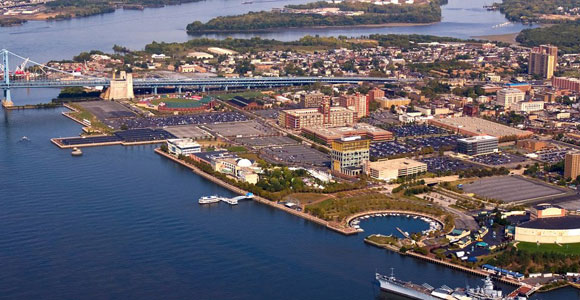
The riverfront has always been the city’s center. Ferry service to Philadelphia began in colonial times, and by the 1800s industrial factories changed Camden’s waterfront into a potent economic hub.

That way of life ended in the mid-20th century, as new highways and a post-industrial economy turned the waterfront into a symbol of decline. Ferries stopped in 1952.

Using Baltimore as a model, South Jersey politicians and activists have since sought to give Camden new life by converting the waterfront into a destination. According to Msgr. Michael Doyle, the water is the city’s “treasure.” He believes that residents of a city on a river must have access to their water.

And that’s why he supports the waterfront effort – including the aquarium expansion – even as he opposes the political takeover.

“We needed to open up this treasure we have,” he said. “It creates a stage to say, ‘We are here.’ ”

Since 1992, when the aquarium opened, ferry service has resumed and the waterfront has added the Susquehanna Bank Center concert arena, the USS New Jersey, a Children’s Garden, and the Campbell’s Field baseball stadium.

The state takeover sought to build on these existing strengths. And so if waterfront visitors today look out the car window on the way into town, they might glimpse the takeover’s winners – and losers.

Visitors from Philadelphia turn off the Ben Franklin Bridge into the historic downtown, where Rutgers-Camden Law School – thanks in part to recovery money – has opened new classrooms.

They might see the rehabilitated neighborhood of Cooper Grant, the restored Johnson Park, and maybe even the new scoreboard at Campbell’s Field, the Rutgers-owned minor-league stadium. The recovery funded all of those projects.

Then there’s the eyesore on Cooper Street with a tree growing through it – the planned Radio Lofts, awarded $2 million for condo conversion three years ago, but delayed for environmental cleanup.

Across the street is the Board of Education, which presides over some of the worst graduation rates and test scores statewide. The board is controlled by the governor, as per the recovery law, but no money was earmarked for the district.

Pass the school board and find an expanse of parking lots on the waterfront where a state trooper is often stationed to protect the tourist attractions – while the rest of the city faces an unprecedented police shortage. Waterfront lots are among six parking projects funded with millions in recovery dollars.

One lot was built for state employees at Riverfront State Prison, which is now shuttered. A sixth of the recovery money finances state entities like this – including the South Jersey Port Corp. and a new state office building.

Some parking lots were intended to be placeholders for a future Camden “town center” called Cooper’s Crossing. Steiner + Associates, a Camden County Democratic donor and Ohio-based builder that controls development rights for 30 waterfront acres until at least 2017, plans six restaurants, dozens of stores, a hotel, 1,500 residential units, a recorded-sound museum, and at least three office buildings.

So far, visitors will find only one element of Cooper’s Crossing – the Ferry Terminal Building, the first privately financed office structure in the city in nearly a half-century, and touted as a key recovery accomplishment. The building is 85 percent filled with tenants, thanks in part to recovery-funded lease incentives, but a long-awaited anchor restaurant has yet to move in.

The other parts of Cooper’s Crossing are on schedule, say Steiner and the state, and are coming soon.

The aquarium

Next door to the Ferry Terminal Building, visitors snap cell-phone pictures of the Philadelphia skyline before going through the aquarium entrance, which now faces Philadelphia instead of Camden.

Once inside, they leave the downtrodden city behind, and they never really return. The old New Jersey State Aquarium at Camden has a new name, Adventure Aquarium.

The gift-shop postcards say “Camden,” but the mugs and snow globes are branded with an aquarium logo that makes no mention of the distressed city that politicians say the aquarium is supposed to promote.

Visitors aren’t here for Camden. They’re here for the fish. You can gaze at sharks straight on or look at them upside down through a marvelous underwater tunnel. You can pet them and, believe it or not, even swim with them for $165.

“He’s having the time of his life!” beamed one man, visiting with his grandson. “What they did here is absolutely fantastic. He wants to work here!”

Large hippos press their noses against the glass and seals clap their fins while visitors feed birds with $1 cups of insects.

As for human food, visitors have no incentive to leave the premises. If there isn’t a fish tank around that corner, then there’s an aquarium vendor wearing a Hawaiian lei, listening to Bob Marley’s “One Love,” and selling Jamaican meat patties. It’s all part of the adventure.

Across the street, the manager of the upscale Victor Pub, which recovery money supported, says he gets few, if any, aquarium visitors.

The subsidized aquarium hasn’t created many jobs, either.

In Steiner’s presentation to the Camden Recovery Board in July 2003, president Barry Rosenberg promised job training for city residents. The board then unanimously approved the project.

Rosenberg said such training existed at first. But Steiner sold the aquarium operations to another company, and now only 23 percent of its employees – 28 percent during the summer – live in Camden. Before the recovery, the percentage of Camden residents employed there was 43 percent.

Even George Norcross III, chairman of the board of trustees of Cooper University Hospital and a political player, says the investment in the aquarium was misguided.

“When everything around you lacks security and stability,” Norcross said, “investing tens of millions in a fish tank on the waterfront does not make any sense to me whatsoever.”

Anchor of activity

The aquarium opened in 1992 as part of the state’s first attempt to save Camden through its waterfront. A plan for a new Campbell Soup waterfront headquarters was fading, so politicians employed the same philosophy they would use 10 years later – attractions would make people and businesses return to Camden, leading to jobs and prosperity. A marina and an office building opened at the same time.

The focus on the aquarium and waterfront met the same community skepticism as its expansion 10 years later. “We got two and three families living in one house and beautiful fishes in tanks by themselves,” activist Luis Galindez told The Inquirer at the time. “We could really have used that money.”

Then, as now, the aquarium and waterfront construction failed to meet expectations. It didn’t replace the jobs lost at the shuttered Campbell Soup plant, and after one year, attendance lagged. The state was subsidizing the operation with millions of dollars in debt payments and operating revenues.

In 2000, Steiner began making political donations and offering plans for the waterfront. Its first donation was to Republicans in 2001, when Republican Gov. Donald DiFrancesco considered a Camden recovery law. Its executives then donated to the Camden County Democrats, who sponsored the final law.

“They were people who we thought would be beneficial, and we supported them,” Rosenberg said. “There was no pay-to-play concept here at all.”

Rosenberg said the state approached Steiner about expanding the aquarium because of the firm’s unique expertise with such facilities, and since then the firm has worked with both parties.

Under Gov. Jim McGreevey, operations of the aquarium were deeded to Steiner, and in 2005 it opened its $57 million expansion – with $43 million in public funding. Two years later, Steiner sold the aquarium to Georgia-based Herschend Family Entertainment, but it is still responsible for development of the surrounding acres.

The stated point of the aquarium has always been to “anchor” a “critical mass” of activity to draw private, nonsubsidized development.

Camden County Freeholder Jeffrey Nash admits that the subsidized aquarium and baseball stadium “on their face don’t help the city directly.” But they are catalysts to make people feel comfortable visiting – and even living in – Camden again.

He cites the Victor, a luxury apartment building, restored without recovery money, yet considered proof of the waterfront’s potential.

“Stand on the Camden waterfront as it existed in 1950,” Nash said. “And open your eyes in that area now.”

In lieu of taxes

Sure, the waterfront looks better, say longtime residents. But how does that help the city?

Greg Charbeneau, the aquarium’s executive director, says the facility now pays sales tax to New Jersey, and the state no longer subsidizes it with $3 million a year. The aquarium doesn’t, however, pay city taxes. It makes an annual Payment In Lieu of Taxes (PILOT), which Steiner told the Camden Economic Recovery Board would be $1.5 million. Instead, it is about a quarter of that.

“That was the number I always anticipated we’d pay,” Rosenberg said. “When I threw out the number, it was maybe based on a certain number of people [visiting].”

As part of the 25-year PILOT deal, the city gets 50 cents per paid ticket, and for 2008 received $329,663.50.

Adventure Aquarium wouldn’t release its figures, but based on the PILOT, paid attendance last year was 659,327 people. In fiscal year 2004, when it was bailed out, attendance was 600,000, according to the former operator’s records.

That’s about $500 in recovery money for each new visitor to Camden.

“It’s a nice thing, but at the end of the day it doesn’t change anybody’s life, and that’s how we measure whether the recovery legislation was a success,” said Roy Jones, a community activist.

PILOTs are common in Camden for its largest institutions and companies, and intensely debated because the discounted taxes go only to municipal governments. Schools and counties get nothing.

Most of Camden is now tax-exempt; its rate is the third-highest in New Jersey.

If the aquarium was assessed taxes at the regular rate, it would be paying more than six times as much, about $2.1 million, and $409,500 would go to the schools.

Melvin “Randy” Primas, the city’s first chief operating officer, explained that the privatization happened because New Jersey wanted out of its investment.

“The aquarium was bleeding money and had to require financial assistance from the state,” Primas said. “And they looked at the money and looked at how much money it would cost. You’ve got to keep feeding the fish.”

‘Means to the end’

Other institutional investments had better results, making parts of the downtown look more vibrant – with more buildings and improved streetscaping.

“Nobody could argue that they’re bad things, but I think they’re really below what people were thinking the money was going to go for from the community perspective,” said Peter O’Connor, of the Fair Share Housing Center in Cherry Hill.

O’Connor, whose lawsuits helped to create the state’s affordable-housing laws, believes the institutions could have found money elsewhere, and a mini-city of mixed-income housing with stores and schools could have been built on the water.

The law’s direction was set, though, before the community could even lobby the Economic Recovery Board.

One of the cosponsors, former State Sen. Wayne Bryant, was directly connected to three institutions earmarked for $21 million: Camcare, a medical clinic run by Bryant’s brother, Lawnside Mayor Mark Bryant; Rutgers-Camden, where Bryant became an occasional, paid lecturer months after the law passed; and the University of Medicine and Dentistry of New Jersey, where Bryant had a job that would later result in a prison sentence. He was convicted of peddling his influence for the school while doing little work.

The impact of this money is mixed. At Rutgers-Camden law school, the $11 million for an expansion project helped to increase the hours of free legal work students provide city residents from about 30,000 to 40,000 hours a year.

The expansion’s resulting increase in student enrollment also sets the stage, the school said, for a planned dormitory in the city.

But the school’s expansion led to only one new job for a Camden resident, a custodial position.

Down the road, at a recovery-funded Rutgers business incubator in a new recovery-funded state office building, most companies do not stay in the city after graduation. Only one of the 30 companies is a major city employer; only one is owned by a Camden resident.

And at Campbell’s Field, $1.2 million was lent for improvements like a new video board and upgraded plumbing. “You’re using Camden as a conduit to fund your institutions, [but] the public impression was Camden was getting all these dollars,” said Kelly Francis, president of the Camden County NAACP and a fiscal watchdog. “The problem is it doesn’t trickle down.”

But amid these disappointments, at Camden County College there’s far more than a trickle effect.

The school used its $3.5 million toward a building with classrooms, a garage, a bookstore, and a computer lab, all of which serve students and the community. And the number of city residents attending the college has increased 50 percent, to nearly 2,000.

“The investment in the physical development, whether it be the law school at Rutgers, or us, or Cooper, is a means to the end,” said Louis Bezich, Camden County College vice president. “And the end is what it’s all about.”

Thousands more people are coming to Camden now, meaning more businesses may crop up to serve them and create jobs for residents.

The hospitals

The most palpable result of this approach can be found at Camden’s hospitals. Although Virtua canceled a plan to use $1 million for the city’s first inpatient drug-treatment facility, as promised in the law, both Our Lady of Lourdes Medical Center and Cooper University Hospital undertook major construction projects with recovery money.

In a city where nearly one in two residents visits an emergency room each year for anything from routine care to trauma, both hospitals expanded their emergency rooms. Lourdes built a new nursing school with its $4.5 million, and Cooper’s $12.35 million check helped to fund a $220 million state-of-the-art patient pavilion. Cooper also received $3 million for a neonatal unit.

“The health care now is better in Camden than it has been in decades,” said Norcross, chairman of the Cooper board of trustees, whose allies sponsored the law.

Focusing solely on the waterfront “was a misguided strategy,” Norcross said, but by supporting institutions – “pockets of excellence” – Camden can be saved.

“Has there been enough emphasis on public safety and improvements in the neighborhood? The answer is no, and I think that’s where it’s got to move to.”

According to Norcross, the eds and meds and Campbell Soup are now creating safe pockets that will spread to other parts of the city.

“When you’re walking around Campbell Soup, Cooper’s, Rutgers, there is no doubt you are as safe as in Cherry Hill, N.J.,” he said.

Campbell Soup is building a $90 million world headquarters and office park with $2.3 million in infrastructure aid from the recovery fund. The construction will change the face of the city at a main entry point, Admiral Wilson Boulevard, in the Gateway neighborhood.

“Improving the front door of the city is much the same as improving the appearance of your home,” said Anthony Sanzio, company spokesman. “In a sense, the revitalized Gateway district symbolizes a revitalized Camden.”

The revitalization fund made Cooper’s expansion possible, Norcross said. Otherwise, “Cooper Hospital would have undoubtedly expanded much faster in the suburbs.”

For the first time, Cooper pays a $247,000 “service charge” to the city. Such charges were mandated for some tax-free recipients of recovery funds, and although the money doesn’t go to schools, it funds city services. Cooper is spending $600 million on expansion. The only city redevelopment plan currently being pursued is connected to Cooper, and most of the recovery money devoted to buying vacant city buildings for redevelopment is for the neighborhoods next to the hospital. There are 265 properties to be bought and held for developers.

Cooper is luring its staff to live near the hospital in new housing, including 94 mostly market-rate units funded with $3.6 million in recovery dollars. And thanks to Corzine’s executive order last summer, Cooper is opening a four-year medical school in conjunction with Rowan University. That project is eligible for a $9 million recovery check.

Norcross said he considered taking a new Cooper Cancer Institute to the suburbs, but saw “the success that was taking place, and the momentum.”

Such momentum, proponents say, paves the way for unrelated projects on the horizon – the demolition of Riverfront State Prison, and the possible extension of Camden’s rail line to Gloucester County.

Still no new jobs

Meanwhile, almost nothing is happening on the recovery’s top goal, job growth, and not much was happening before the recession, either.

The only Camden sector growing jobs is health care, according to state labor statistics.

That’s because many of the recovery-funded institutions aren’t hiring Camden residents. Since the takeover, city jobs increased by about 1,000, but the percentage of Camden residents who held jobs in the city decreased, from 23 percent to 18 percent. Some argue that once residents get good jobs, they move to middle-class towns like Pennsauken and Winslow. But the city has been bleeding jobs for decades.

At Campbell Soup, only 3 percent of the employees are Camden residents – compared with 1989, before the plant closed, when they held a third of the 940 factory jobs.

Officials from the Camden Higher Education and Healthcare Task Force cite a 31 percent increase in residents working for the eds and meds – 400 new people making an average of $25,0000 – but it’s unclear what those jobs are and whether they are full time with health coverage.

Less than 1.5 percent of the recovery dollars were spent on workforce development and job training.

In the one notable success, Respond, a longtime city nonprofit, used $1 million to build a training center for culinary arts, carpentry, auto repair, landscaping, and HVAC installation. There’s a child-care center on site, and a class for teens from a juvenile-detention facility.

“Anyone . . . would agree that that was insufficient for the city of Camden,” said Edward Gorman, president of American Community Partnership, which received $100,000 for a training facility yet to open. If his group had received $1 million, Gorman said, he would have trained 200 Camden residents in construction, 400 in culinary arts, and 500 as nurse’s assistants.

Lack of jobs means fewer taxpayers. And by that measure, Camden has actually gone backward.

During the takeover, the city became twice as dependent on state aid – to the tune of $110 million annually, plus $308 million more for the schools. This contradicts a core mission of the law, to get Camden off the state dole.

As a self-sustaining entity, Camden barely exists.


Contact staff writer Matt Katz

at 856-779-3919 or mkatz@phillynews.com.

Chris Christie and America’s Poorest City

logo-110
MATT KATZ | JULY 11, 2014
During a routine business meeting in a conference room in Trenton on Thursday, the New Jersey Economic Development Authority approved its third largest tax break in state history — $260 million for a new manufacturing plant on the waterfront in Camden.

The unanimous vote was remarkable in that it is yet another indication that Camden – routinely derided as the poorest and most dangerous city in America – has become something of a laboratory for Gov. Chris Christie to experiment with urban renewal.

Through a mix of state intervention in police and schools, tax incentives for large businesses and a personal touch with local Democratic politicos, Christie has created a potential legacy for his governorship and a platform for winning swing voters in a 2016 presidential race.

But to some long-time Camden residents and political observers, Christie is repeating a failed pattern of the past by building up institutions without directly helping the people. To that end he has partnered with George Norcross, the de facto leader of the South Jersey Democrats, the chairman of Camden’s Cooper University Hospital and the former co-owner of The Philadelphia Inquirer. For decades Norcross has been able to amass political donations to become a kingmaker in New Jersey politics.

After Christie took over the Camden schools last year — a move that had Norcross’s support — Christie spoke at an event that Norcross held at Cooper University Hospital.

“This stuff isn’t easy to do,” Christie said. “But nor should it be easy for us to continue to ignore these children. Let’s be honest. That’s what we have done. We can rationalize as much as we want. We have ignored their futures. And today is a symbol of the beginning of the end of that conduct.”

Christie speaks in grand terms when visiting Camden — and he has visited often. Christie held about two dozen public events in the city, more than any municipality besides Trenton since 2012. That’s an extraordinary number — especially for a Republican in a city that went 97 percent for President Barack Obama in 2012.

Recently, Camden has offered Christie safe haven when things in Trenton get hot. It was one of his first public stops after the Bridgegate story broke in January; he held five events in one day last month while his chief of staff was testifying about the lane closures before the legislature, 40 miles away.

Unlike Newark, New Jersey’s largest city, which has a more fractious political climate, Christie is welcomed in Camden because he has the support of Norcross. Christie has relied on the bloc of votes that Norcross controls in the legislature for initiatives like public worker benefits reform, which forced Democrats to buck their labor union base. And Christie has supported Norcross’s priorities for remaking Camden, from expanding higher education institutions to signing a bill, sponsored by Norcross’s brother, State Sen. Donald Norcross, that created a new kind of publicly-financed, privately-run school in Camden. The first such school, the KIPP Cooper Norcross Academy, is now under construction.

Sen. Donald Norcross also co-sponsored a bill that created new corporate tax incentives in Camden. It was signed by Christie. One result of that bill was $260 million for Holtec International, which manufactures industrial energy equipment, over 10 years — that’s the deal that the Economic Development Authority approved on Thursday. Holtec’s CEO, Krishna Singh, was George Norcross’s partner when he owned The Inquirer, and Norcross sits on Holtec’s board of directors. The company is expected to create 235 new jobs in Camden, but there’s no guarantee Camden residents will get those positions.

A spokesman for Norcross said Norcross will not financially benefit from the deal, and is not paid for his board position. Michele Brown, the close Christie adviser who is his top appointee at the Economic Development Authority, said she was not aware of Norcross’s connection with the company until the press reported on it this week. She told WNYC that she had no contact with Norcross about the deal.

But the Christie-Norcross relationship has been publicly evident elsewhere in Camden. Last year, citing the fact that the city had 23 of the state’s 26 worst performing schools, Christie initiated a state takeover of the district and appointed a new superintendent who subsequently laid off teachers to deal with a budget gap. But Norcross-backed Democrats, most notably the mayor and city council in Camden, continued to support Christie. By contrast, leaders of other urban school districts under state control are agitating for independence.

This political support is the reason why Christie has spent so much time here, his advisers say — he can get things done. Christie long worked with Newark Mayor Cory Booker, but Booker has moved on to the U.S. Senate and anti-Christie activists there have grown more vocal.

In Camden, Christie has built alliances with African American and Hispanic politicians that his advisers believe will resonate in a presidential race. And they think it could help him not just in cities, but in towns that surround those cities — like in the nearby Pennsylvania suburbs around Philadelphia, filled with swing voters.

A photographer and videographer document Christie’s trips to Camden (as they do for his visits to other towns), collecting images of cute moments, like when he plays catch with a bunch of kids at a Little League field or shoots free throws at a rec center. Last month, he missed 11 of those shots, but asked for the ball back one more time — when he finally banked it in.

That constant presence is bearing fruit. He got just 604 votes in the city in 2009, but tripled that in 2013. Small numbers still, but a trajectory his advisers like to see.

“In all the years of previous governors, we were always the forgotten city, they never came to Camden and showed the love that Christie does,” said Emiliano Reyes Jr., a 40-year-old Camden truck driver, who sees new development near the waterfront as an optimistic sign. “It’s like flowers growing out of concrete, man it’s awesome, it’s awesome.”

But for some who have been involved in Camden politics for years, skepticism abounds.

Kelly Francis, long-time head of the NAACP here, stood one afternoon at a parking lot on the Camden waterfront — on the very site where yet another tax incentive will lead to yet another development that Francis doesn’t believe will have any impact on the community.

This one is for $82 million, so the Philadelphia 76ers can open a practice gym. Fifty new jobs are being created, but none are guaranteed for Camden residents.

The waterfront is filled with similarly-gleaming investments that were intended to revitalize the economy here — an aquarium, a battleship museum, a minor-league ballpark — but so far none of them has had a transformative effect, and few jobs for city residents have been created. All make so-called PILOTs — Payments In Lieu of Taxes. None of that money goes to the Camden school district, which relies on the state for almost all its funding.

The state also funds most of the city’s municipal budget, and Christie has found another way to save money in the long-term: He provided $10 million in state funding so the city police department could be closed and replaced with a countywide force.

Camden officials had long complained of overly-generous police contracts. By eliminating the police department they said they could roll back those perks. He has said he would consider replicating this experiment in other cities, too.

The police chief, Scott Thomson, ran the old force and is at the helm of the new one. He says there are more cops on the street and violent crime is rapidly dropping.

“You have to remember our residents were being victimized at Third World country rates,” Thomson said. “It was time for a new paradigm.”

But activists think Christie created a problem he could then fix. When he first came into office, Christie didn’t provide enough state dollars to maintain staffing levels. Nearly half the department was temporarily laid off, leading to a drop in arrests and a record-setting murder rate. That created a crisis, said the NAACP’s Francis, that allowed the local police to be taken over by outside politicians.

“It hasn’t made any impact on the resident of Camden,” Francis said. “We’re still the poorest, we’re still the most dangerous city in the country.”

Other budget cuts have negatively affected Camden’s poor even as Christie argues that he is trying to help them. He eliminated the Earned Income Tax Credit for the working poor. He rolled back benefits for businesses in cities’ Urban Enterprise Zones. And he slowed the school construction program, so century-old buildings in Camden continue to fall apart.

The governor cites state fiscal woes, saying he is trying to balance all residents’ needs. And like he demonstrated that day on the basketball court, he promises to keep coming back, to keep doing more, to keep trying to get the ball in the hoop.

2055

Political reporter Matt Katz is The Christie Tracker at WNYC.org. NJ Spotlight is hosting his blog and running his stories, which can also be heard on WNYC 93.9 FM and 820 AM, as well as New Jersey Public Radio: Trenton 88.1, Sussex 88.5, Netcong 89.3, and Toms River 90.3.

Listen to Matt Katz at New Jersey Public Radio/WNYC  http://www.podtrac.com/pts/redirect.mp3/audio.wnyc.org/news/news20140711_christie_camden_web.mp3

Read more in Katz on Christie at http://www.njspotlight.com/stories/14/07/11/chris-christie-and-america-s-poorest-city

Copyright 2014 NJ Spotlight

City on the Brink

Economic and Community Development in Camden, NJ

By V. Michele Farquharson

Today people know Camden, NJ as one of the poorest and most dangerous cities in America. It has a population of 80,000 people with an unemployment rate of 10.1% and for those over the age of 25 only 50% graduated from high school. [1]. Of those who work their median income is $23,421, which puts 36% of Camden residents and 45% of Camden children in poverty. [2]. But how did Camden reach this state? How did decades of disinvestment go unnoticed until “on November 21, 2005, Camden was deemed the most dangerous city in America for the second consecutive year,” with a murder rate “over 10 times the national rate” and a “rate of robbery in 2004 [that] was 30% higher than the #2 city.” [3].

The Beginning

Old Camden’s industrial and commercial sectors survived two World Wars, the Great Depression, and it was not until the 1970s that Camden’s steady decline became a rapid dive. Why then did Camden fall harder than other industrial cities? Disinvestment affected most cities across America, as did white-flight, but why did Camden never resurface? The city began in the mid-1800s with the industrial revolution, and by “1920 Camden’s population exceeded 100,000 for the first time, ranking the city fifty-eighth nationally, just behind New Bedford, Trenton, and Nashville and ahead of Lowell, Wilmington, and Fort Worth.” [4]. Camden continued to grow into a stable city community that supported a diverse mix of immigrants during the years following World War II. Like most cities, Camden struggled with racial as well as gender lines that eventually played a part in Camden’s decline. In the 1950s, the wide variety of ethnic backgrounds contributed to assorted entrepreneurial commercial corridors. While there were separate neighborhoods for the Polish, Italians, Jewish, African-Americans, and Irish Catholics, the center of each of these ethnic groups brought different traditions, food, and business to the city. Each of these ethnic groups drew strength from its particular community centers, usually in the form of a place of worship and what Howard Gillette, Professor of History at Rutgers University and author of Camden After The Fall, calls an “ethnic parish.” [5].

Religious and Ethnic Enclaves

Within ethnic groups, there remained divisions and “although parishioners quickly formed at least ten regional organizations, the church made a point of melding the whole community by recognizing all the special feast days of Italy’s different regions.” [6]. These parades united the Italian neighborhood as a “public display of their solidarity to church, neighborhood, and ethnicity.” [7]. Churches in general promote this type of community activity, but William Simon, Saunders Professor of Law at Stanford University, argues the Roman Catholic Church and certain Black Protestant churches impact their communities more effectively. He points out that “For decades, [the Catholic Church] has supported community organizing and development efforts in low-income areas across the countries,” and “urban black Protestant churches have undertaken major housing, commercial, and health care projects.” [8].

Camden’s industrial and commercial centers survived the war, and yet the ethnic neighborhoods “remained primarily parochial and isolated from other communities. Each unit of the larger urban fabric thus held strongly unto itself, recognizing other units but keeping a distance.” These religious and cultural roots grounded the communities in Camden during the Great Depression and a Second World War. Unfortunately, this sense of community would not last. 9 This division between ethnic communities did not seem damaging at the time because it gave each group a support group particular to its interests. However, these divisions, especially those based on race, prevented the neighborhoods from uniting as the entity – Camden. The voluntary (and in some cases involuntary) separation made Camden a city of enclaves, “a voluntarily developed spatial concentration of a group for purposes of promoting the welfare of its members.” [10]. While the city government ran the city as a whole, these enclaves relied on their local “churches [which] are often the strongest nongovernmental institutions in poor neighborhoods. They are invariably involved in the production of relations of trust and cooperation.” [11]. While an involuntary isolation, such as those seen with racial minorities such as African-Americans are considered ghettos, this initial separation was universal and based more on ethnic background than socioeconomic or racial status.

For ethnic minorities in particular, these churches took the place of City institutions. This lack of political agency for isolated ethnic and racial communities contributes to the development of the Community Economic Development Movement. Despite the developments in the 1970s, such as Community Action Programs and Empowerment Zones, “municipalities were often too centralized and bureaucratic” or “dominated by white political coalitions insensitive to racial minorities,” which prevented them from “deliver[ing] services effectively to poor neighborhoods.” [12].

The ethnic communities formed such strong ties amongst themselves that as each ethnic enclave made a decision to leave or stay in Camden, the majority of the ethnic parish followed. For instance, in 1951 the Federation (Jewish community leaders) wanted to build a new community center outside the city on a suburban site, which caused Jewish community members to be “appalled at the prospect of getting their children to Hebrew School or attending other functions far from their homes.” From the time of Camden’s founding through the 1960s African-Americans were considered second-class citizens, and thus did not receive equal treatment from city institutions. As a city of immigrants, African-Americans were not the only group discriminated against, and ultimately the city was comprised of ethnic neighborhoods that rarely overlapped. [13]. But the Federation could not resist the cheaper larger lot for the community center and the Jewish community soon followed the community center into suburbia during the 1950s marking “the first wave of change that dramatically altered Camden’s social landscape,” leaving only three hundred Jews in Camden by 1972. [14].

The Competition

Moving into the second half of the twentieth century, America’s economy surged and with efficient modes of production communities accumulating wealth moved into suburbia, drawn by the new commercial economic centers, in particular, malls. For Camden, “a central factor in the area’s conversion from country to suburb was the opening of the Cherry Hill Mall in October 1961.” [15].

The mall was so successful that the then Delaware Township changed its name, which is to this day – Cherry Hill. Cherry Hill Mall’s tremendous economic success “came at Camden’s expense, as businesses shut down or changed hands during the 1960s along the city’s historically dominant commercial corridors.” Camden fell to the suburbanization of one of Southern New Jersey’s more expensive neighborhoods, Cherry Hill. The city’s commercial corridors could not keep pace with the new Cherry Hill mall, and the neat row houses and city apartments lost their charm in comparison with the new single-family homes spreading farther and farther outside the city. Cities across the nation lost their appeal to the typical American family. [16].  This economic shift drew out the middle class families not already living in suburbia. Camden never had a major upper class, and without the middle class commercial corridors, and lack of industrial work, the lower classes were left to fill the void. As the working middle class moved up and out of the city, they left behind those that could not afford to move, primarily African-Americans and Latin Americans. Both of these minorities suffered discrimination during Camden’s best days and because of the class and racial lines there was not a strong enough economic base within these two groups to keep the city afloat. Cities across the nation saw their “severe problems beg[i]n to mount only later, when its physical, fiscal, and political growth was choked off by the suburbs, which from then on were able to capture relative prosperity for themselves.” [17]. This lack of economic power intensified with the disinvestment of the city as public and private investors saw the benefit of moving commercial and even industrial sectors into suburban neighborhoods. Without the middle class investors did not look to Camden as a place to set up shops, but went to Cherry Hill where they were guaranteed a customer base. Thus, Camden took a turn for the worse and riots sprang up throughout the city in the 1970s pushing the remaining middle class families out of the city, leaving behind a “neighborhood of transients.” [18].

Redevelopment: Part One

While most Old Camden residents moved to suburbia and never looked back, Al Pierce returned to Camden after World War II to fight for the preservation of the Camden he knew and loved. In the same year as the construction of Cherry Hill Mall, Al Pierce was elected mayor of Camden. His policies included a “comprehensive plan released in 1962 laid out the vision of a revitalized city in the heart of a growing region.” [19]. Pierce recognized the stiff competition with suburban areas and made efforts to create an urban version of the Cherry Hill Mall by starting over in downtown Camden. While Pierce desired redevelopment in Camden, he ignored protests from local businessmen who saw their businesses displaced by his plan. It is this lack of political representation that gives rise to the Community Economic Development Movement, because “bureaucrats have poor incentives and poor information.” [20].

Resistance and Racial Tension

Mayor Pierce pushed forward with a plan that focused only on the economic benefits for private investors, not on providing the necessary resources for the survival of the local population. The 1960s housed the civil rights movement in cities across the nation, and white politicians ran into minority activism, which called for increased equity in city policy. Most redevelopment policies proposed during this time ignored the problems affecting minority populations. Pierce’s plans for redevelopment benefited the white population, and damned the minority population as “three thousand city buildings had been demolished in the previous six years with no low-cost housing to replace them.” [21]. By not including a comprehensive low, or even mixed, income housing plan to make up for this loss, Mayor Pierce began a trend of vacant lots that continues to plague Camden. The Mayor’s plans also included a “Hi-Speed rail line, bypassing Camden’s blighted inner-city neighborhoods, which were becoming more black and Latino.” [22]. The racial tensions continued as the black community developed militant groups that eventually incited “Mayor Pierce and Police Chief Harold Melleby [to file] a civil suit against the Friends of the Black People’s Unity Movement [BPUM] charging it with inciting others to violence and conducting unlawful assemblies.” [23]. Eventually riots ensued during which a white police officer and innocent black female bystander were shot and killed. This incident solidified the line between the African-American activist movements and law enforcement officials.

Alternating between riots and raids, faults were committed on both sides as activists were found with drugs, and officers took advantage of their positions of power to discriminate against African-American citizens. Ultimately, the redevelopment attempts by Pierce’s government failed because they did not recognize “the requirement of community participation” and instead intended “to remove the minority groups from the city through demolition of housing and ultimately to bring back the suburban white population to live in luxury housing.” [24]. Activists continued to protest against Pierce’s redevelopment programs and “the Black People’s Unity Movement, assailed the redevelopment plans as ‘Negro removal.’ In 1970, the Camden County Regional Legal Services aided the BPUM in filing suit against all urban renewal and highway construction projects.” [25]. The activists won the suit and the U.S. District Court ruled “to halt redevelopment in its tracks” until city planners produced “an official plan of action for effectively dealing with Camden’s problems of urban slums and blight.” [26]. Thus, Mayor Pierce’s economic redevelopment plan produced vacant lots, insufficient housing, closed businesses, and a public sentiment that no longer trusted government officials to act in the best interests of the local community. Redevelopment programs like Mayor Pierce’s failed to revitalize cities nation-wide because they focused on bringing the upper class back into the city, and ignored the initial residents within the city limits.

As civil unrest continued, the police force became more and more belligerent, especially when dealing with minorities. Despite calls for justice when citizens experienced police brutality, the government refused a public hearing, and defended their police force. On August 19, 1971 Mayor Mario Rodriguez’s inability to communicate and negotiate with the public led to “three nights [of] fires, looting, and destruction of property [that] paralyzed the city.” [27]. The 1970s rolled by and Camden’s government funneled money in from the state to try and save Camden, but without outside investment there was no jolt to the economic system to push it into any kind of growth pattern. Despite the prevalence of vacant lots in Camden during this time, no city programs focused on externalities. This is surprising considering that “the value of your house depends more on what your neighbors do with their property, how they behave, and who they are than on any decision you make.” [28].

The Importance of Community Involvement

By 1980, the suburbanites who left Camden in the sixties no longer felt an obligation to give because the redevelopment they thought they were investing in for the past ten years was nowhere to be found. This opinion predominated in suburban areas surrounding most major cities, but it is unfounded considering the failure of redevelopment programs before the 1980s had more to do with a lack of coordination than any wastefulness on the part of urban residents. While the government recognized the need for development, it focused on appealing to a group of people no longer invested in the city. Mayor Pierce’s plans for a mall and new commercial district aimed at bringing white suburbanites back into the city – “the plan ignored the realities of economic decline, suburban white flight, and the prevailing disinvestment on the part of banks and other lending institutions.” [29].

Camden’s political leaders found that no private investors wanted to invest in a city with so much civil unrest, and no local business center (Mayor Pierce’s redevelopment plan drove local businesses away and failed to bring other investments in). As Camden’s economic situation continued to decline politicians looked to the state’s coffers to pay their debt, and “embraced an offer of $3.4 million in state funds in return for giving up valuable land on the North Camden waterfront for a new state prison.” The inability of the government in the 1960s to effectively integrate the remaining communities, and adhere to their needs destroyed the relationship between the public and the government for the next thirty years. The politicians of the 1980s did not learn from Mayor Pierce’s mistake and continued to focus their development attention on outside investors rather than their citizens and constituents. Minority populations across the nation felt the strain of racism in politics. Despite BPUM’s success at halting Mayor Pierce’s redevelopment plan, there was no action to replace it with a more equitable plan. Those involved in the community activist quarter were sequestered from local politics, and thus decades went by with continual flawed redevelopment. [30]. This was the first of many detrimental projects that took up prime real estate property on Camden’s prime waterfront and residential properties. The sewage treatment plant built in 1987 “replaced 46 local treatment plants shut down when suburban residents articulated concerns about the degraded environmental quality in their own communities.” [31]. The solid waste facility accompanied the sewage treatment plant in 1989, jeopardizing the health and overall quality of life in Camden. Camden’s poor minority population suffered at the hands of “environmental racism … that those at the bottom end of the social scale, living in the poorest and especially the darkest skinned neighborhoods and rural zones, share space with dirt and disease at the bottom end of the environment scale.” [32]. Not only were the suburban powers unconcerned with Camden’s development, they valued the lives of Camden citizens less than their own.

Camden suffers because the suburban powers view the city as “a local failure of physical and human resources” [33] rather than as a victim of inequality. The plants forced on Camden “can be construed as largely suburban-generated problems insofar as suburbanites consume more, demand more and more spread-out facilities … Indeed, such problems are frequently viewed a products of dense urbanization, as if the green and apparently clean suburbs somehow lived on their own.” [34]. While the state’s investments kept Camden from disintegrating, the cost did not fall on Camden’s politicians but on its citizens in the form of ever declining public health and a permanent blight on the small amount of land investors might be interested in. During this period, the community’s voices were not organized and could not be heard over Camden’s political machine. The surrounding wealthy counties’ residents dictated what happened to Camden. This trend continued across the United States due to the inequalities in the “distributive effects of postwar urban development.” [35]. The federal policy changed as of “January, 1973, [when] President Nixon suspended all federal housing and redevelopment assistance programs. This action virtually killed all new assisted housing projects.” [36].

The Community Economic Development Movement

With a lack of federal support for assistance programs, Camden’s attempts at redevelopment failed, and the community lacked the organization to change the political leadership. The Community Economic Development (CED) Movement came about in response to cities such as Camden going through failed redevelopment programs like the ones implemented by Mayor Pierce. The CED “movement has been fueled by trends toward decentralizing public administration, … channeling the development of local markets along socially desirable paths, … [and] by changes in the contours of urban politics, especially new strategies by neighborhood activists.” [37]. The goals of the CED movement are threefold: to develop housing, work and business opportunities; to establish non-profit leadership within the community; and to ensure that community leadership are accountable to the community’s residents. [38]. On all three of these factors, Camden’s initial redevelopment programs failed because they focused on business investment from external private businesses and developers; ignored the non-profit leadership within the community; and agreed to development projects that put the community in harms way. The CED movement addresses the failures of previous redevelopment programs, and works to build institutions geared towards community action apart from government and privatized institutions. By making the community an independent agent, it redistributes political and economic power more equitably.

Ensuring Benefits for the Community

The CED movement produces better redevelopment plans because it remedies the coordination failures with real estate development and financial investments. Previous redevelopment plans, such as Mayor Pierce’s, “come at the expense of the initial residents of the community being developed … [and] citizen-participation goals were never realized.” [39]. The racial segregation and inequalities influenced the first attempts at redevelopment so that “municipalities were dominated by white political coalitions insensitive to racial minorities.” [40]. One of the CED movement’s primary goals is to ensure the initial community is the beneficiary of economic development. The movement benefits the community in four primary ways: through residents, synergy with local institutions, mitigating “negative environmental externalities,” and “reinforces … a stable, independent community structure.” [41].

CED Institutions

In addition to ensuring the community is the beneficiary of economic development, the CED movement provides guidelines for developing effective, community-friendly institutions. The two most common forms of CED Institutions are Community Based Organizations (CBOs) and Community Development Corporations (CDCs). Both types must adhere to the three characteristics of CED Institutions: relational density and synergy, maintain a geographic focus, and ensure face-to-face encounters with the local community. [42]. Relational density and synergy implies internalizing community activism and ensuring community agency and strengthening political and economic relationships within the geographic focus. CDCs and CBOs are essentially “forms and structures to facilitate the kinds of collective activities [the CED movement] promotes.” [43].

Community Based Organizations

Community Based Organizations wield six tools to help with local development. These tools include: financial assistance, technical assistance, and tax concessions, provision of public goods, procurement preference, and land-use permission. [44]. CBOs have access to resources not normally available to the average community member or small business. As an intermediary institution these organizations can provide “financing [for] housing, job, and business development in low-income areas through community-based organizations. Assistance to CBOs and by CBOs to others can take the forms of grants, equity investments, loans, and loan guarantees.” [45]. Financial assistance can also be in the form of certain tangible property, the most common one being land. City land redevelopment can be the gateway into combining public and private interests. Most “urban municipalities often have title to a good deal of land in low-income neighborhoods that has reverted to them because of defaulted tax payments or was acquired for public facilities that are no longer in use.” [46]. CBOs help connect the municipality with private investors and community leaders to ensure they develop the land with community interest in mind. In addition to private investment, city owned land, as well as charitable donations; prove useful for housing and public facility projects.

Community Based Organizations also provide technical assistance in the form of training to help reinforce community businesses by providing training for local entrepreneurs, job-readiness preparation, as well as various forms of community planning and organizing. Technical assistance provides the CED movement its primary tool by forging opportunities for extensive human capital development. Most resident-leaders in these communities are inexperienced and “they, as well as active rank-and-file members, should be trained in the fundamentals of an organization’s structure, procedures, and finance and in the nature of its projects.” [47]. The resources covered in financial and technical assistance provided by CBOs help community leaders navigate the tax concessions granted to Empowerment Zone programs, incentivizing donations from private investors with subsidies as well as procurement preference. The final tool, land-use permission “is the most extensive power of economic regulation that local government has.” [48]. Community Development Corporations With effective training and guidance CBOs can partner with local government in order to pursue the redevelopment programs most beneficial to the local residents. Community Based Organizations help lay the foundations for the emergence of Community Development Corporations (CDCs). CDCs are formalized institutions with a “standard legal form,” which ensures the CDC demonstrate “development [of] some geographically bounded community of disproportionately low-income people … it must be charitable … have a governing board that includes representatives of the beneficiary community; and its membership must be open to the beneficiary community.” [49].

Redevelopment: Part Two

These CDCs are classified as 501(c)(3)s and maintain that status only by fulfilling the above mentioned requirements. The legal structuring of CDCs helps protect community interest by requiring direct community interaction with the governing board of these corporations. Private investors will fill the void if local community members do not take charge of what happens to their own neighborhoods. The institutions emerging from the CED movement are not perfect but they do help diminish the political and economic inequalities of lowerincome urban communities. For the initial local communities to benefit from redevelopment programs, the public-private partnerships provided through the development of CDCs must take root. The 1990s brought on another attempt at redevelopment, but once again political machinations got in the way of the public benefit. Mayor Pierce set the tone for redevelopment programs under future administrations, resulting in the state takeover of the parking authority, the housing authority, “a 300-page audit that accused city government of mishandling its finances,” and “as of the summer of 1997, urban redevelopment in Camden was at a standstill both within and outside the Empowerment Zone.” [50]. Camden’s political organization lacked leadership and the initiative necessary to bring back a city. The few redevelopment programs such as Empowerment Zones and Community Action Programs that emerged in the time after Mayor Pierce were the result of Federal programs in addition to initiatives from the Department of Housing and Urban Development. While the past fifty years demonstrates failed attempts at redevelopment on the part of politicians it does not mean they are not necessary for effective development. The role of government should be to balance the three branches necessary for effective redevelopment: public, private, and community participation.

Community Organizing—Camden Churches Organized for People

Camden Churches Organized for People (CCOP) is a non-profit that focuses on training local residents to be effective community organizers and leaders. While not associated with any particular faith, CCOP works with churches in pursuit of “a fundamental orientation that social change, as compared to social services, is necessary to address the causes of problems faced by individuals and families.” [51]. Working close within the community CCOP aims to make Camden’s communities agents of their own economic development. In order to increase the community’s intentional exercise of power it is necessary “that citizens come together collectively through formal organizations; this perspective views voluntary, non-economic organizations successful only to the degree that they develop relationships among members within a community.” [52].

Using the resources available to them as a non-profit, as well as partnering with public and private powers within the city, CCOP proved a linkage between vacant lots and violent crime. This connection “proved remarkably effective for discussion and policy change … [and] what developed from this process became formally known as the Camden On behalf of the community, the CCOP focused on demonstrating an exercise of power in Camden. Community Housing Campaign.” [53]. The collective political action resulted from “hundreds of one-on-one conversations held, in the collaboration conducted with the university-based research centre and in the dozens of research meetings arranged with public officials and experts.” [54].

Cooper’s Ferry Development Association

The key part in CCOPs success lies in their ability to include the community in every step of the process. In 1985, Camden saw the emergence of its first public-private partnership in the form of Cooper’s Ferry Development Association (CFDA). Cooper’s Ferry managed $55 million to develop and revitalize Camden’s waterfront property, which it did and continues to do today. Unfortunately, the driving force behind CFDA was the same as Mayor Pierce’s from 1965. The target audience of the development projects reached beyond Camden’s borders, and despite “qualified success … its economic impact on Camden has been slight.” [55].  In this situation the political leaders got two parts of the equation right – there was public and private participation in the project, but a major piece was still missing— community input. Without a community-based direction, projects such as the Aquarium, Campbell’s Field (Minor League Baseball Stadium), and Susquehanna Bank Convention Center lose their impact. The community ends up resenting these new developments because they do not impact their lives.

While the CFDA’s initial projects did not receive the desired community acceptance, the benefits should not be overlooked. First, the Waterfront Development plan took the place of a 65-acre landfill that required extensive environmental treatments that the government would not have been able to provide. Thus, the institutional hybridization of CFDA (public and private investors) enables it to achieve much more than the government alone. Second, CFDA has taken on citywide redevelopment efforts that extend to neighborhoods such as Cramer Hill and Waterfront South. This diversification of development projects will hopefully improve the relationship with the community. Something the CFDA lacks in its projects is a face-to-face encounter with community members, but this is on the mend. A group of their interns in the summer of 2010 went door to door in Cramer Hill passing out flyers for events, and making the non-profit’s presence known in the community. For so long residents of Camden lacked advocacy in redevelopment programs, that they lack trust, and no longer participate in community movements. For example, in the 2009 elections “only 20.7% of eligible voters cast a ballot, representing 23.5% of the registered voting population.” [56].

Camden possessed the pieces for redevelopment for almost twenty years, and yet progresses slowly. Previous projects aimed at revitalization, but “this focus on projects has produced endless conflict as proponents for various developments fight for their piece of the action, with no one, including city government, coordinating the process with a comprehensive plan to fit all the pieces together.” Part of redevelopment is not only the roles of these public-private institutions, and the government, but on the community to participate when opportunities exist. As the trend of community agency and representation in municipal governance changes, hopefully voter participation will increase and there will be more community involvement. [57]. The lack of political leadership and of an efficient and effective plan to replenish the foundation of Camden’s local community has hurt Camden more than the economic shift to suburbia. Other industrial cities succeeded because they developed an economic sector or middle to upper class residential area that offsets the poorer areas. Because of Camden’s size and socioeconomic homogeneity the development process requires cooperation between the government, public, private, nonprofit, and community sectors.

Greater Camden Partnership

In 2001 a non-profit organization called the Greater Camden Partnership took on the role of coordinator in the process of Camden’s redevelopment. The governing board of the Greater Camden Partnership (GCP) consists of representatives from almost every major anchor institution in Camden. These institutions include the colleges and universities, law enforcement, hospitals, the Salvation Army, and other non-profit leaders, just to name a few. While such a large board of directors can be daunting to an organization, it enables the GCP to serve the city as the coordinating body to connect the dots between the various project proposals throughout Camden. This role as coordinator is essential to effective redevelopment projects. Simon argues that the failure of past redevelopment efforts were the result of coordination failures. In 2010 GCP finished its first year under the leadership of its new CEO, Davie Foster. Under his leadership the GCP “focused on a single goal— revitalizing Camden by leveraging the economic development potential of the city’s anchor institutions.” [58].

Camden Special Services District

While the GCP does not execute the majority of the development projects in Camden, it helps pave the way to ensure the projects are completed. The GCP also plays an important role as a voice to the community in the development process. While certain projects focus on development projects to attract private investors, the GCP primarily pursues development projects aimed at benefiting Camden residents. The GCP started the Camden Special Services District (CSSD) in 2005, which employs Camden residents to keep the business corridors clean and safe. In addition to providing an increased sense of safety, the CSSD “are supported by voluntary contributions, fees for services, and grants from nearly thirty sources, including the major institutional anchors in the city, local government and private businesses.” [59].

Vacant Lot Stabilization Program

CSSD was so well received among businesses and community members that it was expanded in 2008 to create the Neighborhood Improvement Program. This expansion included a program for removing graffiti citywide. The CSSD now has a website where community members can upload photos of graffiti with its address and CSSD workers will track what tags belong to various gangs, and remove the graffiti within forty-eight hours. This development program demonstrates the CED goals of benefiting the community and using community members as agents for change. The Camden Community Green-Up campaign was the brainchild of the Greater Camden Partnership. The initiative’s goal was to clean and ‘green’ the vacant lots throughout Camden and “deliver to the city and citizens of Camden the benefits of superb vacant lot stabilization.” [60]. Given that 13% of the land in Camden lies vacant, this project was unable to green every lot, but the lots they completed made a sustainable difference in the community. [61]. The Green Up campaign began in September 2009 and lasted for six weeks during which “about 70 lots in the Cooper Plaza/Lanning Square neighborhoods [were] landscaped.” [62]. The project’s goal was not only to change the landscape of Camden’s vacant lots but also to inspire community work amongst local residents. The CEO of GCP was quoted as saying, “if you create a place that looks like it is respected, people will respect it.” [63].

Ray & Joan Kroc Community Center in Cramer Hill

The Green-Up campaign was not a permanent redevelopment fix, but it did temporarily revive the surrounding area by removing some of the blighted areas in Camden. This project represents mass cooperation amongst the major development organizations, anchor institutions, and local government. The primary partner with the Ray and Joan Kroc Foundation is the Salvation Army. This community center “is one of the most ambitious projects in the city’s history,” and “will be built on 24 reclaimed acres of the Harrison Avenue Landfill in the Cramer Hill neighborhood and is slated to open in December 2011.” [64]. This center represents the epitome of a CED project because it is all about providing resources for local residents. The only drawback is its location – Cramer Hill is in the northern tip of Camden City and thus neighborhoods such as Waterfront South, Morgan Village, and Fairview will not have the same access to Salvation Army resources. However, this should not detract from the impact this community center can make. It is designed to have a small grocery store, basketball courts, a place of worship, job training programs, youth programs, and baby-sitting and daycare services. Not only did Camden beat out cities across the nation, it is “one of only eight centers in the Northeast region … [and] is made possible by a $54 million grant from the estate of Mrs. Joan Kroc.”65

The Urban Land Institute – Technical Assistance Program

Acquiring the additional $34 million in funds has been a joint effort between the NJ Department of Environmental Protection, the Camden Redevelopment Agency, the Camden Economic Recovery Board, and the local Camden Salvation Army. While this project is not technically one of GCP’s projects, many of the participants sit on GCP’s board of directors, and thus GCP resources are used to help promote and support the Community Centers’ efforts. The Urban Land Institute is an international non-profit organization whose mission is “to provide leadership in the responsible use of land and in creating and sustaining thriving communities.” [66]. One of ULI’s tools is their Technical Assistance Panels (TAP) that provides advisory assistance to cities who apply and qualify for ULI assistance. Typically, only 2-3 of these panels convenes each year and Camden’s plan for the development of a University District was selected. This means that a team of experts and seasoned professionals in the field of developing University Districts in environments like Camden’s will provide “project analysis sessions, fellows advisory panels, on-site analysis sessions, five-day panels, technical assistance programs, advisory workshops, and special services.” [67]. This TAP is a great tool for putting together a comprehensive redevelopment plan for a University commercial corridor, but does it meet the requirements of the CED movement? While a University District is definitely necessary considering the number of Universities located in Camden, how many permanent residents will this commercial corridor impact? Given that half of the adult population does not graduate high school, it is unlikely many Camden residents will be attending these Universities, but that does not mean the development will not positively impact the lives of Camden residents.

It all depends on the direction this redevelopment initiative takes. If this commercial corridor recruits small businesses from within Camden, and encourages vendors and other opportunities for local business owners to either expand their restaurants to this area or start anew, it could be a great opportunity for Camden residents. On the other hand, if the development project focuses on bringing a mall to Camden with brand name labels it could be detrimental to Camden residents because it would make it nearly impossible for mom-and-pop shops to compete with brand name commercial corridors. Most University Districts do have a more local focus, and the ULI’s goals is to create sustainable communities, lead one to believe this development will be more beneficial to Camden residents, as well as local University students.

Grocery Store & Haddon Avenue Transit Village

There is currently no grocery store within Camden’s city limits, which contributes greatly to the diabetes crisis within the city. Families who cannot drive to Wal-Mart (cheapest and closest shopping center) in Cherry Hill are restricted to shopping at corner stores and bodegas, which are overpriced and lack products with nutritional value. In partnership with “Our Lady of Lourdes Medical Center, the Delaware River Port Authority and Grapevine Development, GCP is working to develop a 15-acre mixed-use transit village on a former industrial strip situated between the Lourdes camps and the Ferry Avenue PATCO station.” [68]. The location of this transit village and grocery store will service primarily the Downtown and Central Business District area. It will also provide the “first new grocery store in more than a generation and will also include 400 units of market rate housing, a new parking garage and both office and retail space.” [69].

Not to detract from the benefit of a transit village and new grocery store, but the location of this development project services only a small proportion of Camden residents, and is geared toward bringing outside investment into the city. Camden’s transportation hub in the Downtown area services over 13 million riders in a given year, the majority of which ride straight through Camden into Philadelphia or Southern New Jersey. Based on the contents and location of this transit village its primary purpose is to coax those 13 million passengers into Camden’s downtown to boost economic growth. While this is great for Camden’s business district, it does not serve residents in neighborhoods South and East of Downtown. If those living in the more residential areas are not included in major redevelopment projects, and if they do not benefit from serious economic investment soon, the redevelopment movement in Camden likely fail due to a lack of support and resistance from those excluded from benefits.

Cooper Medical School of Rowan University

The construction of the new Cooper Medical School of Rowan University will make a great impact in the development of Camden. It may not meet the requirements of the CED movement, but it demonstrates exorbitant faith and investment from major anchor institutions (Cooper University Hospital and Rowan University). Scheduled to open in fall 2012 this development project should benefit the community by increasing medical facilities and medical personnel in the area. Students and Faculty will be encouraged to live in the City, and the Haddon Avenue Transit Station, as well as other luxury housing development projects will appeal to these new Camden residents. Despite the obvious benefits of building a new Medical School, this project does not meet the requirements of the CED movement because it does not serve the initial Camden community. It also focuses development in the most successful areas in Camden rather than some of the more blighted areas.

Conclusions

The redevelopment programs and corporations discussed here represent only a snap shot of the institutions emerging in Camden, NJ. Despite the number of programs and non-profits located in Camden, the level of community resident participation must be higher. For example, the CSSD program sponsored by the GCP benefits business corridors but does not provide services to neighborhoods. The Cooper’s Ferry Development Association pursues a more privatized redevelopment process, and as of March 14, 2011, it merged with the Greater Camden Partnership into one entity. Over the past decade the two organizations partnered on multiple development projects, but most of these projects have focused on bringing outside investment into the city rather than addressing the problems of current residents. While the merger between CFDA and GCP should enable more streamlined development, it leads community members to speculate on who will benefit more from this partnership, private investors or the initial residents of Camden?

In addition to the projects discussed earlier, the fused CFDA and GCP are also sponsoring a Campbell’s Soup international headquarters expansion, a new dorm for Rutgers University, and a Market Street façade renovation and commercial revitalization project. These projects will certainly change the face of Camden, but only the Kroc Community Center and the grocery store provide a direct service to the local community. While these other development projects are certainly beneficial to the city’s reputation, it is important to remember that the ultimate goal should be to elevate the standing of current residents in order to truly be part of the Community Economic Development movement. The Camden Green-Up and the CSSD program, which received universal community support, cost a fraction of these other redevelopment programs. For each dollar spent on projects such as the Medical School, University commercial corridors, and Waterfront Development, some portion should go to continuing vacant lot stabilization programs.

The Camden of the 1950s was segregated into neighborhoods based on race, ethnicity and socio-economic standing, and it has not changed. There are multiple localized community non-profits doing amazing things in their respective neighborhoods, and yet they are unaware of counterparts on the other side of the city. Culinary training programs in North Camden and Parkside should be included in the University development program, because a partnership from graduates of each of these programs could open a bakery or café. In each of these neighborhoods programs are in place to provide financial support, job training, and soft skills development. With proper coordination an over-arching Camden community could finally emerge. The isolation of neighborhoods contributes not only to the difficulty of economic development but to the racial tension and violence that plagues Camden’s streets. If the GCP and CFDA focus only on developing the business districts, this coordination effort falls on community leaders to reach out to one another and cross racial and ethnic lines to keep up with the development of the Downtown commercial corridors.

The past ten years have been instrumental in Camden’s progression, and the next ten are vital to the success of Camden’s redevelopment efforts. One of the major improvements Camden must make is the level of local resident involvement in developing community agency opportunities. This includes going to the polls, attending city council meetings, and pressuring non-profits such as the new CFDA/GCP to include local residents on their Executive Board. Community agents must hold non-profits and CDCs accountable for the distribution of their redevelopment projects’ benefits. It is also the duty of CDCs to work toward furthering coordination efforts within the community. The community accepted the GCP more readily than CFDA because there were more face-to-face encounters with Farquharson 30 members of GCP. The jury is still out on whether the merger between these two organizations will benefit the Community Economic Development Movement in Camden, but given the financial instability of the GCP it was a necessary business move. Either way, both organizations must know that if this merger pulls development projects further into the Central Business District, without providing comparable development projects in other high-need neighborhoods, it will lessen the chance of Camden’s successful redevelopment.

Works Cited

[1]  CamConnect, “An Introduction to Camden,” Camconnect.org, http://www.camconnect.org Camden continued to grow into a stable city community that supported a diverse mix of immigrants during the years following World War II. Like

[2]  Ibid.

[3]  CamConnect, “Most Dangerous City Rankings: Camden Reports 2005,” Camconnect.org, http://www.camconnect.org, p. 2.

[4]  Gillette Jr., Howard, Camden After the Fall: Decline and Renewal in a Post-Industrial City, Philadelphia: University of Pennsylvania Press, 2005, p. 19.

[5]  Ibid, p. 27.

[6]  Ibid, p. 26.

[7]  Ibid.

[8]  Simon, William H, The Community Economic Development Movement, Durham: Duke University Press, 2001, p. 138.

[9]  Gillette, p. 29.

[10] Marcuse, Peter, “The Enclave, The Citadel, and the Ghetto: What has Changed in the PostFordist U.S. City,” Urban Affairs Review, 33.2 (1997): p. 228.

[11] Simon, p. 138.

[12] Ibid, p. 14.

[13] Gillette, p. 46.

[14] Ibid, p. 47.

[15] Ibid, p. 48.

[16] Ibid, p. 49.

[17] Goldsmith, William W. “Is There a Point in the Cycle of Cities at Which Economic Development Is No Longer a Viable Strategy? Or, When Is the Neighborhood Too Far Gone?” Dilemmas of Urban Economic Development: Issues in Theory and Practice. Ed. Richard D. Bingham and Robert Mier. Thousand Oaks: Sage Publications, 1997, p. 307.

[18] Gillette, p. 55.

[19] Ibid. p. 69.

[20] Simon, p. 42.

[21] Gillette, p. 75.

[22] Catlin, Robert A. “Camden, New Jersey: Urban Decay and the Absence of Public-Private Partnerships,” Rebuilding Urban Neighborhoods: Achievements, Opportunities, and Limits, Thousand Oaks, California: 1999, p. 55.

[23] Gillette, p. 81.

[24] Ibid.

[25] Catlin, p. 55.

[26] Gillette, p. 84.

[27] Ibid, p. 86.

[28] Simon, p. 43.

[29] Catlin, p. 55.

[30] Gillette, p. 103.

[31] Catlin, p. 58.

[32] Goldsmith, p. 309.

[33] Ibid, p. 298.

[34] Ibid, p. 308.

[35] Ibid, p. 294.

[36] Catlin, p. 55.

[37] Simon, p. 2. 38 Ibid, p. 3.

[38] Ibid, p. 3.

[39] Ibid, p. 9, 14.

[40] Ibid, p. 14.

[41] Ibid, p. 69, 70, 71, 72.

[42] Ibid, p. 41-42.

[43] Ibid, p. 113.

[44] Ibid, p. 114, 115, 116, 117, 118.

[45] Ibid, p. 114.

[46] Ibid.

[47] Ibid, p. 115.

[48] Ibid, p. 118.

[49] Ibid, p. 119.

[50] Ibid, p. 61.

[51] Speer, Paul, et al. “The Intentional Exercise of Power: Community Organizing in Camden, New Jersey,” Journal of Community & Applied Social Psychology, 13.5 (2003), p. 399.

[52] Ibid.

[53] Ibid, p. 405.

[54] Ibid, p. 406.

[55] Catlin, p. 58.

[56] CamConnect, “Camden Voter Participation in 2009,” Municipal Governance, http://www.camconnect.org.

[57] Ibid, p. 64.

[58] Dave Foster quote in Paul Laskow, “Downtown & Beyond 2010,” Annual Report on the State of Economic Development in the Camden Special Services District, Camden: Greater Camden Partnership, 2010, p. 2.

[59] Laskow, p. 22.

[60] Camden Community GreenUp, “A Green Initiative from Greater Camden Partnership,” http://www.camdengreenup.org, http://www.camdengreenup.org/#main, p. 1.

[61] CamConnect, “Vacancy in Camden,” CamConnect.org, http://www.camconnect.org, p. 7.

[62] Aleardi, Marianne, “The Superstar Rocks Camden: Jon Bon Jovi,” SJ Magazine, 9.10 (2009), p. 5.

[63] Ibid.

[64] Laskow, p. 17.

[65] Ibid.

[66] Urban Land Institute Foundation, “ULI Mission & Principles,” Urban Land Institute, 12 April 2011, Accessed: Web, 12 April 2011.

[67] Urban Land Institute Foundation, “Technical Assistance Panels,” Urban Land Institute, 12 April 2011, Web, Accessed: 12 April 2011.

[68] Greater Camden Partnership, “The Changing Face of Camden,” Greater Camden Partnership, Web, Accessed: 12 April 2011.

[69] Ibid.

Source Material

Aleardi, Marianne. “The Superstar Rocks Camden: Jon Bon Jovi.” SJ Magazine. 9.10 (2009): 1-6. Print.

CamConnect, “Camden Facts.” CamConnect: Change What You Know. Know What To Change. 18 Feb 2011. Web. 18 Feb 2011.

CamConnect, “Vacancy in Camden.” Camden Real Estate & Redevelopment Reports. 2 April 2011. Web. Accessed: 2 April 2011. . CamConnect, “Voter Participation in 2009 Elections.” Municipal Governance. 12 April 2011. Web. Accessed: 12 April 2011.

Catlin, Robert A. “Camden, New Jersey: Urban Decay and the Absence of Public-Private Partnerships.” Rebuilding Urban Neighborhoods: Achievements, Opportunities, and Limits. Ed. W.

Dennis Keating and Norman Krumholz. Thousand Oaks California: Sage Publications, 1999. Print. Goldsmith, William W. “Is There a Point in the Cycle of Cities at Which Economic Development Is No Longer a Viable Strategy? Or, When Is the Neighborhood Too Far Gone?” Dilemmas of Urban Economic Development: Issues in Theory and Practice. Ed. Richard D. Bingham and Robert Mier. Thousand Oaks: Sage Publications, 1997. Print.

Gillette Jr., Howard. Camden After the Fall: Decline and Renewal in a Post-Industrial City. Philadelphia: University of Pennsylvania Press, 2005. Print. Farquharson 32 Greater Camden Partnership. “The Changing Face of Camden.” Greater Camden Partnership. Web. Accessed: 12 April 2011.

Laskow, Paul. “Downtown & Beyond 2010.” Annual Report on the State of Economic Development in the Camden Special Services District. Camden: Greater Camden Partnership, 2010. Print.

Marcuse, Peter, “The Enclave, The Citadel, and the Ghetto: What has Changed in the PostFordist U.S. City,” Urban Affairs Review, 33.2 (1997): 228-264. Print. Simon, William H. The Community Economic Development Movement. Durham: Duke University Press, 2001. Print.

Speer, Paul, Mark Ontkush, Brian Schmitt, Padmasini Raman, and Courtney Jackson, et al. “The Intentional Exercise of Power: Community Organizing in Camden, New Jersey.” Journal of Community & Applied Social Psychology. 13.5 (2003): 399-408. Print.

Urban Land Institute Foundation. “Technical Assistance Panels.” Urban Land Institute. 12 April 2011. Web. Accessed: 12 April 2011.

Urban Land Institute Foundation. “ULI Mission & Principles.” Urban Land Institute. 12 April 2011. Web. Accessed: 12 April 2011, .

Camden Rebirth: A Promise Still Unfulfilled

The Promise and the Price: How the biggest municipal takeover in U.S. history – $175 million – cost residents their rights for little in return.

POSTED: November 08, 2009

Raw sewage seeped into Jackeline and Eduardo Gonzalez’s basement, through its bathroom, hallway, and bedroom.

The fumes forced the family to eat outside and sent 1-year-old Eduardo Jr. to the emergency room three times with respiratory problems. The toxic flow burned holes in walls and ruined clothes and a sofa. The mold ended Grandma’s visits from Puerto Rico.

The sewage comes from a collapsed pipe at the end of their block, on Cherry Street in Camden. How does the city respond? For three hours, three days a week, a bored employee uses a noisy machine to transfer waste from the busted sewer into one that works.

This jury-rigged solution has been in place for more than a year.

Camden is so broke, so unable to perform the basic functions of government, that the obvious solution – repairing the century-old brick sewer system – is almost impossible to achieve, fiscally and politically.

Life in Camden wasn’t supposed to be like this. Seven years ago, New Jersey rolled out a revitalization plan that brought with it the biggest municipal takeover in American history.

After years of being subsidized by state taxpayers, corrupt and crumbling Camden would be taken over, repaired, and put on a path to self-reliance.

Then-Gov. Jim McGreevey gave Camden $175 million in bonds and loans, plus a one-time $7.5 million appropriation from the state budget, in exchange for an appointed chief operating officer to run the government and for gubernatorial control over the school board. His plan would create jobs, improve the quality of life, decrease crime, demolish all unsafe vacant buildings, lure new businesses, and, yes, mend sewers.

Five years later, when the recovery effort was first scheduled to be completed, the Gonzalezes bought a small rowhouse with money earned cleaning offices in Cherry Hill. But their odorous problem has now forced them to put that house on the market for the price they paid, $69,900.

So far, no buyer is interested.

Unknown to the Gonzalezes – or their neighbors who have cleaned black muck from their own basements – Cherry Street’s sewer was labeled an “emergency” with a purple dot in an April 2003 capital-improvement plan.

The state spent $145,570 on that plan as part of the recovery, but nothing to solve the problem.

Cherry Street tells the story of Camden today. A 13-month Inquirer investigation has found that with notable exceptions, the state takeover has failed.

Goals not reached

Officials say an impoverished place with such intractable problems cannot be turned around with just $175 million and in just seven years; the renewal has only begun.

“Is Camden better off than it was before this process began?” asked Assembly Speaker Joseph J. Roberts Jr., a law sponsor and city resident. “I think without question.”

The takeover’s first chief operating officer, Melvin R. “Randy” Primas Jr., said he believes that the money was a “downpayment,” and that no one can expect Camden to fully come back “until the state of New Jersey deals with the issues of race, class, and poverty.”

“You can’t put all the poor in Newark, Camden, and Atlantic City and expect those places to survive.”

Besides, the recovery has benefited the city in visible ways: a larger aquarium, a better-looking downtown, and a growing presence of higher-education institutions. Residential projects in several neighborhoods were undertaken, including a new senior-citizen complex and the redevelopment of a notorious drug alley. Some money was directed to social services, like community centers, a soup kitchen, and buildings for job training.

And with funding for two expanded emergency rooms at two expanded hospitals, Camden has better access to health care than ever before.

In paying for a piece of all these projects, the architects of the takeover say, they “leveraged” more private and public dollars, even in a tough economy, for Camden’s revitalization.

But measured by the standards of the recovery law itself – rather than an outsider’s ideal of urban transformation – politicians and officials still failed to meet their goals.

These are the investigation’s findings.

Camden residents are just as poor today and just as likely to be murdered. They are just as unemployed and lacking in the skills to succeed at work. Their children’s reading and math skills are just as abysmal. And the city is twice as reliant on state taxpayers as before.

The law replaced the political power of Camden’s most significant advocates – its 70,390 residents – with a murky bureaucracy unable to govern. State legislators have said some control could return to city leaders by the end of the year, but gave no specifics.

“Countries we invade have more rights than we do,” former school board member Dwaine Williams said.

Seventeen stipulations of the law were ignored. The state would assist Camden, the law said, in “maintaining not less than that number of police officers employed” on the day of passage, yet the force has been cut by 60 officers to about 350. New Jersey Attorney General Anne Milgram said that the requirement was a “legislative finding, not a statutory mandate,” and that 75 officers would be hired in the next few months.

The law also said New Jersey would “provide the necessary level of funding to allow for the demolition of unsafe structures,” but more than 1,500 such buildings remain, as drug dens, fire hazards, and eyesores. Gov. Corzine said that razing some vacant buildings would imperil the rowhouses connected to them, and that the vacants posing the greatest crime risk had been demolished.

Less than 5 percent of the $175 million recovery package was spent on the things residents care about most: crime, city schools, job training, and municipal services.

Funding priorities were set by a state board that has never had the legal number of representatives. The board comprises 11 voting members. One other seat was never filled, while two more members showed up for one meeting each and never returned.

Originally intended to be spent in three years, the $175 million has about $16 million – including loans that have been repaid – left over. But applications from residents and community groups are no longer accepted; the board capped funding for “public-purpose projects,” like community centers, at $7.5 million.

Nearly $100 million of the $170 million spent so far went to construction projects for large institutions, like a law school and an aquarium. And much of the construction work was handled by contractors and labor unions that contribute to the authors of the takeover law, the Camden County Democrats.

The largesse did not, as promised, trickle down to poor people, or many neighborhood blocks. Officials now say $1 billion would be needed to do just two things the law promised – level dangerous abandoned buildings and modernize the sewer system. “To do everything we wanted to do in the city we would need billions and billions of dollars,” said Assemblywoman Nilsa Cruz-Perez (D., Camden), a law sponsor.

Like the Gonzalezes, Maritza and Ezequiel Rivera have damage to their home caused, they say, by governmental negligence.

The Woodland Avenue family has asked “100 times” over five years to have the long-abandoned house next door knocked down. Frequented by drug users, the “‘bando” is caving into their home, flooding the basement, and damaging the ceiling. According to a letter from the city, the house next door has 13 code violations.

“We’d like to fix our house real nice,” Maritza said, “but we can’t.”

Msgr. Michael Doyle, a longtime advocate for Camden’s poor, supported the recovery at first because he thought the state “would take responsibility for Camden,” and its progress would be “on somebody’s report card.”

“It didn’t work out that way,” he said. “It’s very sad.”

Officials see success

Not one leader of the recovery takes responsibility for its failings.

From Corzine to Caren Franzini, who oversees the Economic Recovery Board; to Roberts, the Democrat who sponsored the law; to Primas, the first Camden chief operating officer; to George Norcross III, an influential political player: All say any delay in Camden’s recovery is the fault not of the political establishment, but of the recession and the state’s unprecedented fiscal constraints.

The $175 million was never intended to fix all of Camden’s problems, they say. In fact, although improvement has come slower than anticipated, they say, the state takeover of Camden has succeeded.

“I know more about this damn thing than almost anybody,” Corzine said in an interview two days after he lost his race for reelection.

As to 17 provisions of the law that haven’t been followed, he said: “I can tell you that the themes that the thing was built on – jobs, public safety – we’ve been dedicated and focused” on.

Corzine said the recovery-funded expansion of Cooper University Hospital and Our Lady of Lourdes Medical Center had meant jobs for Camden residents.

Most of all, he said, his four years as the de facto leader of Camden have laid the “foundation” for improvement in public safety.

Statistics show no improvement in crime control during the takeover. But this year, since a Corzine-led reorganization of the Police Department, arrests for drug-dealing and gun possession have gone up, and homicides are falling.

Yes, the number of officers has decreased, contrary to a stipulation in the law. But those working the streets, instead of sitting at their desks, have increased, Corzine said.

He described Camden as a “50-year problem” that won’t be fixed in seven: “It’s not like we’re sitting around with huge pools of money to do anything we want.”

Corzine cited smaller successes, like new community gardens and the hiring of a new schools superintendent. And he said the city’s fiscal house is finally in order, even if the current year’s budget has yet to be introduced.

“It’s not perfect,” he said. “I’m not trying to say it is.”

Problems like Camden’s are “why I got into government.”

“It is a hard thing to go and hear legitimate frustrations of the public when you know you’re working on something and you know you’re not going to be able to satisfy all their needs in four more years.”

Recovery bandwagon

Mayor Gwendolyn Faison was a 75-year-old councilwoman when she came to office in 2000 to replace Milton Milan, the third Camden mayor in two decades to be convicted of corruption. When the recovery plan came up for a legislative vote in 2002, Faison didn’t want her “constitutional rights” taken away, she said, but with an annual city budget of $118 million, she couldn’t turn down the $175 million in state money, either.

At the signing of the Municipal Rehabilitation and Economic Recovery Act, she literally sang, “Good things are happening!”

Camden ministers in attendance shouted amens. State Sen. Wayne R. Bryant, who’d crafted the law (and was later imprisoned for unrelated corruption), called it “liberation.”

The people in the room had long memories of Camden, beginning with its heyday in the early 20th century, when RCA Victor produced phonographs for the world and trucks of tomatoes rolled down the streets to the Campbell Soup plant. Ferries linked commerce to Philadelphia, and a population of more than 120,000 in 1950 – 70 percent greater than today’s – filled what are now huge tracts of vacant land.

Then manufacturing left. Riots, white flight, drugs, and crime followed. By the end of the century, the tax base was nearly obliterated, and the city’s criminal culture had infiltrated City Hall.

Weary of dishonest leadership and hoping to wean Camden from the state dole, legislators gave a governor-appointed chief operating officer the mayor’s powers, from hiring to redevelopment to finances, plus veto power over City Council and city agencies. The laws the COO introduces pass if Council takes no action.

“When you looked at a city like Camden that had distinguished itself by sending mayors to prison, you had to achieve political stability, governmental stability,” said Roberts, the Assembly speaker and coauthor of the law. “People had to know there wasn’t going to be a complete lack of responsiveness from a changing cast of characters in City Hall.”

The South Jersey Democrats enthusiastically backed the extraordinary recovery law. But their ardor was quite the switch from their views in 2000, when they didn’t want it to happen.

A Republican, Christie Whitman, was governor, and the Camden County Democrats said her proposal of a takeover would “trample over the rights of our citizenry to elected representation. . . . It collapses the constitutional protections of Camden citizens . . . reducing them to bystanders of their own government.”

Writing a joint editorial in a local newspaper, the opponents, three Democratic legislators from Camden County, were “astonished by the blind faith” being put in Trenton even after it “has left too long a trail of poor performance and broken promises in Camden.”

“Dictatorship,” they sneered.

The legislators were successful. When Whitman joined the Bush administration, her proposal for Camden – economic development and political takeover – died.

A year later, interim Republican Gov. Donald DiFrancesco had a law on his desk with more than $180 million for Camden, and Norcross, Camden County’s unelected Democratic leader, had offered input.

“He had his own ideas about Camden, too, positive ideas,” DiFrancesco said.

But when McGreevey won the election in November 2001, the governor-elect instructed fellow Democrats to avoid voting on the proposal until he could assume office. This delay gave him and the party the power to appoint the city’s COO – who would hold more power than any New Jersey mayor. Ten of the 14 members of the Camden Economic Recovery Board, which disburses the cash, would also be his appointees.

Six months into his term, in July 2002, a law with bipartisan support and much of the same powers as the alleged “dictatorship” was signed. Three of the sponsors? Sen. Bryant, Assemblyman Roberts, and Assemblywoman Cruz-Perez, the three who had penned that editorial less than two years before.

Who gets the money?

At Corinne’s Place on Haddon Avenue, a charming soul-food spot with a wide reputation, proprietor Corinne Bradley-Powers said she had requested recovery money to expand into the long-vacant building next door. The former social worker wanted to create a cooking school for teens, but said she had never heard back from state officials.

Bradley-Powers already hires tough kids, turning their lives around, but she wanted to do more. “You’ve been fighting and fighting and there’s no help nowhere around,” she said.

The Economic Recovery Board, made up entirely of elected Democrats and Democratic appointees, favored projects that, unlike Bradley-Powers’, had other funding sources. It wanted to leverage money, not be the sole provider.

The board gave a quarter of the money to two intermediary groups with Democratic ties and redevelopment experience – the governmental Camden Redevelopment Agency and the nonprofit Cooper’s Ferry Development Association.

Those groups in turn distributed money to contractors, almost all of whom were Democratic donors.

Leaders of both groups deny that pay-to-play had any role in distributing money, even if both entities have ties to leading Democrats.

“Cooper’s Ferry Development Association has always administered the public funding it has received through an open, transparent bidding process,” the organization said in a statement. “That process is governed by what is in the best interests of the people of Camden, not any political party or interest. Any statement or inference to the contrary would be false and misleading.”

At the Camden Redevelopment Agency, which was led by COO Primas, Michaels Development of Marlton benefited from recovery money to support two affordable-housing projects.

Between 2000 and 2008, the Michaels company, chief executive officer Michael Levitt, and his wife donated more than $220,000 to Camden County and statewide Democratic funds.

Levitt also had a business partnership with Primas in the 1990s to build housing in Camden. But according to Primas and a statement from Michaels, that partnership dissolved before their business began.

The recovery paid for $5 million in infrastructure improvements so Michaels and two other builders, all Democratic donors, could build affordable housing in the Centerville section of the city.

Neighbors carp that new sewers and roads are being constructed there even as sewers elsewhere crumble and nearby Charles Street remains a dirt road. Besides, the recovery law stipulated that market-rate housing be built to expand Camden’s tax base, instead of low-income housing that concentrates more poverty in the city.

Primas said pay-to-play had nothing to do with the Michaels project. He said that market-rate developers had wanted to come into some parts of town, but that the community had rejected the plans, fearing property would be seized under eminent domain.

So to improve some housing in the city, Primas supported the project. “You’ve got to play the cards you’re dealt,” he said.

Primas also noted that Michaels is one of the few companies that specializes in affordable housing.

Michaels said in a statement that its donations are not tied to its success in getting money, noting that it had lost bids with the city in the past. It received the recovery money for a project it was already working on with the Housing Authority after winning a competitive bid, the company said.

“We absolutely and totally reject any suggestion that Michaels Development Co. has won jobs for any reason other than presenting the best plan in a competitive bidding process and being the most qualified developer to achieve that plan,” the company said. “We believe in being good corporate citizens. This includes participating in the political process.”

Norcross’ coalition

As soon as McGreevey put down his bill-signing pen, donors were given business. Eight of the 12 firms that handled the initial $175 million bond sale were Democratic contributors.

Even the $45,000 job to print the bonds went to a donor. The company’s executive lived in Swarthmore, yet he gave $6,400 to the Camden County Democratic Committee.

Contributions don’t influence policy, officials insist, because there’s a fair, open, advertised bidding process for most contracts. Yet for some of the biggest donors – law firms, engineers, and other professionals – the Camden Redevelopment Agency approves annual lists of eligible professionals so contracts can be awarded faster. Cost is not a factor for inclusion on these lists, and firms can win contracts based only on experience.

Skeptics believe these arrangements were the point of the takeover.

“What you have is a political machine that has its own agenda. They seek to survive, they seek to expand, they seek the status quo,” said Camden school board member Jose Delgado, who could not run for reelection after the takeover because an appointee took his seat.

George Norcross does not use the word machine.

He said he had built an unprecedented bipartisan coalition of people who care about the region. He is proud he has helped long-neglected South Jersey win state resources back from the more populous, powerful north.

“I think it’s fair to say we have a prominent seat at the table, and we couldn’t say that before.”

In a city so dependent on state and federal money, these political ties mean survival, politicians believe. Camden County Democrats even allied with some Republicans to sponsor the recovery law, though not its 2007 renewal.

Norcross said that donors were local residents and businesspeople of all political stripes who agreed with the Democrats’ approach, and that most did not do business with government. Considering the hundreds of school boards, municipal councils, and other government bodies in New Jersey, that’s difficult to verify.

A Cherry Hill resident and the son of a prominent South Jersey labor leader, Norcross, 53, hasn’t been chairman of the party in nearly two decades. But insiders say he still calls the shots, and is one of the most powerful unelected people in New Jersey politics.

His businesses – both at Commerce Bank, where he led the insurance division, and at Conner Strong, the Marlton insurance firm he runs – have collected millions of dollars in governmental work.

Such contracts represent less than 5 percent of his business, Norcross said. And Conner Strong’s ethics policy forbids executives and their relatives to contribute to state or local candidates.

Norcross’ other role, as chairman of the board of trustees of Cooper University Hospital, where he has presided over a recent financial rebound and physical growth, has put a public face on his backroom persona.

The law, sponsored in part by Norcross’ political allies, earmarked $12.35 million – the second-biggest recovery check – to Cooper’s $220 million expansion. An additional $3 million was provided for its neonatal unit, and the hospital is in line to receive $9 million toward the construction of a new medical school run with Rowan University. Millions more bought property next to Cooper for future hospital-related growth.

Of the dozens of recovery-funded projects, the work at Cooper has had the most visible impact on the city, improving residents’ access to health care, and creating more immediate jobs for residents than any other element of the recovery.

Yet the hospital has also angered residents who fear seizure of their homes under eminent domain. They say their city has become “Cooper, New Jersey.”

Lawsuits are pending against a Cooper-driven redevelopment plan in the surrounding neighborhoods.

“It’s all about a big takeover,” nearby resident Benigno Rodriguez said. “The reason why they want to take over that area is so it can benefit the waterfront, Cooper Hospital, and the higher tax bracket.”

Because of the state’s recovery effort and one-party control in Camden, residents say, they’re excluded from the process. The circle of businesspeople and political operatives who maintain the Democratic organization is tight-knit, and includes two Norcross brothers, both of whom benefited professionally from the recovery.

Donald Norcross, who heads the South Jersey AFL-CIO, was appointed by the Camden County Democrats this fall – after the party primary – to run for a suddenly vacant Assembly seat. He will replace Roberts, a former George Norcross business partner.

Donald Norcross is the business manager of International Brotherhood of Electrical Workers Local 351, which wrote checks totaling more than $125,000 to Camden County Democrats and their candidates between 2001 and 2008.

“I’ve been very supportive of candidates and elected officials who work toward issues of concern to working families,” he said.

The law also mandated that unions have a seat on the recovery board, to which McGreevey appointed the president of Donald Norcross’ union, William Hosey.

Neither the state nor the unions keep track, but the law created an estimated thousands of construction jobs. Many went to Camden residents, Donald Norcross said.

Residents, however, say the recovery has failed entirely on the job front.

“There were no new millionaires in my neighborhood,” said Rodney Sadler, a citizen member of the recovery board. “There were not a lot of people who stepped up the ladder – and that was the intention. . . . It had zip effect on the local population.”

Few recovery vendors are from Camden. Another Norcross brother, Philip, is a bond lawyer who signed two contracts for $200,000 so his law firm, political donor Parker McCay in Marlton, could handle real estate services – condemnation, eminent domain – for an infrastructure project at Campbell Soup headquarters.

The Camden Redevelopment Agency awarded Norcross the no-bid contract after his firm was chosen from an annual preapproved list.

A lawyer who has never donated, Vera McCoy, was on that list, too, but never got a call for work. “I wonder if I knew more of the right people I would have gotten a contract,” she said.

The two men chosen for the recovery’s biggest job, chief operating officer, knew George Norcross.

The first, Primas, a former Camden mayor and Democratic player, was an executive at Commerce Bank with Norcross before McGreevey chose him. He left office after a dispute with the state over his level of control.

The wife of the second COO, former Superior Court Judge Theodore Z. Davis, serves on the board of Cooper University Hospital with Norcross. Joan Davis is vice chairman; Norcross is chairman.

Joan Davis said her husband’s selection had nothing to do with political connections.

“I don’t do anything political,” she said. “Never have, and I’m too old to do it now.”

Theodore Davis resigned in August after suggesting that Camden remain under state control until about 2030. Since then, Corzine, who appointed him, has distanced himself from the judge, saying Davis was not his first choice.

State Treasury official Albertha Hyche is interim COO. It is unclear how Gov.-elect Christopher J. Christie will handle the takeover.

Residents disconnected

The takeover’s dysfunction lies in its lack of transparency and connection to people. There are almost no issues a city resident can raise in Council that the elected governing body can do anything about.

City government received no funds, and although the state spent $220,000 on a new operational plan for City Hall, none of the recommendations was implemented.

Under the Municipal Rehabilitation and Economic Recovery Act, Camden cannot even raise taxes, so when funding is insufficient, workers must go. Last year, the COO dismissed 23 workers against Council’s formal objections and in alleged violation of union agreements.

At the school district, which received no recovery aid, the governor has used veto authority over the school board. Together the governor and mayor appoint six of nine members, and the appointees’ poor attendance has frequently delayed business of the board.

And at the Economic Recovery Board, the Camden legislators who have sat on the board have shown up to fewer than 20 percent of the meetings.

“It’s a wonder why people don’t riot. They ought to riot,” said Assemblyman Joseph Malone, a Burlington County Republican.

But riot against whom? No single person has a handle on everything happening in the city.

Officials have made misleading or bogus statements – from the number of houses demolished to the specific projects funded. The COOs have failed to file more than a dozen mandated progress reports to the state; Corzine said he thought they had been filed.

Even with state control, the city has yet to approve a budget this fiscal year. Davis had overruled Council and tried to close the deficit by raising water and sewer rates. An elected official, he said, is a “political animal” ill-equipped to take such action.

“You can be elected [mayor] even if you just went to the first grade.”

Takeover extended

In 2007, Corzine signed a law extending the five-year takeover to 2012, or possibly 2017. No further funding was provided. And no way to measure progress was instituted.

Residents on the Economic Recovery Board, however, have measured the progress from their own backyards. And they say they have seen nothing.

They feel like “puppets,” said member Rosa Ramirez, who lobbied for the state takeover through the civic group Camden Churches Organized for People.

“Am I there to speak my voice, make some noise, or do they put me on so they can have someone from the neighborhood?” she asked.

City business owner and board member Robert Milner admitted “some of the things they wanted to do helped the city, yes. But they did not help the people in the city.”

Funding applications are cleared in “committee” meetings that the public and reporters are forbidden to attend. Once the proposals get to the full board, in all but one case, they pass. About 98 percent of the board’s votes have been unanimous.

Caren Franzini, who oversees the recovery board as CEO of the state Economic Development Authority, said the closed-door policy is standard in New Jersey and done for efficiency, not privacy.

The unique version of democracy practiced by Camden’s leaders downtown has had little effect on the Gonzalezes and their Cherry Street sewer.

The block is still surrounded by empty lots of urban wildlife (possums, pit bulls), the skeleton of an old water tower, and a bustling scrap-metal facility.

Across the street, all the homes are long gone, from fires or demolition. Down the block, an abandoned house lives out its days as a reputed house of prostitution. And all around are South Jersey’s most environmentally precarious places, including the county sewage-treatment plant, a trash incinerator, and the South Jersey Port.

In other words, everything looks pretty much the same.

The United Water Camden employee responsible for pumping Cherry Street is a former school board member and something of a local revolutionary. He reads to keep himself occupied in his truck, and recently finished a book on New Jersey corruption.

“They told people that Camden was going to be reborn, and all the ills such as the bad water, the problems with the sewers, were going to be taken care of,” said Brother Zawdie Abdul-Malik, 68, his gray dreads tucked under a skullcap.

“But they didn’t tell them that it would only be taking care of the people at Campbell’s, Cooper’s, Rutgers, and the aquarium. They don’t care about us.”

Neighbors George Arroyo, 56, and Lance Merrill, 34, work to clean and clear-cut vacant city-owned property on Cherry Street so ticks don’t fester and kids can walk to school on a sidewalk.

“Somebody’s got the money. I don’t know who,” Arroyo said of the $175 million bailout.

He heard an explanation he believes: The money was sent to Camden in an armored truck from Trenton, but the truck got carjacked.

“It got into the truck, but where is it?” he asked, lifting his arms, then shaking his head. “I don’t see it.”


Evolution of Camden

1828: A group of settlements clustered around ferries forms the new city of Camden.

1869: Campbell Soup Co. is founded.

1892: The city’s most famous resident, Walt Whitman, dies.

1901: The Victor Talking Machine Co., later RCA, begins making Victrolas and records.

1926: The Ben Franklin Bridge, then called the Delaware River Bridge, opens.

1952: Ferry service to Philadelphia ends after 264 years.

1963: The Camden Beer brewery closes.

1967: New York Shipbuilding Corp., a longtime source

of jobs, closes

after 68 years.

1971: Riots follow the police beating

of a Puerto Rican motorist, destroying parts of the city.

1981: Mayor

Angelo Errichetti is convicted in the Abscam federal corruption scandal. He would serve 32 months in prison.

1986: General Electric buys RCA, now defense contractor L-3 Communications.

1987: A 32-acre county wastewater treatment plant opens on the

city’s waterfront.

1990: Campbell Soup closes its factory, eliminating 950 jobs; corporate headquarters remain.

1991: A $108 million trash-to-steam incinerator opens.

1992: The New Jersey State Aquarium opens. The Woolworth store in East Camden,

a vital retail store in the city, closes.

1994: Ferry service between Camden and Philadelphia resumes.

1995: A concert arena, now called the Susquehanna Bank Center, opens.

1999: Former Mayor Arnold Webster pleads guilty to paying himself with school money while mayor. He would serve six months

of house arrest.

2000: Mayor Milton Milan is convicted of accepting drug and mob money and sentenced to seven years in prison.

2002: The state takeover and $175 million recovery plan is approved by the Legislature.

2004: The Victor luxury apartments open in the old RCA building.

2005: An expanded, recovery-funded, privatized aquarium opens.

2006: Camden chief operating officer Melvin “Randy” Primas resigns

after a dispute with state officials.

2007: The Legislature renews the Camden takeover until

at least 2012.

2009: Camden chief operating officer Theodore Z. Davis resigns without explanation. The first new mayor in nine years, Dana Redd,

a state senator and city councilwoman, is elected.


Videos: Reporter Matt Katz on this series, plus a street-level view of the city by Camden Film Project youths.http://go.philly.com/takeover


Contact staff writer Matt Katz at 856-779-3919 or mkatz@phillynews.com.

The Christie Political Machine Family Tree

logo
BY ALEC MACGILLIS

February 12, 2014

THE BOSSES

GEORGE NORCROSS

Controls Democratic politics in South Jersey, and increasingly the rest of the state.

JOE DIVINCENZO

The North Jersey boss avoided federal investigation in 2002 under Christie’s watch.

THE ENFORCERS

MICHAEL DREWNIAK

Christie’s famously profane spokesman; once described a Star-Ledger reporter as “such a fucking mutt.”

BILL STEPIEN

Ran the office that oversaw grants to local officials who agreed to endorse Christie. He kept tabs using color-coded dossiers.

THE TRENTON HACKS

KEVIN O’TOOLE

Christie’s point man in the legislature; has served as a link to both “Joe D.” and Norcross.

BILL BARONI

New Jersey’s top staff appointee at the Port Authority; fall guy for the bridge affair.

THE CONSIGLIERES

DAVID SAMSON

Appointed by Christie to chair the Port Authority. Also represented the developer of a big Hoboken project that benefited from a study paid for by the Port Authority.

BILL PALATUCCI

Introduced Christie to the Bushes; now works at a powerful Newark law firm.

THE GUYS FROM BACK IN THE DAY

DAVID WILDSTEIN

Statistician for Christie’s high school baseball team; dirty trickster at the center of the bridge scandal.

TODD CHRISTIE

The governor’s overeager younger brother has poured money into Republican causes.

THE CONFIDANTE

MICHELE BROWN

Longtime close aide who regularly traveled with Christie; helped pick Christie’s Sandy comeback ad that portrayed him in glowing terms.

THE CAMPAIGN-IN-WAITING

MIKE DUHAIME AND MARIA COMELLA

DuHaime, Christie’s chief strategist, managed Rudy Giuliani’s ill-fated 2008 campaign. Comella, Christie’s communications chief, served as Giuliani’s spokeswoman and guardian to Sarah Palin.

Chris Christie’s Entire Career Reeks

It’s Not Just the Bridge

logo

By Alec MacGillis @AlecMacGillis

February 12, 2014

Has there ever been a political reversal of fortune as rapid and as absolute as the one just experienced by Chris Christie? At warp speed, the governor of New Jersey has gone from the most popular politician in the country to the most embattled; from the Republicans’ brightest hope for 2016 to a man with an FBI target on his back. One minute, he was releasing jokey vanity videos starring Alec Baldwin and assorted celebrity pals; the next, he was being ridiculed by his lifelong idol, Bruce Springsteen. Mere weeks ago, Christie was a straight-talking, corruption-busting everyman. Now, he is a liar, a bully, a buffoon.

What is remarkable about this meltdown is that it isn’t the result of some deep secret that has been exposed to the world, revealing a previously unimagined side to the candidate. Many of the scandals and mini-scandals and scandals-within-scandals that the national media is salivating over have been in full view for years. Even the now-infamous Bridgegate was percolating for months before it exploded into the first major story of the next presidential race.

Case in point: Last year, just before Thanksgiving, I traveled to Trenton to see Bill Baroni, Christie’s top staff appointee at the Port Authority of New York and New Jersey, get grilled by state legislators about the closure of access lanes to the George Washington Bridge in September. It was clear that something fishy was going on. Baroni gave a command performance, defending the closures as part of a traffic study, but more than that, as a matter of justice. Discussing whether Fort Lee deserved three dedicated lanes during rush hour, Baroni demanded, “Is this fair?” His voice actually cracked with emotion. “And if it is not fair, how do you not study it?” But there were only a handful of reporters in the room to witness his melodramatics, and it was six weeks before the national media caught on to the story. Outside New Jersey, at least, it seemed inconceivable that Christie, good-government evangelist, scourge of Soprano State shenanigans, could preside over a piece of payback so outrageous and so petty.

Read More: Chris Christie’s Machine Politics Family Tree
Now, of course, we know that there was no traffic study and that the lanes were deliberately shut to punish the mayor of Fort Lee, who had declined to endorse Christie for reelection. (“Is it wrong that I’m smiling,” crowed a Christie aide in a text message, even as congestion got so dire that ambulance workers were forced to respond to an emergency on foot.) We also know that this act of retribution wasn’t an isolated incident: The mayor of Hoboken, to name just one example, has claimed that Christie’s office pressured her to approve a big development project represented by a Christie crony—or risk losing recovery aid for damage caused by Hurricane Sandy.

And yet, even post-Bridgegate, the prevailing interpretations of Christie fundamentally miss the mark. He has been so singularly successful at constructing his own mythology—as a reformer, a crusader, a bipartisan problem-solver—that people have never really seen him clearly. Over the past three months, I talked to more than 50 people who have crossed paths with Christie throughout his career—legislators, officials, Democrats, Republicans, lawyers, longtime New Jersey politicos. (Christie himself didn’t respond to a detailed request for comment.) The problem with Christie isn’t merely that he is a bully. It’s that his political career is built on a rotten foundation. Christie owes his rise to some of the most toxic forces in his state—powerful bosses who ensure that his vow to clean up New Jersey will never come to pass. He has allowed them to escape scrutiny, rewarded them for their support, and punished their enemies. All along, even as it looked like Christie was attacking the machine, he was really just mastering it.

article_inset_macgillis_1

Chris Christie
Photo Illustration by Jacqueline Mellow
WOKE UP THIS MORNING AND ALL THAT LOVE HAD GONE

To understand Chris Christie, first you have to understand that he was raised to never give an inch. He grew up in the North Jersey suburb of Livingston, to parents descended from big Newark clans—Sicilian for his mother, Sandy; Irish-German for his father, Bill. The strength of their marriage was exceeded only by the strength of their opinions. They argued constantly—about money, about politics, about pretty much everything.

Chris, the oldest child, was the family mediator—reassuring his younger brother, Todd, and adopted sister, Dawn, or barging into the fray to take his mother’s side. Not that Sandy needed any help. Funny, relentless, and willing to punctuate her point with a raised middle finger, she got her way more often than not. “They demanded a lot out of us,” Todd Christie told his brother’s biographers, Bob Ingle and Michael Symons.

Anthony Hope, the baseball coach at Livingston High School, told me about a game when Chris got picked off third base, costing his team the win. That night, all the kids headed to the town’s big Battle of the Bands, except Chris. Hope, who was chaperoning, inquired where he was. He’d been grounded—because of the game.
The Christie brothers were close, but very different. Todd was a bro in the making—“an outgoing, happy-go-lucky type,” says Hope. Chris was the serious one, the type of kid who started running for office long before his first keg party. He was known for introducing himself to other kids on the playground as if he were a first-time candidate at the Iowa State Fair. (“Hi, I’m Chris Christie.”) By the third grade, he was piping up at PTA meetings to give his opinions on field trips and fund-raisers. Whenever the neighborhood boys played cowboys and Indians, Todd once reminisced, Chris always opted to be the sheriff. At the age of 14, at Sandy’s urging, he knocked on the front door of the local assemblyman, Tom Kean, and asked for advice on how to get elected.

article_inset_macgillis_2

Chris Christie and George Norcross
Associated Press
During Christie’s term, Democratic boss George Norcross has become more powerful than ever.

Since fate had placed Christie in New Jersey, he was about to get a very particular kind of political education. In his senior year, he was one of two students chosen to represent New Jersey in the Hearst Foundation’s Senate Youth Program. The students were to spend a week with their home-state senators, observing the legislative process from the inside out. Unfortunately for Christie and his partner, the day before they got to Washington, news broke of a massive FBI operation in which a federal agent posing as an Arab sheik had bribed elected officials with suitcases stuffed with cash.

Thus began the season of Abscam, the elaborate sting that would eventually reel in the mayor of Camden, six members of the House of Representatives, and New Jersey’s senior senator, Harrison Williams, among others. That week, Williams went to ground, and so, while all the other students got pictures in the group yearbook with both their senators, the Jersey kids only got a photo with one—Bill Bradley. “It was an incredible embarrassment,” Christie later recalled. “We were the butt of jokes all week.” In his telling, it was the defining moment that alerted him to “the problem of corruption in New Jersey.”

To say that corruption was a problem in the Garden State was an epic understatement—its political system might as well have been expressly designed to facilitate public fraud. The state’s official history is one of legendary self-dealers: Enoch “Nucky” Johnson built and ruled Prohibition-era Atlantic City from the ninth floor of the Ritz-Carlton. The midcentury mayor of Jersey City, Frank Hague, earned a salary of $8,500 a year and yet left office with a fortune of $2 million. His signature accoutrement, according to Jersey lore, was a desk with an outward-facing drawer in which visitors would deposit their bribes. As one mayor of Newark memorably put it, “There’s no money in being a congressman, but you can make a million bucks as mayor.”

In most of the United States, the big political machines have been broken, or reduced to wheezing versions of their former selves. In New Jersey, though, they’ve endured like nowhere else. The state has retained its excessively local distribution of power—566 municipalities, 21 counties, and innumerable commissions and authorities, all of them generous repositories of contracts and jobs. The place still has bona fide bosses—perhaps not as colorful as the old ones, but about as powerful. The bosses drum up campaign cash from people and firms seeking public jobs and contracts, and direct it to candidates, who take care of the bosses and the contributors—a self-perpetuating cycle as reliable as photosynthesis.

When a brash young Christie decided to wade into this swamp, casting himself as a reformer seemed like the smart thing to do. By the time he was 31, Christie had married his college sweetheart, Mary Pat (her first impression of him was as “a student government geek”), gone on to law school, and then to a small firm where he handled medical-malpractice cases and, later, securities litigation and some state lobbying. In 1994, he ran for a seat on the Board of Chosen Freeholders in Morris County, the prosperous exurb where he and Mary Pat, a Wall Street investment banker, had settled. It was time, he declared, for an end to the cycle of campaign contributions from those who did business with local government. “I’m sick and tired of people hiring their political friends,” he said.

But even as Christie was running against Jersey’s political culture, he was willing to borrow some of its uglier tactics. One afternoon, Ed Tamm Jr., a Republican he was challenging, got a call from a friend who asked if he’d seen a Christie ad that had just aired during the Devils game, alleging that Tamm and his fellow board members were under investigation. Alarmed, Tamm called the county prosecutor, who reassured him it wasn’t true. It was the final weekend before the Republican primary, leaving no time to respond, and Christie finished first, tossing Tamm and another Republican off the board. They sued him successfully for defamation, but years later, Tamm is still dumbfounded. “Politicians get hammered all the time, but there’s got to be an element of truth to it,” he told me.

Only four weeks after taking office, Christie announced that he was thinking of challenging a veteran Republican for the state Assembly. His ambition rankled local Republicans. “A lot of people were like, who does this guy think he is?” says Rick Shaftan, the campaign manager for another candidate. (So determined was Shaftan to beat Christie that, at one point, he went to a local crawfish festival and recruited some overweight drunk guys for an ad that depicted Christie wrestling opponents in a mud pit.) Christie lost that race. Two years later, local Republicans recruited challengers to knock him off the freeholder board, too. On election night, after Christie gave his concession speech, one of his nemeses smacked his lips in his direction and explained, “That’s just me kissing your fucking career goodbye.”

Mapping Chris Christie’s Power Plays
Christie had now spent tens of thousands of his family’s money and lost two races in a row. Not long after the election debacle, he had lunch with his Assembly running mate, Rick Merkt. “It was a couple of gut punches,” Merkt says of the defeats. But he saw a path forward for his friend. He suggested to Christie that “the federal route might give him another bite at the apple.” What Merkt meant was that, instead of running for election, Christie should try to get himself appointed to an influential post. In New Jersey, that meant engaging in precisely the sort of grubby glad-handing Christie had condemned. Still, he was in his late thirties and all he had to show for his foray into public life was a middling legal career and a lot of local Republicans who hated him. And so he took Merkt’s advice.

The “federal route” turned out to be quite straight­forward. First, Christie sought the counsel of Bill Palatucci, a colleague at his firm. Years earlier, Palatucci had served as George W. Bush’s driver when he campaigned for his dad in New Jersey, and he advised Christie to raise money for Bush’s 2000 presidential campaign. Christie and Palatucci proceeded to pull in $350,000, more than enough for Christie to qualify as a Bush “Pioneer”; he and Mary Pat also personally contributed $29,000 to Bush and other Republicans between 1999 and 2001. After the election, it came time for Bush to nominate a U.S. attorney for New Jersey, one of the biggest offices in the country. Palatucci pitched Christie to Karl Rove. It was a competitive field, and Christie had zero experience in criminal law; indeed, he had never so much as filed a motion in federal court. He got the nod.

Only after the September 11 attacks did his qualifications come under any heavy scrutiny. Suddenly, it didn’t seem like a terrific idea to appoint an untested, undistinguished lawyer to the district across the river from Ground Zero. The New Jersey Federal Bar Association, the Newark Star-Ledger, and the state’s junior senator, Jon Corzine, all criticized the choice. But the power to clear the nomination for a vote belonged to the state’s senior senator, Robert Torricelli. The two men met in Torricelli’s office, and the senator told Christie that, in light of the terrorist attacks, Bush was entitled to get the post filled fast. (It was no secret that he also liked the idea of a prosecutor with Italian-American roots, to counter ethnic stereotypes.) Torricelli told me that he imposed only one condition: Christie had to hire a “professional” as his deputy—that is, someone who knew his way around federal court. A few weeks later, Christie and Torricelli saw each other at a Christmas party, hours after the Senate had approved Christie’s nomination. Christie made a beeline for Torricelli to thank him and the two embraced.

article_inset_macgillis_3

Chris Christie and Joe Vincenzo
Associated Press
Christie has boasted that Joe DiVincenzo (center) has been with him “right from day one.”

Torricelli may have had other reasons to want Christie in the job. At the time, the rakish Democrat was under investigation for illegal fund-raising during the 1996 campaign. When it came time for Christie to select his “professional,” his first pick was a former federal prosecutor and close Torricelli confidante. Then it emerged that Christie’s choice had not been candid about a visit he paid to Torricelli’s home while it was under FBI surveillance, and Christie had to find someone else.

Soon afterward, Christie reshuffled the top staff in Newark. One of the apparent losers was Michael Guadagno, the head of the frauds division who had led the initial investigation into Torricelli. Christie sent Guadagno down to the satellite office in Trenton, a demotion that some in top legal and political circles linked to Guadagno’s work on the Torricelli case. “Christie exiled him to Trenton,” says one New Jersey legal veteran. (The case against Torricelli was dropped after he decided not to run for reelection. He told me he had “no knowledge” of Guadagno’s involvement and praised Christie’s performance as prosecutor: “Chris kept the commitment that he made to me.”)

It wasn’t the cleanest beginning. But Christie had a plan for quashing any doubts about how he got the job: He would unleash the full might of his office against corruption. Fighting public fraud, he announced, would be his office’s top priority after terrorism. “Corrupt politicians will steal your trust, your taxes, and your hope,” he told a New Jersey crowd in 2007. The problem was not, he noted, “an insufficient number of targets.”

Soon after Christie took office, Essex County’s Republican executive, Jim Treffinger, was out walking his dog when seven police cruisers surrounded him. Treffinger knew he was under investigation for awarding no-show jobs to friends and extorting campaign donations in exchange for contracts. He had repeatedly offered to surrender to authorities when the time came. Instead, his wife and daughter watched from the house as he was thrown up against a car and frisked, an image that appeared in the next day’s Star-Ledger, which had been tipped off to the arrest.

At first, Christie said the arrest had been left to the marshals. But later, he cast Treffinger’s treatment in moral terms. Corrupt officials, he said, shouldn’t be coddled—they were “worse than the street criminal because the street criminal never pretends to be anything but what he or she is.” (Local lawyers wondered whether the public shaming might be linked to Treffinger’s observation, caught on a wiretap, that Christie was a “fat fuck” who “wouldn’t know a law book from a cookbook.”) “The perception was that the U.S. attorney was sending a message,” one lawyer told me.

The next seven years unfolded like a never-ending perp walk, as Christie racked up more than 130 convictions and guilty pleas for elected and appointed officials. He had a knack for extracting the maximum p.r. from every arrest or indictment. “The office leaked like a sieve,” one Democratic operative recalls. “I had reporters calling me at four in morning and saying, [so and so] is going to get pinched.”

Democrats howled that Christie was on a partisan witch-hunt, since he targeted so many more Ds than Rs. But it was hard to take such accusations very seriously. After all, New Jersey’s power structure was dominated by Democrats, and Christie was uncovering undeniable cases of abuse. One state senator pleaded guilty for accepting a low-show job at a medical school in exchange for state grants, another to accepting a $25,000 “success fee” for helping a mining company obtain permit approvals. Longtime Newark Mayor Sharpe James got 27 months on charges stemming from the sale of steeply discounted city properties to an ex-girlfriend. (James’s successor, Cory Booker, is the first mayor of Newark not to be indicted since 1962.)

Besides, to accuse Christie of protecting Republicans over Democrats was missing the point. True, his office had knocked out a swath of New Jersey’s biggest Democratic power brokers and weakened their organizations in crucial parts of the state. But that meant the bosses left standing had only grown stronger.

In 2002, an insurance firm in Mt. Laurel received an unexpected e-mail from a man named George Norcross. Congratulations, Norcross told the firm: It had won a big contract for the Delaware River Port Authority, which oversees four bridges in the Philadelphia area. The e-mail was unexpected because the firm hadn’t bid for the job. But there was no need for thanks. The company was simply expected to send Norcross’s insurance company $410,000 over the next few years, as a “finder’s fee.”

This is how things work in the world of George Norcross III. Officially, he is the supremely wealthy chairman of Conner Strong & Buckelew, one of the largest insurance firms in the nation; the chairman of Cooper University Hospital in Camden; and, as of last year, the majority owner of The Philadelphia Inquirer. Unofficially, he is the most powerful man in New Jersey never to have held elected office. Close observers of state politics have estimated that more than 50 elected officials in South Jersey owe their positions to Norcross (including his brother, a state senator). Much of the money he raises for candidates comes from people and companies eager to secure government work or development deals, as documented over the years by his local paper, the Courier-Post, among others. Norcross’s own firm holds sway over New Jersey’s large municipal insurance market. (He declined to comment for this article.) “George is probably the smartest politician we have now in the state of New Jersey,” says former Republican State Senator John Bennett. “He knows where the power is and goes to the power. Whether that power is a Republican or Democrat.”

One reason that Norcross is so good at working the machine is that he was born into it. His father, George Norcross Jr.—“Big George”—was a much-loved union chieftain, and he would bring “Young George” along to meetings around the state with governors, state legislators, and CEOs. Young George would go on to drop out of college—Rutgers wasn’t teaching him anything about politics he didn’t already know—and start selling insurance out of a basement office. In 1989, after Big George was snubbed for a spot on the New Jersey Racing Commission, Norcross entered politics, motivated by a specific grudge against the legislator who’d stiffed his father and a more generalized resentment over the slighting of South Jersey. Thanks to Big George’s lessons and his own hyper-confidence, it wasn’t long before he gained control of Camden’s Democratic organization and set his sights on the rest of South Jersey. Today, Norcross is silver-haired and impeccably dressed and runs his operation out of well-appointed boardrooms. He is only foul-mouthed in private.

One Jersey Democrat described to me the first time he experienced the Norcross treatment. Not long after this politician announced his candidacy, he was summoned to a meeting with the man himself. Norcross was all magnanimity. “He said, ‘You don’t need to do anything. I’ll raise all the money. You just go out there and meet people,’ ” the candidate recalled.

There was no need for Norcross to spell out the rest of the arrangement: The fate of those who cross him is well known. When Bennett dared to oppose state financing for the arena of a minor-league hockey team Norcross co-owned, Norcross got in a shoving match with him at the State House. In the following months, a stream of critical stories about Bennett appeared in a paper edited by a Norcross friend, contributing to Bennett’s 2003 reelection loss. “He does everything in his power to go after you,” Bennett told me, almost admiringly. “He said, ‘I’m going to get you,’ and then he gets you.”

On numerous occasions, Norcross’s operation has come under legal scrutiny—from the Securities and Exchange Commission (SEC), state investigators, and the FBI. The cases are labyrinthine, but they all involve some dubious overlap of his many public and private interests. One case in particular threatened to get real traction. In the early 2000s, several New Jersey attorneys general investigated whether he had pressured a Palmyra councilman to fire a city solicitor, Ted Rosenberg, who wasn’t cooperating with the machine. Wiretaps offered a rare glimpse of a man completely convinced of his power. “[Rosenberg] is history and he is done, and anything I can do to crush his ass, I wanna do cause I think he’s just a, just an evil fuck,” Norcross said. In another conversation, referring to then-top Jersey Democrats, he declared, “I’m not going to tell you this to insult you, but in the end, the McGreeveys, the Corzines, they’re all going to be with me. Not because they like me, but because they have no choice.” While discussing plans to remove a rival, he exclaimed: “Make him a fucking judge, and get rid of him!”

In February 2003, Norcross met Christie for a steak dinner at Panico’s in New Brunswick. It was, to put it mildly, highly unorthodox for a U.S. attorney to sit down with a political boss who was the subject of state and SEC attention. But Christie brushed off the criticisms. “I’m very careful with who I would go out with,” he said. “If I’m looking at somebody, I’d try to stay away from them.”

That, to the skeptics, was just the issue. His corruption squad was scrutinizing dozens of lower-profile figures, all the way down to an Asbury Park councilman charged for getting his driveway paved for free. Why wasn’t he looking at Norcross? And didn’t he realize that he might have to in future? Sure enough, the following year the state attorney general referred the Palmyra case to Christie’s office.

Two years later, Christie issued a scathing six-page letter announcing that he would not bring any charges against Norcross. It was a remarkable document. Not only did Christie openly declare a controversial figure to be home free, but he accused the state prosecutors of bungling the case so badly that they may have been shielding Norcross. “The allegation of some bad motive on the part of the state prosecutors is very unusual,” says Andrew Lourie, a former chief of the Public Integrity Section of the Department of Justice.

High-ranking legal sources in the state view the letter as the ultimate Machiavellian maneuver. They agree that there may not have been a strong case to bring against Norcross in the Palmyra case after so much time had lapsed. But by publicly accusing his state counterparts of protecting Norcross, Christie was inoculating himself against accusations of favoritism. One of the former attorneys general who’d handled the case, John Farmer, who went on to become senior counsel to the 9/11 Commission and is now dean of Rutgers Law School, told me: “The statements and insinuations contained in that letter were, as I said at the time, utter nonsense. The passage of time has only magnified their essential absurdity.”

Norcross may have been the most formidable player to escape Christie’s net, but he wasn’t the only one. Another was Brian Stack, a state legislator and Union City mayor who exemplifies a Jersey tradition Christie had long railed against: holding paid elected office at both the state and local levels. Stack maintains his constituents’ loyalty with acts of largesse such as doling out 15,000 free turkeys at Thanksgiving. He is rewarded with Soviet-style vote totals. (His slate won 92 percent in 2010.) In 2007, Christie conducted a massive investigation into legislative earmarks. It found that Stack had secured $200,000 in state grants that benefited a day-care center run by his then-wife. Charges were brought against other legislators for directing money to entities in which they held a personal interest, but not Stack.

There was also Joe DiVincenzo Jr., lumbering and gregarious, the protégé of legendary Newark community leader Steve Adubato Sr. In 2002, “Joe D.” ran to replace Treffinger as executive of Essex County, the largest source of Democratic votes in the state. Rumors raged that he, too, was under investigation, for conflicts between his freeholder duties and his job (one of four he held at the time) at a produce company with a county contract. Then, right in the heat of the primary, Christie released a statement denying that Joe D. was under investigation. “It was totally unprecedented. I’ve never seen that done by a sitting U.S. attorney,” said DiVincenzo’s opponent, now-Assemblyman Tom Giblin. “Trying to get a letter out of the U.S. attorney’s office is usually like pulling a wisdom tooth.” After Joe D. took office, he invited Christie to give county workers a symposium on ethics.

Finally, there was Glenn Paulsen of Burlington County, who had become the most powerful Republican power broker in the state in part because of his symbiotic détente with Norcross. Norcross got a lot of business for his insurance firm in Burlington County, while Paulsen’s law firm got plenty of municipal work in Norcross territory. In 2006, Christie’s office secured a guilty plea from a Republican operative, Robert Stears, for hugely overbilling several million dollars of lobbying work for the Burlington County Bridge Commission. According to one person with knowledge of the matter, it seemed likely that more revelations would follow and that an investigation of the commission’s spending could draw in Paulsen, and perhaps even Norcross. Stears, according to Christie’s announcement, was cooperating with an “ongoing criminal investigation.” In court, he explained that he had been “sucked into a corrupt group of people” and that he had been directed how much to bill the commission and how much to donate to the county Republican Party, which had been led by Paulsen. “Everyone was waiting for the second shoe to drop,” David Von Savage, the former GOP chairman in Cape May County, told me. It never did. “Chris essentially dumped that investigation—he absolutely dumped it,” says one lawyer, who asked to remain anonymous for fear of retribution. “As a favor to these guys, he tanked the investigation completely.”

By taking down some of the state’s bosses while leaving others off-limits, Christie had effectively turned the supposedly apolitical role of prosecutor into that of kingmaker. It was a brilliant strategy. New Jersey offered such a target-rich environment that Christie was able to get credit for taking down a slew of crooked officials and build alliances with some of the most powerful bosses in the state at the same time. Christie’s allies insist that he wasn’t playing favorites. “I can’t imagine Christie would suggest in any way, ‘I want you to lay off of this guy or go after this guy.’ It’s inconceivable to me,” says Ed Stier, a former federal and state prosecutor. Still, by the end of his tenure, Christie began showing up to administer the swearing-in ceremonies of town officials who were replacing the ones he’d pursued. No one could recall a prosecutor doing so, says one longtime Jersey hand: “It was like he was giving them his blessing.”

Meet the Christie Machine
In 2004, Todd Christie started showing up at state GOP functions—at one, he distributed boxes of “Christie’s Popcorn” in a not-so-subtle attempt to build his brother’s brand. By now, Chris’s name was regularly surfacing as a potential gubernatorial candidate, although protocol prevented him from openly campaigning. Given this restriction, Todd proved to be a useful surrogate. A Wall Street trader, he had made $60 million when his firm was sold to Goldman Sachs. Not long before Christie’s nomination as U.S. attorney, he gave tens of thousands of dollars to county Republican organizations; not long afterward, he gave $225,000 to a subset of the Republican National Committee. Todd’s generosity won him entrée to exclusive events at the 2004 GOP convention—an ideal venue to talk up his brother. “You want to do everything you can to stay active at a time when he can’t,” he told a reporter. “I’m not shy in saying I’m one of the people who chirps in his ear that I think he would make a great governor.”

Even though Chris was prevented from overtly running for anything, there were ways he could use his position to quietly lay the groundwork. In 2007, Christie announced a $311 million settlement of a probe into kickbacks given by five manufacturers of knee and hip replacements. Rather than pressing charges, Christie opted for deferred prosecution agreements, under which the companies would pay a fine and accept outside monitors. This approach saved courtroom costs, but it also handed Christie the keys to what amounted to a lucrative patronage system.

In an unusual step for a prosecutor, he flew around the country meeting with the companies’ boards. The handful of people he selected as monitors all had one qualification in common: a personal connection with Chris Christie. John Ashcroft, Bush’s first attorney general and Christie’s former boss, got a contract worth as much as $52 million for 18 months of work. Another went to David Samson, a former Republican state attorney general and founder of one of the state’s most connected law firms. Yet another, for $10 million, went to Christie’s mentor, Herbert Stern, and his friend John Inglesino. Even Christie’s alma mater, Seton Hall Law School, got in on the act: Bristol-Myers Squibb endowed a $5 million professorship as part of its agreement.

There was one monitoring contract that was especially eye-catching. Here’s the backstory: In 2005, the SEC issued civil charges against 20 Wall Street floor traders, alleging that they had illegally traded for their firms’ accounts ahead of those of their customers. Todd Christie was among the 20. The U.S. attorney for the Southern District of New York, David Kelley, followed up with criminal charges: 15 traders were marched across a plaza in downtown Manhattan in cuffs. But five of the people named in the SEC action were spared the public humiliation and the threat of a criminal conviction. Todd was one of them.

Todd’s absence from the criminal indictment puzzles lawyers on the case to this day. Unlike some of the traders who had been charged, he had handled his trades personally rather than relying on an assistant. And under the formula that authorities used to quantify the suspect trades, he ranked quite high—people both above and below him on the list were charged. “It had us scratching our heads,” said Julian Solotorovsky, who represented one of the accused traders.

Over time, the criminal cases crumbled. On the civil side, however, the traders agreed to a range of SEC settlements. Todd’s company paid a fine, and he acknowledged that he had engaged in “inappropriate trading.” Other lawyers from the case dismissed the notion that Todd Christie had gotten special treatment, saying there were plausible legal explanations for why he’d been spared a criminal charge. “David Kelley,” attorney Henry Putzel told me, “is as straight as they come.”

Two years after Kelley moved to private practice in late 2005, Chris Christie decided to award him one of the monitoring contracts. “What happened with [Todd] Christie was very fishy,” one of the skeptical lawyers told me. “When they skipped over him, I was stunned. And then I heard the other stuff [about the contract for Kelley], and I was like, Holy shit, it’s so blatant. In my opinion, [Todd] definitely got a pass because of his brother. I can’t think of any other reason.” Kelley rejected this suggestion, telling me: “If anybody tries to draw the inference that there was anything untoward in my appointment, they’re being silly and irresponsible and unknowing of the facts.”

House Democrats in Washington would eventually call a hearing on Christie’s use of deferred-prosecution agreements, and Christie was asked whether there was a “perception of a quid pro quo” when Kelley was awarded a contract after having let Todd off the hook. “No, sir, because my brother committed no wrongdoing and was found not to have committed any wrongdoing, both by the Southern District of New York and the SEC,” he answered. The answer begged for a follow-up. The SEC had found wrongdoing, and it was precisely the Southern District’s finding of no wrongdoing in his instance that was at issue1. But the lawmakers didn’t get a chance to press the matter, because moments later, Christie abruptly announced that he had to catch a train and walked out. “It was a strange hearing,” Tennessee Representative Steve Cohen told me. “He just got up and left.”

article_inset_macgillis_4

Todd Christie
Associated Press
Todd Christie (right) is one of his brother’s most deep-pocketed boosters.

In late 2008, Christie announced his campaign for governor. His image as an enemy of cronyism served him well against Jon Corzine, who was widely derided as a creature of Wall Street. And behind the scenes, his years as U.S. attorney paid off in other ways. Brian Stack was conspicuously slow to endorse Corzine, while Norcross did not hide his lack of enthusiasm for the incumbent. Christie later recounted a telling encounter on the night of his first debate with Corzine, five weeks before he would win the race by four points. After the event, Christie was approached by Democratic State Senator Steve Sweeney, Norcross’s childhood friend who had become a linchpin of his machine. Sweeney told Christie: “I look forward to working with you.”

New Jersey’s governorship is the most powerful in the nation. It is the only statewide elected office, since the governor nominates attorneys general and treasurers. The governor also determines the size of the budget, fills hundreds of well-paying slots on the state’s many commissions and authorities, and doles out aid to its hundreds of towns and cities. No governor in modern memory has worked these levers as skillfully as Christie.

First, Christie filled top posts in his administration with loyalists from the U.S. attorney’s office. The most controversial hire was Michele Brown, a longtime close aide who had accompanied Christie on business trips as a prosecutor. During the campaign, it was revealed that Christie had given her a $46,000 loan and failed to disclose it on his tax returns. Christie named her his appointments secretary, a $140,000 post, and put her in the office directly outside his own, a spot typically reserved for the chief counsel. The proximity got tongues wagging, and in 2012, Christie installed Brown as director of the Economic Development Authority, a $225,000 post in an office a block away. (Christie joked that he had been forced to rely on former colleagues because so few people answered his ad: “Wanted: People willing to work for a moody, passive-aggressive, demanding, outspoken, unreasonable, fat bully—to make miracles happen in Trenton.”)

Next, Christie hit the road to sell his ambitious plan to clean up the state’s finances—slashing wasteful spending, cutting unsustainable benefits for public employees, and reining in absurdly high property taxes. In the process, he perfected a political persona that was somehow enormously appealing in spite of itself. Christie could be charming when he felt like it: Sometimes, he would pace the stage, stand-up comedian-style, dispensing observational humor about public pensions. More often, though, he was just plain aggressive. At one meeting, as one teacher rose to earnestly question his agenda, Christie sloughed off his suit jacket as if it were a boxer’s robe. “If what you want to do is put on a show and giggle every time I talk, then I have no interest in answering your question,” he said. The crowd swooned; the clip got 1.3 million hits on YouTube. (“I love the guy!” said a township committeeman afterward.) Insults that Christie has publicly hurled at his antagonists—reporters, lawmakers, citizens, little old ladies—include, but are not limited to: “stupid,” “jerk,” “idiot,” “hack,” “ignoramuses,” “thugs,” “big shot,” “losers,” and “numb-nuts.”

It’s no easy feat to become a political hero by yelling at schoolteachers, and yet Christie has managed it. Just as he carefully cultivated his image as an anti-corruption crusader while he was U.S. attorney, as governor, Christie has presented himself as the implacable enemy of fiscal irresponsibility. Even his weight, so often the subject of disparaging speculation among national reporters, has worked to his advantage in these settings. Christie utterly dominates a room—planted center stage, an immovable force. His willingness to get in the face of his critics, his refusal to budge—it all gives the impression of a rare politician who cannot be co-opted or cowed.

And yet right from the outset, Christie was working as closely with the machine as any recent governor. Well before his election, the Democratic bosses had met at the U.S. Open in Queens to divvy up the leadership spoils. Sheila Oliver, who worked under Joe D. in Essex County, would become the speaker of the Assembly. Sweeney would get the Senate presidency. Sweeney was a union man—an ironworker—but he was a Norcross man first and foremost.* When it came time for the vote on Christie’s proposal to cut public-employee pensions and health benefits, Sweeney delivered the numbers. It was a coup for Christie—national pundits hailed him as a politician more interested in getting results than scoring partisan points.

In hindsight, what is notable is how openly Christie embraced the bosses. He sent massive resources in their direction; when they came under fire, he vouched for them. In early 2011, it emerged that Stack’s wife, now estranged, had been allowed to use city SUVs for personal use and fill up for free at the city’s natural gas pumps. Christie defended him: “I have no reason to question Brian Stack’s integrity.” (Stack returned the compliment, calling Christie “the greatest governor the state has ever had.”) On paper, Union City embodies the kind of waste that Christie has vowed to eliminate—it paid its police chief a handsome $248,000 in 2011 and provides health benefits to part-time elected officials. And yet it has been showered with cash from Trenton—about $12 million per year in discretionary “transitional aid.”

Christie’s bond with DiVincenzo was just as overt. Corzine’s attorney general had led an investigation into voter fraud by election workers in Essex County, after reams of absentee ballots were filled out to benefit Joe D.-approved candidates. Following Christie’s election, the case was quickly wrapped up with a handful of light sentences for low-level workers. During his term, Essex County has been deluged with millions for big capital projects. The relationship has thrived despite 2012 revelations by The Star-Ledger that Joe D., who makes $153,000 per year on top of a $68,000 pension for the same job (via a legal loophole), has claimed an astonishing list of reimbursements from his campaign funds for personal expenses, such as a trip to Puerto Rico and more than 100 meals over the course of three months. In 2011, Christie observed that Joe D. had been with him “right from day one.”

As for George Norcross, he is more powerful than ever. “It’s not just South Jersey anymore. Now it’s way beyond that,” says the longtime Jersey hand. Christie consented to Norcross’s pick to lead the patronage goldmine that is the Delaware River Port Authority.* The following year, the authority gave a $6 million grant to a cancer center at Norcross’s Cooper University Hospital. Next, Christie pushed through a controversial measure that granted Norcross his desired merger between Rutgers-Camden and nearby Rowan University.2 The result was a well-funded university that will further expand the Norcross empire—boosting beleaguered Camden, yes, but also putting even more jobs, money, and development projects at his disposal. (A former Navy SEAL attending Rutgers-Camden challenged the merger at a town-hall meeting. As he was escorted out by police, Christie hollered after him: “After you graduate from law school, you conduct yourself like that in a courtroom, your rear end is going to be thrown in jail, idiot!”)

Christie’s administration had set out to change the way Trenton did business. But its behavior has turned out to be all too familiar. Those with close ties to the governor have thrived. According to one senior lawyer, it was made clear to supplicants that their prospects would improve if they hired the lobbying firms that employed Samson (now the Port Authority chairman) and Palatucci (the Bush connection). A Louisiana company that wanted to win the $68 million contract for overseeing Sandy relief funds brought on Glenn Paulsen, the GOP power broker from Burlington County. Last May, Paulsen’s law firm made a $25,000 donation to the Republican Governors Association, which Christie leads, and soon afterward the Louisiana company got the Sandy job. Torricelli, too, has flourished as a lobbyist in the Christie era.

Any hard feelings Michael Guadagno might have had about his 2002 move to Trenton would seem to have been allayed: Christie named Guadagno’s wife to be his running mate in 2009 and he himself was elevated to an appellate judgeship three years later.* But there was no lenience for those who bucked the system. Take Democratic State Senator and former Acting Governor Richard Codey, a Norcross nemesis. First, Christie slashed funding for an anti-postpartum-depression program founded by Codey’s wife. Then, Codey’s former chief of staff lost his state job and Codey’s cousin was fired from his high-paying post at the Port Authority. A personnel report on the cousin’s sexual harassment of another man, years earlier, was leaked to the press. Legislators told me of seeing GOP colleagues who had threatened to defy Christie on key votes leaving his office in tears or drenched with sweat.

In early 2013, as Christie’s reelection neared, the operation kicked into overdrive. Christie was fixated on securing Democratic endorsements to bolster his image as a Republican with crossover appeal. It didn’t matter that he was expected to waltz back into office—people needed to get on the list. The administration’s intergovernmental-affairs staff, who knew which mayor or county official had gotten which grant, was moved almost wholesale to the campaign. Christie himself made repeated calls to mere county-level officers: clerks, sheriffs, registers of deeds.

For those who got behind the governor, there were incentives. To give but one example: The close-knit Orthodox community in Lakewood had endorsed Corzine in 2009. In March, a coalition of the town’s rabbis and businessmen announced it would be backing Christie this time around. Two months later, the state granted $10.6 million in building funds to an Orthodox rabbinical school in Lakewood, one of the largest expenditures for any private college in the state. (The yeshiva was not exactly cash-strapped: A copy of its application I obtained noted that its endowment “far exceeded” the $1.84 million it was expected to contribute to the project.)

As Election Day neared, you could be forgiven for mistaking Christie for a Democrat. State Republicans were frozen out; candidates were told not to include his name or picture on their literature. “We didn’t get the support,” says George Wagoner, a losing Assembly candidate. Meanwhile, the weight of the Democratic machine swung behind the Republican governor. More than 50 Democratic elected officials endorsed Christie, including Brian Stack (who was hit with a $68,725 fine in July for failing to properly disclose campaign spending) and Joe D. (who also has a large fine looming). In photos and media appearances, Christie kept showing up smiling alongside Sweeney and other prominent Democrats. Norcross didn’t formally endorse Christie, but he made his approval clear. At one event, Norcross said he’d recently seen a man in a “Chris Christie: too big to fail” t-shirt. He told Christie: “You’re not too big to fail—you’re too good and too important to fail us.”

Meanwhile, Barbara Buono, the state senator who had volunteered to challenge Christie when more prominent Democrats, such as Cory Booker, declined, was unable to raise anywhere near enough money for a credible campaign. Numerous Democratic donors refused to give above the $300 threshold where their names would be disclosed, fearing Christie’s retribution. “I’d say to people, ‘What is going on?’ ” Buono recalls. “This is an election, not a military junta.” She attended one campaign rally in a North Jersey church, at which Sheila Oliver, once a reliable ally of the bosses, railed against unnamed powerful people who were supporting Christie only because he had a “dossier” on them. A month before the election, a picture surfaced on Twitter of Christie and Norcross, arm in arm at a Cowboys-Eagles game in Philadelphia. “I didn’t think [Norcross] would embrace me,” says Buono. “But I didn’t think he’d work directly against me.” In the end, Christie won by 22 points and Republicans gained not a single seat in the state Senate.

And now we come to the national uproar over the mother of all traffic jams in Fort Lee. Christie has denied any knowledge of the ruse. But it has become increasingly hard to credit his ignorance, given how deeply involved he had been in his team’s political outreach to local officials, not to mention that the names of many of his closest aides were surfacing in communications about the closures. Among national Republicans, even some of Christie’s most vocal backers have started to waver. One Republican strategist told me: “No one’s rushing out there to defend him, because they don’t know where this could go next.”

The Democratic bosses, though, are standing by their man. Norcross declared that, instead of obsessing over the bridge, national Democrats should be “pretty concerned about circumstances involving the implementation of Obamacare right now.” Joe D. struck a blasé tone: “Every place I go, people say, ‘What do I care? Why are we talking about it?’ ” And Brian Stack blasted the claim that Christie had threatened to withhold Sandy aid from Hoboken as “far-fetched.” “My relationship with the governor and his staff and this administration has been one of the best,” Stack said—as if that wasn’t part of the problem.

What Bridgegate has laid bare is the skill and audacity with which Christie constructed his public image. “It’s almost like people were in a trance,” Buono told me. Christie may have been misunderstood for so long because his transactionalism diverted from the standard New Jersey model. He wasn’t out to line his own pockets, or build a business empire. He wasn’t even seeking to advance a partisan agenda. And yet it was transactionalism all the same. Christie used a corrupt system to expand his own power and burnish his own image, and he did it so artfully that he nearly came within striking distance of the White House. When he got cozy with Democratic bosses, people only saw a man willing to work across the aisle. When he bullied his opponents, they only saw a truth-teller. It was one of the most effective optical illusions in American politics—until it wasn’t.

Alec MacGillis is a senior editor at The New Republic.

*Corrections: This article initially misstated Steve Sweeney’s former trade. The title of the Delaware River Port Authority official whom Gov. Christie consented to keeping on, John Mattheussen, was CEO, not chairman. And Michael Guadagno’s promotion to an appellate judgeship was made by the state’s chief judge, a gubernatorial appointee.
(1) I interviewed Kelley in connection with this story. Soon after it was published, he called to clarify details about the investigation. Kelley says it is not accurate to say his prosecutors found no wrongdoing. Rather, they did not find sufficient evidence of wrongdoing that would allow them to bring a criminal case. He says they forwarded their findings to the SEC.
(2) Opponents of Norcross’ push to merge Rutgers-Camden and Rowan note that they succeeded in limiting the new alliance to the health sciences arms of the institutions.

Read More at: http://www.newrepublic.com/article/116601/chris-christies-rise-and-fall

All-Powerful, Never Elected

Norcross Wields Influence Statewide

 download (3)
Aug. 22, 2007
Written by JIM WALSH, GANNETT NEW JERSEY
CHERRY HILL — George E. Norcross III has never run for public office, but he holds more political power than any mayor, freeholder or lawmaker in South Jersey, observers say.

That’s because many elected officials in the region essentially answer to Norcross, a superboss in New Jersey politics and the unofficial leader of the powerful Camden County Democratic Party.

His influence has been felt throughout the state for more than a decade.

From multimillion-dollar development deals funded by taxpayer dollars to raising millions of dollars for legislative races, Norcross seems omnipresent on the political scene.

Party bosses like Norcross are insulated from the financial disclosure requirements lawmakers and even local officials have to make public each year.

As a result, a party boss’s conflicts of interest can’t be fully known, said Ingrid Reed, director of the New Jersey Project at the Eagleton Institute of Politics, Rutgers University.

“There’s no way to hold that person accountable,” Reed said. “It’s like a privately held company, yet they have a tremendous amount of political influence.”

Norcross, 48, is a top executive at Commerce Bancorp Inc. of Cherry Hill, a trustee at}Cooper Health System in Camden and a multimillionaire.

Supporters call Norcross a potent advocate for South Jersey, who wrests millions of dollars in state aid for the region.

But critics say he is more powerful than some local governments.

They cite his influence with the McGreevey administration and Commerce Bank’s ability to win no-bid contracts to underwrite hundreds of millions of dollars in state bonds. They ask why a power broker known mostly for his fund-raising skills should have private access to the state’s top executive and be regularly consulted on major appointments from South Jersey.

And some, like Mark S. Lohbauer, say they’ve even lost jobs after crossing Norcross.

Lohbauer, 51, of Pennsauken was a top-level planner at the Schools Construction Corp., the state agency in charge of building schools in low-income districts, until he was summoned to the director’s office in October 2002 and was told he was out of a job.

“I like you. I want to keep you,” said Alfred T. McNeill, the agency’s CEO, according to Lohbauer’s account. “But they (the Governor’s Office) told me George Norcross wants you gone, and I don’t even know who he is.”

Lohbauer had run against the Norcross machine 11 years earlier, as a Republican freeholder candidate in Camden County.

“I had become a technical person,” Lohbauer said. “I knew that I worked at the pleasure of the governor. But was the work at the schools a political appointment? No.”

McNeill declined to comment. McGreevey spokesman Micah Rasmussen said the Governor’s Office does not make personnel decisions at the Schools Construction Corp.

Richard McGrath, a Norcross spokesman, said Norcross had no knowledge of the firing.

“It sounds like fodder from supermarket tabloids, along with Elvis sightings and spaceships,” he said.

A tough talker known for his explosive temper, Norcross declined to be interviewed for this article after Gannett New Jersey newspaper editors requested that his remarks be tape-recorded and entirely on the record.

Norcross is best known in political circles for raising millions of dollars from private companies and firms, many of whom do business with local governments. But in a recent statement, Norcross described himself as a reformer seeking a more equitable way to finance campaigns.

Norcross said there should be a ban on the pay-to-play, the legal practice in which elected officials reward campaign donors with no-bid government contracts, reinforced with “severe and lasting penalties.”

“Violators must be required to forfeit existing public contracts and must be barred from holding any future public contracts,” he said.

But some opponents, like Palmyra Mayor John J. Gural Jr. and the borough’s solicitor, Ted M. Rosenberg, both Democrats, said Norcross should be held to account.

Gural and Rosenberg have filed a federal civil racketeering lawsuit against Norcross and various other defendants. Rosenberg is a former Democratic Party chairman for Medford in Burlington County.

They contend Norcross and others conspired with a}Moorestown engineering firm, JCA Associates, in an effort to deny Rosenberg the solicitor’s job in Palmyra. Rosenberg fell out of favor because he had challenged another Democrat for leadership of the Burlington County organization, according to the suit.

Gural, who worked for JCA, refused to participate in the attempted ousting of Rosenberg as Palmyra’s solicitor after the internal dispute. Norcross denied the lawsuit allegations in court papers.

William Tambussi, a lawyer for Norcross, has called the charges “pure fiction.”

The lawsuit claims that JCA, eager for government contracts controlled by the Democrats, first threatened to fire Gural, then tried to bribe him to act against Rosenberg in 1999 and 2000. At the time, Gural was a JCA employee and a Palmyra councilman.

In the suit, Gural said he tape-recorded some conversations on his own, then approached state investigators with the Attorney General’s Office, which asked him to secretly record conversations with Norcross. The plaintiffs want to use the tapes as evidence, Rosenberg said.

Three JCA executives have pleaded guilty to state charges of income tax evasion stemming from a campaign law infraction in West Deptford. Norcross was not charged in the case.

Hero or ruler
Observers are split over whether Norcross is a local hero or an iron-fisted ruler on the political scene.

His supporters say the power broker has won more clout for local legislators. They say Norcross bargains from a position of strength after molding Democratic officials into a tight-knit team that covers Camden, Gloucester, Salem and Cumberland counties.

“Previously, South Jersey always got the short end of the stick. George used his political power and his business savvy to make sure that changed,” said Charles E. Sessa Jr., chairman of Cooper Health System, Camden. He credits Norcross, Cooper’s unpaid vice chairman, with getting more state money for Cooper University Hospital, which plans a $125 million expansion.

But critics say the Democratic machine exploits an army of patronage workers and a rich treasury of no-bid government contracts that are handed out to campaign contributors as part of the state’s pay-to-play tradition.

The Democrats control every freeholder and legislative seat in Camden and Gloucester counties.

In a state now rethinking the pay-to-play system, Camden County’s Democratic Committee raised $3.6 million last year, the second-highest figure out of 21 counties — and a sharp increase from $1.7 million in 2002, according to the state Election Law Enforcement Commission. A third of the 2003 money came from businesses, according to election reports.

Norcross in recent years has expanded his influence by helping to fund Democratic campaigns in North Jersey, notably in Bergen and Essex counties.

Skeptics also note Norcross’ involvement in a planned $65 million Camden County civic center and arena. Norcross originally owned part of a minor-league hockey franchise that is to play in the 6,400-seat arena but sold his $500,000 interest in the team last year following criticism of his involvement.

Blocked by the Republicans, the state Senate didn’t vote on funding the civic center in 2002. So arena backers turned to the Casino Reinvestment Development Authority, which in November 2002 approved $24 million for the project. The balance is being funded through the Camden County Improvement Authority, whose members are appointed by the Camden freeholders — all of whom were elected with Norcross’ backing.

Unhappy residents resisted early efforts to put the civic center first in Lawnside, then in Gloucester Township. It now is to rise on the site of the Pennsauken Mart, where merchants facing forced relocation fought the venture without success.

The project’s supporters include a key Norcross ally, the Southern New Jersey AFL-CIO Central Labor Council.

The labor group is led by Donald Norcross, 46, of Voorhees, who is co-chairman of the Camden County Democratic Committee and George Norcross’ brother.

County officials say the arena will create up to 400 construction jobs and spur more than $100 million in new development.

Powerful party boss

Even the appearance of favoritism can shake public confidence in government, said Camden County GOP Chairwoman Gail Peterson, who allowed that “George Norcross is very good at what he does.”

But, Peterson said, “We need to make sure that our officials are serving the public.”

Such skepticism may be particularly strong in Camden County because Norcross gave up the position of county chairman in 1995.

In one example, environmental groups believe — but cannot prove — that Norcross worked behind the scenes for a new state “fast-track” law streamlining environmental permits for developers.

Jane Nogaki, of the New Jersey Environmental Federation, said she fears the law will be felt locally as a private firm seeks to develop Petty’s Island, an industrial area that is part of Pennsauken’s waterfront development plan, but which environmentalists envision instead as a nature preserve.

The fast-track measure was sponsored by Sen. Stephen M. Sweeney, D-Gloucester, a union leader and a lifelong friend of Norcross’.

Part of Norcross’ power comes from his fund-raising prowess, said David P. Rebovich, managing director of the Rider Institute for New Jersey Politics, Rider University.

Rebovich noted Norcross’ position at Commerce, where the silver-haired executive is chairman and president of Commerce Insurance Services.

Commerce includes on its board of directors several political figures, both Democrats and Republicans.

The bank, through its political action committees, was a substantial corporate donor until last year. It has contributed $1 million to candidates over the years but suspended PAC operations in 2003 following criticism from within the financial community.

Norcross’ future in politics “is uncertain because it’s not clear what will happen with pay-to-play,” Rebovich said.

Norcross, however, said in his statement that he wants “to provide political momentum for reform efforts.”

If pay-to-play were banned, he said, campaigns would have to rely on basics like the quality of candidates and “a grass-roots agenda.”

Norcross also said future campaigns may rely heavily on “energetic political organizations.”

In that regard, the Camden County machine could benefit from the role of Norcross’ brother, Donald, whose 85,000-member union — one of the largest in the state — has been heavily involved in get-out-the-vote efforts in local races.

Leadership, family

Supporters say the Norcross team does what is necessary to bring state funds to South Jersey.

“The problem is the political process, not George,” said Dr. Edward Viner, chief of the Department of Medicine at Cooper, which is receiving $12 million through an urban renewal program. “George had to learn to work in the political pits, and it’s good that he did because a lot of people in South Jersey have benefited.”

As an example, Norcross’ backers say he won more money for the state-funded $175 million effort to spur private development in Camden. The state funds are intended to serve as seed money for a wide range of private development projects, most still in the planning stages.

Proposals include a $1 billion golf course community in the Cramer Hill neighborhood along the Delaware River and another $1 billion in downtown development, including university and health care districts.

Former Gov. Christie Whitman first proposed a state takeover of Camden in June 2000, but her plan lacked money to fix the city’s problems.

Sen. Wayne R. Bryant, D-Camden, opposed the measure and in May 2001 announced agreement on a $150 million package with acting Gov. Donald T. DiFrancesco, a Republican, and Burlington County GOP Chairman Glenn Paulsen, who is as powerful in Republican circles as Norcross is with Democrats.

The money would have been administered by the Delaware River Port Authority, of which Paulsen was the vice chairman at the time.

McGreevey wanted to replace the package with his own plan.

Norcross, who opposed allowing his rival Paulsen to control the money, supported killing the rescue package. At roughly the same time, four South Jersey lawmakers backed by Norcross received key leadership positions in the Legislature that would control the flow of jobs and money from Trenton.

The governor finally released a new $175 million package for Camden in the summer of 2002 with Norcross’ blessing — two years after it was first proposed.

Friends say Norcross is driven by the example of leadership and community service set by his late father, George Jr. The elder Norcross, who died in 1998, was president of the Southern New Jersey A.F.L.-C.I.O. Central Labor Council. He also was a Cooper Hospital trustee.

The father’s union post now is held by Donald Norcross.

George Norcross’ skill as a fund-raiser can eclipse other talents, says Tambussi, a Haddon Township lawyer who represents the Camden County Democrats.

“George Norcross didn’t just wave a wand. He’s built relationships across South Jersey,” Tambussi said. He notes Norcross learned politics “at his father’s side.”

Norcross, the married father of two, typically starts each day before dawn. He makes early morning visits to a gym and, often, to his father’s grave in Colestown Cemetery in Cherry Hill.

“It’s not uncommon for me to get phone messages at 4 or 5 a.m. That’s him starting the morning,” Tambussi said.

Norcross, a reformed smoker who relaxes with golf and yoga, works from a glass-walled office at Commerce headquarters, where he fields calls from business people and politicians alike.

A Pennsauken High School graduate, Norcross was paid $1.2 million in 2003 by the bank. He holds or has control over Commerce stock options worth an estimated $60 million.

Norcross founded an insurance firm, Keystone National Companies Inc., in 1979, after leaving Rutgers-Camden as a freshman.

His only public position was as the Camden Parking Authority chairman under then-mayor Angelo Errichetti in the late 1970s.

He sold his company to Commerce eight years ago. The insurance company now has 14 offices in New Jersey, Pennsylvania and Delaware and more than $850 million in annual premium volume.

Much of the unit’s business is generated by contracts with municipalities and with government agencies like the Burlington County Bridge Commission. The insurance division had 2003 revenues of $66.5 million, or about 7 percent of Commerce’s total revenues of $1 billion.

Commerce Chairman Vernon W. Hill II bristles at any suggestion that Norcross’ clout has translated to cash for Commerce.

“He’s built the biggest insurance company in the state, using his skills and the Commerce brand,” said Hill, who describes Norcross, a Commerce director, as a results-oriented manager who values loyalty and teamwork. “George brings to the bank an understanding of the governing environment in the state of New Jersey.”

Others say Norcross has worked hard to broaden his party’s appeal.

Assemblywoman Nilsa Cruz-Perez, D-Camden, says Norcross reached out to the Hispanic community in the early 1990s.

“He wants to be inclusive. Nobody else made that approach to us,” said Cruz-Perez, who was elected to the Assembly in 1995.

Norcross also has a charitable side, providing donations to people in need and personal calls in times of hardship, supporters say.

“He’s been a very generous person to us over the years,” said Susan Weiner, executive director at the LARC School in Bellmawr, a private facility for disabled children that has received many donations from Norcross and that expanded last year with the help of $2 million budgeted by Camden County’s freeholders. “It’s a shame that people don’t know that about him.”

Political uncertainty
Even rivals acknowledge the tactical skills of Norcross, who pioneered the use of South Jersey political ads on Philadelphia TV stations in the early 1990s.

In recent years, observers say Norcross raised millions of dollars and worked back-room deals to win the 4th District Senate seat, which was held by the Republicans and which covers part of Camden County.

The maneuvering became apparent in April 2003 when that district’s GOP senator, John Matheussen, vacated that seat to take the executive director’s job at the Delaware River Port Authority, a job he got with Norcross’ support, political observers say. That post pays $195,000 a year, a sizable jump from the $49,000 Matheussen made as a state senator.

Norcross and Camden County Democrats then raised a record $4.4 million to win the 4th District Senate seat for Democrat Fred Madden of Washington Township by a 63-vote margin.

The victory unseated Republican George F. Geist of Gloucester Township, who was appointed to the seat after Matheussen resigned, and helped Democrats gain a majority in the Senate for the first time in a decade.

But even this kind of power could fade.

Christopher Carlson, political director of the Camden County Republicans, said the local machine could sputter if a Republican is elected governor next year.

“Camden County would be wise to hedge its bets,” he said. “You don’t want to be shut out when the wheel turns.”

He also contends a one-party system is prone to abuse because it lacks an effective watchdog. “One can only wonder what is simmering under the surface,” Carlson said.

Asbury Park Press staff writer Jason Method contributed to this article.

bilde

Among those who pressured Gov. McGreevey to resign early so that a special election could be held in the Fall of 2007 was Democratic boss George E. Norcross (left). McGreevey resigned on Nov. 15, 2004, three months after admitting to having an adulterous same sex relationship with his homeland security adviser Golan Cipel.

GANNETT NEW JERSEY FILE PHOTO

George Norcross’ Slippery Insurance Deal with Delaware River Port Authority Legal in N.J., For Now

April 01, 2012 at 6:13 AM
The political boss George Norcross holds no job or title at the Delaware River Port Authority. Yet in the state comptroller’s scathing report about financial mismanagement there, guess who plays a starring role?

Turns out, Norcross got kickbacks for steering insurance contracts from the state agency, according to the report. And what makes it worse is that using political juice like this, while a crime in some states such as New York, is apparently legal in New Jersey. That clearly needs to change.

State Comptroller Matthew Boxer has just completed an investigation — ordered by the governor — of the DRPA, the agency that controls several bridges connecting South Jersey to Pennsylvania. He found that it’s wasted millions. It sunk tollpayer money into the pockets of friends, political allies and profiteering middlemen, he found. And lo and behold, Norcross stands tall among them.

Not surprising, since the Democratic power broker runs South Jersey — but prefers to do so behind the scenes. Norcross, also the biggest name in the state’s insurance brokerage business, allegedly orchestrated a payment of $410,000 to his own company in return for recommending another insurance broker for the authority.

An additional payment went to a second broker, Michael Martucci, who happens to be an acquaintance of Norcross’ wife. When asked by the comptroller exactly what work he did to deserve his $45,000 cut, Martucci was succinct: “I performed nothing.”

Norcross, of course, disputes this version. He concedes he may have recommended these firms for the insurance work. He didn’t want the “reputational risk” of doing business with the tainted DRPA himself, he said, because it was under federal investigation. But Norcross insists he had no role whatsoever in the final selection.

The payments to his firm and Martucci were part of a broader agreement on sharing business, Norcross says. And even if we believe the most sinister interpretation of these facts, there’s nothing illegal about it.

Sadly, he is right on that last point. New York has a law that requires full disclosure of commission-sharing on local government contracts. It demands not only transparency, but evidence of actual work being done.

New Jersey has no such law and needs one badly. Over the past decade, more than $1.5 million in insurance commissions from DRPA contracts was shared among various brokers, but only some were doing actual work, the state comptroller reported. If others are being paid to do nothing, the state surely isn’t getting the best possible deal.

It took a two-year probe to pull the curtain back on these South Jersey shenanigans. Now imagine how many other backstage handshakes we pay for in this state.

In New Jersey, Leader of an Agency Under Investigation Is Given a Judge’s Robe

By MICHAEL POWELL


Gov. Chris Christie recently paused in his war over traffic cones, gargantuan traffic jams and accusations of political retribution to nominate a few men as judges on the state’s Superior Court.

His nomination of John J. Matheussen, a fellow Republican, caught my eye. These are important, not to mention pleasant, jobs carrying salaries of at least $165,000 and the possibility of lifetime tenure.

Mr. Matheussen served a decade as the chief executive of the Delaware River Port Authority, a vast bistate fief that governs four major bridges to Pennsylvania and a mass transit system. There is no arguing that his was a complex job.

But unfortunate facts quickly crowd in.

In Philadelphia, a federal prosecutor is investigating the Delaware River Port Authority and its unchecked spending on development projects. These projects, without fail, came tethered to the authority’s commissioners and to Mr. Matheussen, who made $220,000 and had to sign off on every deal. The prosecutor sent out the most recent round of subpoenas last month.

I scratched a little further and read a 77-page report issued by the New Jersey comptroller in 2012. It turns out the agency, with the explicit knowledge of Mr. Matheussen, doled out a spectacular number of loans and grants to politically connected organizations, pitching the authority deep into debt. The comptroller’s investigators pored through the authority’s files and reported that, without fail, every project was missing required documentation.
A few authority projects came accompanied by almost nothing. No formal application, no specs, no work plan, nothing. The money invariably was paid out.

“In every area we looked at, we found people who treated D.R.P.A. like a personal A.T.M., from commissioner to private vendors to community organization,” noted A. Matthew Boxer, the state comptroller.

At this point a reasonable observer might inquire of the governor: Say what?

I wondered if the governor saw hidden strengths in his nominee. I put these questions to Colin Reed, a spokesman for Governor Christie, sending him a detailed email on Friday, and another on Monday. I am still waiting to hear back.

Not to worry. The New Jersey State Senate offers a constitutional check. It is controlled by the Democrats and they can push, prod, ask tough questions and reject nominations if they so desire.

They did not. The Democrats on the Judiciary Committee, with one abstention, voted for Mr. Matheussen’s nomination. (The full Senate approved the nomination that same day.)

Reporters asked the State Senate president, Stephen M. Sweeney, a Democrat, if Mr. Matheussen came with more ethical dents than a demolition derby hot rod.

“I’ve known John for many years, and he’s proven to be a dedicated public servant with exceptional ability,” Mr. Sweeney replied. Mr. Sweeney is well acquainted with the authority. His brother, Richard, serves as a commissioner on the Delaware River Port Authority and has received a subpoena in the federal investigation.

Which leads me to this point:

Governor Christie loves to emphasize his bipartisan credentials (It apparently was in search of bipartisan cred that his staff turned Fort Lee into a parking lot). When it comes to the southern half of the state, he is undoubtedly correct.

Governor Christie has struck a wonderfully accommodating partnership with George E. Norcross III, who is chairman of a powerful medical center in Camden and runs a politically wired insurance agency — Mr. Norcross arranged to get another insurance agency an authority contract, and it in turn gave his firm a $455,000 taste of that commission. Mr. Norcross long ago took out a lifetime mortgage on ownership of the Democratic Party in southern New Jersey.

Mr. Sweeney, a childhood friend of Mr. Norcross, is a brigadier in this organization.

Years ago, Mr. Norcross convinced Mr. Matheussen to give up his State Senate seat and become chief executive of the Delaware River Port Authority. This allowed Mr. Norcross and the Democrats to take control of the State Senate. In exchange, he worked out a deal that allowed Mr. Matheussen to keep his state pension even as he moved over to the authority, in that way quadrupling its value.

This is known as New Jersey win-win.

Which brings me to the point of this tale: “Christie’s totally fortified the boss system,” noted a prominent Republican in Trenton, who spoke on condition of anonymity as he saw no percentage in voicing such unpleasant thoughts on the record. “He’s strengthened and empowered it.”

Mr. Matheussen came to embrace the virtues of bipartisanship. At the authority, a reform-minded staff member asked him why Mr. Norcross’s insurance company, among others, received payments even though it had no contract with the authority.

The comptroller discovered the staffer’s email, in which she described what happened next.

“All I ever got was a closed door meeting where I was told ‘you don’t want to get in the middle of this,’ ” she wrote, adding that it was as if she was dealing with the mob “or somethin’.”

Two Republican state senators voted against the nomination of Mr. Matheussen. Their reasoning was old fashioned.

“I view becoming a Superior Court judge as the capstone of an impeccable professional career,” State Senator Mike Doherty said. “When a report says you and others used a public agency as an A.T.M. and you didn’t do anything to stop the abuses, you don’t deserve a pat on the back.”

As it happened, on Friday I reached Mr. Matheussen. I asked about his decade running an agency now under federal investigation. The judge demurred.

“I think that’s a question you would have to ask those who nominated me,” he said.

The judge should be credited with offering excellent advice.

Email: powellm@nytimes.com

Twitter: @powellnyt

Inquirer Editor Reinstatement Case Brings Out the Powerful and Connected

Pennsylvania Record Report

Nov. 14, 2013, 11:33am

It was an interesting dichotomy in Judge Patricia McInerney’s sixth-floor

courtroom at Philadelphia City Hall on Wednesday, as veteran newspapermen and women sat near high-profile attorneys and the politically connected, with many of the latter serving as subjects in the journalists’ past news stories.

What brought everyone together on this day, however, was a lawsuit initiated last month by two members of the parent company that owns the Philadelphia Inquirer who are suing other controlling members over the firing of editor William Marimow.

Lewis Katz, who made his money in parking lots, and H.F. “Gerry” Lenfest, a well-known philanthropist, are two members of Interstate General Media, an investors’ group that last April purchased the Inquirer, the Philadelphia Daily News and the website Philly.com.

They are suing their counterpart, George Norcross, and the limited liability company itself over allegations that they were left out of the decision to terminate Marimow’s employment.

Katz in particular takes issue with the firing since he and Norcross are supposedly equals, with each having ponied up the same amount of money to buy the newspapers and website, and each serving as members on a management committee that have equal say on hiring’s and firings.

On Wednesday, what began as a mere procedural hearing turned into a daylong event, as witness after witness took the stand to offer testimony in the case.

McInerney, who late last month ruled the litigation could proceed at Philadelphia’s Common Pleas Court, despite the fact that Interstate General Media was incorporated in the State of Delaware, is proceeding over an injunction request in which the plaintiffs seek Marimow’s reinstatement as editor.

The plaintiffs also seek declaratory judgment that Robert Hall, the man who canned Marimow, is no longer publisher of the Inquirer.

(Hall’s name still appears as publisher on the Inquirer’s masthead).

At the heart of the lawsuit is the contention by Katz and Lenfest that Norcross and his camp breached a partnership agreement in not informing the plaintiffs of the decision to fire Marimow, who, despite not being a party to the litigation, testified during Wednesday’s proceeding.

The plaintiffs, who are being represented by veteran Philadelphia attorney and octogenarian Richard Sprague, also both testified Wednesday about their involvement with the Inquirer’s still fledgling parent company.

“Our pledge was we would not interfere,” Katz testified.

Katz and Lenfest claim that Norcross broke that pledge to not get involved in the editorial operations of the newspaper.

Norcross says Hall singlehandedly made the decision to fire Marimow.

The defense claims the plaintiffs are the ones who stuck their noses in newsroom business.

On the stand, Lenfest said he never approved of Marimow’s termination.

“I objected to the termination of Bill Marimow,” Lenfest testified.

Lenfest maintains that his colleague, Katz, needed to approve of the firing as per the terms of the management agreement because of Katz’s seat alongside Norcross on the management committee.

(Norcross, who didn’t testify on Wednesday, was accompanied to court by former U.S. Homeland Security Secretary Michael Chertoff. The relationship between the two was unclear, although one individual in court said Chertoff is part of Norcross’s inner circle).

Norcross is perhaps best known for his strong political ties to the Democratic Party in South Jersey.

His brother is New Jersey State Sen. Donald Norcross.

On the stand, Katz said he always wanted to ensure that he and Norcross shared equal power because both had shucked out the same number of dollars to purchase the newspapers and Philly.com.

Katz testified that the reason behind the decision to institute a hands-off approach when it came to newsroom operations and editorial decisions was that some in the community, including reporters themselves, shared concerns that Interstate General Media members would influence news stories because of their political ties.

Katz testified that he had wanted to hire the best editor he could find to help alleviate some of those concerns.

And that man was Marimow, a Pulitzer Prize-winning journalist who was teaching at Arizona State University when he got the call about returning to Philadelphia in the spring of 2012 to run its newsroom.

Hall, the publisher, who ended up firing Marimow on Oct. 7, had told Marimow that 60 to 70 percent of the newsroom staff had opposed the editor’s return to the paper, Marimow testified.

“I wondered whether I made a mistake in accepting the job,” he said on the witness stand.

Marimow said he was assured by Katz that Katz and Norcross had power over hiring and firing, not Hall.

At the time of his termination, Marimow said he told Hall, “I don’t think that what you’re doing is legal or proper.

“He said, ‘I have my legal opinion and you have your legal opinion,’” Marimow testified.

Marimow said he initially agreed to return to the newspaper to help alleviate some of the tension.

“I care deeply about the Inquirer and this community,” he said. “I knew I could be effective in returning.”

It has been alleged that Hall fired Marimow because of the editor’s refusal to fire top newsroom staff.

In court on Wednesday, Marimow said he believed that the firings were unnecessary to make room for new hires, which is what the publisher gave as the reason for terminating three deputy editors in particular.

It has been said that Hall fired Marimow because Marimow was not on board with the company’s goal of focusing more on local news coverage, rather than something like investigative reporting, which is what the paper is perhaps best known for.

Marimow disputed the notion that he was not on board with the local news focus goal, testifying that he “treasured local news.

“Mr. Hall, I think, knows I love local news,” he said.

Nevertheless, Marimow testified, Hall continued to press the editorial firings.

It was not immediately clear when McInerney, the judge, would rule on the injunction request seeking Marimow’s reinstatement and Hall’s ouster.

“If we desire respect for the law, we must first make the law respectable.” – U.S. Supreme Court Justice Louis D. Brandeis