All posts by Lawrence Christopher Skufca, J.D.

My name is Lawrence Christopher Skufca. I am a civil rights activist and community organizer in the Camden, New Jersey area. I hold a Juris Doctor from Rutgers School of Law; a B.A. in Political Science from Furman University; and an A.A. in the Social Sciences from Tri-County Technical College.

Chris Christie Pushes Camden Police Force To Disband, Despite Questions Over New Plan’s Finances

download (3)
John Rudolf Headshot

CAMDEN, N.J. — On a cold autumn night, Darran Johnson, 22, stands by the police tape strung between two trees in the housing complex where he lives with his mom and siblings. On a walkway 20 feet away, a middle-aged man lies dead, shot in the throat and head, sprawled on his back beside a battered 10-speed bicycle. His face is masked in blood that gleams bright red in the crime scene photographer’s flash.

Johnson watches tight-lipped as investigators comb the grass for shell casings. “Kids play out here. Average people live here,” he says. “I’m shaking. It’s getting too close.”

Gunfire rings out often in the neighborhood, he says, a regular reminder of the crime wave that has this city of 77,000 on pace to double its homicides in just three years, and has already shattered a nearly 20-year record for killings. With 59 homicides so far this year, the murder rate is on par with levels seen in Haiti in the chaotic aftermath of the 2010 earthquake.

“A bullet has no name. If somebody shoots and I’m walking, I could be hit,” Johnson says. “People are afraid right now. You can see it in their faces.”

The crime surge coincides with new census data identifying Camden, long battered by vanishing industry, as the most impoverished city in the U.S., with 42 percent of residents under the poverty line, and an average family income of $21,191. If trends persist, Camden may soon hold the grim title of both the country’s poorest and most dangerous city.

As residents decry the violence, local leaders are readying a radical plan that they call the only practical solution at hand to calm the streets: the dismantling of the Camden Police Department and the outsourcing of policing to a new, cheaper force run by the county government, to be called the Camden Metro Division. They say the closure of the 141-year-old department and the creation of a new agency is necessary because the existing union-negotiated police contract is no longer sustainable in a time of deep budget deficits.

The plan was sold to Camden residents as a security fix: by firing the existing police force, they were told, millions of savings would be redirected into hiring about 130 new uniformed officers — a 50 percent increase over current staffing.

“It’s time to reject the status quo and ramp this police department up to a level that it needs,” Louis Capelli, director of the Camden County Board of Freeholders, which would control the metro agency, tells The Huffington Post.

City and county leaders approved the plan last year, and it cleared major legal hurdles this summer, opening the way for full implementation. Applications are being accepted for the new force, and training for the first group of hires will begin in November, according to Dan Keashen, a county spokesman. As early as next March, the old police department will be shut down for good. Other Camden County cities have been invited to join the new department, but none have shown interest yet.

On the surface, the shift to a county-run force resembles efforts in other cities around the country to save money by merging departments and regionalizing police services. But several experts say there are few specific parallels with the Camden plan, which involves a densely populated, high-crime city, and will not include any actual merger between police departments.

“I don’t know that this has been done before,” says Louis Tuthill, a criminal justice professor at Rutgers University. “I have never heard of it.”

Some see the move to shut down the Camden Police Department and shift to a cheaper county-run model as a frontal attack on public safety unions. They warn the same strategy may soon be used to extract concessions from cops and firefighters across New Jersey, and ultimately the country.

“This is not a policing strategy. This is something more sinister,” says Eugene O’Donnell, a professor at the John Jay College of Criminal Justice in New York. “Every cop in America should worry about what’s happening in Camden.”

“The taxpayers of New Jersey aren’t going pay any more for Camden’s excesses,” Christie said in a 2011 interview on MSNBC, as the police plan began gathering steam.

Christie has unique leverage to drive the plan, as the city of Camden relies on roughly $60 million in emergency state aid every year to close deep structural budget deficits and provide basic city services. According to local leaders, Christie threatened to slash this aid in the absence of major reforms. Since Christie has veto power over much of Camden’s budget, the threat carried weight. Chief among the governor’s concerns was the structure of the policing contract, says Ian Leonard, a member of the Board of Freeholders.

“The governor’s saying this is too expensive,” Leonard says. “And when someone else is writing the checks to you, you know, he or she — as my mother used to say — who holds the pen holds the power.”

To drive the plan forward, its backers have gone on the offensive, depicting the existing police contract as laden with extravagant perks negotiated by the union in better days and out of step with the current hard times. They say they have identified between $14 million to $16 million in savings to be had by cutting out wasteful “fringe” pay from $60 million in annual police spending in the city.

“Previous administrations, they gave the store away,” Capelli says.

Keashen, the Camden County spokesman, provided HuffPost with a one-page email briefly outlining how the $14 million to $16 million in savings would be achieved. According to the outline, fringe pay — which includes pension and health care benefits — will cost the county roughly $25 million in 2012. Under the new county plan, nearly 65 percent of this spending will be eliminated.

The outline did not break down the specific spending categories that would be targeted for savings, however. And further detail on the finances of the plan is not available to the public, Keashen says.

Under the terms of the plan, the city of Camden’s remaining cops will all receive layoff notices within the next few weeks. At the same time, they have the option to apply for a new job with the county-run force, though they have no guarantee of employment. And under the city and county’s interpretation of state labor law, only 49 percent of current officers will be eligible for hire with the new force.

It is a harsh calculus for a department that already suffered sweeping layoffs in 2010 as a result of a steep budget deficit. But city leaders say it is the only way forward.

“We’ve been encouraging officers to move over, get ready for the new paradigm,” Camden Mayor Dana Redd tells HuffPost. “This is the way we’re going.”

Backing the plan are Camden’s mayor and six of seven city council members — all Democrats — together with the Democratic-controlled Camden County Board of Freeholders, which represents the county’s 400,000 residents. Those involved say New Jersey’s Republican Gov. Chris Christie has also been a crucial force behind the proposal. In interviews and town hall meetings over the past two years, Christie has repeatedly denounced the Camden police contract as “obscene” and described the county police plan as a common-sense measure to bring down public safety costs during tough economic times.

Brian Coleman is the only Camden city councilman to oppose the new metro policing plan. “The numbers don’t add up,” he says. Photo by Antonio Bolfo.

‘THE NUMBERS DON’T ADD UP’

Even as city and county leaders call the metro agency a done deal, it faces a growing outcry from critics who assail it as a harsh experiment in public sector union-busting and say it’s being forced on New Jersey’s most economically vulnerable population by state power brokers with little interest in Camden’s well-being.

They say the plan was crafted in secrecy and that basic information about the current police department’s finances, and budgeting for the new agency, have never been provided to the public.

Other critics focus on the county’s plan to replace seasoned officers with new recruits, with some community activists warning that an influx of young officers from outside the city could spark unrest on the streets.

The perception that older cops are being discarded as a cost-saving maneuver has also deeply embittered many in the department’s ranks, officers say.

“I might not have a job in a couple of months, after risking my life for years,” says one veteran cop, who spoke on condition of anonymity because he fears retaliation by his superiors.

Brian Coleman, the only Camden councilman to oppose the metro plan, says he has tried to get a full accounting of the police department’s current spending from city hall, but he’s had no success. The finances of the new police agency have never been provided to the public or discussed in detail by the city council, Coleman says.

“I’ve asked for an explanation and requested documents, but they haven’t turned them over,” he says. “The numbers don’t add up. That’s why they don’t release them.”

Brendan O’Flaherty, a Columbia University economics professor who specializes in urban finance, reviewed the one-page financial summary provided by the county to HuffPost and calls it “incomprehensible.”

“I don’t see how anybody could have made an intelligent decision on this based on the information they’ve shared,” he says. “It’s a serious breach of normal standards of transparency.”

Without a detailed financial breakdown of current spending or of the budgeting of the new metro agency, it is impossible to verify even the most basic claims being made about the proposal, says O’Donnell.

“They’re doing this under cover of darkness,” he says. “It’s beyond belief. This can’t be anything less than a scandal.”

Kevin Roberts, a spokesman for Christie, says the governor “fully supports” the policing plan. He declined to comment on questions about the plan’s finances or on issues of transparency.

“Those specific questions about the savings estimates and breakdown are best directed to the county and/or city,” Roberts said in an email.

At a press conference in September, Christie praised the Camden plan and called it a model for the rest of the state, according to a transcript of comments provided by the governor’s office.

“I think this should be a wave of the future in places that are challenged like this, and so we’re certainly going to be full partners in it,” Christie said.

According to Keashen, the county spokesman, the governor’s office is currently in negotiations to provide about $5 million in start-up funds for the new metro agency. Those negotiations are in their final stages, he says.

As the plan grows nearer to reality, any chance for a smooth transition between the two agencies appears increasingly dim. The Camden Fraternal Order of Police, the city’s police union, is fiercely resisting the creation of the metro agency. Its president, John Williamson, continues to blast city and county leaders for what he calls a shameless attempt to crush the union and strip away rights earned through decades of collective bargaining.

“Would you buy a car sight unseen?” Williamson asks. “This deal is not being conducted out in the open. And the math just doesn’t add up.”

County officials reject the allegation that the plan’s finances are shaky, and maintain that the metro agency’s budget is simply not ready for public consumption.

“We’re not going to go live with a budget until it’s completely done,” Keashen says. “You’ll see at the end of the day that the numbers add up.”

Efforts to block the county plan have all faltered, including a drive in 2011 to place the new police plan up to public vote. Petitioners gathered enough signatures to put the initiative on the ballot, but the city sued to have it thrown out and prevailed in state court.

Opponents of the metro police plan continue to fight, however, with a new focus on building public pressure to force the city back to the negotiating table, and to forge a compromise that will save the old department. They gained a major ally in this battle in late October, when James Harris, president of the New Jersey NAACP, appeared at a press conference called by the Camden police union.

In brief remarks, Harris denounced the plan to disband the Camden Police Department as “wrong” and “unjust,” and pledged his organization’s full support.

“The NAACP will use all of our resources to stay on this issue and to bring national attention to the disrespect and the unreasonable approach to bringing about police reform in the city of Camden,” Harris said.

“Do not eliminate the Camden Police Department. Find ways of improving it, but do not eliminate it,” he said.
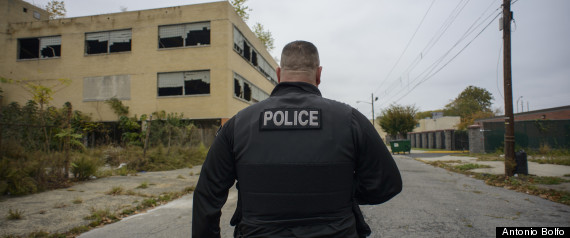
CAMDEN, NJ-OCT 25: A Camden police officer inspects an abandoned building looking for squatters, prostiutes, and drug dealers October 25, 2012 in Camden, NJ.
CAMDEN, NJ: A Camden police officer inspects an abandoned building looking for squatters, prostiutes, and drug dealers.

‘A WAR ZONE’

At the heart of the battle over the policing plan are Camden’s 267 cops, who face the imminent loss of their jobs, even as they contend with a city that seems to some to be spinning out of control.

Times were not always so tough in Camden, which sits on the banks of the Delaware River, across the water from Philadelphia. As recently as the 1960s, the city was an industrial powerhouse, with dozens of major factories employing thousands of residents. With a population nearly 70 percent higher than today, crime was just a fraction of its current rate.

But in 1971, long-simmering racial strife exploded into riots, accelerating the flow of middle-class whites to the suburbs. Factories closed down, taking with them about 60,000 manufacturing jobs, part of a wave of de-industrialization that hollowed out the economic heart of cities across the county. As the economy tanked, crime soared.

It has remained that way for decades, making Camden among the toughest beats in all of local law enforcement, often topping the FBI’s annual list of most dangerous cities.

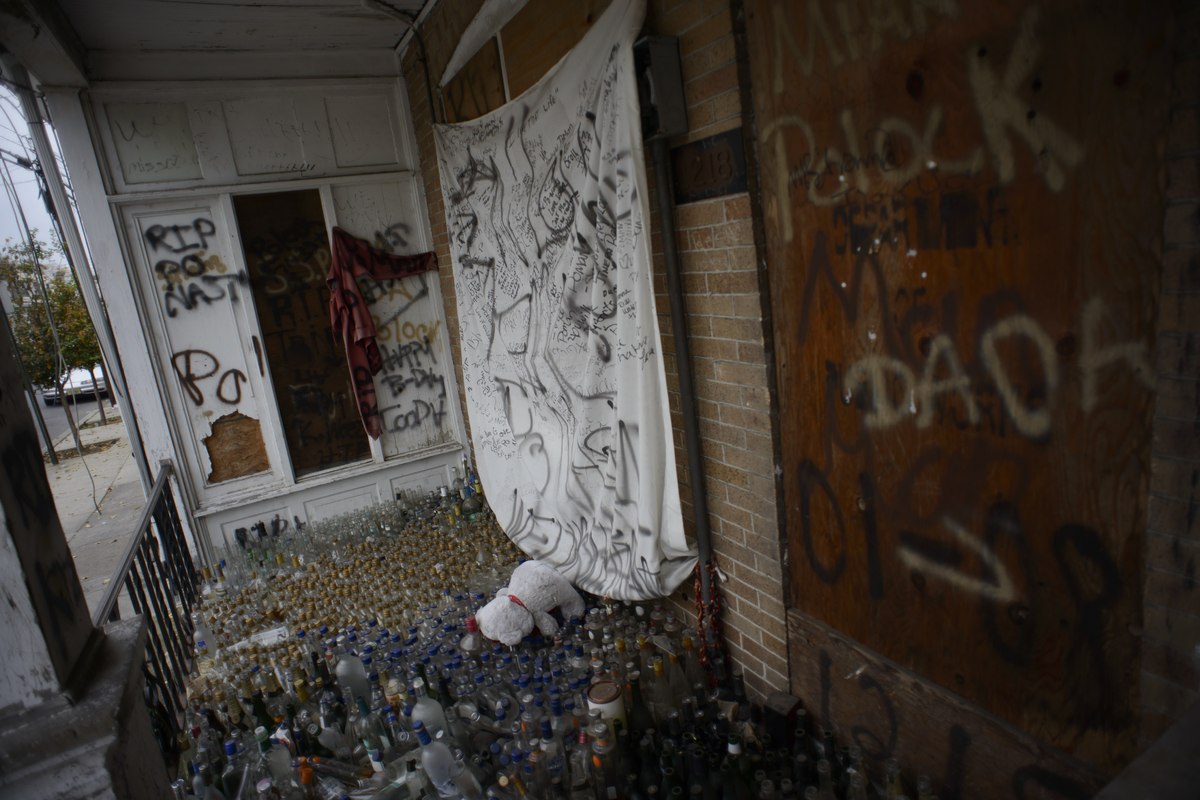
Today, thousands of abandoned homes blight the streets, their porches often doubling as tombstones, with spray-painted tributes to murder victims. Across broad quarters of the city, drug dealers and prostitutes roost on stoops and street corners, scattering only for a moment at the approach of a police cruiser.

The intensity of police work in Camden can reach almost unimaginable levels. Just this September, officers handled two grisly crimes involving children that made national news. In one, a mother high on PCP decapitated her 2-year-old son, then called police to report the crime. Weeks later, a young man, also high on PCP, broke into a Camden home and stabbed a 6-year-old boy to death and savagely assaulted his 12-year-old sister. Uniformed police apprehended the killer after an intensive manhunt.

Several current Camden officers spoke about their situation with HuffPost on condition of anonymity due to fears of retaliation by their superiors. They describe a department crumbling from within, whose demoralized officers feel abandoned by the city they pledged to protect. Bitterness runs deep over what they feel is a long-running campaign by city and county officials to paint Camden’s cops as ineffective, unreliable and over-compensated.

“Camden is not a joke. Some parts of this place are a war zone,” says one officer. “My friend opened up a freezer and saw a kid’s head looking back at him. He’s got to live with that the rest of his life.”

“We risk our lives every day. And this is what you get in return,” he says. “See you later and don’t let the door hit you on the way out.”

Another veteran officer warns that replacing seasoned Camden cops with large numbers of inexperienced, lower-paid recruits — as the metro plan envisions — is a recipe for disaster. He scoffs at a recent comment by Capelli, the Board of Freeholders director, announcing that the new agency had received more than 1,000 applications, including some from states as distant as Alabama.

“They’re going to be thrown to the wolves,” he says. “If some outsider from Alabama comes in and shoots a kid, it’s a potential for some civil unrest.”

In August, county leaders announced that Camden police Chief Scott Thomson would lead the metro agency once the existing force was disbanded. For months, Thomson has spoken out in favor of the new agency – while leveling harsh criticism at members of his current force, saying it is plagued by absenteeism.

Many within the department see his role in pushing the plan as a betrayal, officers say. But they add that the sense of betrayal and abandonment extends far past Thomson, from city hall to the governor’s mansion.

“It’s a feeling of being unappreciated by your boss, by your mayor, by your government,” says a long-serving officer.

slide_264202_1775437_free

Gang memorials to murder victims are a common sight on the porches of Camden’s thousands of abandoned and derelict homes.
‘PEOPLE ARE AFRAID’

In an interview with HuffPost, Thomson, the Camden police chief, did not dispute that officer morale is abysmal. He says spirits are understandably low given the challenges facing officers, from soaring crime on the streets to the looming closure of the department.

“It is tough. And nobody has it tougher than these guys on the front lines,” he says.

But he also says the department faces a crisis of absenteeism, a claim the police union calls exaggerated. According to Thomson, the department’s daily call-out rate is 30 percent — far above the average in other cities.

“There are some days when half the platoon calls in sick,” Thomson says.

Redd, the Camden mayor, regularly cites the absentee rate as a crucial reason for creating the county metro force.

“Given the recent spike in homicides and an absentee rate of nearly 30 percent within the Camden Police Department, I recently announced that the city is aggressively moving towards joining the Camden Metro Division,” Redd said in a statement in August.

Thomson, however, says the absentee problem is primarily due to abuse of a state family medical leave program overseen by the city, not any provision in the police union’s contract. He calls it peripheral to Camden’s overall public safety crisis. “You fix the 30 percent issue, that doesn’t change our situation,” he says. “We’re still at 1962 staffing levels.”

He says he has no comment on the $14 million to $16 million in fringe spending that county officials say they will eliminate by liquidating the current police force.

“I’m not intimately involved in the finance end of this. My primary focus is keeping the public safe,” he says. “I’m not bean counting in the back room.”

Thomson adds that he cannot agree with Christie’s assessment that Camden’s current police contract is “obscene” — or even say whether it is more or less generous than the average police contract in New Jersey.

“I don’t know. I don’t have a baseline of comparison,” he says. “Without knowing what the other contracts are, that’s a difficult comparison.”

Nevertheless, Thomson calls the current police contract unsustainable, given Camden’s dire economic situation. Switching to the metro agency will not solve all of Camden’s problems, but will boost the number of cops on the street and help bring crime to a more manageable level, he says.

“I don’t think there’s any other option,” he says. “The status quo cannot remain.”

Out on the streets, Camden residents call the city’s crime rate intolerable, and condemn the economic calculus by the city and state that forced deep cuts to policing even in the face of soaring violence. A few welcome the creation of the metro police force and the promised surge of cops on the beat. For many others, the move represents a worrying leap into the unknown.

“They’re experimenting with the lives of the people,” says Rev. David King, a local activist and a pastor at Community Baptist Church. “They’re using the city as a guinea pig.”

“People are afraid,” he says. “They don’t know what’s going to happen.”

Mass police, firefighter layoffs begin in Camden

The Associated Press
By The Associated Press
on January 18, 2011 at 12:35 PM, updated January 18, 2011 at 6:06

CAMDEN — Firefighters began turning in their helmets and police officers their badges today as part of deep municipal layoffs destined to further erode the quality of life in Camden, already one of the nation’s most impoverished and crime-ridden cities.

As many as 383 workers, representing one-fourth of the local government work force, are expected to lose their jobs, including about half the police force and one-third of the city’s firefighters.

Laid-off firefighters walked eight blocks together from the police union hall to Fire Department headquarters, snaking past City Hall, then lined up their helmets in front of the building, picked them back up and started to turn them in along with their other gear.

“It’s one of the worst days in the history of Camden,” said Ken Chambers, the president of the firefighters union.

Eighty-three laid-off police officers put their work boots along the sidewalk near police headquarters to symbolize the lost jobs.

Mayor Dana Redd planned a noon news conference to talk about the layoffs in a city facing a huge budget deficit and declining state aid.

Chambers said residents should not expect to be safe as the number of fire companies is reduced. He said the union will continue to meet with city officials to try to reach a deal where some firefighters could be brought back.

Police officers had begun turning in their badges Monday as it became clear that no last-minute deal was going to save many jobs.

Located directly across the Delaware River from Philadelphia, Camden is rampant with open drug-dealing, prostitution and related crimes. More than half of Camden’s 80,000 residents, mostly black and Hispanic, live in poverty.

A local pastor says “the fear quotient has been raised,” and a police union took out a full-page newspaper advertisement last week warning that Camden would become a “living hell” if layoffs were not averted.

Mayor of Camden announces police and fire department layoffsCamden Mayor Dana Redd and Police Chief John Scott Thomson address the media regarding layoffs. 168 police and 67 firefighters were let go to help close a $26.5 million budget gap. The mayor blamed the unions for not being willing to make job saving concessions. (Video by Andre Malok/The Star-Ledger)

The city was the nation’s second-most dangerous based on 2009 data, according to CQ Press, which compiles such rankings. Camden ranked first the previous two years. In 2009, the city had 2,380 violent crimes per 100,000 residents — more than five times the national average, the FBI said.

The anti-crime volunteer group Guardian Angels also says it will patrol Camden, as it has Newark, where there were major police layoffs in November.

The Fire Department has already been relying on help from volunteer departments in neighboring towns. Interim Fire Chief David Yates, who retired Jan. 1, has warned that that layoffs will increase response times.

PREVIOUS COVERAGE:
Guardian Angels to send members to Camden in light of police layoffs

Large cuts in staff for Camden, Newark police could threaten anti-crime progress

Camden considers the effects of pending police layoffs

N.J. approves plan to lay off more than 300 Camden public workers

Camden City Council Approves Massive Police And Fire Layoffs

download

CAMDEN, NJ (CBS) — Camden City Council, as expected, voted Thursday to lay off almost 400 workers, half of them police officers and firefighters, to bridge a $26.5 million deficit.

That’s about a quarter of the city’s entire work force.

Five members of City Council voted unanimously to approve the layoff plan — two other members were absent. The cuts take effect in mid-January.

walco Camden City Council Approves Massive Police And Fire LayoffsExactly how many city workers will be affected is still an open question, although nearly half the city’s police and a third of the firefighters are slated to go.

Karl Walco (right) is with the union that represents non-uniformed Camden city workers.

“If we agreed to everything that the city proposed in concessions, it would only have a minor impact on the number of layoffs,” Walco told the council members.

No argument from Council. They sat impassively as workers and residents alike voiced their frustration.

When it was over, Council president Frank Moran suggested they’re not to blame.

“We didn’t put a price tag on public safety. Unfortunately, the governor of the State of New Jersey put that price tag on it,” he said at the packed Council meeting.

That price tag is $69 million, in transitional aid. Moran suggested that Camden residents should vent to Governor Chris Christie.

After the vote, council members and Camden Mayor Dana Redd avoided reporters by going into their offices.

Reported by David Madden, KYW Newsradio 1060.

In Sheridan case, new reasons for doubt amid stunning incompetence | Moran

download

Tom Moran | Star-Ledger Editorial BoardBy Tom Moran | Star-Ledger Editorial Board
Email the author | Follow on Twitter
on April 12, 2015 at 8:00 AM, updated April 14, 2015 at 2:25 PM

House Fire 2 Killed
FILE- In this Sept. 29, 2014 file photo, a Montgomery Township police officer sits in front of the partially burned home of John and Joyce Sheridan in Montgomery Township, N.J. The Somerset County prosecutor’s office found that John Sheridan killed his wife and himself, a conclusion the family has challenged. (Mel Evans)

A dead man accused of murder never gets his day in court. Guilty or not, he is damned for all eternity, unable to answer the charges.

John Sheridan, a confidante of New Jersey governors and other elites over two generations, is one such man.

Sixth months ago, prosecutors say, he snapped just before dawn one morning and stabbed his wife Joyce repeatedly with a carving knife. He then stabbed himself as he poured gasoline around their bedroom in a wealthy suburb of Somerset County, and threw a match on it.

But we should ask ourselves: Did he really do it?

Not because Sheridan was a powerful man. And not because his four sons, one of whom is the top attorney for the state’s Republican Party, can’t accept this verdict.

We should question this conclusion because it is built on flimsy evidence that any respectable defense attorney could swat down in an afternoon. This was amateur hour in a prosecutor’s office that rarely handles murder investigations, and clearly botched this one.

If John Sheridan had lived, it’s impossible to imagine a jury convicting him knowing what we now know.

Put it another way: If John Sheridan had lived, it’s impossible to imagine a jury — any jury — convicting him, knowing what we now know.

Newly released documents and a lengthy and exclusive interview with Somerset County Prosecutor Geoffrey Soriano point to several key weaknesses in the case.

Prosecutors still can’t find the weapon they say Sheridan used to kill himself. They have no credible motive, and Soriano admits it.

The DNA evidence prosecutors used to link Sheridan to his wife’s murder weapon evaporates under closer examination: In fact, the marker they found is present in one of every two white men, according to a State Police report given to the Star-Ledger by the Sheridan family that had not been released to the public.

It gets worse.

No one dusted for fingerprints outside the master bedroom to see if an intruder entered the house through one of four unlocked doors.

The key wound to Sheridan’s neck, which nicked his jugular and is listed as a cause of death, was not made by the carving knife that killed his wife. Two autopsies concluded that only a narrow-gauge weapon could leave the mark.

But prosecutors didn’t realize that until a renowned pathologist hired by the Sheridan family produced the second autopsy. A full week after the killings, after the crime scene had been closed, investigators returned to the house to search for such a weapon, according to both Soriano and the Sheridans.

Asked how his crew could have missed such basic evidence, Soriano said that investigators had assumed the carving knife had killed both husband and wife.

They realized the mistake only after the autopsy that was paid for by the Sheridans. “That was the first time we were told that the knives we had could not have caused the wound,” Soriano says.

What they found was a blob of melted metal, which their report suggests was the narrow-gauged weapon. It turned out to be a mixture of zinc and aluminum, according to State Police. Even the prosecutor, Soriano, concedes that he has no clue if it really was once a weapon.

“Knives are not made of zinc and aluminum,” he says. “Letter openers could be.”

When pressed, he wouldn’t stand by that theory, either. Most letter openers have dull edges, and Sheridan’s wounds included slices as well as punctures.

The metal might have been a harmless piece of hardware from the armoire that fell on Sheridan during the fire, Soriano concedes.

“I don’t know what it is,” he said, finally. “It could have been anything.”

Two months after the killings, an insurance adjuster came to inspect the home and found a bag full of jewelry in a closet off the master bedroom. Investigators had somehow missed it.

So what if that bag contained a weapon, or drugs, or some other clue? Isn’t this more evidence of flat-out incompetence?

“I’m not going there,” Soriano says.

Imagine being a defense attorney in this case. No weapon in John Sheridan’s death. No motive, no history of violence in a 47-year marriage, no evidence of debt or drug use or scandal of any sort.

Bogus DNA evidence. No fingerprints check on possible intruders. And evidence of incompetence.

Michael Critchley, one of the state’s top defense attorneys, said Sheridan would never be convicted on such weak evidence.

“If he had lived, he never would have been indicted,” Critchley says. “They don’t have many homicides in Somerset County. This is not a skill set they have had an opportunity to develop.”

Possibly correct

Is it possible this was a murder-suicide? Even Mark Sheridan, while he doesn’t believe it, concedes the answer is yes.

There is no evidence of an intruder in the home that morning. Cash and jewelry were left behind in plain sight. And several people close to Sheridan say he was acting unusual in the days before the deaths, upset by a pending report that was critical of the cardiac unit at Cooper Health System in Camden, where Sheridan served as CEO.

George Norcross, the chairman of Cooper’s board, says the report was a routine problem, not a crisis. Sheridan was upset, he said, but not to the point of a mental breakdown.

“I received an email from John the night before,” Norcross says. “It was business-like, a reasoned response to something I had written to him, and it’s hard to conceive that someone would have gone from that to an enraged person who committed murder. I always was, and continue to be, skeptical. I’m not sure this will ever be solved.”

Even Soriano doesn’t go so far as to say the pending report caused Sheridan to crack. The prosecutor’s seven-page summary of the case implies that, but when pressed, Soriano again backpedaled.

“What we tried to do is gather all the relevant evidence,” he says. “I don’t know what else was going on in his life.”

In the face of this uncertainty, and the big gaps in the evidence, the obvious answer would have been for Soriano to admit that the facts lead to no definite conclusion.

The possibilities are infinite. A murder-suicide. A burglary gone bad. A drug dealer who came for Matt, a son who lived at the home and was arrested for cocaine possession shortly after the killings. A work crew that did work on the home recently, and might have seen the ample stock of painkillers Joyce Sheridan had after a recent surgery.

But prosecutors don’t like to leave a murder unresolved. This was by far the most high-profile case to come Soriano’s way during his nearly five years as prosecutor. Before he was appointed to this job, he had served only as a municipal prosecutor handling minor cases.

And in the interview, he says that it was a priority for him to reassure the public.
Within a week of the killings, he announced there was no danger to the general public, suggesting he had already concluded this was a murder-suicide.

“Early on, no doubt about it, we concluded it was murder-suicide,” Soriano says. “There are some who say, ‘You made your mind up and shut down.’ It’s the opposite. I challenged our detectives and assistant prosecutors to go out and find the person who did this. And we tried.”

At times, Soriano sounded like a nervous rookie who didn’t want to stand behind his own conclusion. That would explain why he didn’t release even basic information in this case, probably in defiance of open records laws. Secrecy like that is a refuge for the incompetent.

In the interview, Soriano emphasized that it was the medical examiner who ruled that it was a murder-suicide, not him. “The truth is we supply him with information,” he said.

So I asked if he is personally convinced it was a murder-suicide. After several seconds of silence I found shocking, he finally squeaked out a low-volume answer: “I am.”

The medical examiner in this case, Dr. Eddy Jean Lilavois, inspires no confidence either.

He resigned from the medical examiner’s office in New York City in 1995 after a similar complaint, when he concluded the death of a 3-year-old was a homicide due to blunt-force trauma, leading police to suspect the father. Weeks later he changed the cause of death to a brain aneurism without notifying the family, police or prosecutors, the New York Times reported in 1997.

Lilavois didn’t return phone calls to discuss the Sheridan case or his history.

A family’s wounds

The final chapter in this story is not yet written. The Sheridans intend to challenge this conclusion in court, so we will all hear much more about the evidence in this case before it is finally closed.

For the time being, this family is stuck in a deep circle of hell, grieving its loss without being able to put it away and accept it. Peter Sheridan, a federal district court judge in Newark, is John’s brother.

‘It’s just really hard. You wake up in the morning and you’re thinking about John and Joyce and how unbelievable this story is,” he says. “And then you try to move through the day and you can only go a couple of hours, and John and Joyce come into your mind, and you lose track of what you’re focused on. It’s just really hard, and the boys are going through the same issue.”

Mark, 41, is the point man for the four sons in this fight. A partner at Squire Patton Boggs, he is a high-priced lawyer who handles the key fights for the Republican Party on issues like legislative redistricting.

“I’m the one with the financial wherewithal to have this fight, and I’ve dealt with prosecutors before,” he says.

His goal in the lawsuit is to change the official conclusion in his father’s death certificate so that the manner of death is “undetermined” rather than murder-suicide. The family is well off, and his father’s life insurance payments do not hinge on the cause of death, Mark says.

“This has been excruciating,” he says. “You don’t get more than a few hours away from it even when you think you’re going to have a normal day. Not just to lose both of our parents in such a horrible way, but to have to fight the people who are supposed to be investigating the deaths.”

When the target of an investigation is dead, and cannot answer, the prosecutor in effect becomes the judge and jury as well. Soriano seems to have missed that. The seven-page summary he released on March 27 is full of unsupported innuendo about motive and DNA evidence, as if he’s trying to score points with spin.

At one meeting with the family, Soriano conceded he didn’t really know what happened in that bedroom, according to Soriano and two members of the Sheridan family who were present.

“I meant that in the literal sense,” Soriano said in a subsequent interview. “I wasn’t there. … The only two people we believe right now who know what occurred were deceased.”

Amen to that. It’s a shame that Soriano could not have left it there. His goal from the start was to close the case. He seems to have forgotten that his job is to find the truth.

Tom Moran may be reached at tmoran@starledger.com or call (973) 836-4909. Follow him on Twitter @tomamoran. Find The Star-Ledger on Facebook.

Charter School Networks and Shady Political Dealings: The Camden, N. J. Story

download (1)

Guest post by Julia Sass Rubin.

[Editor’s note: A clarification has been added at the end of this post.]

Last week, while many of us were busy making plans for the summer, something much more sinister was happening in the halls of the State Capital in Trenton, N. J..

At 11 p.m., on Tuesday, June 24th, legislation was discussed and voted on by the New Jersey Senate and Assembly Budget Committees, without all the legislators understanding what they were approving.  “We didn’t have the bills in advance,” complained one of the Senators, “I didn’t know what the hell the bills were.” This legislation was then quickly pushed through the full New Jersey Senate and Assembly.

The legislation revised a 2012 law known as Urban Hope in order to enable two charter chains – Mastery and Uncommon Schools – to claim a large share of Camden’s public education dollars.  The charters’ efforts had been imperiled by the grassroots group Save Our Schools NJ, which had sent a series of letters in May to New Jersey Education Commissioner David Hespe.  The letters detailed how the two charter chains and the Camden state-appointed Superintendent Paymon Rouhanifard were violating various aspects of the Urban Hope law in their efforts to open new renaissance charter schools in Camden next fall.  The violations included using temporary facilities instead of building new schools; failing to provide key information required by the application; and not giving Camden residents the opportunity to review and comment on their applications.

Rather than stopping their illegal activities in response to the letters, the Mastery and Uncommon charter chains and the Camden Superintendent turned to their friends in the legislature to “fix” the problem by amending the Urban Hope legislation so that what had been illegal could now be legal. [Editor’s Note: See clarification at the end of this post.]

Mastery and Uncommon also retroactively provided some of the information that had been missing from their renaissance charter applications, although they still did not make this information available to Camden residents, as required by the Urban Hope law.  Instead, the information could only be obtained through an Open Public Records (OPRA) request.

The public education advocacy group Education Law Center filed such a request and discovered that the Mastery charter network planned to create 6 renaissance charter schools in Camden, which could enroll up to 4,654 students. The Uncommon Schools charter network planned to create an additional four renaissance charter schools, which could enroll up to 2,260 students. A third renaissance charter, the KIPP Cooper Norcross Academy, had been previously approved to build 4 schools that could enroll up to 2,800 students.  This could bring the total enrollment in KIPP, Mastery and Uncommon renaissance charter schools to almost 10,000 students by 2019.  At that level, the three renaissance charter schools would represent a significant majority of the 14,000 students currently enrolled in Camden’s public and traditional charter schools.

As part of last week’s revisions to the Urban Hope Law, legislators also added an extra year to the program’s duration, so that a fourth renaissance charter chain – the maximum allowed by the program – could be rushed through the application process and opened by the fall of 2015.  In total, the four  renaissance charter school chains could result in the complete destruction of Camden’s public schools.

The negative fiscal impact of the renaissance charter program is already being felt on the Camden District’s public schools.  Hundreds of teachers and staff members were fired this spring because of projected budget shortfalls caused by payments the district has to make to renaissance and regular charter schools.  Over the next few years, Camden parents are likely to see many more public school teachers laid off and extensive school reorganizations and closings as the privately-managed renaissance charters open more and more schools, aggressively competing for the public school dollars.

Camden parents already lament the constant harassment by those charter chains, whose representatives approach them at every venue, come to their homes, and even try to recruit their children on school playgrounds. One Camden father recounted to me that he had repeatedly told the paid renaissance charter recruiters who came to his house that he did not want to send his child to their charter school, only to have them return the next morning and resume their recruitment efforts.

The charter chains also send marketing emails and letters to parents’ homes.  Sometimes, this has been done with the assistance and endorsement of the state-appointed Camden District Superintendent, who has mailed the charter chains’ recruitment materials to parents along with District correspondence.  But parents also report receiving personally-addressed mail sent directly by the charter chains.  A Camden mother told me that she called the Mastery charter chain’s offices in Philadelphia after receiving such a personally-addressed recruitment letter from them and spoke with a woman who asked for her name and the names of her children and then found their address on a list in front of her.  Based on such experiences, Camden parents are convinced that the Camden School District’s state-appointed superintendent is giving their children’s personal information to the charter chains in order to facilitate the chains’ enrollment growth.

Rouhanifard, the Camden superintendent, is undeniably allied with the charter chains.  He was instrumental in recruiting Mastery and Uncommon to apply for renaissance  charter status and he preliminarily approved those chains to open schools in Camden in September.

Camden parents understand that the superintendent works for the governor rather than for them.  They also know that they cannot expect their political representatives to protect their public schools.  The District has no elected Board of Education and even the appointed Board that served prior to the 2013 state takeover of the District has been replaced by individuals willing to rubber stamp the Christie Administration’s actions.  Camden’s political establishment, at both the local and state levels, is closely aligned with the South Jersey political machine of George Norcross, who was the primary force behind the creation of the Urban Hope program and whose name graces one of the renaissance charter schools.  And Norcross is a close ally of the Governor.

In contrast to the corporate education reformers’ mantra of greater parental choice, many Camden parents feel that they have no real choices.  Not only are they barraged by the aggressive and relentless recruitment efforts of the charter chains, they also are concerned about the impact on their children of having to be transferred multiple times as their local public schools are sequentially closed due to the expansion of renaissance charters.

Many parents – and Camden public school administrators – also believe that a complete charter takeover of the district is inevitable and beyond their control.  There is even a publicly-availableblueprint that details the Christie Administration’s intentions to convert Camden into a New Orleans style all-charter district that includes a few remaining public schools to educate the children too challenging for the charter chains to take on – children with significant special needs; children who are not English proficient; and children whose families are too economically or emotionally distressed to meet the charter networks’ parental-involvement requirements.  To minimize the uncertainty that they see ahead for the district and for their families, some parents have decided to move their children to a charter school now to avoid subjecting them to multiple possible future transfers.

But there are Camden parents who are mobilizing against the destruction of their public schools.  They reject the Christie Administration’s mantra that their public schools are all failures because their personal experiences show that to be a lie.  And they do not want to give up on public schools that accept every child rather than weeding out those who do not score well on standardized tests or who are more challenging to educate.

These parents express shock at the Mastery charter chain’s reported practice of having children carry a “demerit card” on a lanyard around their necks, with demerits issued for such minoroffenses as students having their shirts untucked or chewing gum, and with eight demerits leading to a detention.

They do not want their children to attend a charter school that touts its 100 percent  graduation rate while only half of the children who start in 5th grade manage to make it to 12th grade (and only 40 percent of the students who are Black and male), as is the case for the UncommonSchools charter chain.

Parents also are increasingly aware of what has happened in Detroit and New Orleans and even parts of Washington D.C.:  Once the local public schools are gone, there is no way to get them back.  Consequently, the children who do not conform to the “no excuses” charter models end up with no place to turn.

Two and a half years ago, when the Urban Hope legislation that created the renaissance charter program was first introduced and rushed through the New Jersey Legislature, in the waning hours of a legislative session, it was not sold as a way of privatizing Camden’s public schools.  Instead, Senator Donald Norcross, the bill’s primary Senate sponsor and George Norcross’s brother, argued that the legislation was urgently needed because Governor Christie had frozen the work of the State’s Schools Development Authority, which had been  tasked with building and renovating schools in 31 of New Jersey’s highest-poverty school districts.  That is the reason that the legislation authorized renaissance charter schools to be funded at 95 percent of their home school district’s average per pupil expenditure levels vs. 90 percent   for regular charters – to give the renaissance charters the financial resources to build those critically needed new schools.

However, revisions to the law that were snuck through the New Jersey legislature last week gave the renaissance charters the option of renovating existing facilities rather than having to build new schools, upending the entire premise for the renaissance charter program. Now, the renaissance charters will receive more of the taxpayers’ dollars for doing exactly what most existing charter schools already do – renovating an existing facility.

For all the efforts by the Mastery and Uncommon charter chains to characterize their work as being driven by what is best for the children, the Camden story suggests that their true motivation is a relentless push for greater market share and a willingness to abuse power, and even to break the law, in order to accomplish that objective.

Clarification: This post characterizes some of the Renaissance schools’ activities  as “illegal” with respect to the original 2012 Urban Hope law. However, neither the charter-management organizations in question nor the Camden school district has in any way been found to be out of compliance with the law or its supporting regulations. The groups’ applications were approved by the state on Monday, July 7.  

Julia Sass Rubin is an associate professor at the Edward J. Bloustein School of Planning and Public Policy at Rutgers University and a visiting associate professor of public affairs at the Woodrow Wilson School of Public and International Affairs at Princeton University. She is researching the community response to public education privatization efforts in Camden and Newark. Dr. Rubin also is one of the founding members of the grassroots, pro-public education group Save Our Schools NJ.

Christie signs bill giving EMS contract to hospital chaired by power broker Norcross

download

Susan K. Livio | NJ Advance Media for NJ.com
By Susan K. Livio | NJ Advance Media for NJ.com
on July 06, 2015 at 7:29 PM, updated July 07, 2015 at 10:33 AM


TRENTON — Gov. Chris Christie on Monday signed a bill that wrests control of emergency ambulance services in Camden from one south Jersey hospital chain and gives it its competitor, Cooper Health, overseen by south Jersey power broker George Norcross.

Virtua Health, with hospitals in Voorhees, Marlton and Berlin in suburban Camden County, has provided advanced life support and paramedic services in the city of Camden since 1977. Cooper University Hospital, the level one trauma center located in Camden and serving south Jersey, trains Virtua’s paramedics.

But under legislation that raced through the Assembly and Senate last month in the final days before the summer break, Cooper would take over emergency medical services for the city. State Assemblyman Gilbert “Whip” Wilson (D-Camden), one of the bill’s sponsors, argued Cooper was best suited to provide these services because their paramedics intend to provide follow-up care after patients — many of whom live in Camden — are discharged.

The budget Christie signed last month for the fiscal year that began July 1 also dedicates $2.5 million to Cooper to buy new ambulances and other equipment.

Norcross is the chairman of the board at Cooper, and is the widely considered the most influential Democrat in the state, with ties to Gov. Chris Christie, a Republican. There was no statement from Christie along with the announcement that he’d signed the bill on Monday.

The legislation sparked a public feud between the two hospital systems. Virtua argued the bill was a blatant power grab because it circumvents the state Health Department’s authority to decide who should provide EMS services. Virtua executives also argued they do a commendable job providing the service without needing to take money from the state budget.

Cooper supporters argued that when Virtua closed down its acute-care hospital in the city 15 years ago, it had abandoned the Camden, despite providing outpatient services there. Paramedic response time data released by Camden County the night before the legislature approved the bill on June 22 called into question Virtua’s service record.

According to the bill, (S2980), “A hospital which is designated a Level 1 trauma center shall be exclusively authorized to develop and maintain advanced life support services in the municipality in which the trauma center is located, and shall have the right of first refusal to provide both advanced life support and basic life support in the municipality.” Cooper is not named in the bill, but it is the only level one trauma center in the state does not provide EMS services to its host city’s hospital.

Cooper officials intend to bid on the basic life support ambulance service contract provided by University Hospital, based in Newark with a substation in Camden.

“The governor’s action today, in addition to the overwhelming, bipartisan support of the legislature, will allow advanced life support services in Camden to finally be fully integrated within the region’s only level 1 Trauma Center,” according to a statement released by Cooper spokeswoman Wendy Marano. “Camden residents will now receive the same level of care as others in the state.”

Richard P. Miller, Virtua President & CEO, said he was “extremely disappointed” the governor signed the bill, and hinted he may sue.

“The best practice model for EMS across the nation supports regionalization of EMS services, not creating a new program for one municipality,” Miller said in a statement released late Monday night.

“When every minute counts, Virtua paramedics are the best in the state, having served all municipalities in Camden and Burlington counties with distinction for more than 38 years,” Miller said. “For the City of Camden, Virtua exceeds the State Department of Health’s guidelines for response time, delivering even faster response times than guidelines established by the Department’s Emergency Medical Services Blue Ribbon Panel.”

“We will explore all options, including the possibility of litigation, and will provide additional information as appropriate,” according to Miller’s statement.

Susan K. Livio may be reached at slivio@njadvancemedia.com. Follow her on Twitter @SusanKLivio. Find NJ.com Politics on Facebook.

Christie’s chief of staff headed to Cooper Hospital Job

Gov. Christie’s chief of staff, Kevin O’Dowd, will step down this month to work for Cooper University Hospital in Camden, nearly a year after the governor named O’Dowd his pick for attorney general.

O’Dowd, whose selection as attorney general never moved forward after controversy arose over lane closures on the George Washington Bridge, will serve as senior executive vice president and chief administrative officer at Cooper, where he will focus on business development, Christie officials said. He will start at Cooper in January.

In a telephone interview, Christie said O’Dowd told him two or three weeks ago he had received the job offer from Cooper and was thinking about it.

“Kevin and I both decided this was the next best step for his future,” Christie said. “He served me extraordinarily well for 11 years. I don’t think I can ask a whole lot more out of somebody.”

O’Dowd, a former federal prosecutor, also worked for Christie while the future governor was U.S. attorney for New Jersey.

“It was an honor and a privilege to serve the people of the State of New Jersey for the last five years,” O’Dowd said in a statement. “While I will miss interacting with my colleagues in the executive and legislative branches, I am very much looking forward to joining the Cooper team and beginning the next phase of my career.”

O’Dowd’s wife, Mary, serves as commissioner of the state Department of Health.

Christie said the prospect that his chief of staff would face questions about the bridge scandal during a confirmation process before a Democratic-controlled Senate “didn’t play a role in this at all.” He noted that O’Dowd had already faced hours of questions about the matter from a legislative committee.

Christie, a Republican, has sought to move past the bridge scandal as he considers running for president in 2016.

O’Dowd testified before the committee in June that he had played no role in the September 2013 lane closures, which jammed traffic in Fort Lee. Lawmakers questioned why O’Dowd hadn’t asked more questions about the controversy, which erupted in January after documents revealed that a now-fired Christie aide, Bridget Kelly, had sent an e-mail calling for “traffic problems in Fort Lee.”

O’Dowd, who supervised Kelly, was never directly implicated in the controversy.

State Senate President Stephen Sweeney (D., Gloucester) said he approached O’Dowd around the time of his testimony to ask whether he wanted to be attorney general.

“I said, ‘Kevin, what are you going to do?’ ” Sweeney said. “He said, ‘Steve, I just want to move on.’ ”

Sweeney added, “If Kevin wanted to be attorney general, he would be the attorney general right now. He had the votes to get passed. I was extremely supportive and would have testified in favor of him.”

A confirmation hearing “wouldn’t have been horribly contentious,” Sweeney said, noting that O’Dowd was well-respected in the Legislature and had already testified before the investigative committee.

Sweeney described O’Dowd’s departure as an end of an era and added, “I trust him with my life.”

Assembly Speaker Vincent Prieto (D., Hudson) praised O’Dowd as “a person of compromise” who would be “sorely missed.”

Over the summer, Christie publicly supported O’Dowd for attorney general but said O’Dowd needed to determine what he wanted to do.

At Cooper, O’Dowd’s focus will include the MD Anderson Cooper cancer partnership and the AmeriHealth New Jersey relationship, Christie officials said. He will also oversee marketing, human resources, compliance oversight, and corporate real estate development.

Adrienne Kirby, Cooper’s chief executive officer and president, praised O’Dowd’s “proven track record of strong management, development and implementation of strategic plans, as well as improving organization performance and productivity.”

O’Dowd’s arrival will be the latest management shake-up at Cooper.

Kirby took over as CEO after her predecessor, John Sheridan, and his wife, Joyce, died Sept. 28 in a mysterious house fire. The case remains under investigation.

Cooper spokeswoman Lori Shaffer said O’Dowd’s hiring was unrelated to Sheridan’s death.

Cooper does not disclose employee salaries, she said. O’Dowd made $141,000 as Christie’s chief of staff.

In the interview, Christie said he never spoke with George E. Norcross III, chairman of Cooper’s board of trustees and South Jersey Democratic leader, about O’Dowd’s move.

“Obviously, Kevin has had a relationship with a number of folks in South Jersey,” including Norcross, Sweeney, and Assembly Majority Leader Lou Greenwald (D., Camden), Christie said.

Revenue at Cooper University Health Care will surpass $1 billion this year, and O’Dowd is the “perfect choice” to manage its growth, Norcross said in a statement.

Christie said he would consider making another nomination for attorney general, “now that Kevin has taken himself out of the running.” John Hoffman has served as acting attorney general since June 2013, when then-Attorney General Jeffrey S. Chiesa was appointed to the U.S. Senate.

Regina Egea, director of the authorities unit, will replace O’Dowd as chief of staff at the end of the month.

O’Dowd, 42, who lives in Princeton, has been Christie’s chief of staff since January 2012. He previously served as deputy chief counsel to Christie, starting in 2010.

O’Dowd worked in the U.S. Attorney’s Office for the District of New Jersey from 2003 to 2010, including as chief of the office’s Securities and Healthcare Fraud Unit. He also served as chair of the office’s Healthcare Fraud Task Force. He twice received the integrity award from the Inspector General of the U.S. Department of Health and Human Services.

He was educated at Catholic University of America and St. John’s University School of Law.


mhanna@phillynews.com609-989-8990

@maddiehanna

www.philly.com/christiechronicles

Camden superintendent announces 241 layoffs at city schools

 download

Jason Laday | South Jersey Times

By Jason Laday | South Jersey Times
Follow on Twitter
on May 12, 2014 at 8:18 PM, updated May 13, 2014 at 6:20 AM

Camden_school_layoffs_protest.jpg
Camden residents gather on May 12, 2014 ahead of a special meeting of the school board in which Superintendent Paymon Rouhanifard announced plans to lay off educators and other staff within the school district. (Staff Photo by Jason Laday.)

CAMDEN — City education officials on Monday announced 241 layoffs across the district’s 26 schools, including 206 teachers.

Camden Superintendent Paymon Rouhanifard approved the layoffs during a special meeting of the school board Monday evening, which was marked by continuous, angry outbursts and comments made by members of the public. They included members of the Camden Education Association (CEA), parents and other residents.

The crowd reserved particular vitriol for the state-appointed superintendent, with shouts of “Go back to New York” and “You sold us out to the governor” heard throughout the beginning of the meetings.

“You work for us, not the other way around – we tell you what to do,” shouted Eulisis Delgado from his seat in the auditorium at H.B. Wilson Family School. Later, he produced a bullhorn and addressed that board and superintendent.

“You sold us out to the governor, that 800-pound gorilla,” he said.

Following an hour-long executive session of the school board, Rouhanifard attempted to address the crowd in advance of a presentation detailing the layoff plan.

However, regular outbursts from many residents, as well as a brief chant of “Whose school? Our school,” caused the superintendent to abandon the attempt in favor of moving directly to the public comment part of the agenda.

“Tonight is hard,” said Rouhanifard, prompting the audience to respond in shouts and sighs of faux sympathy. “I have been responding to a number of teachers about this, and you can shout back at me – nothing is stopping you, and I won’t stop you – but I want to say we went about this process in a way that reflects the importance of this decision.

“I want to make it immensely clear that there are many people who will lose their job (in this plan) who care deeply about their students – this is not an indictment of them,” he added. “And while I know that this may seem to contradict with what we’re doing here today, we care deeply about these teachers.”

Teachers who spoke out Monday against the layoffs, criticized the district for issuing “pink slips” during the week of the NJASK standardized tests. They also questioned the criteria used by the district in selecting which teachers are to be laid off.

According to Rouhanifard, the layoff plan follows state law and seniority requirements in the collective bargaining agreement with the CEA.

Robert Farmer, a leader in the CEA, called the layoffs the “first step” in converting more students over to charter schools at the expense of public schools.

“We will sit down with the superintendent and board in order to lessen the impact on schools employees,” he said.

The 241 layoffs made official Monday evening follows the termination of 94 central administration employees late last month.

The Camden school district began the most recent budget process with a $75 million deficit, including a $42 million operating budget shortfall. According to Rouhanifard, non-personnel cuts and the use of surplus funds have helped fill all but $28 million of that gap. However, the superintendent that remaining gap will have to be reconciled with the elimination of 575 positions.

The budget he proposed in April included the elimination of 575 positions, many of them vacant. In all, 335 central office and school employees have been laid off.

In addition to teachers, the layoffs will hit guidance counselors, nurses and other staff.

However, there are 10 positions that managed to escape the school-based layoffs. According to Lowe, those positions did not suffer any personnel cuts.

They include the district’s athletic directors, attendance and dropout prevention officers, crisis counselors and social workers, custodians, JROTC and JAG team members, psychologists, school-based youth service team members, school safety officers, special education teachers and speech therapists.

The plan also calls for one or more art teacher, guidance counselor, librarian, music teacher and nurse per school.

“So, people are going to say we cut guidance counselors, and we did, but those services will still be provided at every school,” said Lowe. “We’re reducing the total number, but every school will have at least one – Woodrow Wilson will have six, and Camden High School will have five.”

The superintendent’s plan increases the number of community school coordinators and pre-K teachers.

Camden students walk out to protest layoffs

When cellphones flashed “noon” in Ziaira Williams’ history class, students shifted in their seats, exchanged glances, and then filed out into a hallway of purple and gold, launching a two-hour protest of Camden City School District layoffs.

Williams’ history teacher received a layoff notice Monday and said goodbye to his exiting pupils with silent pats on the back and nods of appreciation, Williams said.

“They’re glad we’re doing this. They said, ‘Go ahead,’ and honestly, I don’t care if I get in trouble – I want my teachers back,” the 17-year-old junior said.

Hundreds more would join the two-mile march from Camden High to the Board of Education building downtown Wednesday afternoon, including students from Creative Arts Morgan Village Academy, Brimm Medical Arts High School, and Woodrow Wilson High School, many carrying signs and chanting, “Save our teachers!”

The walkout came in response to the district’s announcement Monday that it would lay off 272 people, 206 of them teachers, to bridge a $75 million revenue gap. Samir Nichols, a senior at Creative Arts and the school’s valedictorian, said he organized the rally.

The protest grew so large that police blocked off Haddon Avenue and Cooper Street. It apparently prompted NJ Transit to suspend for about an hour service on the RiverLine between the Walter Rand Transportation Center and the waterfront.

Don’t suspend

Superintendent Paymon Rouhanifard said he would encourage principals not to suspend students for the day’s protest. “We respect their right to peacefully protest,” he said.

“Students have an important voice, and students care about their teachers – we care about their teachers. What we care about, also, is continuing the dialogue with students.”

On the route downtown, students sat on the roofs and hoods of cars rolling alongside the pack, which filled the two-lane roadways. Students in the marching band brought along their instruments to play Camden High’s fight song.

“We feel like our teachers are being disrespected,” said Dejon Sullivan, 18, student body president of Camden High and the student representative for the school board who attends monthly meetings.

“It’s disgusting to me. I believe the education is not the greatest here, but we’re trying to progress. Our teachers have a lot to do with that progress. Camden High is my home, no matter how many fights we have, no matter what. It’s my home, and these teachers treat me like I get treated at home.”

Former Camden school board member Sara Davis watched from her porch as the students marched by.

Davis disagreed with many of the changes state-appointed superintendent Rouhanifard was bringing to the district, including two “Renaissance” schools, which will open in the fall, pending state approval.

“I’m glad to see the kids are interested in what’s happening. Hopefully it will have an effect, but the bottom line is, more people should be speaking on their behalf,” she said.

She said the last time Camden students staged a walkout was in the late 1960s.

As the crowd walked passed Hatch Middle School, little heads peered out of windows, waving at the older students, below who beckoned them to join them outside.

Security guards smiled. “That’s right, keep our jobs,” one said.

The large revenue gap comes in a district that already has one of the highest per pupil expenditures in the state at $23,500. The student-to-teacher ratio is extremely low at 9-1. It will be 11-1 after the layoffs.

Officials cut $28 million in non-personnel costs, but also cut $29 million through the layoffs. Charter school transfer funds increased to $72 million for next year.

Most students said they were upset to find teachers suddenly without jobs. Because layoffs were based on seniority, evaluations, attendance, and other qualitative measures did not come into consideration.

Critics echoed

Some echoed school-choice critics, saying they didn’t want to see public schools get turned over to private operators. The leaders of both magnet high schools in Camden, Brimm, and Creative Arts, have said they are looking into charterizing, a process they would go through with the state, not the city.

Once outside the Board of Education building, students chanted from the steps as employees peeked out from office windows.

Parents and community members from Save Our Schools joined in the protest, at times appearing to run it. Ronsha Dickerson stood at the top of the steps and yelled out to students, “They’re laying off all your teachers, they’re closing your schools.” She called for teachers to strike and make a trip to Trenton to see the governor next week.

Up on the seventh floor of the administration building, Rouhanifard heard the chants and decided to face the large crowd.

“We’re not closing any schools, no schools are closing, we’ve been saying that for the past three months,” he yelled over the crowd. “We have a budget problem; we’re trying to manage it as best we can. We’ve cut other areas, too. This is a really hard time for everybody – for you, for your teachers.”

Meet representatives

Rouhanifard said he would meet with representatives from each school in the next two weeks. Some teachers could be reappointed in the fall, but fewer positions will be available than in previous years, he said. Before heading back into the building he told students:

“This dialogue is important and we’re going to continue to have the conversation, OK? That’s my commitment to you all.”


jterruso@phillynews.com856-779-3876 @juliaterruso

Camden’s ‘Renaissance Schools’ Takeover Plans May Face Legal Challenge

kipp school camden

Latin Kings graffiti adorns the wall of a building near the new KIPP Cooper Norcross Academy now under construction in Camden.

Plans for sweeping restructuring of state-run Camden school district, including turning over four schools to charter operators, faced its first open challenge yesterday when lawyers contended that the moves violated state law and regulations on several fronts.

The Education Law Center, the Newark-based advocacy group, released a statement that said the plans failed to meet both the letter and spirit of the Urban Hope Act, the 2012 law that cleared the way for the charter-operated “renaissance schools.”

It is these “renaissance school” projects that would expand under the reorganization plan announced by Superintendent Paymon Rouhanifard last month.

Four schools would be turned over to Mastery Charter Schools and Uncommon Schools, and a fifth school would be closed outright, with most of its students attending the new KIPP Cooper Norcross Academy now under construction.

The ELC contended that the Urban Hope Act was never intended to have existing schools handed over to the charter operators.

The group said the plans also violate the state’s own procedures, under which the targeted school are already operating under improvement plans that preclude such charter conversions.

“Once again, there has been really no public process here,” said David Sciarra, the ELC’s executive director. “The superintendent doesn’t put anything out, doesn’t even post the applications, and he provides no opportunity to have any public input in this.”

Sciarra wouldn’t yet commit to a formal legal challenge, noting that the plans still require final approval from the Christie administration.“I don’t want to get into that at this point,” he said last night.

Rouhanifard’s office rejected the claim that public input had not been sought or even that the changes could even be defined as conversions. It said that the schools are actually being closed and reopened under the new management, including “substantial reconstruction” of the buildings, as allowed under the law.

That might have been semantics but it was, perhaps, a critical legal distinction as Rouhanifard had initially characterized the moves as “transformations.”

District officials said that selling or leasing of the properties to the charter operators is also still being considered.

In addition, Rouhanifard said public hearings were held last year when the first charter projects were approved and again this winter as the new plan was being considered.

“The misrepresentations and factual errors of interest groups will not distract us from the urgent cause of improving our schools,” he said in a statement. “With two out of five students not graduating from high school, it’s critical that we stay focused on improving the education of our children. We have remarkable students, but for far too long the system has come up short in providing them with the educational opportunities they deserve.”

“Over the past 18 months, I have listened to the concerns of parents from every school in Camden, at dozens of community meetings, and most recently, at four town halls,” Rouhanifard added. “I heard loudly and clearly that where our schools are struggling the most, we need to take action. These new renaissance school partnerships represent a real opportunity for us to dramatically invest in our facilities and provide new, high quality educational options for our students and families.”

The challenges to the restructuring were hardly unexpected in light of such sweeping changes and considering that two lawsuits have already been filed since the first of the renaissance-school plans were unveiled.

The first case ended when the state Legislature amended the law to address the complaint. The second lawsuit, lodged by a group of parent advocates, is pending in appellate court.

Rouhanifard is moving ahead with plans for the next school year – including door-to-door canvassing — as the proposals go through the formal review process with state Department of Education.

In each case, the state needs to sign off on the specific applications for each school, and there is also a review process for when a school is closed.

But it would be surprising if the state rejected the plans, given that Rouhanifard is a state appointee whose every move has been backed by the Christie administration