

Artist: Aaron Douglas,
Aspects of the Negro Life Series ,
Medium: Mural at Schomburg Center for Research in Black Culture, NYC, NY (formerly New York Public Library’s 135th Street branch),
Date: c. 1934
Images
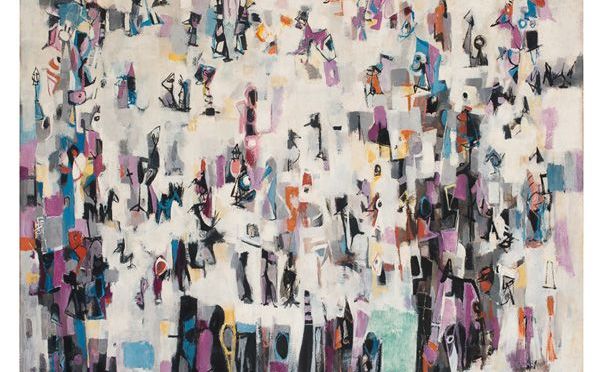
Carnival
Artist: Norman Lewis
Medium: oil on linen
Date: c.1957
“Carnival, has a visual rhythm that looks the way jazz sounds. Skids of blue and mauve jag out from under the white overpainting while shapes in black, orange, and yellow skirt and slide on a vertical axis.”
Charles Schwartz, artobserver.com
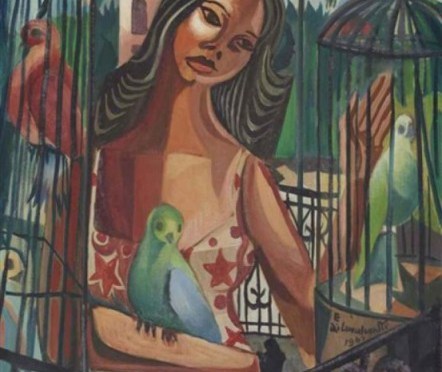
Mulata e Pássaro
Artist: Emiliano Di Cavalcanti
Medium: oil on canvas
Date: c. 1967

The Builders
Artist: Jacob Lawrence
Medium: tempera on board
Date: c. 1947
The Builders Series communicates Lawrence’s belief in the possibility of building a better world through skill, ingenuity, hard work, and collaboration. The Builders concept first appeared in Lawrence’s work in the mid-1940s, and by the late 1960s had became a major theme of his artwork. For the last three decades of his life, Lawrence consistently pursued the Builders motif, creating a sequence of vibrant modernist images that highlight his pervasive humanist vision.
His subjects were carpenters, cabinetmakers, bricklayers, and construction workers in a variety of workaday and family situations. Overall, they came to symbolize some of his larger ideas about American culture, hope, persistence, and the shared responsibility for transforming society, inspired, as he once said, by his “own observations of the human condition.”
Away from Harlem and the urban environment that he had grown up in, Lawrence increasingly pursued more symbolic and universal subjects that were less overtly grounded in contemporary social issues than much of his earlier art. At the same time, the new work was also the result of his continued growth as an artist. As he explained in 1974, it was a “broadening of imagery, an expansion of my humanist concept. … like most artists, I’m expanding, probing, constantly seeking new symbols—always within the humanist context.”
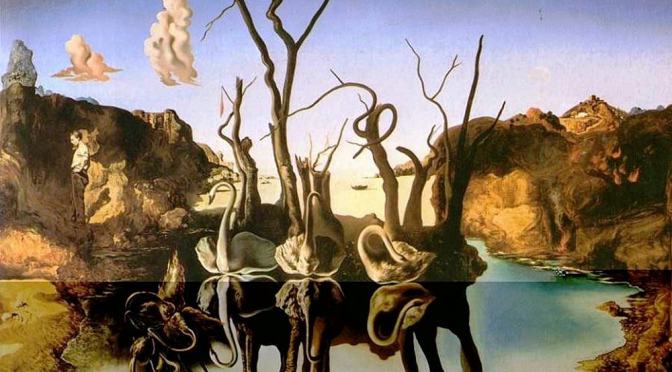
Swans Reflecting Elephants
Artist: Salvador Dalí
Medium: oil on canvas
Date: c. 1937

Aspects of Negro Life
Artist: Aaron Douglas
Medium: Mural at Schomburg Center for Research in Black Culture, NYC, NY (formerly New York Public Library’s 135th Street branch)
Date: c. 1934
In 1934, Aaron Douglas was commissioned, under the sponsorship of the Public Works of Art Project (PWAP), the first relief program for artists sponsored by President Franklin Roosevelt’s New Deal, to paint a series of murals for the135th Street branch of the New York Public Library.
One his best-known works, the Aspects of Negro Life series is characteristic of Douglas’s style, with graphically incisive motifs and the dynamic incorporation of such influences as African sculpture, jazz music, dance, and abstract geometric forms. The four panels chart the progression of African Americans through slavery, the Reconstruction period, the Northern Migration, and the Great Depression. Using a stylized vocabulary, Douglas conveyed political and social messages and included allusions to Marxist theory that he and others in Harlem studied in the mid‐1930s.
The series reveals the bold modernist risks Douglas was prepared to take at a time when regionalism was the norm. The layered, condensed space, geometric forms, and silhouettes draw on African, cubist, and constructivist motifs in an allegorical representation of issues central to African American history and contemporary life.

Femme Assise Dans Un Jardin
Artist: Pablo Picasso
Medium: oil on canvas
Date: c. 1938

Jacqueline aux Fleurs
Artist: Pablo Picasso
Medium: oil on canvas
Date: c. 1954
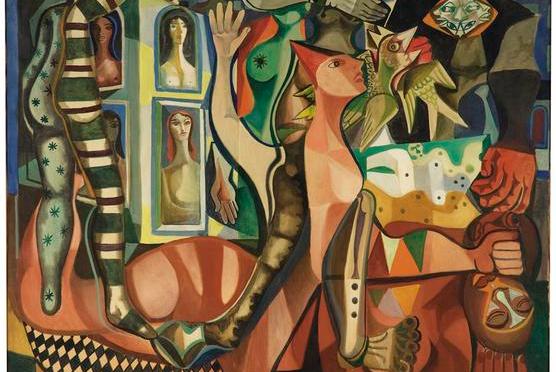
Sohos de Carnival
Artist: Emiliano Di Cavalcanti
Medium: oil on canvas
Date: c. 1955

Guernica
Artist: Pablo Picasso
Medium: oil on canvas
Date: c. 1937
One of Picasso’s best known works, Guernica is Picasso’s critique of the German bombing raid of a little Basque village in northern Spain. As Germany gears up for war, Adolph Hitler, with the approval of Generalissimo Francisco Franco, chooses the village of Guernica as a site for bombing practice. On April 27th, 1937, the unsuspecting hamlet is pounded with high-explosive and incendiary bombs for over three hours. Townspeople are cut down as they run from the crumbling buildings. Guernica burns for three days. Sixteen hundred civilians are killed or wounded.
By May 1st, news of the massacre at Guernica reaches Paris, where more than a million protesters flood the streets to voice their outrage in the largest May Day demonstration the city has ever seen. Eyewitness reports fill the front pages of Paris papers. Picasso is stunned by the stark black and white photographs. Appalled and enraged, Picasso rushes through the crowded streets to his studio, where he quickly sketches the first images for the mural he will call Guernica.
Prior to the bombing, Picasso had been commissioned to create the centerpiece for the Spanish art exhibition at the 1937 World’s Fair in Paris. Three months later, Guernica is delivered to the Spanish Pavilion at the Paris Exposition. Almost prophetically, the Spanish Pavilion stands in the shadow of Albert Speer’s monolith to Nazi Germany. The Spanish Pavilion’s main attraction, Picasso’s Guernica, is a sober indictment of the tragic events in Spain.
After the Fair, Guernica tours Europe and Northern America to raise consciousness about the threat of fascism. From the beginning of World War II until 1981, Guernica is housed in its temporary home at the Museum of Modern Art in New York, though it makes frequent trips abroad to such places as Munich, Cologne, Stockholm, and even Sao Palo in Brazil. The one place it does not go is Spain. Although Picasso had always intended for the mural to be owned by the Spanish people, he refuses to allow it to travel to Spain until the country enjoys “public liberties and democratic institutions.”
Described as modern art’s most powerful anti-war statement, Guernica is seen as an amalgamation of pastoral and epic styles. Guernica is a mural-size canvas (3.5 m (11 ft) tall x 7.8 m (25.6 ft) wide) painted in oil. The somber palate of blue, black and white intensify the drama, producing a stark, almost photographic record of the tragedy. The meaning of key figures – a woman with outstretched arms, a bull, an agonized horse – are left open to one’s interpretation. When asked for their symbolic meaning , Picasso replied “A painting is not thought out and settled in advance. While it is being done, it changes as one’s thoughts change. And when it’s finished, it goes on changing, according to the state of mind of whoever is looking at it.”
 Camden Civil Rights Project