
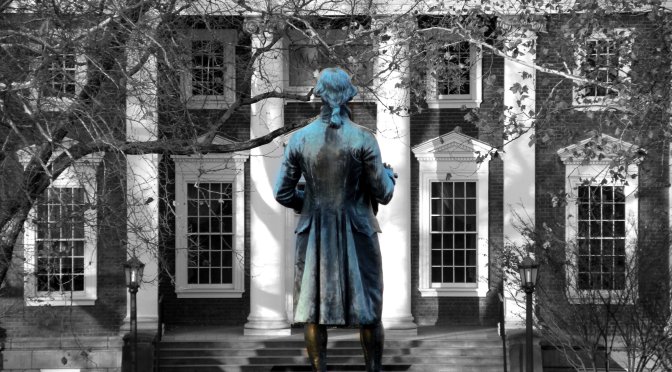
Thomas Jefferson’s last testament to his political, religious, and educational ideology is encapsulated by his self-ascribed epitaph: “Here lies Thomas Jefferson, Author of the Declaration of American Independence, of the Statute of Virginia for Religious Freedom, and father of the University of Virginia.” [1]. Fittingly, these three accomplishments are the culmination of Thomas Jefferson’s lifework, and reflect the progress he made in affecting American attitudes in each of these areas. Continue reading Thomas Jefferson: The Progressive Libertarian
Category Archives: Philosophy

The Gadfly Syndrome: The Tension Between the Good Individual and the Good Citizen
In the Apology, Socrates describes himself as a “gadfly” cast upon the city of Athens to awaken it from its slumber.[1] Herein lies the tension between the individual and the social aspect of the philosopher – the act of existing as both a good human being and a good citizen. For Socrates, the “unexamined life is not worth living,” [2] therefore it is the duty of every individual to engage in the search for the truths about society and one’s self. However, the individual’s duty to self-discovery is reliant upon his interaction with the city. Unfortunately, it is precisely this activity which makes the philosopher a nuisance to the public good. His inquiries subject the city to repeated offense, as the philosopher continuously questions the moral foundations upon which the city gains its legitimacy. The contradictions that are presented serve as a constant reminder of the city’s own self-deficiency. Thus, the gadfly eventually gets swatted.
This is the paradox presented by the lifestyle advocated by Socrates. The human being and the citizen have a mutual claim on the philosopher’s life. Like a bad marriage, they can’t seem to live with each other, nor can they seem to live without one other, but are simply forced to coexist in a conflicting state of mutual necessity. The two are perpetually at odds with one other due to their separate allegiances; the one to philosophy and the other to the city. This is the dilemma I hope to resolve. In doing so I will look to several texts to examine (1) the solitary life of the philosopher and its claim on the human being, (2) the social life of the citizen and his responsibility towards the city, and (3) the conflict between the philosopher’s two natures.
INDIVIDUAL SELF-AWARENESS
One aspect of the philosophical life is its radical call to forsake the material comforts of home, family, and wealth in pursuit of the truth. In the Symposium, Socrates describes the life of the philosopher through his portrayal of Eros: “First of all, he is always poor; and he is far from being tender and beautiful, as the many believe, but is tough, squalid, shoeless, and homeless … always dwelling with neediness … Eros is — necessarily — a philosopher.”[3] Much like Eros, Socrates has chosen to be “careless” for his own things by accepting a life of poverty.”[4] Although the Socratic depiction of Eros seems to contain an element of self-reflection, it also serves as a metaphor for the self-discipline required to live a truly philosophic existence.
Socrates’ Myth of the Soul in Phaedrus, gives us an ample word picture of the soul, and how the philosopher directs it. The soul is likened to a “natural union of a team of winged horses and their charioteer.”[7] The charioteer is in charge of two horses; a white one of good stock (the spirited part of the soul), and a black one of bad stock (the desirous part of the soul). The driver, or ruling part of the soul,[8] is responsible for steering the chariot (soul) clearly, although the two horses pull the chariot in different directions. On Socrates’ account, this makes “chariot driving … a painfully difficult business.”[9] The success of the chariot driver rests on his ability to guide the two horses to catch a glimpse of the transcendent forms of the truths, “visible only to intelligence.”[10]
The ruling part of the soul must gain control over the spirited and desirous part of the soul if it is to keep from being prejudiced by their competing passions. As Socrates notes, it is the desirous part of the soul which is the most difficult to conquer: “The heaviness of the bad horse drags its charioteer towards the earth [away from the truth] and weighs him down if he has failed to train it well, and this causes the most extreme toil and trouble the soul will face.”[11] Thus, the more control the philosopher has over his passions, the more truth he is permitted to see.
The philosopher must become a “skilled hunter” [5] in recognizing the truth for the correct governance of his soul.[6] The soul can never be led to true understanding if the ruling part lacks authority over the soul; the discovery of true knowledge is ultimately found by recollecting those eternal, permanent truths that are only perceivable through disciplined thought. Therefore, Socrates contends the individual who is unable to subdue his passions can never truly achieve the status of a good human being:
A soul that never saw the truth cannot take a human shape, since a human being must understand speech in terms of general forms, proceeding to bring many perceptions together into a reasoned unity. That process is a recollection of the things our soul saw … when it disregarded the things we now call real and lifted up its head to what is truly real instead.[12]
THE CIVIC LIFE OF THE INDIVIDUAL
The philosopher exists on the continuum between “being wise and being without understanding,” thus, he can never use himself as the sole standard for truth. No matter how skillful the chariot driver the soul needs dialogue with the city; for “all the great arts require endless talk and ethereal speculation about nature.” [13].
Dialogue is a way of conditioning the receptivity of the soul towards learning: “the rhetorical art, taken as a whole, [being] a way of directing the soul by means of speech.”[18] It is the virtue of speaking the truth,[19] for the person who speaks “well and nobly” must understand the reality of what he speaks of.[20] This form of artful speaking forces the orator to engage in the activity of philosophy by carefully examining the nature of the things he speaks about. It is a systematic art of “divisions and collections”[21] by which to differentiate and categorize things as to gain a fuller understanding into their nature.
After the Oracle at Delphi prophesies there is no one wiser than Socrates, the philosopher’s first impulse is to measure his knowledge by speaking to those in the city who are “reputed to be wise.”[14] Socrates discovers that “those with the best reputations” seem to be the “most deficient,” while those with lesser reputations seem “to be men more fit in being prudent.”[15] He accredits this to the fact that because each “performed his art nobly, each one deemed himself wisest also in the other things, the greatest things.”[16] Therefore Socrates recognizes his wisdom to be the realization of his own ignorance: “for probably neither of us knows anything noble and good, but he supposes he knows something when he does not know, while I … do not even suppose that I do.”[17]
Thus, Socratic dialogue becomes a method for transmitting knowledge,[22] enabling the philosopher to lead himself, and others to knowledge by directing souls[23] through the process of recollection. The Meno slave narrative provides a vivid example of how the process of recollection operates. The conversation with Meno’s slave takes on the form of a cross-examination by which he is skillfully led to distinguish a recognizable form of truth. Without any prior knowledge of geometry, Socrates directs the slave to acknowledge a simple geometrical reality through a series of leading questions. Socrates goes on to explain that “the truth about the beings is always present for us in the soul.”[24]
Simple truths, such as mathematical proofs, serve as a springboard in the dialectical education for grasping the recognizable form of the truth through the mind’s eye: “whoever has been educated up to this point in erotics, beholding successively and correctly the beautiful things, in now going to the perfect end of erotics shall suddenly glimpse something beautiful in its nature.”[25] The dialectician can only lead the student towards the answer to these truths; he can never directly provide the solution. This serves a twofold purpose, 1.) for the student to fully recognize the truth, he must take the final dialectical leap himself, and 2.) it provides confirmation to the philosopher of the existence of the truth.
THE CONFLICT BETWEEN THE INDIVIDUAL’S TWO NATURES
The citizen is dependent on the city for his physical and intellectual well-being. The city nurtures, educates and protects its citizens from birth through death via its laws and social institutions. [26] This is the duty of the city; its legitimacy depends on the good that it claims to provide its citizens, that of justice executed through the law. In exchange for the city’s protection, the citizen enters into a willing covenant to preserve the laws of the city through his obedience. This is the duty of the good citizen. In Crito, Athens makes a claim on Socrates’ life; his obedience to its laws in exchange for the good it provides. So long as Socrates chooses to remain in the city, he has willingly consented to this arrangement. [27]. Nevertheless, while the city may own the philosopher’s body, it cannot own his soul.
The allegiance of the good human being is to the protection of the soul through philosophic activity. A tension develops between the human being’s obligation to truth and the citizen’s duty to the law. Philosophical intercourse within the city will ultimately challenge the city’s integrity by inquiring into the basis of its laws. This eventually places both, the philosopher and the city in jeopardy: “For there is no human being who will preserve his life if he genuinely opposes … [the] multitude.” [28]. Anytus reminds Socrates of how “very easy” it is to be harmed for speaking against the city, when he objects to Socrates examination of the esteemed fathers of Athens. [29]. Therefore, the philosopher must protect himself and the city by engaging in private, rather than public dialogue.
The skilled lawgiver must recognize the correct application of the truth. The problem with Athens is that it has fallen asleep, thus lacks the necessary self-awareness to distinguish justice from immorality. Socrates contends that for the law to be viewed as legitimate, it must be universally accepted as noble:
“Noble things, it would seem, are everywhere considered noble, and base things base; not base things noble or noble things base … And thus, as a universal rule, realities, not unrealities are accepted as real, both among us and all other men.” [30].
This forms the basis of the Socratic notion of the law’s responsibility to truth. Only when the good is applied can the law and justice coexist.
CONCLUSION
What the city fails to realize is that it has a need for the philosopher. In order to maintain its legitimate claim to authority, the City’s laws must provide a benefit to the citizen. For the laws to provide a benefit they must be founded on truth. The ancient standards of law based on prophecy, tradition and the opinion of the many contain contradictions that incessantly leave them open to question, making them detrimental to the city’s continued existence. Once corrupted by bad governance, the City loses its legitimate claim of authority over the citizen.
The skill of lawmaking is to apply the good which benefits the citizen. Socrates duty as a citizen requires him to become the “gadfly” which alerts Athens of the deficiencies which would undermine respect for its laws. His duty as a philosopher requires him to prod lawmakers into gaining control over their passions and correctly assess the Good. By doing so, Socrates’ is able to find consistency between his obligations of being a good citizen and a good human being. He becomes a useful nuisance to the City through his constant diagnosis of the social ills which threaten its health.
By Lawrence Christopher Skufca (2008)
Some Rights Reserved
(Cover Art: Ezra Pound‘s “Gadfly” Signature)
Bibliography
[1] Plato. Apology of Socrates. “4 Texts on Socrates.” Trans Thomas G. and Starry West (Ithaca, NY: Cornell Univ. Press, 1984); 31a.
[2] Ibid.; 38a.
[3] Plato. Symposium. Trans Seth Benardette. (Chicago, Il: Chicago Univ. Press); 203d-204b.
[4] Plato. Apology of Socrates. “4 Texts on Socrates.” Trans Thomas G. and Starry West (Ithaca, NY: Cornell Univ. Press, 1984); 31b,31c.
[5] Plato. Symposium. Trans Seth Benardette. (Chicago, Il: Chicago Univ. Press); 203e.
[6] Plato. The Republic. Trans Alan Bloom. (New York, NY: Basic Books, Inc., 1968); 591b.
[7] Plato. Phaedrus. Trans. Alexander Nehamas and Paul Woodruff. (Indianapolis, IN: Hackett Publishing, 1995); 246b.
[8] see footnote 69, p. 31, Phaedrus.
[9] Plato. Phaedrus. Trans. Alexander Nehamas and Paul Woodruff. (Indianapolis, IN: Hackett Publishing, 1995); 246b.
[10] Ibid.; 247c,d.
[11] Ibid.; 247b.
[12] Ibid.; 249c.
[13] Ibid.; 270a.
[14] Plato. Apology of Socrates. “4 Texts on Socrates.” Trans Thomas G. and Starry West (Ithaca, NY: Cornell Univ. Press, 1984); 20c.
[15] Ibid.; 22a.
[16] Ibid.; 22e.
[17] Ibid.; 21d.
[18] Plato. Phaedrus. Trans. Alexander Nehamas and Paul Woodruff. (Indianapolis, IN: Hackett Publishing, 1995); 261a.
[19] Plato. Apology of Socrates. “4 Texts on Socrates.” Trans Thomas G. and Starry West (Ithaca, NY: Cornell Univ. Press, 1984); 18a.
[20] Plato. Phaedrus. Trans. Alexander Nehamas and Paul Woodruff. (Indianapolis, IN: Hackett Publishing, 1995); 261a.
[21] Ibid.; 266b.
[22] Ibid.; 270d.
[23] Ibid.; 271d.
[24] Plato. Meno. “Protagoras and Meno.” Trans. Robert C. Bartlett. (Ithaca, NY: Cornell Univ. Press, 2004); 86b.
[25] Plato. Symposium. Trans Seth Benardette. (Chicago, Il: Chicago Univ. Press); 211a.
[26] Plato. Crito. “4 texts on Socrates.” Trans Thomas G. and Starry West (Ithaca, NY: Cornell Univ. Press, 1984); 51d.
[27] Ibid.; 51e.
[28] Plato. Apology of Socrates. “4 Texts on Socrates.” Trans Thomas G. and Starry West (Ithaca, NY: Cornell Univ. Press, 1984); 32a.
[29] Plato. Meno. “Protagoras and Meno.” Trans. Robert C. Bartlett. (Ithaca, NY: Cornell Univ. Press, 2004); 94e.
[30] Plato. Minos. The Annenberg/CPB Project. (Internet: www.perseus.tufts.edu, 2008); 316b.

Religious Tolerance: John Locke
John Locke’s “The Reasonableness of Christianity,” is the unification of enlightenment era idealism with traditional Christian thought. Locke’s assertion of the freedom of the individual believer and his call for tolerance in doctrinal differences lead to a uniquely modern interpretation of the Holy Scriptures. Deemed by many to be a defense of Christianity, “The Reasonableness of Christianity” comes across to this reader as Locke’s attempt to reconcile his own philosophical views with his personal religious faith.
Locke advocates the individual freedom of the believer in non-essential matters of religious conviction: “The law of faith … is for everyone to believe what God requires him to believe as a condition of the covenant he makes with him.” [1]. To Locke, the Christian faith consisted of the acknowledgement of fundamental precepts that were necessary for the attainment of eternal security, and of supplemental spiritual truths in which we are only regulated by the revelation we are given. This allows for a certain amount of freedom of belief within Christianity.
Locke’s evaluation of the Bible is that only the direct instruction of Christ and the apostles, contained in the Gospels and Acts, are to be trusted as the necessary components of salvation. Locke makes a distinction between the “fundamental articles” of faith revealed in the Gospels and the instructions to the Christian community contained in the epistles to the churches. [2]. For lack of a term provided by Locke, I will label these primary, and secondary teachings. The primary doctrines which Locke deems necessary for salvation are faith in the eternal God of scripture, as evidenced by repentance and a return to morality, and belief in the messiahship and resurrection of Jesus Christ. The secondary teachings are those moral precepts that are espoused by Paul and the other early church fathers through their instructions to the infant churches. Locke values these teachings as useful truths to the observance of the Christian faith, but unnecessary for entering into the covenant of salvation with God. [3].
According to Locke, salvation is a restoration of the immortality and state of bliss that was lost to humanity by the fall of Adam: “as Adam was turned out of paradise, so all his posterity were born out of it, out of the reach of the tree of life; all, like their father Adam in a state of morality, void of the tranquility and bliss of paradise.” [4]. Locke acknowledges that this original act of disobedience tainted humanity, but contends that the penalty enacted upon future generations was not a state of guilt, but a state of mortality. [5]. The idea that God would impose a penalty upon Adam’s posterity for an act they did not commit offends Locke‘s notion of divine justice. This is where I believe that Locke’s theology breaks down. His argument presupposes that eternal damnation is the consequence of a penalty imposed, rather than a state of separation which exists between God and humanity. It can be reasonably argued that humanity is not so much penalized, but rather voluntarily removes itself from God’s providence and protection, returning us to the original state of chaos which existed prior to the act of creation.
Whichever state existed after the fall, Locke conjectures that Jesus Christ was the Messiah promised by scripture, whose purpose was to restore the original condition of humanity. Locke argues that belief in this restoration is a fundamental requirement of “saving faith,” reasoning that this is the only requirement for salvation set forth by “Our Savior and his apostles.” [6]. Locke asserts a “threefold declaration of the Messiah” through the miracles performed by Christ, his fulfillment of the prophecies, and his proclamation of the doctrine of the Messiah. [7]. This provides Locke with sufficient proof of the identity of Jesus, and the validity of his teachings. Locke’s dependence on the use of scripture to validate scripture is an obvious shortcoming in his contention that the truth of Christianity can be attained objectively through human reason.
The innovation of “The Reasonableness of Christianity” is in Locke’s supposition that humanity would be incapable of constructing an equitable system of morality without the aid of divine revelation. Locke reproves previous religions for their failure to instill virtue, maintaining that prior to the advent of Christianity, organized religion did little more than advocate proper observance of rituals. Locke also faults philosophy for its unsuccessful attempts to produce an organization of ethics comparable to the teachings of Jesus Christ. Locke finds Christian morality to be the most substantive and comprehensive system ever proposed to humanity.
Locke’s theological essay serves as a testament to the influence of the Age of Reason upon traditional Christian beliefs. Its success lies not in Locke’s defense of traditional Christian beliefs, but in its call for theological reform. It is a challenge to reassess traditional Christian values to accommodate the enlightened ideals of freedom, individuality and tolerance.
By Lawrence Christopher Skufca (2008)
Some Rights Reserved
Bibliography
[1]. John Locke. 1695. “The Reasonableness of Christianity.” (Stanford University Press: Stanford, CA): 32.
[2]. Ibid., 32, 43-44.
[3]. Ibid., 43.
[4]. Ibid., 27.
[5]. Ibid., 26-27.
[6]. Ibid., 43.
[7]. Ibid., 37.

The Evolution of Equality in America
A Comparative Analysis Between the Lincoln and Jeffersonian View of Racial Equality
“Four score and seven years ago our fathers brought forth on this continent, a new nation, conceived in Liberty, and dedicated to the proposition that all men are created equal.” [1].
With these words, Abraham Lincoln impressed his vision of racial equality upon the American political landscape, effectively supplanting the limited Jeffersonian concept of human equality based on natural right and the utility of “moral sense.” [2].
Lincoln envisioned an equality of the races, both, politically and socially, which ventured far beyond Jefferson’s simple premise of equal treatment under the law. Lincoln understood racial equality to be based upon natural, as well as, sacred right. [3]. He attributed the intellectual differences among men to be due to the “doctrine of necessity”– men’s intellect being guided “by some power,” outside of their control [4], rather than strictly being the product of biology or education.
For Lincoln, all men are created equal meant all of mankind, not just Whites of European descent. Thus, Lincoln’s sense of equality was more inclusive than Jefferson’s. While Lincoln was careful not to denigrate Negros as necessarily being physically, mentally, nor morally deficient, he was also careful not to enrage the dominant class by publicly conceding racial equality, acknowledging “he is not my equal in many respects – certainly not in color, perhaps not in moral or intellectual endowments.” [5].
Lincoln saw Negros as being capable of making an intellectual contribution to society. In a private letter to Michael Hahn, Governor of Louisiana, Lincoln wrote:
Now you are about to have a Convention which, among other things, will probably define the elective franchise. I barely suggest, for your private consideration, whether some of the colored people may not be let in-as, for instance, the very intelligent, and especially those who have fought gallantly in our ranks. They would probably help, in some trying time to come, to keep the jewel of liberty within the family of freedom. [6].
Jefferson felt otherwise; he conceded that Negros might be morally equal to the Whites, but saw them as physically and intellectually inferior. According to Jefferson, nature had provided “distinctions” between the races; besides the physiological differences, blacks lacked “forethought,” proper “reason,” and were “much inferior” in intellect. [7]. For these reasons, Negros, if emancipated, were to be segregated to prevent a “mixing of the races.” [8]. Jefferson was victimized by the poor science of his day, the prevailing European theory of Phrenology posited that Negros had a smaller brain mass than Whites.
Jefferson’s equality was contingent on natural rights. All men were not “created equal” with natural attributes; each was endowed with differing degrees of “talent” and “virtue,” – thus, each was afforded the right to pursue prosperity on an equal footing, but were unequal in their ability to attain the same level of achievement. [9]. Nevertheless, all men were equal in their natural right to procure “life, liberty, and the pursuit of happiness,” and they shared a common “moral sense,” of “right and wrong” provided by nature. [10]. Jefferson upheld that by exercising this intrinsic quality, through education, all men were capable of coming to a consensus on “self-evident” truths such as these.
Lincoln’s views on morality differed, in that they were based on his doctrine of necessity, rather than the Jeffersonian understanding of an internal moral sense. For Lincoln, educated men could come to opposing positions on the same issue, for “the human mind is impelled to action, or held in rest by some power, over which the mind itself has no control.” [11]. Lincoln’s later writings support the notion that he may have believed this vague external force to be the result of God exercising his sovereign will in different circumstances to meet His divine plans and purposes. [12].
One of the great moral truths both, Lincoln, and Jefferson, could agree on was the injustice of the subjugation of the African race. Jefferson wrote:
The love of justice and the love of country plead equally the cause of these people, and it is a moral reproach to us that they should have pleaded it so long in vain, and should have produced not a single effort, nay fear not much serious willingness to relieve them and ourselves from our present condition of moral and political reprobation. [13].
Lincoln echoed these sentiments:
The monstrous injustice of slavery itself . . . Deprives our republican example of its just influence in the world-enables the enemies of free institutions, with plausibility, to taunt us as hypocrites- causes the real friends of freedom to doubt our sincerity, and especially because it forces so many really good men amongst ourselves into open war with the very fundamental principles of civil liberty. [14].
Where Lincoln veered from Jefferson was on the source of the natural right to equality. Lincoln appealed to the common humanity of the Negro, in His assertion that “it is your own sense of justice, and human sympathy, telling you, that the Negro has some natural right to himself … will you ask us to deny the humanity of the slave?” [15]. Lincoln also contended slavery was a transgression of the natural right to self-governance “according to our ancient faith,” and that “the just powers of governments are derived from the consent of the governed.” [16]. He agreed that this was intrinsically understood, not by nature, but by divine ordinance. Furthermore, Lincoln argued that “the relation of masters and slaves is Protanto, a total violation of this principle.” [17].
Jefferson and Lincoln concurred on the premise of a slave’s right to equal treatment under the law. Jefferson asserted that “whatever be their degree of talent it is no measure of their rights” [18], while holding onto the future hope for the Negro’s “re-establishment on an equal footing with the other colors of the human family.” [19]. Lincoln was even bolder in his stance, asserting “there is no reason in the world why the Negro is not entitled to all the natural rights enumerated in the Declaration of Independence.” [20]. Lincoln avowed that the Negro, “in the right to eat bread, without the leave of anybody else, which his own hand earns… is my equal… and the equal of every living man.” [21].
Lincoln’s greatest innovation was in transforming Jefferson’s abstract intellectual principle of equality into a concrete moral imperative. While treading lightly, Lincoln sought to replace Jefferson’s equality of nature, with an equality of status. In Lincoln’s opinion, the question was not “can any of us imagine better?” but rather, “can we do better?” [22]. Lincoln’s major obstacle was that “the great mass of white people” was reluctant to embrace the ideal of social and political equality between the races. Despite his lack of public support, Lincoln endured, and patiently nurtured the seeds of racial equality that Jefferson had so carefully sown. However, it would take another century before those seeds would begin to bear fruit.
Lawrence Christopher Skufca (2007)
Some Rights Reserved
Bibliography
[1] Lincoln, Abraham. Address Delivered at the Dedication of the Cemetery at Gettysburg, November 19, 1863. Abraham Lincoln: His Speeches and Writings. Editor: Roy P. Basler. Cleveland and New York: The World Publishing Co., 1946: 735.
[2] Jefferson, Thomas. Moral Sense. Coursepack. Greenville: LAD Custom Publishing, Inc. 2007: 72.
[3] Lincoln, Abraham. The Repeal of the Missouri Compromise and the Propriety of its Restoration: Speech at Peoria, Illinois, In Reply to Senator Douglas. Abraham Lincoln: His Speeches and Writings. Editor: Roy P. Basler. Cleveland and New York: The World Publishing Co., 1946: 302-304.
[4] Lincoln, Abraham. Religious Views: Letter to the Editor of the Illinois Gazette. Abraham Lincoln: His Speeches and Writings. Editor: Roy P. Basler. Cleveland and New York: The World Publishing Co., 1946: 187-188.
[5] Lincoln, Abraham. First Debate, at Ottawa, Illinois, August 21,1858. Abraham Lincoln: His Speeches and Writings. Editor: Roy P. Basler. Cleveland and New York: The World Publishing Co., 1946: 445.
[6] Lincoln, Abraham. Letter to Governor Michael Hahn, March 13,1864. Abraham Lincoln: His Speeches and Writings. Editor: Roy P. Basler. Cleveland and New York: The World Publishing Co., 1946: 745.
[7] Jefferson, Thomas. Notes on the State of Virginia, queries XIV and XVIII. Coursepack. Greenville: LAD Custom Publishing, Inc. 2007: 48-49. Stable URL: http://press-pubs.uchicago.edu/founders/documents/v1ch15s28.html
[8] Ibid., p. 50.
[9] Jefferson, Thomas. The Natural Aristocracy. Coursepack. Greenville: LAD Custom Publishing, Inc. 2007: 75-79.
[10] Jefferson, Thomas. Moral Sense. Coursepack. Greenville: LAD Custom Publishing, Inc. 2007: 72.
[11] Lincoln, Abraham. Religious Views: Letter to the Editor of the Illinois Gazette. Abraham Lincoln: His Speeches and Writings. Editor: Roy P. Basler. Cleveland and New York: The World Publishing Co., 1946: 187-188.
[12] Lincoln, Abraham. Meditation on the Divine Will. Abraham Lincoln: His Speeches and Writings. Editor: Roy P. Basler. Cleveland and New York: The World Publishing Co., 1946: 655.
[13] Jefferson, Thomas. Emancipation and the Younger Generation. Coursepack. Greenville: LAD Custom Publishing, Inc. 2007: 91-92.
[14] Lincoln, Abraham. The Repeal of the Missouri Compromise and the Propriety of its Restoration: Speech at Peoria, Illinois, In Reply to Senator Douglas. Abraham Lincoln: His Speeches and Writings. Editor: Roy P. Basler. Cleveland and New York: The World Publishing Co., 1946: 291.
[15] Ibid., pp. 302-303.
[16] Ibid., p. 304.
[17] Ibid.
[18] Jefferson, Thomas. The Negro Race. Coursepack. Greenville: LAD Custom Publishing, Inc. 2007: 61.
[19] Ibid.
[20] Lincoln, Abraham. First Debate, at Ottawa, Illinois, August 21,1858. Abraham Lincoln: His Speeches and Writings. Editor: Roy P. Basler. Cleveland and New York: The World Publishing Co., 1946: 445.
[21] Ibid.
[22] Lincoln, Abraham. Message to Congress, 1862. Abraham Lincoln: His Speeches and Writings. Editor: Roy P. Basler. Cleveland and New York: The World Publishing Co., 1946:
 Camden Civil Rights Project