
BY GARY WEBB
“Oh, God, help me! Oh, my God! Oh, no no no! Oh, God, help me! Help me, God! Help me, God! Please, God, save me! Oh, God! Oh, my God!”
Our instructors call him the Screamer. We are not told his name, which is just as well. That added bit of humanity would make his debasement all the more difficult to watch.
Judging from the enthusiasm of the California Highway Patrol officers who are training us, the Screamer promises to be a high point of sorts in our lessons. Several times during this morning’s classes, when the lectures have dragged, one or another of our uniformed instructors has called out from the back of the classroom, “Play the Screamer!” And so, eventually, they do.
As the video equipment is being readied, a sergeant briefs us on what we are about to see: a tape of an actual search made by an Operation Pipeline team in rural Arkansas. The tape will demonstrate several things, we are told, not the least of which is the effectiveness of the training we are receiving. We will see with our own eyes just how well Operation Pipeline works.
The television monitor flickers on and we see a smeary black-and-white shot of a gangly man in a checkered shirt. He is standing by a car, alongside some highway in the boondocks, trailer trucks roaring by. On the tape, it is the dead of winter, overcast and blustery, and the man keeps brushing long strands of hair from his eyes as he nervously answers questions from the two Arkansas state troopers towering over him. He is nobody, some jobless hillbilly plucked from the traffic stream by two cops who have been specially trained–like us–to spot suspicious characters.
The troopers give the man the once-over and tell him they want to search his car. He reluctantly agrees and is shoved into the backseat of their unoccupied prowl car, behind the dash-mounted video camera, and from then on, we watch through his eyes as the Pipeline team searches his car.
When the trunk lid pops open, the man begins to whimper. When one of the troopers reaches in and tosses a black plastic garbage bag onto the hood of the patrol car, he lets loose with a piercing off-camera shriek.
“Help me! Help me, God! Help me, God! Please, God, save me! Oh, God! Oh, my God!”
He keeps it up, alternating between wails and moans, for what seems like an eternity, gibbering at the visions he is conjuring of his near future. Just when he seems finished, when it seems certain his lungs can take no more, he starts up again, screaming even louder than before. “Oh, God, save me! Oh, sweet God, please! Please save me!”
“Now, look, look,” our instructor says excitedly, pointing at the screen. “The troopers are finally gonna hear him!”
As a gut-wrenching howl erupts from inside the patrol car, one of the cops looks up slowly from the Screamer’s trunk and gives the camera a puzzled glance. Comedy.
The classroom explodes with laughter.

CURTIS V. RODRIGUEZ IS A SAN JOSE LAWYER. He looks far younger than his forty years, has a couple kids, owns a house, drives a nice car. He’s a prime example of an emerging army in California: educated urban professionals who happen not to have white skin.
Last June, he and a friend, fellow attorney Arturo Hernandez, drove Rodriguez’s Mazda Millenia to Merced on a mundane legal task: taking pictures of a client’s house. On their way through the windy Pacheco Pass, in the mountain range separating the Pacific coast from the dusty farms of the San Joaquin Valley, they saw some cars that had been pulled over and were being searched by California Highway Patrol officers. In every instance, it seemed, the car’s driver was a dark-skinned male.
On the way back, hours later, they saw more. One after another, every couple of miles.
“After seeing the third car in a row–same deal, driver is a dark-skinned Latino and the cops have them standing off on the side of the road–Art and I looked at each other and said, ‘Do you believe this?’ ” Rodriguez says. “It was obvious whom they were stopping. It’s not like there are that many dark-skinned Latinos on the road, but that’s all they had. Art got the camera out and started taking pictures of the stops, because we figured no one would believe us.”
Hernandez began snapping away, getting photos of a fourth car whose dusky occupants were being questioned by the roadside. As the Millenia whizzed by the fifth such vehicle, a highway patrolman looked up and saw Hernandez with the Olympus. Soon, the Mazda’s rearview mirror was filled with the chrome grille of the trooper’s hard-charging Crown Victoria.
“I’m driving like a saint,” Rodriguez recalls. “I’m going under the speed limit, straight down the middle of the lane. There’s nothing he can do to me. But he turns on his lights and pulls me over. He walks up and tells me I was weaving, which is a total lie, because I was driving that car like it was on rails.”
The trooper then told Rodriguez he wanted to search the Mazda, and Rodriguez scoffed. To hell with that, he thought. I didn’t go to law school for nothing. No way, he told the officer, am I consenting to a search. I know my constitutional rights. Art and I are criminal lawyers. The Fourth Amendment protects us from this kind of nonsense. If you want to search the car, get a warrant. Otherwise, just give me a ticket and let me go.
The trooper was unmoved. He looked at the two attorneys calmly and ordered them out of the vehicle. I’m in fear for my life, he informed them in a monotone. The passenger made suspicious motions, which gives me the right to search your car–for my own safety. Rodriguez’s license and registration were taken back to the cruiser, where a drug dog sniffed at them indifferently. Not surprisingly, the search turned up nothing.
Rodriguez was dumbfounded. “The whole thing was about as illegal as you can get. He had no cause to pull me over. He had no reason to search my car. He knows I’m a lawyer, and he goes ahead and does it anyway! So the thing I’m wondering is, what happens to the people who aren’t lawyers?”
What sometimes happens is this: They get frisked, and sniffed by dogs, their luggage gets dumped out and pawed, on occasion their cars are towed away and dismantled back at the police station. Other times, their vehicles are taken apart on the spot. If they’re lucky, they are simply left standing alongside the road, frightened and mystified, holding an expensive traffic ticket they didn’t deserve and wondering why, out of all the cars on the highway, the police came after them.
In most cases, it can be summed up in two words: Operation Pipeline. Like tens of thousands of other innocent motorists, Curtis Rodriguez had been sucked up and spit out by one of the federal government’s more secretive antidrug campaigns, a giant vacuum cleaner of a program financed by the U. S. Drug Enforcement Administration and run by hundreds of state and local police agencies across the country. Over the past thirteen years, Operation Pipeline has been waging an expanding and largely invisible war on the nation’s highways against “mules,” people who haul cash and drugs for dope dealers. In its time, Pipeline has scored some impressive victories. But as with any war, it has left considerable collateral damage in its wake: legions of law-abiding motorists who have been ticketed, interrogated, and searched simply because they looked or acted funny–or happened not to be white.
“It isn’t just blacks and Hispanics, though they do seem to be the majority,” says Utah attorney W. Andrew McCullough. “In my experience, any motorist who looks different is a candidate for getting pulled over by these folks.”
Complaints of racially motivated traffic enforcement are nothing new, of course. But in the last couple of years, these complaints have become louder and more persistent. Some legal experts, such as constitutional-law professor David A. Harris of the University of Toledo, believe we are in the midst of a “national epidemic of race-based traffic enforcement.”
That perception has been strengthened by recent civil-rights suits filed in Maryland and New Jersey and statistical studies done in North Carolina and Florida proving that on some highways, the traffic laws have been enforced far more stringently against dark-skinned drivers. Because of these documented cases of roadside racism, Democratic congressman John Conyers of Michigan was able to persuade the Republicans in the House last year to pass a bill requiring traffic police to record the race of the drivers they stop so that the phenomenon could be studied nationwide, but the measure died in the Senate. Last September, the California legislature overwhelmingly passed a similar bill–sponsored by Senator Kevin Murray of Los Angeles, who himself had been subjected to a questionable search–only to see it vetoed by Governor Pete Wilson.
For the most part, police characterize these cases as isolated lapses in judgment by rogue officers or insensitive police commanders who’ve sent out the “wrong signal” to the troops. But what no one has seemed to notice so far is the thread that connects many of these seemingly unrelated cases: this unheralded federal program called Operation Pipeline.
I ended up inside Pipeline last summer as an investigator for the California Legislature after hearing stories from law-enforcement sources about special CHP units that were pulling Latino motorists off the interstates on a whim and rousting them in an effort to find guns, cash, and drugs. What was happening on California’s highways, I discovered, was happening across the country–methodically and with increasing frequency.
Operation Pipeline has helped give rise to a new catchphrase in the minority community: DWB, Driving While Black, or Driving While Brown. Yet few outside of law-enforcement circles have even heard of Operation Pipeline.
The DEA, Operation Pipeline’s federal sponsor, doesn’t talk about it much, which is odd, since the agency considers Pipeline to be “one of the nation’s most effective drug-interdiction programs.”
But with 301 police commands in forty-eight states now participating in Pipeline in some fashion–from the tiny Picayune Police Department in Mississippi to the New York State Police–the program is in danger of becoming a victim of its own excess. The problems have become so obvious to the CHP that the agency recently embarked on a major overhaul of its Pipeline program.
Two months before Curtis Rodriguez had his car tossed, a reporter had asked a veteran California Highway Patrol sergeant to explain the operating principle behind this campaign to remove contraband from highway travelers. The answer: volume, volume, volume.
“It’s sheer numbers,” he said. “Our guys make a lot of stops. You’ve got to kiss a lot of frogs before you find a prince.” California Highway Patrol canine units kissed nearly thirty-four thousand frogs in 1997. Only 2 percent of them were carrying drugs. In other states, up to 95 percent of all Pipeline searches have been found to be dry holes.
An Ohio trooper testified in a drug-seizure case a few years ago that he’d personally conducted 786 searches in a single year, sometimes for no other reason than to keep in practice. The state judge, James Brogan, was outraged.
“If we multiply this among all agencies and officers who are currently using routine traffic stops to search the vehicles of citizens they suspect of no crime, the number of individual citizens being asked to relinquish their privacy rights . . . is staggering,” Brogan wrote.
Within the past year, according to one DEA official, Attorney General Janet Reno and her top aides have begun asking questions about Pipeline, wondering why the program keeps spawning complaints from black and Hispanic motorists and lawsuits accusing the police of racism and selective enforcement.
Frankly, it’s not much of a mystery. The answer can be found in the muddy median strip of I-95, a four-lane concrete corridor that cuts through the desolate coastal swamps of Florida. It’s where Operation Pipeline arose and where it grew to become what it is today.

LIKE THE PHRENOLOGISTS OF THE NINETEENTH CENTURY, who believed that a person’s personality could be divined from the shape of his skull, Robert L. Vogel Jr. believes he can spot drug traffickers from the general cut of their jib.
“Bob has a God-given sixth sense,” Vogel’s dark-haired wife, Jeannie, says earnestly. “A lot of people are jealous of that or can’t understand it.”
Vogel discovered his unusual talent in the mid-1980s, while working as a Florida state trooper, cruising I-95 outside Daytona Beach and Port Orange, looking for traffic miscreants. Certain drivers, he noticed, just gave him a bad feeling inside. When he searched their cars, he would frequently find drugs or weapons.
A compact, soft-spoken Vietnam vet who bears a faint resemblance to Richard Gere, Bob Vogel is a deliberate, methodical man, serious about his job, so he began compiling his observations about the drivers who set off the alarm bells in his head. He discovered common traits among them and gathered these together into a list of “indicators,” which he began mentally checking off whenever he pulled someone over.
He broke down the indicators into two types: physical and behavioral. The physical indicators were the ones he could see as he scanned the interior of his quarry’s car. Such things as car phones and pagers, radar detectors and radio scanners, were obvious. But there were many others. Cops regard the indicators as something akin to a magician’s secrets. Our Pipeline instructor warned against disclosing them in court lest “the bad guys” find out. But in truth, records of them can be found in a good public library. Among the most common:
Air fresheners, especially the ones that look like leaves or little pine trees. Pipeline cops call them “the felony forest.” They can be used to mask the odor of drugs. Having fabric softener, coffee grounds, or laundry detergent lying around is also a sign something could be amiss.
Fast-food wrappers on the floor. Evidence of “hard travel”; suggests a desire not to leave the drug load, even to get a sit-down meal. Pillows and blankets in the car fall under this rubric as well.
Maps with cities circled on them. A circled “drug source” or “drug destination”–which covers just about all major cities–is more evidence of a motorist’s true nature.
Tools on the floor, for easy access to those hidden compartments full of drugs and money. Tinted windows, new tires on an older car, or high mileage on a new car are also worrisome signs.
A single key in the ignition. Most people, presumably, have lots of keys on their key chains. Solitary keys suggest someone just handed the driver a key.
Not enough luggage for a long trip or too much luggage for a short one. Rental cars are extremely suspicious, as is an auto-registration certificate in someone else’s name.
Vogel acknowledges that each of these indicators can be found in the cars of innocent citizens and, by itself, is no indication of criminal activity. But when they are found in combination, he insists, it means you’ve got a potential drug mule on your hands. Spotting them is nothing more than good, basic police work, he says, and, as shown by the thousands of drug seizures Pipeline units make every year, obviously he is right.
But it’s when you get to the next step–the behavioral indicators–that things get a bit trickier, that Vogel’s sixth sense comes into play. It’s also when good, basic police work can sometimes mutate into racism and stereotyping. In a deposition in 1997, Utah state trooper Paul Mangelson, one of the nation’s best-known Operation Pipeline instructors and a frequent consultant to other police agencies, offered an insight into how the behavioral indicators work: “The secret of criminal interdiction is being able to read people. And there are things about people and things they do that are a definite tip-off,” Mangelson explained. “I don’t necessarily teach this, but on a freeway, prior to stopping somebody, I like to pull up in the inside lane, traffic permitting, and observe the individual.”
“Now, when you pull up alongside of somebody and take a look at them,” Mangelson was asked, “would this be any joe motorist or somebody that has already attracted your attention?”
“Somebody that I’ve already decided I’m going to stop. I want to see his reaction as I pull up alongside of him. For example, will he make eye contact with me? And I maintain that if a guy is doing something illegal, ninety-nine times out of a hundred he won’t look at you. Number two, he knows good and well that you are there, and he is going to have a death grip on that steering wheel, and you can probably see that his knuckles are turning white. That’s a very good indicator that guy is dirty. Something is illegal in that car.”
Other indicators, he said, are adornments like “earrings, nose rings, eyelid rings. Those are things that are common denominators with people who are involved with crimes. Tattoos would go along with that,” particularly tattoos of “marijuana leaves.”
Bumper stickers also give him a feel for the soul of the driver. “Deadhead stickers are things that almost–the people in those kinds of vehicles are almost always associated with drugs.”
How about ACLU stickers? “Yeah, I look for them.”
“What about, for instance, Hispanics in an out-of-state vehicle?”
“A lot of Hispanics are transporting narcotics,” Mangelson said. “That’s common knowledge. I don’t think it matters whether they’re in an out-of-state vehicle or not.”
What if he saw pornography in the car? “I would certainly have a belief that drugs could be in the vehicle.”
Not surprisingly, such unorthodox crime-fighting techniques were not immediately embraced by the courts. In Florida, Bob Vogel was viewed as something of an oddball at first. Judges, he learned, were simply unwilling to make allowances for a cop with clairvoyance.
When the federal eleventh-circuit court of appeals got a look at Vogel’s police work, the judges denounced it as illegal, unconstitutional, and possibly un-American. You mean you pulled over someone because you thought he looked like a drug dealer? the judges gasped. What was your probable cause?
“That trooper Vogel’s ‘hunch’ about the appellants proved correct is perhaps a tribute to his policeman’s intuition, but it is not sufficient to justify, ex post facto, a seizure,” the judges wrote in a 1986 opinion. To condone Vogel’s methods, they wrote, would mean that every car on the road could be pulled over and searched, which “would run counter to our Constitution’s promise against unreasonable searches and seizures.”
Undeterred by the stinging judicial rebuke and the queasiness of some of his bosses, Vogel plowed ahead. “No one else was doing this but me, and there were some people who were nervous about it, but there always has to be someone to test the waters,” Vogel says quietly. “I’ve never been a quitter.”
He looked over the legal opinions and slightly changed his approach. Instead of pulling over a driver merely for looking suspicious, he would find other reasons to stop the shifty-looking ones. He found them by the hundreds in the thick volumes of the Florida vehicle code: rarely enforced laws against driving with burned-out license-plate lights, out-of-kilter headlights, obscured tags, and windshield cracks. State codes bulge with such niggling prohibitions, some dating from the days of the horseless carriage.
“The vehicle code gives me fifteen hundred reasons to pull you over,” one CHP officer told me.
For Vogel, it was the perfect solution to his problem. Since it’s nearly impossible for drivers to go ten feet without violating some obscure ordinance, Vogel would simply tag along and wait for it to happen. Then he would pounce. Nobody could complain about that; he was duly enforcing the traffic laws of the State of Florida. And with that one refinement, Operation Pipeline was up and running.
After Vogel pulled a car over, he would search it, and, sure enough, sometimes he would find drugs. Once in a while, he would find a lot of drugs. Newspaper reporters started writing stories about him, marveling at the way he was able to turn a routine traffic stop into a major drug bust.
Within a year of being publicly flayed by the highest federal appeals court in the Southeast, Bob Vogel was honored four times with law-enforcement awards. 60 Minutes sent down a camera crew and produced a flattering profile depicting a dedicated, hardworking policeman trying his best to fight the drug war. Vogel became a local hero. In 1988, he was elected sheriff of Volusia County, and one of his first official acts was to set up a special antidrug unit in his image: the oddly named Selective Enforcement Team, handpicked deputies who had Vogel’s training methods instilled by the master himself.
Vogel had his admirers in Washington as well. By 1987, the DEA had formally adopted his highway drug-interdiction system and begun funding a training program to preach Vogel’s gospel around the country. (Though Vogel did not invent the notion of using profiles to spot potential drug couriers, he pioneered their adaptation to highway travelers, and my CHP instructors credited him as Pipeline’s creator. Previous police use of drug-courier profiles had been largely confined to airports.)
With DEA financing, training courses were set up, and they began churning out thousands of Pipeline graduates a year, officers who would return home and train thousands more.
It spread like a virus.
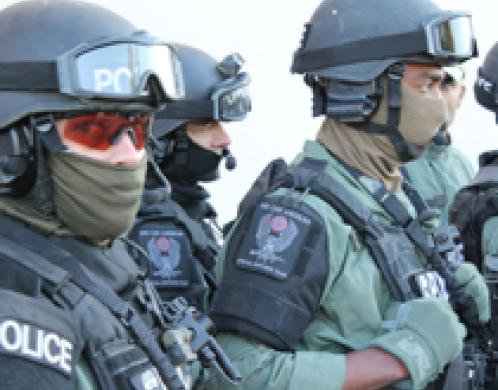
IF YOU COME INTO CONTACT WITH ONE OF THE ESTIMATED TWENTY-SEVEN THOUSAND Operation Pipeline grads currently cruising the highways, chances are you’ll never know it. The officer who pulls you over will look the same as any other traffic cop. Same hat. Same badge. Same car. He will not tell you he is a narcotics officer, and you will never suspect it, because, after all, who ever heard of drug agents passing out tickets for broken taillights?
The mechanics of a Pipeline stop are much like a minuet, except the trooper is the only one who hears the music or knows the steps–all of which lead inexorably to a thorough search of your car.
“I’m looking for anything that will get me in that car or get him out of the car,” Utah trooper Mangelson explained in his 1997 deposition.
Because of various court rulings and constitutional impediments, things must be done delicately and in the proper order, so as not to overtly violate your rights.
It will begin like any traffic stop. You’ll be asked for your license and registration, and while looking over your papers, the officer will ask you a series of questions about your travel plans. He’ll be friendly and polite: Where are you heading? How long will you be there? He’ll ask what you do for a living, or something equally innocuous.
“And when I’m doing this, you know, I’m not sitting there grilling you,” Mangelson said. “I’m doing it in a way that you probably don’t even realize what I’m doing.”
What he’s doing is called an interrogation, and your responses are being watched very closely. Did you have to think before answering? Did you repeat his questions? Are you being too helpful, too cooperative, or too talkative? Those are all bad signs, as bad as monosyllabic answers. If you have a passenger, the passenger will be taken off to the side and interrogated separately. The officer will check to see if your stories match.
“Criminals on the road are–how can I put it? I’ve always used this theory. If a guy can convince me of his legitimacy of being where he is or where he’s going, then there’s probably not much criminal activity going on,” Mangelson said. “But by the same token, if he tells me he’s going to Salt Lake, and I say, ‘What takes you to Salt Lake?’ and he goes, ‘I’m going to see a friend.’ If I say, ‘What’s your friend’s name?’ and he doesn’t know the friend’s name or he rattles some name off the wall, [I ask] ‘What’s his address?’ He’s now becoming extremely nervous, and he can’t tell me the friend’s address, doesn’t know the phone number. ‘How are you going to visit your friend if you don’t know his address or phone number?’ By now, he’s trembling. The veins are poking out on the side of the neck and you can see his heart beating there and his hands are shaking and his mouth is so dry, he can’t even talk to you. You know he’s dirty. And he knows I’m on to him.”
The indicators are tallied up. No indicators, no problem. Unless you’ve got a gun or a kilo of cocaine lying on the front seat, you’ll be kicked loose. You may not even get a ticket. Many Pipeline officers don’t write them or write only enough of them to maintain the facade that they are traffic policemen.
If your indicators are on the high side, however, this is what will happen. You’ll be given your papers back, and then the officer will hang around and strike up a conversation. What most drivers don’t realize is that at this point, they have magically crossed into a whole new legal universe. At the moment your license and registration are returned, you are technically free to leave. In the eyes of the law, the traffic stop is over. Now you and Officer Friendly are just having a “consensual” chat. And your new friend is free to ask you anything.
From here, it’s almost a script.
You’ll be told that the local police have been having a problem with people ferrying guns and drugs along this part of the highway, but they’re doing their best to stop it. Good, you may say. Glad to hear it. The officer will nod and say he’s happy you see it that way. By the way, you wouldn’t happen to have any guns or drugs in your car, would you?
Me? you will ask. Oh, no. Of course not.
Then the officer will look at you and say, Then you don’t mind if I take a look-see, do you?
If you’re like nine out of ten people who get asked this question, you’ll gulp and say, No, no, officer, go right ahead.
You’ll be asked to consent–orally or on paper–to a search, but don’t think too hard or hesitate to comply, because those are more indicators of drug trafficking, as is refusing to allow the search. (And here’s where things can get dangerous, where the psychopath who won’t be taken might pull his gun. A 1992 Pipeline stop in South Carolina resulted in a shoot-out that killed the officer and wounded his suspect. And this past January, a veteran Pipeline officer in Georgia was murdered during a stop.)
“If they refuse, the stuff’s in the trunk,” our CHP instructor tells us matter-of-factly. A refusal justifies calling out the dogs and letting a drug-sniffing canine take a walk around your car. If Fido gets a whiff of something, the cop doesn’t need your permission anymore.
Most drivers consent. This can authorize a complete search of everything, including your luggage and your person. It allows the officer literally to take your car apart with an air hammer, which has happened. One of the CHP’s first Pipeline officers, Richard Himbarger, was legendary for carrying an electric screwdriver in his patrol car and removing heater ducts, fenders, trunk lids, and interior body panels, right by the side of the road.
“Once they’ve given consent,” our CHP instructor tells us, “they’ve dug their own grave.”

DEPUTY LOU GARCIA WAS ASSIGNED TO SHERIFF VOGEL’S SELECTIVE ENFORCEMENT TEAM IN 1989. A canine-unit officer, Garcia would be summoned at all hours to walk his drug dog, Condor, near the cars the SET squad had pulled over on I-95. Lots of times, he’d be out on the highway at 3:00 a.m., splashing through swamps with Condor, chasing down panic-stricken motorists who’d bolted into the darkness. He didn’t mind. Garcia was thrilled to have been chosen to work with Vogel’s crew. The sheriff took good care of his boys: overtime, fancy Stetson hats, rapid promotions. By all accounts, Vogel was equally thrilled to have Lou Garcia on his team, and he commended the officer repeatedly.
“Thanks to you, our drug- and money-interdiction program is working,” Vogel wrote in one enthusiastic letter.
The son of a New Mexico coal miner, Garcia had come to the Volusia County Sheriff’s Office after fifteen years in the U. S. Army as a paratrooper, a military policeman, and a drill instructor. He hired on at the sheriff’s office in 1985 at $10.50 an hour and was in paradise. “When I finally got to be a deputy, I felt I had achieved my goal in life.”
But his wife, Angie, began noticing that her husband was increasingly moody after his shift. “He’d get home sometimes after being out on that highway,” she says, “and he’d just be shaking his head, and I’d ask him what was wrong, and he’d say, ‘You won’t believe what they’re doing out there.’ ”
Garcia says he soon discovered the secret of Vogel’s highly touted highway interdiction program: The cops concentrated on minority drivers, narrowing the universe of motorists to those they thought most likely to have drugs or guns, even though, in reality, drugs and guns turn up in searches of their vehicles with the same frequency as in those of white drivers. Garcia says he was present at a gathering of deputies on the median of I-95 when Vogel instructed them to focus their attention on black and Hispanic drivers. Vogel denies that happened, but another deputy, Frank Josenhans, corroborates Garcia’s story.
Still, it wasn’t as if Garcia needed to hear it from the sheriff’s mouth. “I knew who they were stopping. I saw the people. It was blacks, mostly, and they were all being pulled over for weaving. The black race was the only race I knew of that wasn’t able to stay in a lane. Black people just couldn’t seem to do it.”
What Garcia was witnessing in Volusia County was not an aberration. As more and more police departments signed up for Operation Pipeline, it began happening in other places, too. Sometimes the police didn’t even bother to hide it. Georgia state troopers told an Atlanta reporter in 1987 that they watched for rented cars from south Florida driven by blacks or Latinos.
Officer Richard Curtis of the Lexington, Kentucky, police department admitted under oath in a drug-interdiction case that race was one of the indicators looked at, as were out-of-state license plates. In another case, Alabama state trooper John Guthrie tes-tified that his indicators included “Texas plates” and “Mexicans.”
The “cocaine-courier profile” used by the New Mexico State Police along I-40 surfaced in court in the late 1980s. The very first indicator: “The vehicle occupants are usually resident aliens from Colombia.” This profile, it turned out, had been sent to police departments nationwide by the DEA’s El Paso Intelligence Center, the department that manages the Pipeline program and provides its annual funding of roughly $800,000.
Ironically, that’s the same amount of money the taxpayers of Eagle County, Colorado–which encompasses the ski resort of Vail–forked over to settle a class-action suit filed on behalf of 402 black and Hispanic drivers who had been stopped and searched by the High Country Drug Task Force, a Pipeline unit funded directly by the DEA. The task force “systematically violated the constitutionally protected rights of blacks and Hispanics to travel and be free from unreasonable seizures,” U. S. district judge James Carrigan wrote in a blistering criticism of the program in 1990. The evidence that race was used as an indicator, Carrigan ruled, was “undeniable,” and such practice amounted to “a racist assumption.”
Federal public defender Bryan Lessley obtained internal Oregon State Police records showing that the number of Hispanics being stopped on the highways near Grants Pass by a Pipeline unit was “grossly out of proportion” to the number of Hispanics on the road. He uncovered state-police training manuals that told Pipeline students a “high percentage” of narcotics traffickers were Hispanic.
In New Jersey, state-police Pipeline units assigned to the southern end of the New Jersey Turnpike were found by a superior-court judge to have had “at least a de facto policy . . . of targeting blacks for investigation and arrest,” which resulted in the dismissal of six hundred cases. A former New Jersey state trooper, Kenneth Wilson, admitted in a sworn statement that he was trained to target blacks and Hispanics. A statistical analysis by John Lamberth of Temple University backed up Wilson’s claims. Lamberth found that though blacks made up only 13 percent of the drivers on the turnpike, they accounted for nearly half the stops made by drug-seeking troopers.
The Maryland State Police made perhaps the biggest tactical blunder in the program’s history in 1992, when a Pipeline unit pulled over a black family in a rental car outside Washington, D. C., ordered them out into the rain, and then ran a drug-sniffing dog in and out of their car, over their repeated objections. The driver turned out to be a Harvard Law graduate, Robert Wilkins, a public defender who was on his way home from a family funeral in Chicago. Wilkins slapped the Maryland State Police with a civil-rights suit and accepted a settlement that forced the cops to keep detailed records of their Pipeline stops for the next three years. The results were more proof of Pipeline’s unique affinity for minorities: Of the 732 people who were detained and searched during 1995 and 1996, 75 percent were black and 5 percent Hispanic. The Maryland ACLU has filed another civil-rights suit based on those figures.

A GRANDMOTHERLY WOMAN IN A SLAB-SIDED PLYMOUTH FURY III ZIPS BY. Not a chance, I think. Next is a man in a suit, driving a gigantic white Lincoln Navigator, cell phone pressed to his ear. Mr. Business. With my luck, he’d turn out to be a lawyer. Pass. A teenage girl in her mom’s station wagon. Ditto. Then comes the carload of Mexicans.
They look as though they’re having one hell of a time, laughing, arms hanging out the window. Then they spot the CHP cruiser I’m sitting in, and the party is over. They look around furtively, sit up straight, won’t meet my steely gaze. The driver begins practicing the ten-and-two hand position on the steering wheel that he probably hasn’t used since driver’s ed. Bingo. A whole bunch of indicators right there. These guys are mine.
That is the result of my first drill using the lessons I gained from Pipeline school. I am sitting in the front seat of the head instructor’s patrol car, shaded by a giant oak. We are parked perpendicular to a bucolic two-lane highway in the hills beyond Susanville, California, checking out the sparse midmorning traffic. It is day two of my Pipeline training class, and I am putting my newly acquired observational skills to the test.
No one has instructed me to look for Mexicans; in fact, we were informed that racial profiling is illegal and frowned upon. But we were also taught that it is the Colombians and the Mexicans whose cartels are bringing most of the dope in and that a lot of drug mules are hired off the streets of Tijuana for $500 in cash. Not many gringos I’ve seen fit that description.
Plus, the Mexicans just look shifty to me. What are they doing, I wonder, driving around, yukking it up at 10:30 in the morning in the middle of the week? I am at work. Why aren’t they? And if they are unemployed, where’d they get the money for that nice Mercury?
And then I realize the problem with Operation Pipeline.
If I were looking for unsafe drivers, as most patrolmen do, it wouldn’t make any difference to me what the driver looked like or how he acted when he drove by or whether I thought he could afford his car. All I would care about would be how he was driving.
But that’s not my job as a Pipeline officer. My job is to get drugs and guns off the highway, so I look for people who look like they might have them. And since I have only a limited time out on the highway each day, I’m not going to waste it pulling over people who look like upstanding citizens–people who look like me and my friends, for instance.
I remember what my instructors told me repeatedly. If something appears “abnormal,” investigate. Always ask yourself whether this is something that you would do or say. If not, be suspicious. And suddenly, the baseline for determining who gets pulled over and searched is a forty-three-year-old white suburbanite’s vision of normalcy. Most of the white people I have seen driving by, I have to admit, look pretty normal to me. But the Mexicans don’t. Plus, there are all those indicators: their nervousness upon seeing a police car, the air freshener dangling from the mirror, their goddamn refusal to look at me.
It’s no wonder, I realize, that 90 percent of the people arrested by the CHP’s Pipeline units during the last two years have been minorities. They never stood a chance.
If I were empowered to do so, I could pull them over on some pretext to satisfy my curiosity. Maybe I would find something–drug-tainted money, a loaded gun, a kilo or two of cocaine or methamphetamine. Or maybe just a peaceable carload of people going from here to there, not owing me or anyone else an explanation. But if I do this long enough and use the indicators I’ve learned to pull over a volume of people, I will invariably find criminals. That was a big bag of dope in the Screamer’s trunk, after all. But does that justify scaring the bejesus out of the thousands of other motorists–the honest ones whose taxes pay my salary and pave these roads–whom I will misjudge? Will they think being interrogated and searched was a fair trade?
And what of the enormous waste of police manpower that goes into stopping and searching thousands of cars in which nothing more incriminating than old gum wrappers is found? Even the cops admit that highway seizures don’t make a dent in the quarter-trillion-dollar-a-year American narcotics industry. So, in the end, one is left to wonder: What is the point of all this harassment, this inefficiency, this futility? Is it really a way of finding contraband? Or is it, perhaps, a way of acclimating us to a future in which we will be routinely shadowed, stopped, and frisked by the police–a nation of suspects?

IN 1996, THE U. S. SUPREME COURT UNANIMOUSLY ENDORSED BOB VOGEL’S METHOD OF STOPPING PEOPLE FOR MINOR TRAFFIC VIOLATIONS IN ORDER TO SEARCH THEIR CARS FOR DRUGS. An officer’s real reason for pulling over a car didn’t matter a whit, the justices said, so long as some type of traffic offense–no matter how trivial–occurred first. It made no difference that the motor-vehicle codes gave the cops a license to “single out almost whomever they wish for a stop,” Justice Antonin Scalia wrote. It was not the role of the Supreme Court to decide whether there were too many traffic laws or which ones should no longer be enforced.
Since that ruling, known as the Whren decision, state and local police participation in Operation Pipeline has soared. Enrollments in DEA training schools are way up. “After Whren,” one of my CHP instructors told me, “the game was over. We won.”
Last fall, another Supreme Court decision, rejecting the search of an Iowa motorist’s car without probable cause, was widely hailed in the media as reinforcing the privacy rights of drivers. But since Pipeline officers are trained to legally justify a “reasonable suspicion,” or, of course, get the driver’s permission, before searching a car, this court decision may actually boost the popularity of Operation Pipeline.
That’s why it’s so ironic that Bob Vogel is no longer on the front lines of this particular war. Though his methods have received the stamp of unanimous approval from the highest court in the land, he’s quit teaching and has mothballed his drug-interdiction program. After a while, he said, it just wasn’t worth it.
In 1992, The Orlando Sentinel began printing stories that essentially accused Vogel’s SET unit of being racist thugs who were stealing money from innocent travelers. The newspaper said it found nearly two hundred cases in which deputies had taken a driver’s cash but made no arrests, and 90 percent of those cases involved minority drivers.
And then the tapes came out. It seemed Vogel’s boys had been videotaping their stops for posterity, and 148 hours of them were turned over to the newspaper. Example: a May 16, 1990, stop of a white driver. SET sergeant Dale Anderson strolls up to the car and asks the man how he’s doing.
“Not very good,” the driver replies.
“Could be worse,” Anderson reminds him. “Could be black.”
The civil-rights suits flew fast and furious after that. The U.S. Justice Department announced an investigation, and FBI agents started snooping around. A federal grand jury was empaneled.
The Sentinel won a Pulitzer prize for its exposé, a fact that grates on Vogel to this day. “Anybody who saw those stories would have thought I was some racist, tobacco-chewing, Billy Bob, redneck southern sheriff,” he complains. He leans forward slightly and asks me, mistakenly, if I was aware that the editor who oversaw the Sentinel’s coverage was an African-American.
“I’ll bet they didn’t tell you that part,” he says.
Eventually, the hubbub subsided. The discrimination suits were dismissed after federal judges declared that they had not seen convincing evidence of racial injustice. And the Justice Department, while muttering darkly about Vogel’s methods, declined to prosecute him on civil-rights charges, reportedly because it didn’t think a jury would convict him.
Critics called the investigation a whitewash, but there was more involved than that. History, for one thing. For more than a decade, Bob Vogel’s controversial system has been officially endorsed, financed, and espoused by the DEA–an arm of the Justice Department. Having Operation Pipeline’s creator brought up on federal civil-rights charges would have put the Justice Department and every other police agency involved in a rather awkward spot, especially when so many civil-rights suits were pending.
Vogel sees this as total vindication. “I’ve been investigated by just about everyone–the FBI, the Justice Department, the NAACP, the ACLU–and they haven’t been able to win a solitary case,” he says. “This whole thing is something that drug lawyers grabbed ahold of to try to beat some arrests by dragging race into it.”
If that’s true, he is asked, then why has this program had such lopsided racial results in state after state? Why are the statistics so one-sided?
Vogel stiffens. “Let me have my assistant, Lenny Davis, come in and answer that question for you. He might have an explanation for it.” A few minutes later, Chief Deputy Davis, a large, friendly black man, sits down and solemnly assures me that the reason so many blacks and Hispanics are being pulled over is because so many of them are involved in the drug business.
Vogel sits next to his chief deputy, nodding. But he doesn’t say a word.
This article originally appeared in the April 1999 edition of Esquire Magazine


 Thoreau’s classic essay popularly known as




 Camden Civil Rights Project