
Category Archives: Civil Liberties

Revealed: How the FBI Coordinated the Crackdown on Occupy

New documents prove what was once dismissed as paranoid fantasy: totally integrated corporate-state repression of dissent

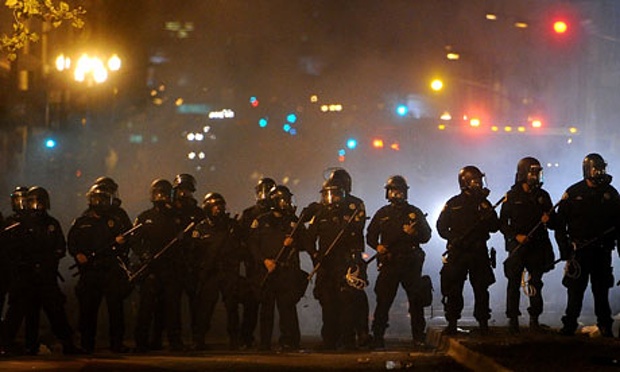
It was more sophisticated than we had imagined: new documents show that the violent crackdown on Occupy last fall – so mystifying at the time – was not just coordinated at the level of the FBI, the Department of Homeland Security, and local police. The crackdown, which involved, as you may recall, violent arrests, group disruption, canister missiles to the skulls of protesters, people held in handcuffs so tight they were injured, people held in bondage till they were forced to wet or soil themselves –was coordinated with the big banks themselves.

The Partnership for Civil Justice Fund, in a groundbreaking scoop that should once more shame major US media outlets (why are nonprofits now some of the only entities in America left breaking major civil liberties news?), filed this request. The document – reproduced here in an easily searchable format – shows a terrifying network of coordinated DHS, FBI, police, regional fusion center, and private-sector activity so completely merged into one another that the monstrous whole is, in fact, one entity: in some cases, bearing a single name, the Domestic Security Alliance Council. And it reveals this merged entity to have one centrally planned, locally executed mission. The documents, in short, show the cops and DHS working for and with banks to target, arrest, and politically disable peaceful American citizens.

The documents, released after long delay in the week between Christmas and New Year, show a nationwide meta-plot unfolding in city after city in an Orwellian world: six American universities are sites where campus police funneled information about students involved with OWS to the FBI, with the administrations’ knowledge (p51); banks sat down with FBI officials to pool information about OWS protesters harvested by private security; plans to crush Occupy events, planned for a month down the road, were made by the FBI – and offered to the representatives of the same organizations that the protests would target; and even threats of the assassination of OWS leaders by sniper fire – by whom? Where? – now remain redacted and undisclosed to those American citizens in danger, contrary to standard FBI practice to inform the person concerned when there is a threat against a political leader (p61).
The stories you need to read, in one handy email
Read more
As Mara Verheyden-Hilliard, executive director of the PCJF, put it, the documents show that from the start, the FBI – though it acknowledges Occupy movement as being, in fact, a peaceful organization – nonetheless designated OWS repeatedly as a “terrorist threat”:

“FBI documents just obtained by the Partnership for Civil Justice Fund (PCJF) … reveal that from its inception, the FBI treated the Occupy movement as a potential criminal and terrorist threat … The PCJF has obtained heavily redacted documents showing that FBI offices and agents around the country were in high gear conducting surveillance against the movement even as early as August 2011, a month prior to the establishment of the OWS encampment in Zuccotti Park and other Occupy actions around the country.”

Verheyden-Hilliard points out the close partnering of banks, the New York Stock Exchange and at least one local Federal Reserve with the FBI and DHS, and calls it “police-statism”:

“This production [of documents], which we believe is just the tip of the iceberg, is a window into the nationwide scope of the FBI’s surveillance, monitoring, and reporting on peaceful protestors organizing with the Occupy movement … These documents also show these federal agencies functioning as a de facto intelligence arm of Wall Street and Corporate America.”

The documents show stunning range: in Denver, Colorado, that branch of the FBI and a “Bank Fraud Working Group” met in November 2011 – during the Occupy protests – to surveil the group. The Federal Reserve of Richmond, Virginia had its own private security surveilling Occupy Tampa and Tampa Veterans for Peace and passing privately-collected information on activists back to the Richmond FBI, which, in turn, categorized OWS activities under its “domestic terrorism” unit. The Anchorage, Alaska “terrorism task force” was watching Occupy Anchorage. The Jackson, Mississippi “joint terrorism task force” was issuing a “counterterrorism preparedness alert” about the ill-organized grandmas and college sophomores in Occupy there. Also in Jackson, Mississippi, the FBI and the “Bank Security Group” – multiple private banks – met to discuss the reaction to “National Bad Bank Sit-in Day” (the response was violent, as you may recall). The Virginia FBI sent that state’s Occupy members’ details to the Virginia terrorism fusion center. The Memphis FBI tracked OWS under its “joint terrorism task force” aegis, too. And so on, for over 100 pages.

Advertisement

Jason Leopold, at Truthout.org, who has sought similar documents for more than a year, reported that the FBI falsely asserted in response to his own FOIA requests that no documents related to its infiltration of Occupy Wall Street existed at all. But the release may be strategic: if you are an Occupy activist and see how your information is being sent to terrorism task forces and fusion centers, not to mention the “longterm plans” of some redacted group to shoot you, this document is quite the deterrent.

There is a new twist: the merger of the private sector, DHS and the FBI means that any of us can become WikiLeaks, a point that Julian Assange was trying to make in explaining the argument behind his recent book. The fusion of the tracking of money and the suppression of dissent means that a huge area of vulnerability in civil society – people’s income streams and financial records – is now firmly in the hands of the banks, which are, in turn, now in the business of tracking your dissent.

Remember that only 10% of the money donated to WikiLeaks can be processed – because of financial sector and DHS-sponsored targeting of PayPal data. With this merger, that crushing of one’s personal or business financial freedom can happen to any of us. How messy, criminalizing and prosecuting dissent. How simple, by contrast, just to label an entity a “terrorist organization” and choke off, disrupt or indict its sources of financing.

Why the huge push for counterterrorism “fusion centers”, the DHS militarizing of police departments, and so on? It was never really about “the terrorists”. It was not even about civil unrest. It was always about this moment, when vast crimes might be uncovered by citizens – it was always, that is to say, meant to be about you.

• This article originally referred to a joint terrorism task force in Jackson, Michigan. This was amended to Jackson, Mississippi at 4pm ET on 2 January 2012

Mass Surveillance: Implications on Privacy and Speech

This entertaining five minute video discusses the legality of the government’s current domestic mass surveillance program, making the case that it invades our privacy and places an unconstitutional chilling effect upon First Amendment speech and political association. Brought to you by Fight for the Future and Demand Progress.

Police Surveillance and Predictive Policing

Privacy today faces growing threats from a growing surveillance apparatus that is often justified in the name of crime prevention. This video short brought to you by AJ+ summarizes some of the highly intrusive technology which allows law enforcement to conduct targeted surveillance against individuals who are not suspected of engaging in any criminal activity.  Numerous law enforcement agencies—including the Federal Bureau of Investigation, private security contractors and state and local police departments—intrude upon the private communications of innocent citizens, amass vast databases of who we call and when, and catalog “suspicious activities” based on the vaguest of standards. The government’s collection of this sensitive information is itself an invasion of privacy. But its use of this data is also rife with abuse as innocuous data is fed into bloated watchlists, with severe consequences upon individuals who do not even realize why they have been targeted. History has repeatedly shown that powerful, state surveillance tools are most often abused for political ends which disproportionately target political dissidents and disfavored minorities.

Cruel and Unusual Punishment

https://www.youtube.com/watch?v=NPVzWAcCyl8

This video short from Test Tube News provides a general overview of the Eighth Amendment’s guarantee against cruel and unusual punishment. The video summarizes the “evolving standards of decency” test used by the court, providing relevant examples and court rulings.

Search and Seizure

This episode of Crash Course in Government and Politics provides a general overview of the Fourth Amendment right against unreasonable search and seizures. The police generally need to secure a warrant issued by a judge based on proof of probable cause to search your home, but this isn’t always the case – exceptions exist for exigent circumstances, such as if there is a reasonable concern that there is a crime in progress or that evidence is in danger of being destroyed.  Also discussed are the vehicle exception to a warrant and the limited protections enjoyed by  students.

Produced in collaboration with PBS Digital Studios: http://youtube.com/pbsdigitalstudios

The Right to Bear Arms

THE SECOND AMENDMENT

By Nelson Lund and Adam Winkler

Modern debates about the Second Amendment have focused on whether it protects a private right of individuals to keep and bear arms, or a right that can be exercised only through militia organizations like the National Guard. This question, however, was not even raised until long after the Bill of Rights was adopted.

Many in the Founding generation believed that governments are prone to use soldiers to oppress the people. English history suggested that this risk could be controlled by permitting the government to raise armies (consisting of full-time paid troops) only when needed to fight foreign adversaries. For other purposes, such as responding to sudden invasions or other emergencies, the government could rely on a militia that consisted of ordinary civilians who supplied their own weapons and received some part-time, unpaid military training.

The onset of war does not always allow time to raise and train an army, and the Revolutionary War showed that militia forces could not be relied on for national defense. The Constitutional Convention therefore decided that the federal government should have almost unfettered authority to establish peacetime standing armies and to regulate the militia.

This massive shift of power from the states to the federal government generated one of the chief objections to the proposed Constitution. Anti-Federalists argued that the proposed Constitution would take from the states their principal means of defense against federal usurpation. The Federalists responded that fears of federal oppression were overblown, in part because the American people were armed and would be almost impossible to subdue through military force.

Implicit in the debate between Federalists and Anti-Federalists were two shared assumptions. First, that the proposed new Constitution gave the federal government almost total legal authority over the army and militia. Second, that the federal government should not have any authority at all to disarm the citizenry. They disagreed only about whether an armed populace could adequately deter federal oppression.

The Second Amendment conceded nothing to the Anti-Federalists’ desire to sharply curtail the military power of the federal government, which would have required substantial changes in the original Constitution. Yet the Amendment was easily accepted because of widespread agreement that the federal government should not have the power to infringe the right of the people to keep and bear arms, any more than it should have the power to abridge the freedom of speech or prohibit the free exercise of religion.

Much has changed since 1791. The traditional militia fell into desuetude, and state-based militia organizations were eventually incorporated into the federal military structure. The nation’s military establishment has become enormously more powerful than eighteenth century armies. We still hear political rhetoric about federal tyranny, but most Americans do not fear the nation’s armed forces and virtually no one thinks that an armed populace could defeat those forces in battle. Furthermore, eighteenth century civilians routinely kept at home the very same weapons they would need if called to serve in the militia, while modern soldiers are equipped with weapons that differ significantly from those generally thought appropriate for civilian uses. Civilians no longer expect to use their household weapons for militia duty, although they still keep and bear arms to defend against common criminals (as well as for hunting and other forms of recreation).

The law has also changed. While states in the Founding era regulated guns—blacks were often prohibited from possessing firearms and militia weapons were frequently registered on government rolls—gun laws today are more extensive and controversial. Another important legal development was the adoption of the Fourteenth Amendment. The Second Amendment originally applied only to the federal government, leaving the states to regulate weapons as they saw fit. Although there is substantial evidence that the Privileges or Immunities Clause of the Fourteenth Amendment was meant to protect the right of individuals to keep and bear arms from infringement by the states, the Supreme Court rejected this interpretation in United States v. Cruikshank (1876).

Until recently, the judiciary treated the Second Amendment almost as a dead letter. In District of Columbia v. Heller (2008), however, the Supreme Court invalidated a federal law that forbade nearly all civilians from possessing handguns in the nation’s capital. A 5–4 majority ruled that the language and history of the Second Amendment showed that it protects a private right of individuals to have arms for their own defense, not a right of the states to maintain a militia.

The dissenters disagreed. They concluded that the Second Amendment protects a nominally individual right, though one that protects only “the right of the people of each of the several States to maintain a well-regulated militia.” They also argued that even if the Second Amendment did protect an individual right to have arms for self-defense, it should be interpreted to allow the government to ban handguns in high-crime urban areas.

Two years later, in McDonald v. City of Chicago (2010), the Court struck down a similar handgun ban at the state level, again by a 5–4 vote. Four Justices relied on judicial precedents under the Fourteenth Amendment’s Due Process Clause. Justice Thomas rejected those precedents in favor of reliance on the Privileges or Immunities Clause, but all five members of the majority concluded that the Fourteenth Amendment protects against state infringement the same individual right that is protected from federal infringement by the Second Amendment.

Notwithstanding the lengthy opinions in Heller and McDonald, they technically ruled only that government may not ban the possession of handguns by civilians in their homes. Heller tentatively suggested a list of “presumptively lawful” regulations, including bans on the possession of firearms by felons and the mentally ill, bans on carrying firearms in “sensitive places” such as schools and government buildings, laws restricting the commercial sale of arms, bans on the concealed carry of firearms, and bans on weapons “not typically possessed by law-abiding citizens for lawful purposes.” Many issues remain open, and the lower courts have disagreed with one another about some of them, including important questions involving restrictions on carrying weapons in public.

Freedom of the Press

This episode of Crash Course in Government and Politics provides a general overview of the First Amendment’s freedom of the press. Like an individual’s right to free speech, the press has a right, and arguably an ethical responsibility, to tell the public what the government is doing. But there are some complications in doing so, such as if that information will compromise national security or wrongfully discredit an individual. When considering Edward Snowden’s NSA disclosures or Julian Assange’s Wikileaks, it’s just as important as ever to understand the role of the press in informing the public as well as our role as citizens in staying informed.

Produced in collaboration with PBS Digital Studios: http://youtube.com/pbsdigitalstudios

Freedom of Speech

This episode of Crash Course in Politics provides a general overview of your First Amendment right to free speech. Theoretically, this right allows you to critique the government without fear of retaliation. But it’s essential to remember that not ALL speech is protected equally under the First Amendment, and it only applies to the government. Therefore, just because you have a right to free speech doesn’t mean your private employer, for instance, can’t fire you for something you say (unless your work for the government and then things get a bit more complicated). Discussed are significant Supreme Court cases that have brought us to our current definition of free speech, and some of the more controversial aspects of free speech – like hate speech.

Produced in collaboration with PBS Digital Studios: http://youtube.com/pbsdigitalstudios

Freedom of Religion

This episode of Crash Course in Politics provides a general overview of the First Amendment and the freedom of religion. It examines some significant Supreme Court decisions and discusses how they’ve affected our interpretations of the law with respect to issues like animal sacrifice and prayer in schools. As you’ll see, there aren’t always clearly defined, or bright-line, rules in approaching these legal questions. Sometimes tests have to be developed to account for the ever-changing nature of the law and it’s applications.

Produced in collaboration with PBS Digital Studios: http://youtube.com/pbsdigitalstudios

Civil Rights & Liberties

This episode of Crash Course in Government provides a general overview of civil rights and civil liberties. These terms are often used interchangeably, but they are actually very different. Our civil liberties, contained in the Bill of Rights, once only protected us from the federal government, but slowly these liberties have been incorporated through the Fourteenth Amendment to protect us from the states. We’ll take a look at how this has happened and the supreme court cases that got us here.

Produced in collaboration with PBS Digital Studios: http://youtube.com/pbsdigitalstudios