Category Archives: Art Gallery

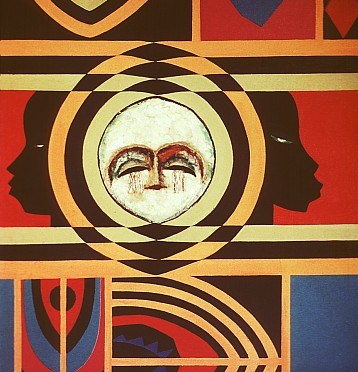
Moon Masque

Artist: Lois Mailou Jones
Medium: collage and oil on canvas
Date: c. 1971

Moon Masque (1971) includes a Kwela mask from Zaire framed by textile patterns that divide the canvas in three horizontal bands, an arrangement that also reflects West African woven strip cloths. Black, ochre and red organize the canvas in series of complex rhythms. The Haitian style, which retains a narrative sense and a realistic treatment of the figures is furthered into bolder abstraction. The narrative is gone and replaced by the juxtaposition of symbolic motifs, underlying the variety of African cultures as well as their proximity and unity, all elements of the pan-African discourse.

excerpt by Dr. Catherine Bernard (2002 Anyone Can Fly Foundation Professional Scholars Grant recipient)

From Slavery Through Reconstruction

Artist: Aaron Douglas,
Aspects of the Negro Life Series ,
Medium: Mural at Schomburg Center for Research in Black Culture, NYC, NY (formerly New York Public Library’s 135th Street branch),
Date: c. 1934

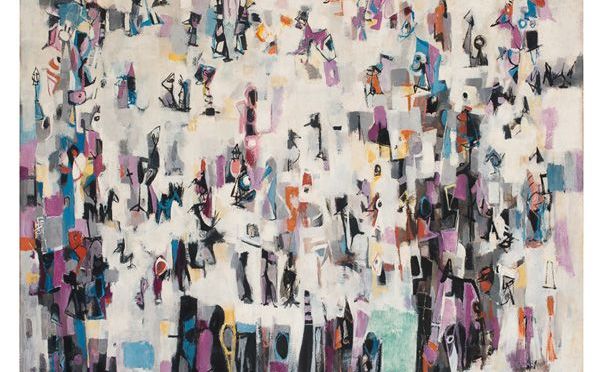
Carnival

Artist: Norman Lewis
Medium: oil on linen
Date: c.1957

Carnival, has a visual rhythm that looks the way jazz sounds. Skids of blue and mauve jag out from under the white overpainting while shapes in black, orange, and yellow skirt and slide on a vertical axis.”

Charles Schwartz, artobserver.com

The Builders

Artist: Jacob Lawrence
Medium: tempera on board
Date: c. 1947

The Builders Series communicates Lawrence’s belief in the possibility of building a better world through skill, ingenuity, hard work, and collaboration. The Builders concept first appeared in Lawrence’s work in the mid-1940s, and by the late 1960s had became a major theme of his artwork. For the last three decades of his life, Lawrence consistently pursued the Builders motif, creating a sequence of vibrant modernist images that highlight his pervasive humanist vision.

His subjects were carpenters, cabinetmakers, bricklayers, and construction workers in a variety of workaday and family situations. Overall, they came to symbolize some of his larger ideas about American culture, hope, persistence, and the shared responsibility for transforming society, inspired, as he once said, by his “own observations of the human condition.”

Away from Harlem and the urban environment that he had grown up in, Lawrence increasingly pursued more symbolic and universal subjects that were less overtly grounded in contemporary social issues than much of his earlier art. At the same time, the new work was also the result of his continued growth as an artist. As he explained in 1974, it was a “broadening of imagery, an expansion of my humanist concept. … like most artists, I’m expanding, probing, constantly seeking new symbols—always within the humanist context.”

Aspects of Negro Life

Artist: Aaron Douglas
Medium: Mural at Schomburg Center for Research in Black Culture, NYC, NY (formerly New York Public Library’s 135th Street branch)
Date: c. 1934

In 1934, Aaron Douglas was commissioned, under the sponsorship of the Public Works of Art Project (PWAP), the first relief program for artists sponsored by President Franklin Roosevelt’s New Deal, to paint a series of murals for the135th Street branch of the New York Public Library.

One his best-known works, the Aspects of Negro Life series is characteristic of Douglas’s style, with graphically incisive motifs and the dynamic incorporation of such influences as African sculpture, jazz music, dance, and abstract geometric forms. The four panels chart the progression of African Americans through slavery, the Reconstruction period, the Northern Migration, and the Great Depression. Using a stylized vocabulary, Douglas conveyed political and social messages and included allusions to Marxist theory that he and others in Harlem studied in the mid‐1930s.

The series reveals the bold modernist risks Douglas was prepared to take at a time when regionalism was the norm. The layered, condensed space, geometric forms, and silhouettes draw on African, cubist, and constructivist motifs in an allegorical representation of issues central to African American history and contemporary life.