All posts by Lawrence Christopher Skufca, J.D.

My name is Lawrence Christopher Skufca. I am a civil rights activist and community organizer in the Camden, New Jersey area. I hold a Juris Doctor from Rutgers School of Law; a B.A. in Political Science from Furman University; and an A.A. in the Social Sciences from Tri-County Technical College.

Redd seen as likely Bryant replacement

With State Sen. Wayne Bryant’s announcement yesterday that he would not seek reelection, eyes in Camden turned to Dana Redd, the vice president of City Council.

Redd, 38, is seen as the likely Democratic candidate to replace Bryant, who in recent months has become the subject of state and federal corruption probes into his taxpayer-funded jobs.

Her name is floated whenever a major elective or appointive office opens in the Camden area. She has been mentioned as an heiress-apparent for the mayor’s job and a possible contender for Camden County freeholder. She recently stepped down as chairwoman of the Camden Housing Authority.

She is also cochair of the city Democratic Committee and vice chairwoman of the state Democratic Party.

Redd’s father was a union activist; both her parents died when she was 8. She grew up in Camden as a protegé of the Hinsons, prominent in Democratic politics, and Freeholder Riletta Cream, and supported by South Jersey Democratic leader George Norcross III.

She has been heavily criticized for her staunch support of the massive Cramer Hill redevelopment plan that would have bulldozed 1,200 homes if it hadn’t been stalled in court.

Yesterday, she had the support of Mayor Gwendolyn Faison.

“Dana Redd,” said the mayor, “is a young and upcoming political person. I think with the right help and advice, she will make an excellent senator.”


Contact staff writer Dwight Ott at 856-779-3844 or dott@phillynews.com.
Read more at http://www.philly.com/philly/news/politics/nj/20070310_Redd_seen_as_likely_Bryant_replacement.html#CtVSoLqeAM3DCtl3.99

Inquirer Editorial: Lessons unlearned

images
POSTED: June 10, 2014

Having twice failed to forcibly reshape Rutgers University, New Jersey Senate President Steve Sweeney is back with yet another ham-handed attempt to commandeer the state school’s governance. Although reform and restructuring of the system should be on the agenda, Sweeney’s approach to the issue continues to reveal a remarkable refusal to learn from his mistakes.

The senator’s latest scheme would pack the university’s Board of Governors with additional political appointees, shifting the balance of power to the governor and legislators. The takeover bid narrowly escaped a Senate committee last week, but that ought to be as far as it goes.

With a 15-member Board of Governors and a less powerful 59-member Board of Trustees – which Sweeney (D., Gloucester) tried and failed to blow up last year – Rutgers hardly needs even more overseers. Nor is micromanagement by politicians a recipe for better university governance.

A similarly dictatorial approach alienated many at Rutgers in 2012, when Sweeney’s proposed merger of Rutgers-Camden and Rowan University came up short despite its merits.

Rutgers officials can help head off Sweeney’s latest attempt by releasing an internal report on potential governance improvements. The university must embrace a measured and open approach to reform lest it be vulnerable to political hijacking.

UMDNJ whistleblower cases cost Rutgers nearly $2M in settlements

Ted Sherman | NJ Advance Media for NJ.com
By Ted Sherman | NJ Advance Media for NJ.com
Email the author | Follow on Twitter
on April 26, 2015 at 9:05 AM, updated April 26, 2015 at 9:08 AM
NEW BRUNSWICK — Rutgers University has quietly resolved several major whistleblower cases inherited with the merger of the University of Medicine and Dentistry of New Jersey, agreeing to nearly $2 million in settlements with former high-level administrators.

The never-disclosed confidential agreements bring to an end two long-running lawsuits that charged UMDNJ, the state’s troubled former medical university, with wrongful termination over alleged fraud and illegal bidding practices.

In one case, Rutgers earlier this month reached a $1.2 million settlement with Edward Burke, the former chief financial officer of UMDNJ’s University Hospital in Newark, who said he was fired after he accused top administrators of systematically defrauding Medicaid.

And last year, Rutgers reached a $700,000 settlement with Ellen Casey, a purchasing official for UMDNJ, who claimed she was terminated after discovering that telecommunications contracts worth millions of dollars were being awarded without public bids.

Rutgers imposed strict restrictions on the disclosure of any terms of the settlements on lawyers in the two cases. NJ Advance Media, however, obtained copies of both through Open Public Records Act requests with the state university.

In a statement, Rutgers spokesman Greg Trevor said the university “is satisfied with the resolution of these cases that were filed before the integration of most of UMDNJ with Rutgers.”

Attorneys for the former employees who brought the litigation did not comment.

But Adam Henick, a one-time vice president at UMDNJ’s University Hospital who oversaw Medicaid billing for outpatient services and first discovered evidence of overbilling in 2002 before being forced out, said Rutgers “is probably trying to put UMDNJ’s sordid past to rest.”

A medical university marred by scandal

That past had included a culture of waste, fraud and abuse, including lucrative consulting contracts that went to political insiders, double-billing Medicare and Medicaid by millions of dollars, and an illegal kickback scheme that gave doctors no-show jobs in return for referring patients to the university’s faltering cardiac surgery program.

One state powerbroker, former state Sen. Wayne Bryant was eventually sentenced to four years in federal prison for using his influence in Trenton to secure a pension-padding job at UMDNJ that required little work.

UMDNJ ultimately came under the oversight of a federal monitor in 2005, following threats by then-U.S. Attorney Chris Christie to prosecute UMDNJ for allegedly overbilling the government $4.9 million for treatment of Medicare and Medicaid patients. The fraud and waste at the medical university, though, spawned more than a dozen whistleblower and wrongful termination lawsuits against UMDNJ, many settled out of court.

In 2009 UMDNJ reached a $2 million settlement with the U.S. Justice Department over the Medicare and Medicaid fraud allegations. Unsealed court records later revealed that it had been a former UMDNJ faculty member and attending physician, Steven Simring, who first alerted federal prosecutors to the illegal billing, after he filed a whistleblower complaint under the Federal False Claims Act. He received a portion of the settlement with the justice department.

After absorbing most of UMDNJ, though, Rutgers still found itself defending—and fighting—several outstanding legal cases being contested in state and federal courts.

Alleged billing fraud

In the most recent settlement, Burke, the University Hospital CFO, had accused superiors of retaliating after he accused the school of covering up its failure to comply with federal rules. According to a complaint filed in federal court in 2008, Burke alleged UMDNJ had been deliberately overpaying doctors and shifting those costs to the hospital to inflate its Medicare, Medicaid and Charity Care reimbursements.

He also claimed the UMDNJ teaching hospital had been subsidizing the private practices of faculty physicians. Burke said he was forced out because he raised the issue of physician overcompensation and potential criminal violations.

The university, in its most recent court filings, responded that Burke’s claims had been raised by others and had been addressed—calling his case an “opportunistic and parasitic suit” based on information already publicly disclosed.

“Burke attempts to walk a paved road years in the making by many others before him,” wrote university attorneys. “For the past decade, numerous litigations and extensive media coverage have discussed alleged Medicare, Medicaid and Charity Care fraudulent billing and reimbursement issues involving the University of Medicine and Dentistry.”

Earlier this month, however, Rutgers agreed to settle the matter and Burke agreed to drop his lawsuit with the payment of $1.2 million by Rutgers, paid in part by the medical school’s faculty practice group.

The settlement covered all claims by the former UMDNJ vice president, as well as any back pay, lost benefits and attorneys’ fees. Rutgers admitted no wrongdoing.

Burke’s attorney, Neil Mullin of Mullin Smith in Montclair, did not return calls or emails.

In a similar settlement, Rutgers last year also agreed to pay Casey, who had complained that telecommunications contracts worth millions of dollars were being awarded without public bids. Casey, in a lawsuit filed in the state courts in 2008, charged that UMDNJ continued to violate New Jersey bidding statutes even as a federal monitor was winding down his oversight and new controls were imposed. At one point, she said her department was forced to hire a politically connected employee for a mailroom position that did not exist.

Her attorney, James O’Donohue of Hill Wallack in Princeton, would say nothing of the settlement, only that the case “was resolved to the satisfaction of all parties.”

Meanwhile, Rutgers officials earlier this month said they were recently notified that the federal Office of the Inspector General of the U.S. Department of Health and Human Services was finally concluding its own monitoring of the medical and health science schools now under Rutgers—nearly a decade after the scandal at UMDNJ first came to light.

Ted Sherman may be reached at tsherman@njadvancemedia.com. Follow him on Twitter @TedShermanSL. Find NJ.com on Facebook.

Rutgers-Camden Law school Provides Sen. Wayne Bryant “No-Show” Position

Few faculty knew of Bryant’s status

images

Angela Delli Santi, Associated Press
POSTED: Wednesday, April 4, 2007, 3:01 AM

TRENTON – Few professors at Rutgers University-Camden knew that State Sen. Wayne Bryant was a part-time instructor there for five years, and most told the FBI they never asked him to teach their classes because they didn’t know he was on the payroll.

Of 125 academics who responded to an inquiry from a college administrator collecting data for the FBI on Bryant’s work history, only two said the senator lectured in their classes in the years he was paid as an adjunct professor, according to the responses obtained by the Associated Press through the Open Public Records Act.

Bryant, 59, was indicted last week on fraud, corruption and pension-padding charges. He and codefendant R. Michael Gallagher, a former dean at the University of Medicine and Dentistry of New Jersey who is charged with fraud, made their initial court appearances yesterday.

The indictment charges that Bryant traded on his powerful post as head of the Senate budget committee by looking out for the financial interests of UMDNJ in exchange for a no-show job. It accuses the senator of tripling his taxpayer-funded pension through the UMDNJ job and similar arrangements at the Rutgers-Camden Law School and Gloucester County Board of Social Services.

Bryant’s lawyer, Carl Poplar, has not returned repeated calls for comment.
Rugters hired Bryant in the fall of 2002 as a “distinguished adjunct professor of law and public affairs,” said Rutgers-Camden spokesman Michael Sepanic. Earlier that year, he helped pass legislation providing funding for an $11 million expansion of the Camden campus.

Bryant was supposed to help the law school recruit minority students and to lecture in law, political science and public administration.

He was paid $130,126 before his position was eliminated in 2006, though there is evidence that he did little work.

Only two professors who responded to the e-mail inquiry said Bryant lectured for them from 2004 to 2006. According to the professors, Bryant completed a total of six graduate-level lectures.

Two others said Bryant had come to their classes long before he was employed by the school. One remembered Bryant giving a lecture on welfare reform in 1990, but said the talk “wasn’t a particularly memorable performance, and I never invited him back.” Another said Bryant spoke free at a public policy colloquium sometime before 2002.

Most of the other professors who answered the associate provost’s e-mail claimed not to have known Bryant was employed by Rutgers-Camden or that he was available to guest-lecture until reading recent news accounts of the federal investigation.

“I heard he was being paid but was not doing any work because he had helped secure funding for Rutgers-Camden,” wrote one faculty member. “I heard this from several people at the law school.”

Several of the respondents said they had been interviewed by FBI agents, and a few scolded the school.

“I still haven’t heard anything official from the school,” one said.

“This is a terrible embarrassment to Rutgers,” another said.

Angela Delli Santi
Associated Press

Read more at http://www.philly.com/philly/news/politics/nj/20070404_Few_faculty_knew_of_Bryants_status.html#O1HsJfPHhBBvzmWk.99

Cooper hospital fined in Medicare fraud case

POSTED: September 25, 2008


Cooper University Hospital will pay a $3.85 million fine to settle allegations of Medicare fraud, the U.S. Justice Department announced yesterday.

The hospital was accused of increasing charges to Medicare patients to boost its reimbursement from the federal health-care program.

Cooper denied any wrongdoing and said it “did not game this system.”

The Justice Department said in a separate release that from January 2001 to August 2003, Cooper improperly inflated charges for both inpatient and outpatient care so that it could obtain higher amounts of “outlier payments.”

Those payments, the department said, are intended if the cost of care – such as that required in an intensive-care unit – is “unusually high” and are designed as an incentive to hospitals to provide those services.

Cooper, in its statement, said it performed a great amount of uncompensated charity care, “receiving notoriously poor governmental program payments,” and had actually lost money on Medicare reimbursements during the period noted in the accusations.

The civil settlement resolves allegations against Cooper originally brought in a suit by Anthony Kite. Under the False Claims Act, private citizens may bring lawsuits on behalf of the federal government. Under the settlement, Kite will receive $654,500. Charles Miller, a spokesman for the Justice Department’s Civil Division, said Kite was a financial consultant with no apparent connection to the hospital.

A PDF version of the 2011 Medicare fraud settlement can be found HERE

Katz and Lenfest win Inquirer parent with $88M bid

images

POSTED: May 29, 2014

Inquirer co-owners Lewis Katz and H.F. “Gerry” Lenfest won a private auction for the newspaper and its parent company Tuesday, ending a fractious battle for control that prompted the business’ sixth ownership change in eight years.

Their $88 million bid bested a group led by co-owner George E. Norcross III and was $27 million more than the partners spent two years ago to form Interstate General Media Holdings L.L.C.

Held at a Philadelphia law firm and closed to the media, the auction capped months of litigation between IGM’s owners and turmoil for the company, which employs about 1,800 people at The Inquirer, Philadelphia Daily News, three websites, and a printing plant in Conshohocken.

It also comes as the news industry continues to battle declining revenue, decreased circulation, changes in reader habits, and struggles to profit from digital operations.

“We know more than anybody how difficult this business is,” Katz told employees Tuesday afternoon at the company’s Market Street headquarters. “We’re going to give it our best. We’re going to try to bring in the best. And, hopefully, we’ll have a wonderful result.”

The pair said they would rename the company and own equal shares, though they hope to lure other investors.

Each is among the most prominent businessmen and philanthropists in the region. Katz, 72, grew up in Camden and made millions in banks, billboards, and parking lots. His son, Drew, 42, chief executive of a Cherry Hill-based billboard company, is expected to play a role in the new venture.

Lenfest, 83, made about $1 billion when he sold his cable company to Comcast in 1999 and has spent recent years giving away his fortune to philanthropic causes.

In their first move, the men announced that Lenfest would serve as interim publisher until a permanent one could be hired. He will replace publisher Robert J. Hall, who Lenfest said planned to retire.

Hall declined to comment as he left the auction.

“We feel very fortunate we were able to prevail in the auction,” Lenfest said. “We want to return The Inquirer to the great newspaper it has been for many years.”

He also endorsed the continued newsroom leadership of Inquirer editor William K. Marimow, who was fired in October by Hall with the support of Norcross.

Marimow’s ouster brought into public view a long-simmering feud between Katz and Norcross, who formed the two-person management committee that together approved all major business decisions at IGM.

Marimow was later reinstated by a judge, but both sides conceded that their disagreements had pushed the company toward paralysis, and they moved for a court dissolution.

Before Tuesday’s auction, Norcross’ group – with owners Joseph Buckelew and William Hankowsky – held 57.45 percent of IGM’s shares, while Katz and Lenfest had 42.55 percent. The auction was to decide which group would buy out the other.

Using the court-ordered auction formula, the Norcross group is scheduled to be paid $41.7 million within 15 days.

Norcross’ personal profit is unclear. The 58-year-old businessman and South Jersey Democratic Party leader bought out another IGM partner, Krishna Singh, for an undisclosed price last year.

If Singh simply recouped his initial investment, Norcross may have netted about $6 million at Tuesday’s auction, according to figures and a sale formula outlined in court filings.

Norcross’ attorney, Robert Heim, described the profit only as a “reasonable return.”

Norcross declined to comment as he left the auction.

“We are happy for the company’s employees, readers, and advertisers that this issue is now resolved,” the Norcross group said in a statement. “It is time to return the company’s focus to journalism and away from conflict among its owners.”

Alan D. Mutter, a former newspaper executive and now managing director of Tapit Partners, a Silicon Valley consulting firm, said the price appeared “generous” for a newspaper company, especially one that might not be profitable.

“It suggests a commitment to sustaining the quality of the newspapers [that] surpasses the dollars and cents,” Mutter said. “However, if the losses get bigger, they might have to reconsider how much they want to underwrite the journalism of the two newspapers and the websites.”

Katz said both sides won.

“One party got a wonderful return on his investment,” he said, “and the other party has the privilege to give the newspaper . . . all it deserves.”

Scattered applause broke out as the auction result reached The Inquirer newsroom just before 11 a.m.

Nancy Phillips, Katz’s longtime companion and The Inquirer’s city editor, teared up as she accepted hugs from colleagues. Editors and reporters also greeted Marimow with congratulations and handshakes.

Huddling with a few staffers who, like him, had previously been targeted by Hall for possible firing, Marimow expressed relief that the owners’ battle had ended.

“I’m really pleased that Gerry Lenfest and Lewis Katz prevailed,” he said in an interview later. “I believe they are committed to the kind of public-service journalism that Philadelphia, its suburbs, and South Jersey really require.”

While Tuesday’s ownership change elicited elation in some corners, it left others with questions. Bill Ross, executive director of the Newspaper Guild, the union that represents nearly 500 employees at the company, said he wondered how Katz and Lenfest would recoup the cost of their $88 million bid.

“We look forward to moving forward, rebuilding the company, and making it very clear to the new owners that they better not come looking for concessions from our union,” he said. “We’ve done enough to help them, and we will continue to help, but we’re done giving.”

Katz and Lenfest said they took on no new debt to finance their offer, a factor that led the newspapers in 2009 into bankruptcy and to their eventual sale to hedge funds.

The decision, in 2012, by a group of six Philadelphia and South Jersey investors led by Katz and Norcross to buy the papers was lauded as a development that would return The Inquirer and the Daily News to local control. But within a year, that partnership soured.

Under rules established by a Delaware judge, the bidding Tuesday morning at the Dechert law firm was to rise by $1 million every 10 minutes until one side dropped out. Both sides of the bidding war declined to describe the auction itself, citing a gag order from the judge.

In his meeting with employees, Katz said its outcome surprised even him.

“I did not expect this result,” he said. “I would have bet anything that I would be cashing the big check today.”

Lenfest said Tuesday that he expected others to join the new ownership group, though he did not name any potential investors. The company’s affairs will now be run by a board of directors, he said, and will not have the mutual-veto arrangement that led to the impasse between Katz and Norcross in the first place.

Katz and Norcross had accused each other of meddling in newsroom matters. The new owners told employees Tuesday they did not intend to be involved in newsroom management.

Lenfest said there were no plans to close the Daily News, whose future has remained uncertain amid repeated ownership change. Asked whether they would seek new leadership for philly.com, currently led by Norcross’ daughter, Alessandra, Lenfest again demurred, saying that decision was best left for the future.

The only substantial shift Katz and Lenfest appeared prepared to discuss Tuesday was the search for a permanent publisher and CEO. Lenfest told employees that they had already identified five potential candidates and expected the process to take several months.

Inquirer executive editor Stan Wischnowski, who led the newsroom during Marimow’s absence, said one of the company’s highest priorities must be unifying its three newsrooms behind a single digital strategy.

“High-quality journalism is still what drives us,” Wischnowski said, “so if we want to broaden our reach, then our content has to be relentlessly timely, interesting, and important on all platforms.”


WHAT’S NEXT

H.F. “Gerry” Lenfest will become interim publisher while a search is conducted for a permanent replacement.

Other investors are expected to join the new company, which will be run by a board of directors.


jroebuck@phillynews.com

215-925-2649

@jeremyrroebuck

Inquirer staff writer Angelo Fichera contributed to this article.

In Camden, it’s takeover all over again


The same forces that orchestrated the state takeover of Camden in 2002 are behind the current plan to create a major research university  through the merger of Rutgers-Camden into Rowan: South Jersey Democrats headed by George E. Norcross.  Just as the municipal recovery legislation garnered grand promises of Camden’s revitalization, so too this latest effort to assemble assets has been cited as the key to Camden’s recovery.  And the same public narrative can be expected to ensue: first protest, then litigation, and finally Camden still struggling to survive on an uneven playing field.

The connection between the current controversy and the state takeover has been brought to mind in recent days with the passing of Randy Primas, Camden’s first African-American mayor and the state-appointed chief operating officer from 2002 until 2005.  As mayor, Primas had to accept a number of devil’s bargains in order to balance his budget: first a prison on prime waterfront property in the heart of the North Camden neighborhood, then a trash-to-steam plant that fouled the environment for residents of the Waterfront South and Fairview neighborhoods.  He also supported another state prison slated for North Camden and would have seen it in place had he not been appointed state commissioner of community affairs. Without his support, the plan withered before intense neighborhood opposition.

Years later, when he returned to Camden as chief operating officer, the shoe was on the other foot.  Now he was proposing externally-devised plans for Camden neighborhoods, most notably Cramer Hill, that generated their own intense opposition.  The effort to remake much of Cramer Hill in favor of  upscale commercial and residential structures shielded by a golf course slated to replace an abandoned landfill failed when the courts ruled the plan invalid for technical reasons. Although a new, community-based plan followed, it is yet to be acted upon.  Even with substantial funds made available under the municipal recovery legislation,  the takeover did little to improve living conditions in the city.

Instead, the takeover boosted the city’s anchor institutions, its “eds” and “meds”  as well as Adventure Aquarium, which not only privatized but also used a $25 million state investment to expand.  Market-rate housing on the waterfront that was promised as part of the return for privatization has yet to materialize. Clearly the municipal recovery intended for Camden was incomplete at best.

Now, we hear a similar story claiming grand returns for Camden should Rutgers-Camden be folded into Rowan.  In essays under his name in  the Courier-Post and the Inquirer, Norcross described the latest takeover as a “once in a lifetime opportunity.”  State Senate President Steve Sweeney, working from the same playbook, used similar language in a subsequent essay.  A two and a half page, front page article describing Norcross’ vision for the city appeared in the Courier-PostFebruary 12th and was subsequently reprinted by at least one other Gannett outlet in the state.

It’s a seductive image, but an illusionary one.  Like Primas when he was mayor, Rutgers is being offered a devil’s bargain:  give up the Camden campus in order to acquire a medical school in New Brunswick.  If the governor manages to execute the plan by executive order, as he has signaled, there is nothing he or a future governor can’t do to compromise Rutgers’ integrity.   In the meantime, what will be the effect in Camden?

Proponents of the merger are quite right about higher education being underfunded in South Jersey.  So they have a case to make for greater equity for South Jersey. Where that money would be directed, however, is critical.   Sweeney asks that the public be patient and await details that were not provided in the Barer report.  But enough information has already come out to make clear what is intended.  Just as in the state takeover, the primary beneficiaries are to be those behind the effort, in this case Cooper Hospital and Rowan University.  Rowan’s own website indicates that a primary source of revenue will be tuition earned in Camden.  In their words, “administrators anticipate that a portion of the cost [for new programs] will come from funds that are no longer sent from the Rutgers-Camden campus to support Rutgers-New Brunswick operations.”   Just as significantly, Rutgers-Camden business professor Gene Pilotte demonstrates how important the acquisition of the Rutgers-Camden campus is to improving Rowan’s bond rating.  Cooper Hospital’s John Sheridan  dismisses Pilotte’s analysis as “off the mark,” without offering any evidence to the contrary. Instead, he seems to have inside knowledge that Governor Christie is  prepared to discard Rutgers’ legislative history as an autonomous institution  and seal the merger by executive action as though Rutgers were, in Sheridan’s words, a state agency.

So this is how politics plays out in New Jersey. Raw power masquerades as benevolence. Desirable ends are stated without acknowledging behind-the-scenes deals that lack accountability.  If there’s any doubt what will happen if current plans are executed, one need look only at the presumed object of reform in the Barer report itself: UMDNJ. Once that university was opened up to political influence through its governing board, the institution nearly sank in a patronage scandal.  One shouldn’t forget that one of the chief victims of that fallout was State Senator Wayne Bryant, the chief architect of the municipal recovery legislation who subsequently was convicted for taking a non-show position at UMDNJ’s facility in Stratford.

Primas, Bryant, and Norcross: they played the key roles in the state takeover of Camden.  Primas and Bryant are no longer factors, but there’s no doubt who remains out front on the Rutgers takeover.  George Norcross has a case to make for his hospital and for South Jersey, but not at the expense of Rutgers-Camden.   The city needs a vibrant Rutgers campus, not the shell of an institution whose assets are being appropriated for another institution’s benefit.  As in so many instances, behind  the rhetoric, there’s a lot of money at stake, and nothing about the Barer report or the process that created it has spelled out who is to pay and who is to benefit. As those details come out, you can be assured that behind the mask of “equity,” lies another, much darker story.

At the scene of the plane crash that killed Philly Inquirer co-owner

images

BEDFORD, Mass. — An airport employee watched as the Gulfstream jet raced past the end of a runway, plunged down an embankment and erupted in flames.

The witness account of the Saturday night crash that killed all seven people aboard, including Philadelphia Inquirer co-owner Lewis Katz, provided some of the first clues as investigators began piecing together what went wrong during the attempted takeoff from a runway surrounded by woods outside Boston.

They were looking for the plane’s cockpit voice recorder and flight data recorder and would review the pilots’ experience and the aircraft’s maintenance history, Luke Schiada, a National Transportation Safety Board investigator, said Sunday. He said investigators also are looking for surveillance video that may have captured the crash at Hanscom Field.

Modal Trigger
A NTSB official walks through the wreckage.Photo: AP

“We’re at the very beginning of the investigation,” Schiada said.

The National Transportation Safety Board planned a media tour of the crash site Monday afternoon and, later in the day, a briefing on the status of its investigation.

The plane was carrying four passengers, two pilots and a cabin attendant, according to the NTSB.

Katz was returning to New Jersey from a gathering at the home of historian Doris Kearns Goodwin. Also killed was a next-door neighbor of Katz’s, Anne Leeds, a 74-year-old retired preschool teacher he had invited to accompany him, and Marcella Dalsey, the director of Katz’s son’s foundation. The fourth passenger, Susan Asbell, 67, was the wife of former Camden County, New Jersey, prosecutor Sam Asbell.

The identities of the other victims weren’t immediately released. Nancy Phillips, Katz’s longtime partner and city editor at the Inquirer, was not aboard.

A public memorial service is planned Wednesday at Temple University for Katz, a 1963 graduate of the university and a major donor.

Katz, who was 72, made his fortune investing in parking lots and the New York Yankees’ cable network. He once owned the NBA’s New Jersey Nets and the NHL’s New Jersey Devils and in 2012 became a minority investor in the Inquirer.

Modal Trigger
The crash site.Photo: AP

Less than a week before the crash, Katz and Harold H.F. “Gerry” Lenfest struck a deal to gain full control of the Inquirer as well as the Philadelphia Daily News and Philly.com by buying out their co-owners for $88 million. Lenfest said Sunday that the deal will be delayed but will continue. Katz’s son, Drew, will take his father’s seat on the board of directors, Lenfest said.

When bidding on the company, Katz and Lenfest vowed to fund in-depth journalism and retain the Inquirer’s editor, Bill Marimow.

The fight over the future of the city’s two major newspapers was sparked last year by a decision to fire Marimow. Katz and Lenfest wanted a judge to block the firing. Katz sued a fellow owner, powerful Democratic powerbroker George Norcross. The dispute was settled when Katz and Lenfest, a cable magnate-turned-philanthropist, bought out their partners.

The event at Goodwin’s home in Concord, Massachusetts, was held to support an education initiative by Goodwin’s son. Afterward, Katz, Goodwin’s friend of nearly 20 years, joined the author and others at dinner, where they talked about their shared interests, including journalism, Goodwin said.

“The last thing he said to me upon leaving for the plane was that most of all what we shared was our love and pride for our children,” she said in a statement.

Dalsey’s daughter, Chelsea Dalsey, said her mother also was on the plane, but she declined to comment further. Marcella Dalsey was president of KATZ Academy Charter school, which she founded with Lewis Katz, and is the former owner of an ice cream shop in Haddonfield, New Jersey, a suburb of Philadelphia.

Modal Trigger
The plane’s landing gear landed a fair distance away from the fuselage.Photo: AP

Platt Memorial Chapels in Cherry Hill, New Jersey, is handling funeral arrangements for Katz and Asbell, who was a friend of Katz and director of the Boys and Girls Club of Camden.

Schiada said the airport employee who saw the crash reported the jet never left the ground. It came to rest 2,000 feet from the end of the paved runway. He said the location of the burned and mangled wreckage, in a gully filled with water, complicated the initial examination and the recovery effort.

State police troopers and divers were among those searching for items from the wreckage Sunday night.

Hanscom Field is about 20 miles northwest of Boston. The regional airport serves mostly corporate aviation, private pilots and commuter air services.

Regional Opposition Helped Camden Fail

The success in turning around Chelsea, Mass., can be attributed in part to consistent support from mayors around the region, according to Jim Carlin, the first Chelsea overseer.

Such support did not exist in Camden.

The takeover law in New Jersey mandated the creation of a Regional Impact Council that would have a vote on the Economic Recovery Board, which distributed recovery dollars.

But the council folded after one meeting; its representative on the board, Collingswood Mayor Jim Maley, resigned; and suddenly, the region forfeited its participatory role in Camden’s recovery.

MORE COVERAGE

Instead, it just subsidizes the city with its state tax dollars.

“It just wasn’t clear what the purpose was, and it was supposed to get set up with some staff, and then” the state budget crisis hit, Maley said. “It just really never get off the ground.”

Peter O’Connor, the father of affordable-housing laws in New Jersey, said the council met only once because there is no appetite for regional solutions.

“What it would take is strong political leadership, and that leadership, although present, is not present on those issues,” he said.

O’Connor said Camden can be saved only with an “out-migration” of up to half of its poor people to the suburbs, which must build more affordable housing, and an “in-migration” of the middle class to the city, which has bled population and has plenty of space.

Such a plan, though, is politically impossible.

“When you have the political leadership of the region opposing it, namely the suburban interests, that’s the problem with Camden,” he said.

Camden increased its number of affordable housing units only during the recovery, in direct contradiction to the law, which stipulated market-rate housing.

But the first chief operating officer of Camden, Melvin R. “Randy” Primas Jr., said he was in a Catch-22: Without existing middle-class housing, middle-class people won’t move in. But without the middle class, there is no market.

He tried to redevelop a section of Camden, Cramer Hill, into waterfront market-rate homes, but the community objected to the planned use of eminent domain and the displacement of families. The plan ended up getting thrown out of court.

“When [Gov. Corzine] took the position that he didn’t want to support the use of eminent domain, then lights out for Camden as far as I’m concerned,” Primas said.

A handful of market-rate homes will never save the city, he said.

“It’s going to continue to be inhabited by those folks at the end of the economic ladder,” he said. “And you can’t have thriving cities with folks who aren’t working.” – Matt Katz

Matt KatzInquirer Staff Writer

Read more at http://www.philly.com/philly/news/special_packages/inquirer/20091111_Regional_opposition_helped_Camden_fail.html#PWYvcKxf6AqECqfh.99

Camden recovery aids some

Other areas and agencies, though, have had no share in state funding.

Third of four parts

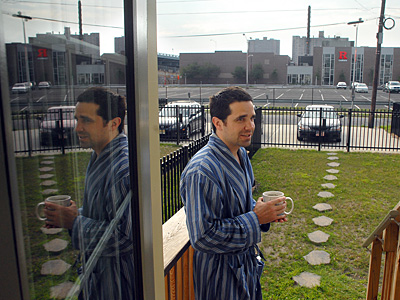
James Reilly sips morning coffee on his new front porch so he can watch the sunrise glow upon the looming Ben Franklin Bridge.

On the weekends, the 34-year-old Manayunk transplant and his new wife, Maria Nasidka, play tennis at the courts across the street and go for long runs along the Delaware River. They organize friends for coed football games at the nearby Rutgers University fields and walk to minor-league Riversharks games. Then they return home to three bedrooms, four bathrooms, 2,300 square feet, and a backyard of suburban proportions.

All this, in Camden – a city with one of the worst reputations in America – for the bargain price of $217,000 and the cheapest property taxes around.

MORE COVERAGE

These newlyweds are a rare realization of the vision set forth in the 2002 recovery law that put Camden City government under state control and funneled $175 million in bonds and loans to the city.

Although the law said market-rate housing to accommodate middle-class people was “critical,” things didn’t work out that way. Most of the $48 million appropriated to residential projects was targeted to low-income renters.

“The ratio is skewed; too much is going to affordable housing,” acknowledged Theodore Z. Davis, the former Camden chief operating officer. “You’ll never grow.”

The newlyweds’ community is a remarkable exception, and it shows the potential that the city has for middle-class growth.

Their home is part of a $10.4 million, 18-home middle-income housing project funded with $1.2 million from the Camden recovery fund. The theory? Offering $100,000 home subsidies could entice employed professionals to a city that has lost middle-class families since the 1950s.

“I could never have imagined the peace of mind I have being here,” Reilly said. “I love living here.”

He’s awestruck over the community feel – with an active neighborhood e-mail chain, a recent mayoral candidates’ forum, and a neighbor’s generosity in lending a power tool.

“It’s so personal,” he said of his neighbors. “It’s almost like [Camden] is their baby that they’re rooting for.”

The homes between Rutgers-Camden and the waterfront sold almost as soon as they hit the market last winter. “Middle-income people will pay a premium to get a good house in a good neighborhood in Camden,” said Frank Fulbrook of the Cooper Grant Neighborhood Association, which developed the project with Pennrose Properties.

Each property was subsidized by about a third, with a 10-year residency requirement. Plus, for each of the first 15 years, the newlyweds will pay a “service charge” of about $4,340 instead of taxes. That’s three times less than the taxes of some of their suburban neighbors.

This money only goes to the city’s coffers, and not the schools’ or the county’s, but it’s an effective enticement for buyers.

Such recovery-funded enticements are also used for businesses, and they helped to bring both a new Rita’s Water Ice to the neighborhood and Victor’s Pub, the city’s nicest bar, which has built a lunch crowd with workers from the waterfront offices.

This slow uptick in improvements has stoked new residents’ enthusiasm and helped strengthen their commitment to Camden – even if people who live in Cherry Hill say they’re “crazy” for moving to a city known as one of the country’s poorest and most dangerous.

“I always have to give them a pitch to tell them what it’s all about,” Nasidka said, gushing about biking to Philadelphia and walking to shows at Wiggins Park and Susquehanna Bank Center.

There’s no nearby supermarket, but, they say, they would have to drive to a market if they lived in Mount Laurel, too.

A few blocks north is an active drug area, but, Nasidka said, “If you’re in Rittenhouse and go a couple of blocks in the wrong direction, you’re not in such a good neighborhood, either.”

Several police departments patrol the area, and Reilly says he’s “safer in Camden than I was in Manayunk,” where his car was broken into twice.

“A city is a city.”

The couple eats at Latin restaurants in East Camden where there’s little English on the menus. Their neighbors include a city firefighter, a Cooper University Hospital emergency room doctor, and Rutgers-Camden professors.

For a couple looking to have a family and interested in a high-quality education, Camden public schools – among the worst in the state in every indicator – are currently not an option.

But, Reilly said, “if we were in Philadelphia, I might not want to send my kids to the schools” there, either.

He said he’d consider charter or private schools. “There’s no doubt in my mind that this city, this location, is going to improve over the next 10 years,” Reilly said.

And, he believes, he’ll be around – perhaps with little ones playing horseshoes in the massive backyard – to see it happen.

Home-improvement money

Her five children moved. Twice, cars crashed into the living room, leaving craters in the wall. Next door, the church burned down.

But Marie Brown stayed at the corner of 28th and High Streets in East Camden. Across the street, her friend and neighbor Dorothy Threat stayed, too. And their loyalty was recently rewarded.

In an innovative, nationally recognized home-improvement program funded in part by recovery dollars, longtime Camden residents current on their taxes are being awarded with $20,000 home-improvement projects.

The workers “did a beautiful job,” said Brown, 71, who is undergoing chemotherapy for breast cancer and lives on Social Security. “I appreciate everything everybody does for me, like these people here.”

The Camden Home Improvement Program (CHIP) is highly successful, officials and civic activists say, thanks to $5 million in funding from the state recovery and an additional $2.85 million from other state and city funds.

Homes in Camden are so old, though, and residents are so poor, that this money has not been enough. And it is just a piece of the $24 million that the group Camden Churches Organized for People requested in 2005 when it complained that recovery money was skipping over the neighborhoods.

With 200 homes covered by the recovery plan’s portion of the money, and with more than 500 homeowners on a waiting list, Brown’s good fortune could have been replicated many times over, and sooner, with more funding.

Brown moved into her five-bedroom home in 1973 after fleeing the fires in North Camden, and thought she was “in heaven.” But her house – which once included a grocery store downstairs – has 33 windows and no adjacent neighbors, so it is vulnerable to the wind. Some winters have been so cold that Brown couldn’t use the washing machine because the pipes had frozen.

So CHIP replaced 10 of the windows, and now Brown’s heating bills are down more than 50 percent, she said. A supply closet was rebuilt, the front of the house was power-washed, and the gutters were replaced.

Brown found out about CHIP from her neighbor and occasional partner in prayer, the 73-year-old Threat. Widowed, Threat bought her three-bedroom house from her parents 30 years ago and then raised nine of her 11 children there. After her husband died, she became a nurse to support the family.

Since suffering a stroke, money has been tight and she hasn’t kept up with the house. So CHIP installed a new back door, banisters and smoke alarms, the home’s first.

“They did lots – I am not complaining one bit,” she said in her singsong voice. “I am grateful. It really has been a blessing to me.”

Part of the intention of the program is to inspire other neighbors to fix their own homes, and sure enough, after CHIP fixed Threat’s sidewalks, two neighbors had their own sidewalks repaired.

Yet Scotch tape still holds together the glass on the front door. And when the washing machine is on, water leaks on the laundry-room floor and pours outside. Clearly, this old house needed more than $20,000.

But for Camden’s most committed residents, any help is welcome. “Whatever you get, be appreciative, be thankful,” Brown said. “Believe me.”

Cultural program unfunded

Alexis was a Camden High School sophomore, fighting at school, running the streets, dealing with what she described as an anger problem. I “do what I do,” she said.

Sister Gigi found Alexis on the streets. “Do you want to join us?” she asked.

Gigi is an outreach coordinator for the Unity Community Center – an organization of 150 praise-dancing, drum-beating, karate-kicking, stilt-walking, brass-playing, military-marching Camden kids.

“Do you want to join us?” she asked Alexis, again and again.

Months passed, and Alexis relented. Last spring she nervously walked into the dilapidated community center and watched a braided, tattooed woman tap a drumbeat on a 6-year-old boy’s shoulders: Boom, ba-boom ba-boom ba-boom.

Boom, ba-boom ba-boom ba-boom, the boy responded, as the beat flowed through his arms for the first time.

And with this, Alexis pulled up a chair and joined UCC.

From saving a girl headed down a dark path to teaching a boy the joy of music, UCC believes it uses martial arts, jazz, and dance to make miracles every day. But despite its 26 years of service, the organization was unable to wrestle a dime from the $175 million Camden recovery fund.

One longtime civic activist in Camden, Andy Thomas, said in an interview before he died this summer: “These kids are the best things to happen in Camden in 50 years.”

Out of a dingy storefront on a particularly ugly stretch of Mount Ephraim Avenue, UCC offers children a chance, usually free, to find self-confidence and discipline. The youths have performed concerts at gubernatorial inaugurations in Trenton, World Cafe Live in West Philadelphia, and a pageant in Gambia. UCC is Camden’s biggest, and most improbable, cultural export.

Three years ago, founders Robert and Wanda Dickerson submitted a several-hundred-page application for a $1 million grant from the recovery fund to renovate a 6,000-square-foot former auto shop that was donated to the group. A $1 million request for a Boys & Girls Club and $5 million for a Salvation Army center had already been approved.

Although the UCC proposal never came up for a vote or public deliberation, officials say the organization wasn’t financially viable, so it was rejected.

There were tax liens from outstanding water bills at the new property, which UCC says are erroneous – because there are no pipes. There were property taxes owed because UCC had failed to submit its tax-exemption form for a couple of years (it is current now).

And there were repeated questions about matching funds. Officials favored projects with other funding sources, which residents complained effectively eliminated grassroots groups.

“It’s like we’re really living in an illusion, it’s a mirage,” Gigi said. “And to have $175 million come into the city – $175 million! – and we haven’t gotten any support? . . . You go to one part of the city, by the waterfront, and you think you’re in Hollywood. You go to another side of the city and it’s Beirut, a war zone.”

Former Camden COO Davis said that he worked with the group but that it failed to get its paperwork and finances in order: “A lot of people are more hell-bent on crying and complaining than doing something.”

UCC has never relied on government funds to operate. Its leaders say they tried to adjust their application to accommodate concerns over their expansion proposal.

The City Council approved a resolution this year absolving UCC of its liens, and the Camden County sheriff – who is in charge of tax sales – even appeared to show support. Each City Council member then handed a signed copy of the resolution to a UCC child.

In state-run Camden, though, a city councilman’s signature is just an autograph. A week later, Davis called the council’s resolution “meaningless.”

UCC is now trying to raise private funds to renovate its building, which it got in 2000. It puts on more than 400 performances a year, but those fees go back into the program, not the building.

“This is a powerful story to show how government went astray in the process of helping poor people,” said Roy Jones, an activist who wrote UCC’s application.


Contact staff writer Matt Katz at 856-779-3919 or mkatz@phillynews.com.

Read more at http://www.philly.com/philly/news/special_packages/inquirer/20091110_Recovery_aids_some_areas.html#FKBTpjdXWs616wVB.99

Read More at: http://www.philly.com/philly/news/special_packages/inquirer/20091110_Recovery_aids_some_areas.html#FKBTpjdXWs616wVB.99